

Live Comments
ECB’s Lagarde Says Rates Will Not Move in Lockstep With Energy Prices
European Central Bank President Christine Lagarde, speaking at a news conference in Dublin on Friday, pushed back against expectations that soaring oil and gas prices would automatically produce an aggressive series of rate increases. Interest rates “do not move in lockstep with the price of energy,” she said, because the shock affects not only inflation but also economic growth and consumption. The ECB will therefore assess how higher energy costs spread through prices and weaken demand rather than responding mechanically to each increase.
Markets are pricing between three and four additional ECB hikes over the coming year after two recent increases, with oil and gas prices approaching assumptions in the Bank’s adverse scenario and inflation potentially nearing 4% by year-end. Lagarde did not rule out further tightening, but said the ECB was taking a “measured response” and had room to evaluate additional data before deciding its next steps. The message suggests policymakers believe current market pricing may be too aggressive, even as they retain the flexibility to respond if the energy shock generates broader and more persistent inflation.
Lagarde also downplayed concerns about rising government borrowing costs, saying the ECB did not see “any disorderly movements” in bond markets. She characterized the increase in long-term yields as a global development affecting multiple sovereign markets rather than evidence of local Eurozone stress. Taken together, the remarks reject a simple oil-to-inflation-to-rate-hike equation: the ECB remains prepared to tighten further, but intends to balance inflation persistence against the damage that higher energy prices and borrowing costs could inflict on demand.
Key takeaways
- ECB President Christine Lagarde rejected a mechanical link between energy prices and interest rates. Higher oil and gas prices affect inflation, but they also weaken growth and consumption.
- The ECB will evaluate the energy shock through its complete economic impact rather than matching each increase in energy costs with another rate hike.
- Markets are pricing three to four additional ECB increases over the coming year after two recent moves.
- Oil and gas prices are close to the ECB’s adverse-scenario assumptions and could push inflation toward 4% by year-end.
- Lagarde characterized the ECB’s current approach as measured and data-dependent, suggesting that policymakers may regard market pricing as too aggressive.
- The comments do not rule out further tightening. The ECB retains the option to act if energy costs spread into broader and more persistent inflation.
- Lagarde saw no evidence of disorderly conditions in sovereign bond markets despite rising government borrowing costs.
- Higher long-term yields were described as a global bond-market movement, rather than a localized sign of financial stress within the Eurozone.
- The central policy question is whether the energy shock primarily produces persistent inflation or increasingly damages demand. That balance will determine how much additional tightening is required.
UK Retail Sales Rise 0.5% as Non-Food Stores Recover
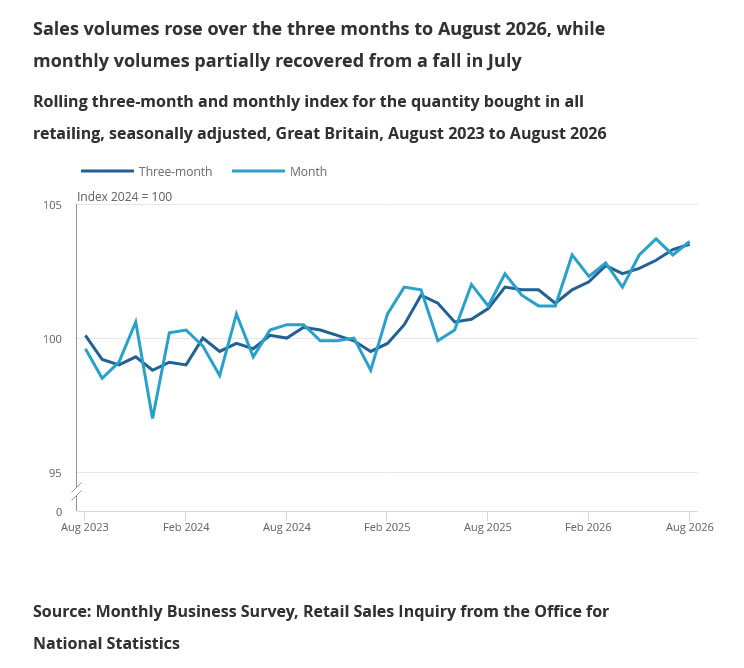
UK retail sales volumes rose 0.5% mom in August, reversing July’s unrevised 0.5% decline and beating expectations for a 0.3% contraction. Annual growth accelerated from a downwardly revised 1.2% to 2.4%, above the 1.9% consensus. The less volatile three-month measure was also positive, with volumes rising 0.9% from the three months to May and 2.4% from a year earlier. Overall sales volumes reached their second-highest level since April 2022, just below June’s level.
The monthly recovery was led by non-food store volumes, which rose 0.6%. Department stores rebounded from stock-availability problems in July, while clothing retailers recovered part of the decline caused by promotional activity being brought forward into June. Non-store retailers also partially recovered, while supermarkets, alcohol retailers and beverage sellers supported the broader three-month increase. Online spending values rebounded from a 4.2% decline to a 2.5% increase, lifting the online share of total sales from 28.4% to 28.8%.
The main area of weakness was automotive fuel, where volumes fell as prices rose sharply. Retailers reported consumers making fewer journeys, delaying purchases and filling tanks only partially. August’s stronger-than-expected result therefore points to resilient consumer demand, but not an unqualified acceleration. Part of the increase reversed earlier timing and supply distortions, while falling fuel consumption showed that higher energy costs were already changing household behavior.
Data summary
| Indicator | Actual | Expected | Previous |
|---|---|---|---|
| Retail sales volumes, m/m | +0.5% | -0.3% | -0.5% |
| Retail sales volumes, y/y | +2.4% | +1.9% | +1.2% |
Key takeaways
- Retail sales volumes rebounded from a 0.5% decline to a 0.5% increase, substantially outperforming expectations for another contraction.
- Annual volume growth accelerated from a revised 1.2% to 2.4%, also exceeding the 1.9% consensus.
- The 0.9% three-month increase indicates that the improvement was broader than one volatile monthly reading, although strong June sales contributed materially.
- Non-food stores led the August recovery. Department stores rebounded from stock shortages, while clothing and non-store retailers reversed some promotion-related weakness from July.
- Online spending values recovered strongly, rising 2.5% m/m after falling 4.2%. Their share of total sales increased from 28.4% to 28.8%.
- Automotive fuel was the principal weakness. Rising prices encouraged consumers to make fewer journeys, postpone purchases and only partially fill their tanks.
- The release points to resilient consumer demand, but August should not be interpreted as broad acceleration. Part of the rebound corrected earlier promotional and supply distortions.
- The divergence between stronger overall retail volumes and weaker fuel demand shows that the energy shock is already changing household behavior in the most directly exposed category.
RBA Turns More Hawkish as Excess Demand Meets Global Inflation Shock
RBA officials delivered a broadly hawkish message ahead of the September 29 policy meeting, warning that inflation risks identified last month were beginning to crystallize. In her opening statement to the House of Representatives Standing Committee on Economics in Canberra on Friday, Governor Michele Bullock said “inflation is too high” and that “some of these upside risks to inflation appear to be materialising.” After raising the cash rate by 75bp to 4.35% this year, the Board’s key question is now whether that tightening will be sufficient to return inflation to target within a reasonable timeframe.
The concern extends beyond the direct effect of higher oil prices. Bullock said the prolonged Middle East conflict, the global AI boom and extreme weather were lifting energy, agricultural and technology costs. RBA liaison indicated that firms were increasingly passing higher input costs to customers, creating a risk that the shock becomes embedded in broader price and wage decisions. She warned that persistent inflation could require a “stronger policy response.” Australia also entered the global shock with domestic capacity pressures already present. As Bullock put it, “we started with excess demand,” leaving the economy more exposed to a second inflationary impulse.
There are signs that higher rates are restraining activity. Household spending growth is moderating, housing prices and new lending have declined, and the full effect of recent tightening has yet to reach the economy. But those counterweights have not yet produced substantial spare capacity. Labour-market conditions remain close to and slightly tighter than full employment, while Bullock described forward-looking employment indicators as “stable-ish.” Business investment has also accelerated, led by data centres and renewable energy, while weak productivity limits how quickly demand can grow without generating further inflation.
The officials’ language suggested that the RBA is prepared to tighten again if incoming evidence does not show sufficient disinflation. Bullock emphasized that “interest rate rises do work,” while RBA Deputy Governor Andrew Hauser said the Bank would “persevere.” Hauser also described the exchange rate as the “biggest single channel” through which higher rates affect the economy, since a stronger Australian Dollar lowers import costs. Bullock stopped short of pre-committing to a September hike, but the collective message was difficult to interpret as neutral: the RBA sees inflation risks intensifying before domestic capacity pressure has been fully removed.
Key takeaways
- RBA officials delivered a broadly hawkish message ahead of the September 29 policy meeting, questioning whether this year’s 75bp of tightening will be sufficient.
- RBA Governor Michele Bullock said inflation was “too high” and that previously identified upside risks were beginning to materialize.
- Australia entered the global inflation shock with excess demand and lingering capacity pressure, making it more vulnerable to renewed increases in energy and input costs.
- The Middle East conflict, AI investment boom and extreme weather are adding pressure to energy, agricultural and technology-related prices.
- RBA liaison indicates that businesses are already passing higher input costs to consumers. Bullock warned that persistent pass-through could require a stronger policy response.
- Household spending and housing have weakened, but labour-market conditions remain slightly tighter than full employment. Forward-looking employment indicators do not point to an imminent deterioration.
- Strong data-centre and renewable-energy investment is supporting demand, while weak productivity limits how quickly the economy can grow without generating inflation.
- RBA Deputy Governor Andrew Hauser said the Bank would “persevere” and identified the exchange rate as the largest single channel of monetary-policy transmission.
- Bullock did not pre-commit to another hike, but the discussion has shifted toward whether additional tightening is needed to prevent the global shock from becoming embedded domestically.