Eurozone GDP shrank -3.8% in Q1, CPI slowed to 0.4% in Apr

    Eurozone GDP contracted -3.8% qoq in Q1, larger than expectation of -3.3% qoq. EU GDP contracted -3.5% qoq. These were the sharpest decline since the series started in 1995. Compared with the same quarter of the previous year, seasonally adjusted GDP decreased by 3.3% yoy in the Eurozone and by 2.7% yoy in the EU in Q1.

    Eurozone unemployment rate rose to 7.4% in March, up from February’s 7.3%, better than expectation of 7.7%. EU unemployment rate also rose 0.1% to 6.6%. Eurostat estimates that 14.141 million men and women in the EU, of whom 12.156 million in the euro area, were unemployed in March 2020. Compared with February 2020, the number of persons unemployed increased by 241 000 in the EU and by 197 000 in the euro area.

    Eurozone CPI slowed to 0.4% yoy in April, down from March’s 0.7% yoy, but beat expectation of 0.1% yoy. CPI core slowed to 0.9% yoy, down form 1.0% yoy, beat expectation of 0.7% yoy.

    Swiss KOF dropped to 63.5, all indicator groups pushing the barometer downward

      Swiss KOF Economic Barometer dropped to 63.5 in April, down from 91.7, above expectation of 58.0. Nevertheless, that’s still a historical decline, sharper than that in 2009 financial crisis.

      KOF said: “Currently, nearly all indicator groups are pushing the barometer sharply downward. The decline is led by the indicators for the manufacturing industry and other services. However, the indicators for the accommodation and food service activities, foreign demand, construction, consumption and for financial and insurance service providers are also heavily in the red.

      Also released, real retail sales dropped -5.6% yoy in March, below expectation of -3.6% yoy.

      France GDP shrank record -5.8%, worse than 2009 and 1968

        France GDP dropped by -5.8% qoq in Q1, worse than expectation of -4.0% qoq. That;s also the largest contraction since record started in 1949. In particular, it’s bigger than the ones recorded in Q1 2009 (–1.6%) or in Q2 1968 (–5.3%).

        INSEE also noted that GDP’s negative evolution in Q1 2020 is primarily linked to the shut-down of “non-essential” activities in the context of the implementation of the lockdown since mid-March.

        Looking at the main components, imports dropped -5.9% qoq. Household consumption expenditure dropped -6.1% qoq. General government consumption expenditure dropped -2.4% qoq. Gross fixed capital formation dropped -11.8% qoq. Exports dropped -6.5% qoq.

        Also released, consumption spending dropped -17.9% mom in March, well below expectation of -5.5% mom. It’s the largest monthly contraction since record began in 1980. Manufactured good consumption dropped sharply (–42.3% after –0.6%) and energy expenditure decreased markedly (–11.4% after –0.9%). Only food consumption increased (+7.8% after –0.1%).

        China PMI manufacturing dropped to 50.8 while non-manufacturing improved

          China’s official NBS PMI manufacturing dropped to 50.8 in April, down from 52.0, missed expectation of 51.0. In particular, new export orders plunged sharply to 33.5. But PMI non-manufacturing improved to a three-month high of 53.2, up from 52.3, beat expectation of 52.8. The set of data suggests that China’s economy is on a double-track. Hope of a strong come back in manufacturing is dim as coronavirus pandemic is continuing elsewhere. Global recession will continue to heap on downward pressure in the sector in the coming months.

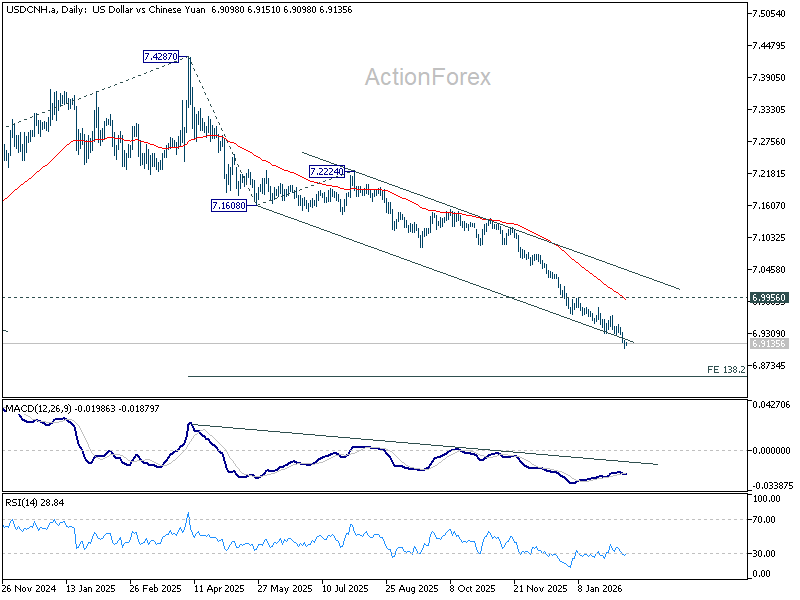
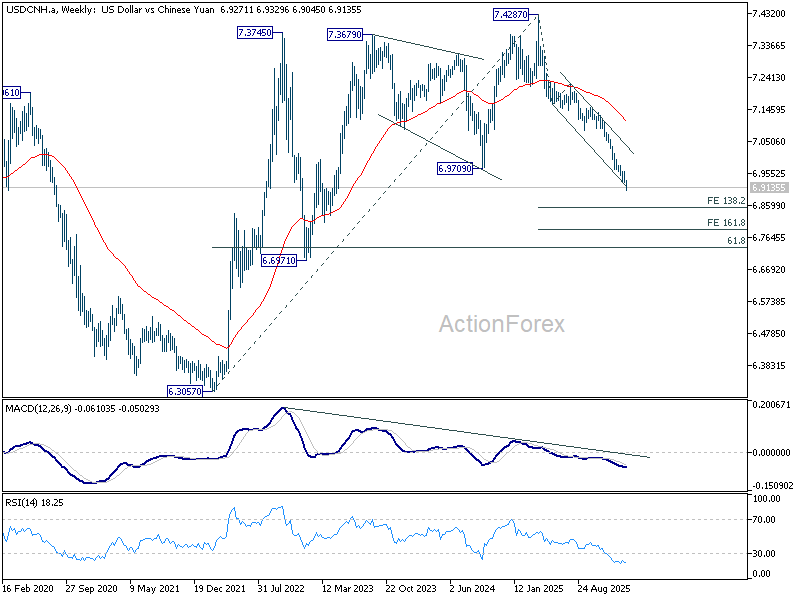
          USD/CNH drops notably today, mainly due to weakness in Dollar. Outlook is unchanged that the pair is staying in consolidation pattern from 7.1953, with rebound from 6.8452 as the second leg. Such rebound has likely completed with three waves up to 7.1649 already. Break of 7.0365 support should add credence to this case and target 6.8452/6.9040 support zone again.

          Japan industrial production, retail sales dropped most since Oct

            Japan’s industrial production dropped -3.7% mom in March, down from February’s -0.3% mom, but was better than expectation of -5.2% mom. But that still the sharpest fall in production since October last year. Retail sales dropped -4.6% yoy, down from February’s 1.6% yoy, slightly better than expectation of -4.7% yoy. That’s also the sharpest decline since last October’s sales tax hike. Housing starts dropped -7.6% yoy, much better than expectation of -16.0% yoy.

            The parliament is set to enact a JPY 25.69 trillion supplementary budget for fiscal 2020 today. The House of Councillors is generally expected to approve the extra budget, which was passed by House of Representative already, to cushion the economy from the impact of the coronavirus pandemic. Meanwhile, Prime Minister Shinzo Abe would announce the extension of nationwide state of emergency that is due to end next Wednesday.

            New Zealand ANZ business confidence off low, offers a glimmer of light

              New Zealand ANZ Business Confidence improved to -66.6 in April, up from preliminary reading of -73.1, while down from March reading of -63.5. All sectors are deep in negative with retail at -70.7, manufacturing at -65.3, agriculture at -89.7, construction at -71.8 and services at -60.3. Activity Outlook also improved slightly to -55.1, up from preliminary reading of -43.6, but down from March’s -26.7. All sectors are also deep in negative with retail at -67.2, manufacturing at -52.7, agriculture at -44.8, construction at -57.9, and services at -52.4.

              ANZ said, “a glimmer of light at the end of the tunnel emerged over the month, with the country making solid progress in its COVID-19 battle”. However, “the levels of most indicators remain at levels that were frankly unthinkable before COVID-19 reached our shores. Businesses are really hurting. And it’s not just expectations. The proportion of firms that have already seen lower activity and have let staff go continues to rise. That will clearly remain a theme for some time.

              Full release here.

              Dollar index shrugs FOMC, DOW jumped on remdesivir news

                Fed kept monetary policy unchanged overnight as widely expected and reiterated the pledge to maintain rate target at 0-0.25% ” until it is confident that the economy has weathered recent events and is on track to achieve its maximum employment and price stability goals.” Chairman Jerome Powell said there will be a “large increase” in economic activity when people are coming out to spend again while unemployment goes down. However, “it is unlikely it will bring us quickly back to pre-crisis levels,” he added. “Trying to be really precise about when that might happen and what the numbers might look like – it is very tough to do that.”

                Some suggested readings on Fed:

                Dollar softened a little bit further after FOMC’s announcement and press conference. But there was no avalanche selling. Dollar index is back pressing 55 day EMA and outlook is unchanged. Price actions from 102.99 are seen as a corrective pattern. Fall from 100.93 is likely the third leg. Break of 55 day EMA will pave the way to 98.27 support and possibly below. But downside should be contained by 61.8% retracement of 94.65 to 102.99 at 97.83 to bring rebound.

                DOW rose 532.31 pts, or 2.21% to close at 24633.86. But that’s mainly due to news that Gilead Sciences found promising results of its experiments on coronavirus treatment drug remdesivir. Technically, DOW’s rebound from 18213.65 could extend higher. But we’d expect strong resistance from 61.8% retracement of 29568.57 to 18213.65 at 25230.99 to limit upside, at least on first attempt. Break of 22941.88 support will mark short term topping and bring near term reversal.

                Fed keeps rate at 0-0.25%, maintains forward guidance, full statement

                  Fed keeps federal funds rate unchanged at 0-0.25% as widely expected. The forward guidance is unchanged too. “The Committee expects to maintain this target range until it is confident that the economy has weathered recent events and is on track to achieve its maximum employment and price stability goals.”

                  Full statement below.

                  Federal Reserve Issues FOMC Statement

                  The Federal Reserve is committed to using its full range of tools to support the U.S. economy in this challenging time, thereby promoting its maximum employment and price stability goals.

                  The coronavirus outbreak is causing tremendous human and economic hardship across the United States and around the world. The virus and the measures taken to protect public health are inducing sharp declines in economic activity and a surge in job losses. Weaker demand and significantly lower oil prices are holding down consumer price inflation. The disruptions to economic activity here and abroad have significantly affected financial conditions and have impaired the flow of credit to U.S. households and businesses.

                  The ongoing public health crisis will weigh heavily on economic activity, employment, and inflation in the near term, and poses considerable risks to the economic outlook over the medium term. In light of these developments, the Committee decided to maintain the target range for the federal funds rate at 0 to 1/4 percent. The Committee expects to maintain this target range until it is confident that the economy has weathered recent events and is on track to achieve its maximum employment and price stability goals.

                  The Committee will continue to monitor the implications of incoming information for the economic outlook, including information related to public health, as well as global developments and muted inflation pressures, and will use its tools and act as appropriate to support the economy. In determining the timing and size of future adjustments to the stance of monetary policy, the Committee will assess realized and expected economic conditions relative to its maximum employment objective and its symmetric 2 percent inflation objective. This assessment will take into account a wide range of information, including measures of labor market conditions, indicators of inflation pressures and inflation expectations, and readings on financial and international developments.

                  To support the flow of credit to households and businesses, the Federal Reserve will continue to purchase Treasury securities and agency residential and commercial mortgage-backed securities in the amounts needed to support smooth market functioning, thereby fostering effective transmission of monetary policy to broader financial conditions. In addition, the Open Market Desk will continue to offer large-scale overnight and term repurchase agreement operations. The Committee will closely monitor market conditions and is prepared to adjust its plans as appropriate.

                  Voting for the monetary policy action were Jerome H. Powell, Chair; John C. Williams, Vice Chair; Michelle W. Bowman; Lael Brainard; Richard H. Clarida; Patrick Harker; Robert S. Kaplan; Neel Kashkari; Loretta J. Mester; and Randal K. Quarles.

                  US GDP shrank -4.8% in Q1, worst since 2008

                    US GDP contracted -4.8% annualized in Q1 slightly worse than expectation of -4.0% annualized. That’s the largest decline since 2008 and marked the formal start of a recession.

                    Looking at some details, personal consumption expenditures dropped -7.6%. Gross private domestic investment dropped -5.6%. Exports of goods and services dropped -8.7% while imports dropped -15.3%> Government consumption expenditures and gross investment rose 0.7%.

                    Price index for gross domestic purchases rose 1.6%. PCE price index rose 1.3%, slowed from 1.4%. PCE core price index rose 1.8%, up from 1.3%.

                    Full release here.

                    UK Raab: No intention of changing Brexit transition period

                      UK Foreign Minister Dominic Raab said said today that the government’s “position is unchanged” regarding Brexit. That is, “the transition period ends on the 31st of December, that is enshrined in law.”

                      He further told the parliament, “there is no intention of changing that and actually what we should do now … is focus on removing any additional uncertainty, doing a deal by the end of the year and allowing both the UK and the European Union and all of its member states to bounce back as we come through the coronavirus.”

                      Eurozone economic sentiment crashed to 67, but stays above 2009 low

                        Economic sentiment “crashed” in both Eurozone and EU in April. Eurozone Economic Sentiment Indicator dropped -27.2 pts to 67.0. EU ESI dropped -28.8 pts to 65.8. These were the strongest decline in the ESI on record since 1985. The indicators are now far below their long run averages of 100 and very close to the lowest levels registered during the Great Recession in 2009.

                        Industrial confidence dropped -19.2 to -30.4, steepest monthly fall on record, but remained above 2009 low. Services confidence dropped -32.7 pts to record low of -35.0. Consumer confidence dropped -11.1 to -22.7> retail trade confidence dropped -19.7 to -28.3. Employment expectations dropped -30.1 to 63.7.

                        Amongst the largest euro-area economies, the ESI crashed in the Netherlands(-32.6), Spain (-26.0), Germany (-19.9), and France (-16.3),2 while no data could be collected in Italy due to the strict confinement measures.

                        Full release here.

                        Dollar index range bound as US GDP and Fed awaited

                          Two heavy weight events are scheduled for the US today. Firstly. Q1 GDP is expected to show -4.0% annualized contraction. That would be the steepest contraction since the Great Recession in 2009. Consumer spending has definitely suffered a big hit from the coronavirus lockdowns. Some focuses would be on business investments. Optimism was lifted just for a brief while by US-China trade agreement phase one, but then nose-dived on the pandemic.

                          Fed is generally expected to keep monetary policies unchanged today. There will be no formal economic projections until June, which is agreeable as everything ties to how the coronavirus pandemic is contained. Nevertheless, Fed chair Jerome Powell could still offer a glimpse of what he expected in the second half, and he view on the shape of the recovery. Guidance on interest rates would be something to watch too. Powell has ruled out negative rates for now and we’ll see if he sticks to the same position.

                          Suggested readings:

                          While Dollar is performing rather poorly this week, the development in Dollar index isn’t that bad. That’s primarily due to indecisiveness in Euro, though. Technically, we’re seeing price actions from 102.99 as a corrective pattern, with the sideway pattern from 98.27 as the second leg. Firm break of 55 day EMA will confirm the start of the third leg towards 98.27 support. But in that case, we’d expect strong support from 61.8% retracement of 94.65 to 102.99 at 97.83 to contain downside and bring rebound.

                          New Zealand imports and exports surged in March, but trade with China shrank

                            New Zealand’s imports rose 7.7% yoy to NZD 5.1B in March while exports rose 3.8% yoy to NZD 5.8B. Trade surplus came in at NZD 672m, smaller than expectation of NZD 700m.

                            Trade with its largest partner, China, continued to drop. Imports from China dropped -10% yoy to NZD 714m. Exports to China dropped -5.8% yoy to NZD 1.4B. Meanwhile, exports to Australia also dropped -8.9% yoy to NZD 738m. But exports to US rose 9.4% to NZD 623m. Exports to EU rose 8.2% yoy to NZD 595m. Exports to Japan also rose 22% yoy to NZD 352m.


                            Full release here.

                            Australia CPI jumped to 2.2% in Q1, highest since 2014

                              Australia CPI rose 0.3% qoq in Q1, above expectation of 0.2% qoq. Annually, CPI accelerated to 2.2% yoy, up from 1.8% yoy, beat expectation of 2.0% yoy. The annual rate was also the highest level since Q3 of 2014. RBA trimmed mean CPI rose 0.5% qoq, slightly above expectation of 0.4% qoq. Annual rate also accelerated to 1.8% yoy, up from 1.6% yoy and beat expectation of 1.6% yoy.

                              ABS Chief Economist, Bruce Hockman said: “There were some price effects of COVID-19 apparent in the March quarter due to higher purchasing of certain products towards the end of the quarter, as restrictions came into effect… More evident effects of COVID-19 are expected in the June quarter CPI.”

                              Full release here.

                              Fitch downgrades Italy rating to BBB-, significant impact of coronavirus on economy and fiscal position

                                Fitch downgraded Italy’s credit rating to BBB- yesterday, down from BBB, with a stable outlook. The rating is now just a single notch above “junk level”. The agency said “the downgrade reflects the significant impact of the global Covid-19 pandemic on Italy’s economy and the sovereign’s fiscal position…. According to our baseline debt dynamics scenario, the [debt] to GDP ratio will only stabilise at this very high level over the medium term, underlining debt sustainability risks.”

                                Fitch also warned “downward pressure on the rating could resume if the government does not implement a credible economic growth and fiscal strategy that enhances confidence that general government debt/GDP will be placed on a downward path over time.”

                                Italian Finance Minister Roberto Gualtieri responded and said “the fundamentals of Italy’s economy and public finances are solid”.He added that Fitch’s move didn’t take into account the measures by EU. “In particular, the strategic orientation of the European Central Bank does not seem to be adequately valued.”

                                US consumer confidence dropped to 86.9, record drop in present situation

                                  Conference Board US consumer confidence dropped to 86.9 in April, down from 118.8, below expectation of 90.1. Present situation index dropped from 166.7 to 76.4. Expectations index, however, improved from 86.8 to 93.8.

                                  “Consumer confidence weakened significantly in April, driven by a severe deterioration in current conditions,” said Lynn Franco, Senior Director of Economic Indicators at The Conference Board. “The 90-point drop in the Present Situation Index, the largest on record, reflects the sharp contraction in economic activity and surge in unemployment claims brought about by the COVID-19 crisis.

                                  ” Consumers’ short-term expectations for the economy and labor market improved, likely prompted by the possibility that stay-at-home restrictions will loosen soon, along with a re-opening of the economy. However, consumers were less optimistic about their financial prospects and this could have repercussions for spending as the recovery takes hold. The uncertainty of the economic effects of COVID-19 will likely cause expectations to fluctuate in the months ahead.”

                                  Full release here.

                                  US trade deficit widened to USD 64.2B, both imports and exports dropped

                                    US goods trade deficit widened 7.2% mom to USD 64.2B in March, up from February’s USD 59.9B. Exports of goods dropped USD -9.1B to USD 127.6B. Imports of goods dropped USD -4.8B to US 19.9B. Wholesales inventories dropped -1.0% mom to USD 650B.

                                    Full release here.

                                    UK CBI realized sales dropped to -55, record low

                                      UK CBI realized sales dropped sharply form -3 to -55 in April, hitting a joint record low with December 2008. A net balance of -55% retailers reported decline in sales. They also expect a similar pace of decline in May, at balance of -54%, weakest expectations on record.

                                      Rain Newton-Smith, CBI Chief Economist, said: “It’s no surprise that the lockdown is hitting retailers hard. Two fifths have shut up shop completely for now. And sales of groceries and other essentials also fell, suggesting households may have been dipping into stockpiles built up prior to the lockdown or tightening their belts more generally as incomes take a hit.”

                                      Full release here.

                                      Ifo: German economy to contract -6.6% this year

                                        Ifo head of economic forecasts Timo Wollmershäuser said Germany’s GDP should have dropped by -1.9% in Q1 and would contract -12.2% in Q2. Overall, the economy is likely to shrink by -6.6% in this calendar adjusted year, or -6.2% when the large number of working days are taking into account.

                                        Wollmershäuser adds: “We will only be back to the state before Corona at the end of 2021. Then as many goods and services will be produced as in a situation without a corona crisis. The gross domestic product will have to increase by 8.5 percent in 2021. ”

                                        Also from Ifo, Germany’s employment barometer plunged to 86.3 in April, down from 93.4, hitting a new record low. All four sectorial employment barometer also deteriorated and turned negative (manufacturing from -18.3 to -28.6, services from -3.4 to -19.4, trade fro m-8.0 to -25.6, construction from 2.3 to -7.0.

                                        BoJ Kuroda: Longer coronavirus pandemic could push up credit costs

                                          BoJ Governor Haruhiko Kuroda told the parliament that there could be surge in credit costs if the coronavirus pandemic lasts longer than expected. But for now, the risk is low.

                                          “If it takes longer than expected to contain the virus at home and abroad, that could hurt the economy and push up credit costs for financial institutions,” Kuroda said.

                                          “The risk of this happening now isn’t big. But it’s something we need to be vigilant about. We’ll closely work with the Financial Services Agency on this matter.”