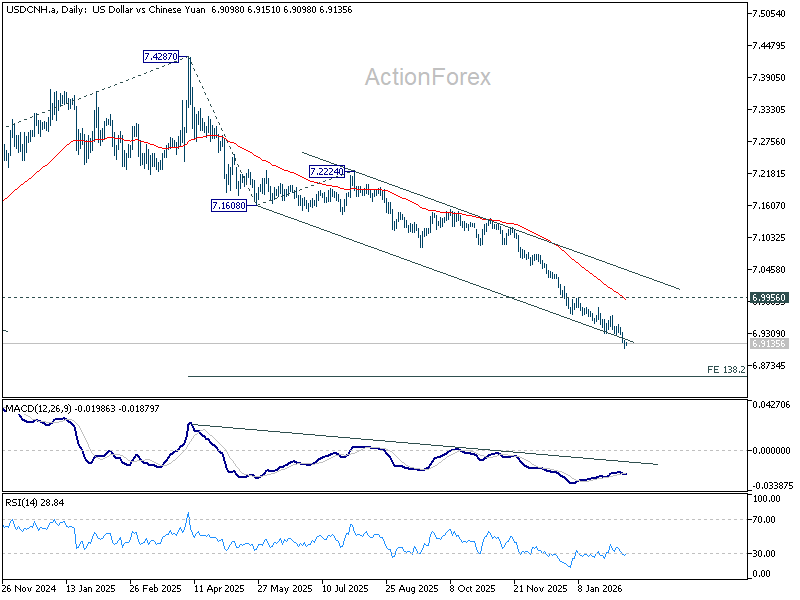
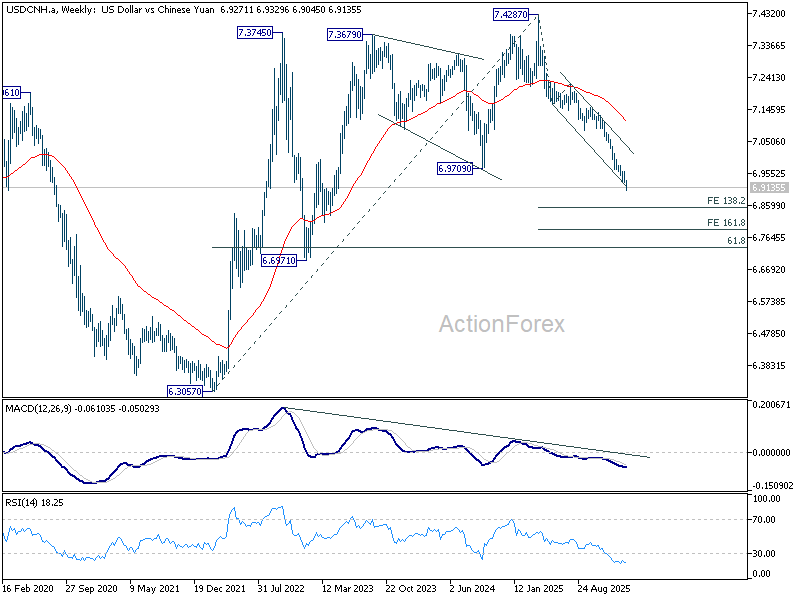
China reaffirms growth target, holds back on major stimulus

    China pledged its full confidence in achieving this year’s growth target of around 5%, vowing to implement timely and multiple support measures as the country is now in full-fledged trade war with the US. However, no major stimulus was announced immediately, giving the impression that Beijing is not in a rush to roll out large-scale interventions. Authorities appear inclined to first monitor the trade shock’s timing and magnitude before deciding on more aggressive measures.

    Zhao Chenxin, deputy head of the National Development and Reform Commission, stressed at a press conference today that China retains “ample policy reserves and plenty of policy space,” and highlighted plans to stabilize employment and strengthen public employment services.

    At a Politburo meeting chaired by President Xi Jinping last week, officials called for a “timely reduction” in interest rates and reserve requirement ratios to support the economy. Additional measures to aid struggling businesses, boost consumption among middle- and lower-income groups, and promote further development in technology and artificial intelligence were also emphasized.

    As a touch of optimism, official data released over the weekend showed China’s industrial profits returning to growth in the first quarter. Cumulative profits rose 0.8% yoy to CNY 1.5T, reversing a -0.3% decline seen in the first two months.

    Japan denies report of US preference for weaker Dollar and stronger Yen

      Japanese officials moved swiftly to deny a media report suggesting that US Treasury Secretary Scott Bessent had conveyed a preference for a weaker Dollar and stronger Yen during recent bilateral meetings in Washington last week.

      Japan’s top currency diplomat, Atsushi Mimura, emphasized to reporters that “the US side did not touch upon exchange-rate targets” in discussions between Finance Minister Katsunobu Kato and his US counterpart.

      Finance Minister Kato also reiterated via social media that exchange-rate frameworks were not discussed, directly refuting the report published by the Yomiuri newspaper.

      Meanwhile, Bessent himself described the talks with Japan as “very constructive” in a post on X, noting that they covered reciprocal trade issues and “matters pertaining to exchange rates” without mentioning any explicit preferences.

      Canada retail sales fall -0.4% mom in Feb, but core spending offers rebound hopes

        Canadian retail sales declined by -0.4% mom to CAD 69.3B in February, in line with market expectations. The overall weakness was driven primarily by a -2.6%mom drop in motor vehicle and parts dealers, with all four store categories in the subsector posting declines.

        However, beneath the surface, the data showed encouraging signs. Core retail sales—which exclude fuel and vehicle-related sales—rose by 0.5% mom.

        Looking ahead, Statistics Canada’s advance estimate points to a 0.7% mom increase in total sales for March.

        Full Canada retail sales release here.

        SNB’s Schlegel: Growth may miss forecasts due to trade uncertainty

          Swiss National Bank Chairman Martin Schlegel warned at the central bank’s annual general meeting that high levels of trade policy uncertainty continue to cloud the economic outlook.

          “It remains very uncertain how inflation and the economy in Switzerland will develop,” Schlegel said, adding that “an economic slowdown cannot be ruled out.”

          Growth forecasts are already under pressure, with SNB’s March projection of 1% to 1.5% GDP growth this year falling below Switzerland’s long-term average of 1.8%.

          Schlegel reiterated that SNB stands ready to adjust policy if needed, including interest rate changes and foreign exchange interventions. However, he acknowledged the limits of monetary policy in addressing deeper structural uncertainty.

          “Price stability cannot prevent trade policy uncertainty,” he cautioned, but emphasized that maintaining stable prices provides an essential foundation for the broader economy.

          UK retail sales rise 0.4% mom in March, 1.6% qoq in Q1

            UK retail sales surprised to the upside in March, rising by 0.4% mom, defying market expectations for a -0.3% mom decline.

            The unexpected strength was attributed largely to favorable weather conditions, which lifted sales at clothing and outdoor retailers. However, this gain was partially offset by weaker performance at supermarkets.

            Looking beyond the monthly figure, the broader quarterly performance painted an encouraging picture of consumer resilience. Retail sales volumes grew by 1.6% qoq 1.7% yoy in Q1. These results indicate that UK consumers remain relatively active despite broader economic uncertainties.

            Full UK retail sales release here.

            BoJ’s Ueda says G20 peers align on tariff risks to trade and sentiment

              BoJ Governor Kazuo Ueda acknowledged growing global concern over the economic impact of tariffs, following discussions with international counterparts at a G20 finance ministers’ meeting.

              Speaking at a press conference, Ueda said many global policymakers “roughly had the same view” that tariffs weigh on trade activity, weaken business sentiment, and increase market volatility. He noted that these factors will be integrated into BoJ’s evolving assessment of Japan’s economic outlook and monetary policy.

              Ueda reaffirmed BoJ’s intention to raise interest rates gradually, provided underlying inflation continues to converge toward the 2% target. But he emphasized a cautious, data-dependent approach.

              “We would like to scrutinize various data that comes in, without pre-conception,” he said.

              Tokyo CPI core surges to 3.4% in April, strengthening case for BoJ June hike

                Inflation in Japan’s capital city surged in April, with Tokyo core CPI (excluding food) accelerating from 2.4% yoy to 3.4% yoy, above the 3.2% yoy forecast. The more domestically focused core-core measure (excluding food and energy) also rose sharply, from 2.2% yoy to 3.1% yoy. Headline CPI jumped from 2.9% yoy to 3.5% yoy.

                Despite the upside surprise, BoJ is still expected to hold rates steady at its May 1 policy meeting as it gauges the broader impact of recent US tariffs and awaits progress in ongoing trade negotiations. However, with inflation gathering pace across key categories, market expectations are shifting toward a rate hike as soon as June.


                Fed’s Kashkari: Trade shift could raise US borrowing costs

                  Minneapolis Fed President Neel Kashkari highlighted the economic risks tied to shifts in the US trade balance and lingering uncertainty from ongoing trade disputes.

                  Speaking at an event overnight, Kashkari noted that the US’s persistent trade deficit has long been supported by foreign capital inflows, which have helped keep interest rates low. However, if the U.S. were to move toward a trade surplus and lose its status as the “singular premier destination for capital”, borrowing costs could rise, along with the neutral interest rate.

                  Kashkari emphasized that resolving current trade disputes with major partners could provide much-needed clarity for businesses and households, reducing the “extraordinary uncertainty” they currently face.

                  He warned that a collective loss of confidence could quickly ripple through the economy, “really bring down the economy, really slow it down” and potentially triggering job losses. While such a downturn hasn’t materialized yet, Kashkari said it’s a risk he is “keeping a close eye on.”

                  Fed’s Hammack: May too early for rate cut, eyes June for clearer data

                    Cleveland Fed President Beth Hammack told CNBC that it’s “too soon” to consider easing interest rates at the May 6-7 FOMC meeting. Emphasizing the need for patience, Hammack said she prefers to “take our time” and monitor how the economy evolves rather than acting prematurely.

                    While Hammack stressed an open-minded approach to every meeting, she suggested that clearer direction could emerge by June.

                    “If we have clear and convincing data by June, then I think you’ll see the committee move,” she said, noting that any decision would depend on whether the incoming information provides a strong signal on the appropriate policy path.

                    ECB’s Nagel and Lane warn of growth hit from tariffs, downplay recession risk

                      German ECB Governing Council member Joachim Nagel acknowledged today that Germany faces significant downside risks to growth due to US tariffs.

                      “As far as economic growth is concerned, which of course also depends on the level of the respective tariffs, the impact in Europe will also be significant for Germany,” he warned.

                      But on inflation, “we are relatively certain that the impact on inflation in the US will be stronger than in the euro zone,” Nagel added.

                      Separately, ECB Chief Economist Philip Lane told Bloomberg News that while the tariff shock will likely drag on Eurozone growth, the region is not on an automatic path toward recession.

                      Lane emphasized the bloc’s diversified trade relationships beyond the US, which could act as a cushion against a more severe downturn.

                      US durable goods orders surge 9.2% mom on transportation demand, but underlying momentum stalls

                        US durable goods orders soared by 9.2% mom in March to USD 315.7B, far surpassing expectations of a 1.5% mom gain. The sharp rise was driven almost entirely by a surge in transportation equipment, which jumped 27% mom to USD124.6B, marking a third consecutive monthly increase.

                        Orders excluding defense also posted a strong 10.4% mom gain to USD 300.0B, highlighting a significant boost in civilian aircraft and related components.

                        However, the underlying momentum in business investment appeared far less robust. Core orders excluding transportation were flat at USD 191.1B, missing forecasts for a modest 0.2% mom increase.

                        Full US durable goods orders release here.

                        US initial jobless claims rise to 222k, matched expectations

                          US initial jobless claims rose 6k to 222k in the week ending April 19, matched expectations. Four-week moving average of initial claims fell -1k to 220k.

                          Continuing claims fell -37k to 1841k in the week ending April 12. Four-week moving average of continuing claims fell -1.5k to 1864k.

                          Full US jobless claims release here.

                          German Ifo climbs slightly to 86.9, but rising uncertainty signals turbulence ahead

                            Germany’s Ifo Business Climate Index edged higher in April, rising from 86.7 to 86.9 and beating market expectations of 85.2. Current Assessment Index climbed to 86.4 from 85.7. Expectations, while slightly lower at 87.4 compared to March’s 87.7, still surpassed the anticipated 85.0.

                            However, a closer look at the sectoral breakdown reveals growing divergence and fragility. Manufacturing sentiment deteriorated further, dropping from -16.6 to -18.1, while trade confidence took a notable hit, falling from -23.8 to -27.0. On the other hand, modest gains in services (from -1.1 to -0.8) and construction (from -24.3 to -21.9) offered some relief, though both remain firmly in negative territory.

                            The Ifo Institute cautioned that “uncertainty among the companies has increased,” adding that “the German economy is preparing for turbulence.”

                            Full German Ifo release here.

                            IMF: BoJ may delay rate hike on tariff risk, backs Yen’s haven role

                              Nada Choueiri, deputy director of IMF’s Asia Pacific Department, told Reuters that BoJ is likely to delay further interest rate hikes as heightened uncertainty from US tariff policy weighs on business sentiment and economic outlook.

                              She noted that many Japanese firms are now hesitant to move forward with investment plans, opting instead to wait for greater clarity on global trade developments. “This is postponing investment decisions as well,” Choueiri said, adding that the downside risks to both growth and inflation have increased.

                              “We do see that if our reference scenario materializes, the BoJ interest rate increases will be pushed backwards in time,” she said.

                              Choueiri also commented on the recent appreciation of Yen, reaffirming its role as a “safe-haven currency”, supported by the country’s economic stability and predictability.

                              Fed’s Beige Book: Stagnant growth, tariff-driven inflation

                                The latest Fed Beige Book painted a picture of a stagnating US economy, with activity described as “little changed” across most of the country. Of the 12 Districts, only five reported slight growth, while three saw flat conditions and the remaining four noted modest declines.

                                However, the most striking theme running through the report was the “pervasive” uncertainty around international trade policy, which was highlighted in nearly all Districts as a key concern weighing on sentiment and business planning.

                                Inflation pressures remain persistent, with half of the Districts describing price growth as moderate and the other half calling it modest. However, many businesses signaled “elevated input cost growth” tied to tariffs, with some already receiving notices from suppliers warning of upcoming price hikes.

                                In response, firms have started add “tariff surcharge” or shortening their pricing terms. Still, the ability to fully pass on higher costs is proving difficult in some sectors, particularly for consumer-facing sectors where demand remains sluggish.

                                Full Fed’s Beige Book here.

                                BoE’s Bailey: We must take tariff-related growth risks very seriously

                                  BoE Governor Andrew Bailey emphasized the growing downside risks to UK growth stemming from US President Donald Trump’s tariff policies. Speaking at an IIF conference, Bailey said, “We do have to take very seriously the risk to growth,” highlighting the UK’s vulnerability as a highly open economy.

                                  He noted that the impact of U.S. trade measures extends far beyond bilateral ties, influencing the UK through broader disruptions in global trade dynamics.

                                  When asked how much the BoE is factoring in the effects of US trade policy, Bailey confirmed that the issue is front and center. “We’re currently working through that because we’ve got an interest rate decision coming in two weeks’ time,” he said.

                                  ECB’s Lane sees Dollar outflows as rebalancing, not the end of dominance

                                    Speaking at an IIF conference overnight, ECB Chief Economist Philip Lane downplayed concerns over recent portfolio shifts away from US Dollar assets, suggesting the move may reflect a normalization rather than a structural retreat.

                                    Lane noted that allocations are likely moving from an overweight position in Dollar-denominated assets toward a more balanced distribution among global currencies.

                                    He pointed out that US assets had been “priced to perfection” following US President Donald Trump’s election last year, making some degree of reallocation expected as valuations adjust.

                                    Lane also addressed recent outflows from U.S. Treasuries, framing them as part of this rebalancing process. “It can either settle down or invite a deeper rethink,” he said, leaving the door open to further shifts depending on global investor sentiment.

                                    However, he admitted that despite the near-term adjustments, Dollar is still expected to far outweigh Euro in most global portfolios.

                                    ECB’s Knot and Muller downplay tariff impacts on inflation and growth

                                      Dutch ECB Governing Council member Klaas Knot noted that the combination of US tariffs, a stronger Euro, and falling energy prices could push eurozone inflation lower than expected in the short term.

                                      “The strong euro, together with falling energy prices, suggests that the near-term impact might not be so inflationary after all,” Knot said. However, he cautioned that medium-term risks remain, especially if global supply chain disruptions intensify. He supported keeping the ECB’s key policy rate within a neutral range of 1.75% to 2.25%, where it currently stands.

                                      Echoing a cautious but measured tone, Estonia’s ECB Governing Council member Madis Muller acknowledged that the US’s evolving trade policy creates “quite a bit more challenging” outlook for the Eurozone. Nevertheless, he maintained that moderate growth remains achievable, albeit at a slower pace than previously anticipated.

                                      Muller added that he is not forecasting a recession, noting that the impact of trade tensions, while significant, is unlikely to derail the region’s economic recovery entirely. Though, he emphasized the need for optionality, suggesting that more accommodation could be warranted if conditions deteriorate

                                      US PMI composite falls to 16-month low, activity cools and price pressures intensify

                                        The US economy showed clear signs of slowing in April, with S&P Global flash composite PMI falling from 53.5 to 51.2, its lowest level in 16 months. While manufacturing activity edged up slightly from 50.2 to 50.7, the services sector lost significant momentum, dropping from 54.4 to 51.4.

                                        According to S&P Global’s Chris Williamson, the early data signals a “marked slowing of business activity growth” at the start of Q2, with output rising at its weakest pace since December 2023. This implies a modest annualized GDP growth rate of around just 1.0%.

                                        At the same time, inflationary pressures are re-emerging. Companies reported a sharp uptick in input costs, led by tariff-related price increases and persistent wage pressures.

                                        In manufacturing, price increases reached their fastest pace in nearly two-and-a-half years. Services firms also raised their selling prices at the highest rate in over a year.

                                        Full US PMI flash release here.

                                        UK PMI composite plunges to 48.2, recession fears, pressures BoE to cut rates

                                          The UK private sector contracted sharply in April, with the flash PMI Composite falling from 51.5 to 48.2, the lowest reading in 29 months. PMI Manufacturing dropped from 45.3 to 44.0, a 20-month low. PMI Services slipped from 52.5 to 48.9, the weakest in 27 months.

                                          According to S&P Global’s Chris Williamson, the downturn marks the steepest fall in output in nearly two and a half years, with data now pointing to a potential quarterly GDP decline of -0.3%.

                                          Also, business sentiment has sunk to its lowest level since late 2021, and even beneath the post-Brexit vote lows. The slump in exports, tied to weak global demand and escalating trade tensions, is adding to domestic burdens. Rising staffing costs—partly due to changes in National Insurance and minimum wage rules—have further squeezed margins.

                                          The sharp contraction and collapsing sentiment pose “red flags” for policymakers and could tip BoE toward cutting rates at its upcoming May meeting.

                                          Full UK PMI flash release here.