Japan Nishimura warns of economic risks from China coronavirus outbreak

    Japan’s Economy Minister Yasutoshi Nishimura warned of the economic impact of China’s coronavirus outbreak today. He said at a news conference, “there are concerns over the impact to the global economy from the spread of infection in China, transportation disruptions, cancellation of group tours from China and an extension in the Lunar Holiday”.

    “If the situation takes longer to subside, we’re concerned it could hurt Japanese exports, output and corporate profits via the impact on Chinese consumption and production,” he added.

    China’s coronavirus case jumped to 4515, death toll at 106

      According to latest update from China’s National Health Commission, confirmed cases of coronavirus in China jumped to 4515 as of January 27, up from 2835 reported a day earlier. Death toll also rose to 106, up from 81. Asian markets continue to trade in deep risk aversion as the outbreak of coronavirus shows no sign of slowdown. At the time of writing, Nikkei is down -0.85% and Singapore Strait Times is down -2.59%. China and Hong Kong remain on holiday.

      The coronavirus also continues to spread to other places in the world. Germany has confirmed the first case late on Monday, in the town of Starnberg, 30km southwest of Munich. The health department said the patient is in “good condition” and isolated under medical observation. Also, “people who have been in contact (with the patient) have been informed in detail about possible symptoms, hygiene measures and transmission channels.”

      The US Centers for Disease Control said yesterday that the number of “patients under investigation” in the U.S. has almost doubled from the 63 reported on Thursday, to 110. The agency increased its travel warning for all of China, asking people traveling to practice “enhanced precautions.”

      DOW down -400pts as correction extends

        DOW follows global stocks lower and is currently down more than -400 pts, or -1.5%. There is no further selling at this point yet, but there is no sign of recovery neither. Despite the steep fall, outlook is unchanged for now. That is, 29373.52 is a short term top. Fall from there is corrective the rise from 25473.46.

        For now, deeper decline is expected to 55 day EMA (now at 28332.18) and possibly below. But we’d continue to expect strong support from 38.2% retracement of 25743.46 to 29373.62 at 27986.89 to contain downside and bring rebound. Long term up trend is still expected to resume at a later stage.

        Risk aversion continues as China’s coronavirus cases jump to 2835

          Risk aversion continues to dominate the markets as there is little sign of slowdown in the outbreak of coronavirus in China. According to Chinese state television, confirmed infections rose to 2835, up from 2744 reported at the start of the day. Death tolls remains unchanged at 81.

          Commodity currencies are trading deeply lower today, as led by Aussie. Yen and Swiss Franc are the strongest on risk aversion naturally. Dollar is following as third strongest.

          In Europe, FTSE, DAX and CAC are all down more than -2.0%. German 10-year yield is down -0.0292 at -0.362. DOW future is currently down -400 pts. Gold hit as high as 1588.51 in initial trading but there is no follow through buying so far. WTI crude oil hit as low as 52.01 but turned sideway since then.


          EU Barnier warns of cliff edge Brexit by year end

            EU chief Brexit negotiator Michel Barnier warned today that there is still risk of a cliff edge Brexit at the end of 2020. He said, negotiation with the UK on trade “is not usual because at the end of this year, the UK is leaving the single market, it is it’s choice, it is leaving the customs union”. “If we have no agreement, it will not be business as usual and the status quo, we have to face the risk of a cliff edge, in particular for trade.”

            Irish Prime Minister Leo Varadkar said the EU has an upper hand in the trade talks because of its size. He told BBC, “the European Union is a union of 27 member states. The UK is only one country. And we have a population and a market of 450 million people”. He also acknowledged that “it will be difficult” to complete the

            German ifo dropped to 95.9, manufacturing improved markedly, services fell noticeably

              Germany ifo Business Climate dropped to 95.9 in January, down from 96.3, missed expectation of 97.0. Current Assessment Index rose to 99.1, up from 98.8, but missed expectation of 99.4. Expectations Index dropped to 92.9, down form 93.9, missed expectation of 95.0.

              Ifo President Clemens Fuest said the decline in the headline index was “due to companies’ more pessimistic outlook for the coming months”. The German economy is starting the year “in a cautious mood”.

              Manufacturing “improved markedly”, up from -5.0 to -1.6, and is showing “signs of recovery”. But services indictor “fell noticeably” from 21.3 to 18.7, “due to companies’ considerably more restrained expectations”. Trade rose from 0.0 to 2.2 while construction dropped from 17.9 to 14.0.

              Full release here.

              Shanghai to stop operations until Feb 9, inter-city bus services suspended

                China’s Shanghai government announced that the city will not resume operations until February 9, due to coronavirus outbreak in the country. Government operations and private companies will remain closed during the period. Nevertheless, utilities companies and companies that provide medical equipment and pharmaceutical products will continue to work.

                Separately announced, the city’s Pudong International Airport will suspend long-distance inter-city bus services to-and-from the airport starting today.

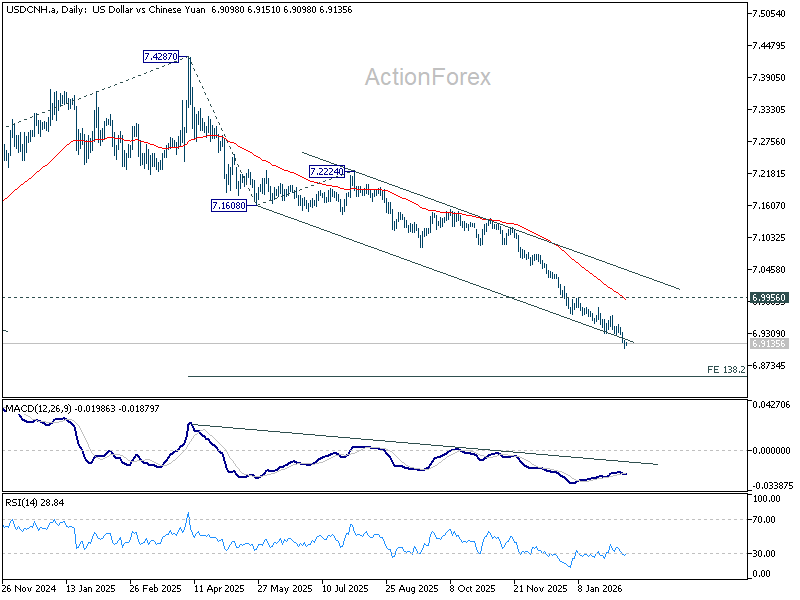
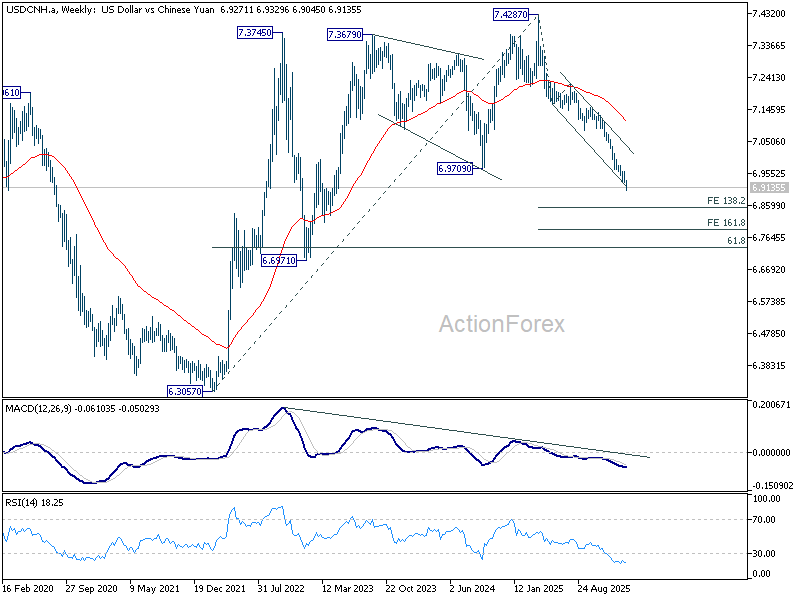
                Chinese Yuan in free fall on coronavirus outbreak

                  USD/CNH surges sharply as offshore Yuan is in suffering heavy selloff on China’s coronavirus outbreak. Rebound from 6.8452 is now targeting channel resistance (7.0135). Decline from 7.1953 high is seen as a corrective move, which might has completed at 6.8452 already. Sustained break of the channel resistance should confirm this case and bring retest of 7.1953 high. Nevertheless, rejection by the channel resistance will retain near term bearishness. Break of 6.9209 will target a test on 6.8452 low instead.

                  WTI oil gaps down, targeting 50.64 key support

                    WTI crude oil gaps down as the week starts and hits as low as 52.10 so far. Further fall is expected as long as 55.89 resistance holds. However, overall outlook is unchanged. Current decline from 65.38 is seen as the third leg of the consolidation pattern from 66.49. We’d expect strong support from 50.64, which is close to 61.8% retracement of 42.05 to 66.49 at 51.38, to bring rebound. Break of 55.89 will indicate short term bottoming. However, sustained break of 50.64 will invalidate our view and open up the case for a test on 42.05 low.

                    Gold gaps up, heading to retest 1611 high

                      Gold starts the week with a gap up and hits as high as 1588.51 so far. Further rise is in favor for the near term to retest 1611.37 high. At this point, we don’t rule out that case that 1611.37 is a medium term top. It could be formed after rise from 1160.17 completed a five-wave sequence on bearish divergence condition in daily MACD. Hence, we’d be cautious on topping signal below 1611.37. Break of 1556.52 support will extend the correction from 1611.37 with another leg down. However, decisive break of 1611.37 will resume the medium term up trend instead.

                      Markets in risk aversion as coronavirus spreads globally

                        Markets start the week in deep risk aversion cases of coronavirus and death tolls surged in China. The spread to other countries is also widening. Nikkei is currently down -1.7% while many other Asian are on lunar new year holiday. DOW future is down -0.9% while WTI crude oil is down -2.33%. Gold is up 0.56%, with Yen jumps across the board with Dollar.

                        Confirmed cases in China jumped to 2744 on Monday, up from 1975 yesterday, and 1287 on Saturday. Death tolls also hit 80. The virus has now spread to countries including the US, France, Australia, Taiwan Japan, South Korea, Singapore, Thailand, Malaysia, Vietnam and Nepal.

                        The Chinese government extends the annual lunar new year break until February 2, from January 30 originally. The US is planning to evacuate some Americans from Wuhan on Tuesday. France is preparing to do the same by mid-week. Japan is also planning to evacuate its nationals.

                        Source: Washington Post

                        US PMI composite rose to 10-month high, recovery continued to quicken

                          US PMI Manufacturing dropped to 51.7 in January, down from 52.4, and missed expectation of 52.3. PMI services rose to 53.2, up form 52.8, beat expectation of 53.1, a 10-month-high. PMI Composite rose to 53.1, up from 52.7, also a 10-month high.

                          Commenting on the flash PMI data, Siân Jones, Economist at IHS Markit, said:

                          “The recovery of growth momentum across the U.S. private sector continued to quicken at the start of 2020, with overall output rising at the sharpest pace since last March. Nonetheless, the underlying data highlights a manufacturing sector that is not out of the woods yet, with goods producers seeing only modest gains in output and new orders. Service providers also registered a slower upturn in new business, which fed through to softer increases in output charges as part of efforts to attract new customers.

                          “On a positive note, private sector firms increased their workforce numbers at a faster rate, with some also expressing frustration at a lack of available candidates to fill vacancies. Job creation reflected stronger optimism regarding future output. Although firms remain wary of the potential for headwinds through 2020, business confidence creeped higher for the second month running.

                          “Further signs of historically soft price pressures will come as no surprise to the FOMC, who meet next week, adding to expectations of a hold in the policy rate. Muted increases in costs and output charges reportedly stemmed from both producers and suppliers increasing their efforts to boost sales.”

                          Full release here.

                          Canada retail sales rose 0.9%, but largely from motor sales

                            Canada retail sales rose 0.9% mom to USD 51.5B in November, well above expectation of 0.6% mom. That also largely offset the -1.1% mom decline in October. However, the growth was primarily attributable to highest sales at motor vehicle and parts dealers. Ex-auto sales grew merely 0.2% mom, below expectation of 0.5% mom. Overall, sales were up in six provinces and all census metropolitan areas.

                            Full release here.

                            UK PMI composite rose to 16-month high, kills off prospect of an imminent BoE rate cut

                              UK PMI Manufacturing rose to 49.8 in January, up from 47.5, beat expectation of 48.8. It’s also just slightly below 50 break-even mark, and was the highest level in nine months. PMI Services rose to 52.9, up from 50.0, beat expectation of 51.1, a 16-month high. PMI Composite rose to 52.4, up from 49.3, turned expansionary, a 16-month high.

                              Commenting on the latest survey results, Chris Williamson, Chief Business Economist at IHS Markit, said:

                              “The survey data indicate an encouraging start to 2020 for the UK economy. Output grew at the fastest rate for sixteen months amid rising demand for both manufacturing and services, suggesting business is rebounding after declines seen late last year. Intensifying political and economic uncertainty ahead of the general election has started to ease, encouraging more spending and helping push business expectations of future growth to its highest since mid-2015.

                              “The survey is indicative of GDP rising at a quarterly rate of approximately 0.2% in January, representing a welcome revival of growth after the malaise seen in the closing months of 2019. Hiring has also picked up.

                              “The uplift in sentiment about the outlook hints at even better growth to come, but confidence needs to continue to rise to ensure this solid start to the year has legs.

                              “It seems likely that the rise in the PMI kills off the prospect of an imminent rate cut by the Bank of England, with policymakers taking a wait and see approach as they assess the performance of the economy in the post-Brexit environment.”

                              Full release here.

                              Eurozone PMI composite unchanged at 50.9, failed again to pick-up momentum

                                Eurozone PMI Manufacturing rose to 47.8 in January, up from 46.3, beat expectation of 46.9. PMI Services, however, dropped to 52.2, down from 52.8, missed expectation of 53.0. PMI Composite was unchanged at 50.9.

                                Commenting on the flash PMI data, Andrew Harker, Associate Director at IHS Markit said:

                                “While the year may have changed, the performance of the eurozone economy was a familiar one in January. Output growth was unchanged from the modest pace seen in December, signalling that the economy failed again to record a pick-up in growth momentum.

                                “The failure of growth to accelerate was in spite of some areas of positivity. The service sector remained in expansion, while the worst of the manufacturing downturn looks to have passed and industry appears to be moving towards stabilisation. France and Germany continued to grow, while business confidence across the single-currency area jumped to a 16-month high.

                                “On the other hand, weakness was evident outside the ‘big-2’, with new orders unchanged and growth of business activity slowing to near-stagnation.

                                “Overall, a stable picture for both growth and inflation will likely reassure the European Central Bank that they are safe to keep monetary policy fixed for now while carrying out a strategy review.”

                                Full release here.

                                German PMI manufacturing rose to 45.2, storm clouds starting to clear

                                  Germany PMI Manufacturing rose to 45.2 in January, up from 43.7, beat expectation of 44.6. That’s also a 11-month high even though it’s deep in contraction region. PMI Services rose to 54.2, up from 52.9, beat expectation of 54.0. PMI Composite rose to 51.1, up from 50.2, a 5-month high.

                                  Commenting on the flash PMI data, Phil Smith, Principal Economist at IHS Markit said:

                                  “A number of positive takeaways from January’s flash PMI survey suggest the storm clouds over the German economy may be starting to clear. The drag from the downturn in manufacturing continues to ease as the sector moves closer to stabilisation, while the services economy is back growing at a robust pace.

                                  “Demand has started to firm up a little both at home and abroad, which is reflected in a first rise in new business for seven months. With confidence starting to return, businesses are reporting clients steadily loosening the purse strings.”

                                  Full release here.

                                  France PMI composite dropped to 51.5, but private sector stays in expansion in the near term

                                    France PMI Manufacturing rose to 51.0 in January, up from 50.4, beat expectation of 50.5. PMI Services dropped to 51.7, down from 52.4, missed expectation of 52.1. PMI Composite dropped to 51.5, down from 52.0, hitting a 4-month low.

                                    Commenting on the Flash PMI data, Pollyanna De Lima, Principal Economist at IHS Markit said:

                                    “The flash PMI data continued to show a slowdown in economic growth across France. While there were warnings of softer conditions in the service sector, linked to national railway strikes, manufacturing displayed mild signs of revival. Factory orders and exports returned to expansion mode – in part aided by price-discounting strategies – thereby boosting production growth. Goods producers signalled their first drop in charges in close to three-and-a-half years.

                                    “Encouragingly companies across both sectors are in buoyant mood regarding the year-ahead outlook for business activity, with optimism at a nine-month high. This upbeat growth projections continued to drive job creation and should ensure the private sector stays in expansion territory in the near-term.”

                                    Full release here.

                                    Japan PMI composite rose to 51.1, domestic-led economic recovery

                                      Japan PMI Manufacturing rose to 49.3 in January, up from 48.4, beat expectation of 48.7. PMI Services rose notably to 52.1, up from 49.4, back in expansion. PMI Composite also rose to 51.1, up from 48.6, turned into expansion.

                                      Joe Hayes, Economist at IHS Market, said: “Positive signs have emerged for Japan’s economy at the start of 2020, with flash PMI data pointing to a domestic-led economic recovery”. While Q4 would likely post an “ugly decline in GDP”, January PMI will “certainly allay fears” of an “impending technical recession”.

                                      Full release here.

                                      Japan CPI core accelerated to 0.7%, BoJ minutes show concerns on overseas

                                        Japan national CPI (all-item) accelerated from 0.8% yoy in December, up from 0.5% yoy, beat expectation of 0.7% yoy. CPI core (ex-fresh food), rose to 0.7% yoy, up from 0.5% yoy, beat expectations. CPI core-core (ex-fresh food, energy) also rose to 0.9% yoy, up from 0.8% yoy and matched expectations. While core CPI remains well below BoJ’s 2% target, the pickup should be welcomed by the central bank.

                                        In the minutes of December BoJ meeting, some members expressed concerns that gloomy global outlook could underscores market expectations. A few members noted “considering the risk that overseas economies could recover only to a small extent or slow further, the outlook for exports could not be viewed optimistically.”

                                        Falling global demand might also hurt household income. Some noted that “Close attention should be paid to how developments in corporate profits … would affect winter bonuses.” Capital spending has shown signs of weakness, which is a “matter of concern” too.

                                        Australia PMI composite dropped to record low 48.6, softness spilled over to 2020

                                          Australia PMI Manufacturing dropped to 49.1 in January, down from 49.2. PMI Services dropped to 48.9, down from 49.8. PMI Composite dropped to 48.6, down from 49.6. That’s the record worst contraction reading since the survey started in May 2016.

                                          Commenting on the Commonwealth Bank Flash PMI data, CBA Chief Economist, Michael Blythe said:

                                          “The January “flash” results show the softness in the Australian economy at the end of 2019 has spilled over into the early part of 2020. There is some fundamental weakness in the Australian economy associated with consumer constraint, the residential construction downturn and the reluctance of business to invest. But the PMI results are also being influenced by the terrible bushfires around Sydney and elsewhere. At this stage the impact seems to be mainly through disruption to supply chains. Supplier delivery times have increased sharply”.

                                          “The gloom should not be overdone. Key leading indicators like new orders and employment are showing a notably stronger result than the “headline” PMI readings. And expectations about future business remain at encouraging levels”.

                                          Full release here.