

Live Comments
Daly Defends Fed Independence as Treasury Steps Into Bond Market
San Francisco Fed President Mary Daly pushed back against concerns that Treasury’s intervention in long-dated debt markets could blur lines between fiscal debt management and monetary policy. Speaking on Bloomberg television Thursday, Daly said it was too early to judge how Treasury’s expanded buybacks might affect Fed’s work, noting “these are early days” and she did not want to be preemptive before policymakers had time to assess implications. She stressed that “the Treasury Secretary is different than the Fed,” adding that central bank remains focused on its congressional mandate and returning inflation to 2%.
Daly also played down idea that recent surge in long-term yields should dictate immediate policy action. She said rise in long yields is a global phenomenon driven by multiple forces and “doesn't give us a lot of signal about what we should do in the policy adjustments or the policy calibration for the Fed.” By contrast, she said shorter-dated yields suggest markets understand Fed’s reaction function. Daly described current monetary policy as being in a “good place” and strongly backed July decision to keep federal funds target range at 3.50–3.75%.
Her strongest message was institutional rather than directional. Daly said “the Federal Reserve cares about its independence and its credibility and sticks to its remit,” while adding, “I don't see our credibility at risk.” She also rejected pressure for immediate preemptive moves, saying she sees little evidence that either a cut or hike is an urgent problem to solve given recent data. The implication is clear: Treasury can alter debt-management mechanics, but Fed intends to keep its policy decisions anchored to inflation and labor-market conditions rather than react mechanically to long-end bond volatility.
Key Takeaways
- San Francisco Fed President Mary Daly said it is too early to judge how Treasury’s expanded long-dated buybacks and possible issuance changes could affect Fed policy implementation.
- Daly stressed institutional separation, saying “the Treasury Secretary is different than the Fed” and that central bank remains focused on its congressional mandate and returning inflation to 2%.
- She played down recent long-yield volatility as a direct policy signal, saying higher long-term yields are driven by global forces and “doesn't give us a lot of signal” about Fed rate calibration.
- Daly said shorter-dated bonds are more informative because they “seem to be signaling to us that they understand our reaction function.”
- She described monetary policy as being in a “good place” and strongly supported July decision to hold rates at 3.50–3.75%.
- On credibility, Daly said “I don't see our credibility at risk” and emphasized that Fed “cares about its independence and its credibility and sticks to its remit.”
- She also rejected urgency for either a preemptive hike or cut, saying recent data do not point to an immediate policy problem that needs solving.
U.S. Jobless Claims Fall to 206K, but Continuing Claims Rise
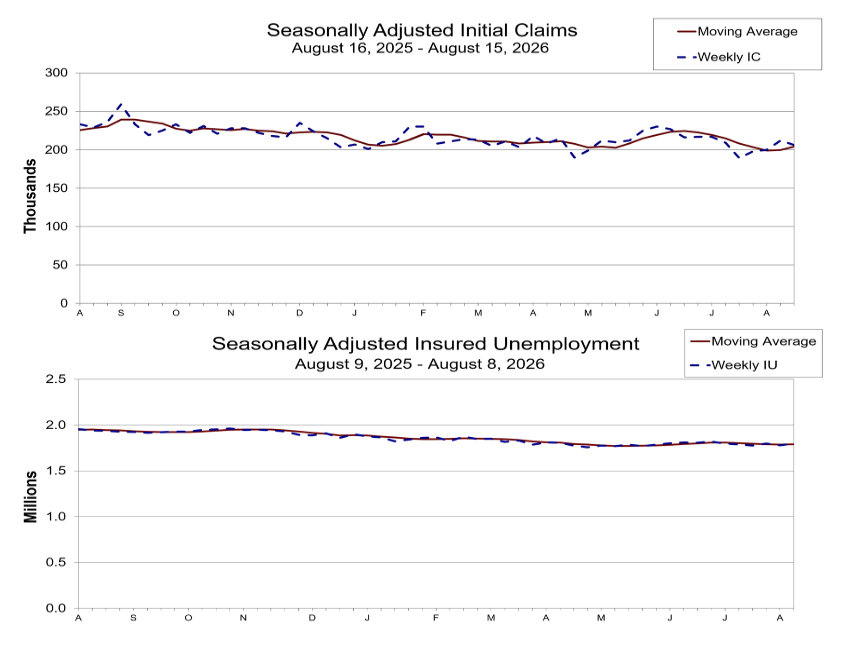
U.S. initial jobless claims fell 6,000 to 206,000 in the week ended August 15, below market expectations for 210,000 and pointing to continued stability in labor-market conditions. However, the previous week's figure was revised up to 212,000 from 209,000, meaning the latest decline partly reflects a higher starting point. The four-week moving average, which smooths weekly volatility, increased to 204,000 from a revised 199,750.
The broader picture is less reassuring than the headline decline suggests. Continuing claims rose 18,000 to 1.799 million in the week ended August 8, while the four-week average increased to 1.789 million. The insured unemployment rate was unchanged at 1.2%. Rising continuing claims indicate that workers who have lost jobs may be taking longer to return to employment, even as the flow of new claims remains relatively low.
Data Summary
| Indicator | Latest | Previous | Consensus |
|---|---|---|---|
| Initial Jobless Claims | 206K | 212K | 210K |
| 4-Week Moving Average | 204K | 199.75K | — |
| Continuing Claims | 1.799M | 1.781M | — |
| 4-Week Avg. Continuing Claims | 1.789M | 1.7865M | — |
| Insured Unemployment Rate | 1.2% | 1.2% | — |
Key Takeaways
- Initial claims fell to 206K, beating expectations for 210K and suggesting layoffs remain contained.
- Previous week's claims were revised higher to 212K, from 209K, reducing the strength of the latest decline.
- Four-week average rose to 204K, pointing to some softening in the underlying trend despite the weekly fall.
- Continuing claims increased 18K to 1.799M, suggesting unemployed workers are taking somewhat longer to find new jobs.
- Labor market is cooling gradually rather than deteriorating sharply. Low initial claims argue against an abrupt downturn, while rising continuing claims provide evidence of weaker labor-market momentum.
Full US jobless claims release here.
Australia Jobs Fall -15.8K as Unemployment Hits 4.5%, Giving RBA More Evidence of Slowdown
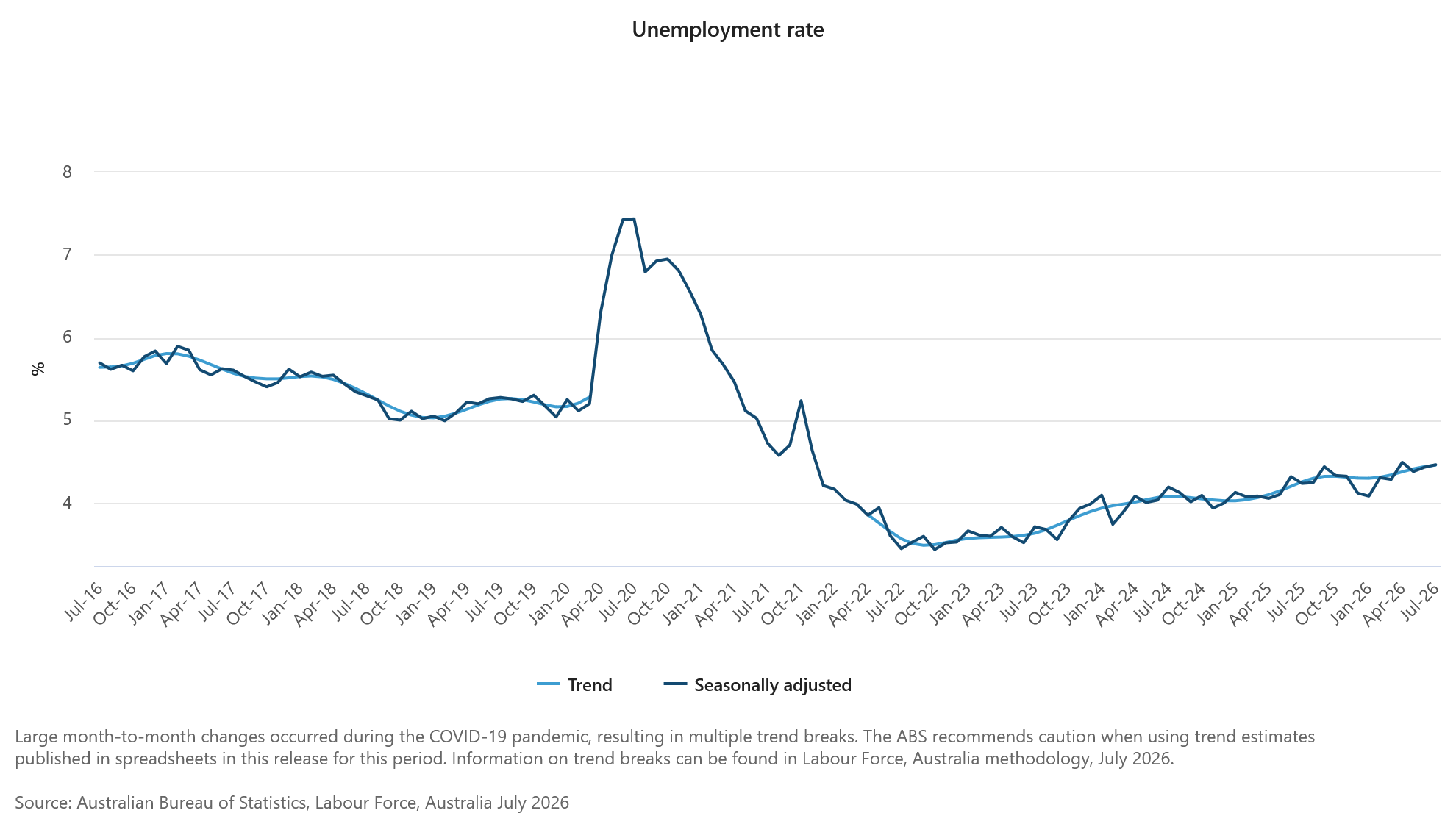
Australia’s labor market softened noticeably in July, with employment falling -15.8K after a revised 80.2K increase in June, missing expectations for an 11.4K gain. Unemployment rate rose from 4.4% to 4.5%, above 4.4% forecast. Weakness extended beyond headline: participation rate slipped from 67.0% to 66.9%, while employment-to-population ratio fell from 64.0% to 63.9%.
Hours worked reinforced cooling signal, dropping -0.6% m/m, or 12 million hours, from 2.010bn to 1.998bn. Employment losses were concentrated among males, down -11K, while female employment fell -5K. Female full-time employment actually rose 17K, but this was outweighed by a 22K decline in part-time positions. Underemployment rate held at 6.4%, suggesting labor-market deterioration is still measured rather than broad-based.
For RBA, report provides fresh evidence that tighter financial conditions are slowing employment after Deputy Governor Andrew Hauser said Wednesday Bank had already seen “a bit of a slowdown in consumption and employment growth, but needs to see more still.” July delivers more of that evidence, with employment, participation and hours worked all weakening together. It does not eliminate tightening risk while inflation and energy costs remain elevated, but it reduces urgency for another near-term hike and raises importance of upcoming inflation data in determining whether RBA’s hawkish bias survives.
Data Summary
| Indicator | Actual | Expected | Previous |
|---|---|---|---|
| Employment Change | -15.8K | +11.4K | +80.2K |
| Unemployment Rate | 4.5% | 4.4% | 4.4% |
| Participation Rate | 66.9% | — | 67.0% |
| Employment-to-Population Ratio | 63.9% | — | 64.0% |
| Underemployment Rate | 6.4% | — | 6.4% |
| Monthly Hours Worked | 1.998bn | — | 2.010bn |
Key Takeaways
- Australian employment fell 15.8K in July after a revised 80.2K increase in June, well below expectations for an 11.4K gain.
- Unemployment rate rose from 4.4% to 4.5%, exceeding consensus for no change.
- Weakness extended beyond headline employment, with participation rate falling from 67.0% to 66.9% and employment-to-population ratio slipping from 64.0% to 63.9%.
- Hours worked fell 12 million, or 0.6% m/m, providing another sign of softer labor utilization.
- Underemployment held at 6.4%, suggesting cooling has not yet turned into a broad deterioration.
- Male employment fell 11K, while female employment declined 5K despite a 17K increase in female full-time jobs.
- For RBA, July delivers more evidence of slowdown in employment that Deputy Governor Andrew Hauser said policymakers still needed to see.
- Report reduces urgency for another near-term hike, although inflation and oil-related upside risks mean RBA’s tightening option remains open.