


What’s happening: Dollar sold off broadly Wednesday after Treasury announced it will at least double its long-dated debt buyback operations, from $2bn to at least $4bn, starting September 9, pulling the 30-year Treasury yield back below 5.20% from above 5.33% earlier in the week and stripping away Dollar’s recent yield support.
Why it matters: The buybacks address liquidity, not the structural fiscal deficit that drove yields toward two-decade highs, so whether 30-year yield stays contained is itself a test. Attention now shifts to Wednesday’s July FOMC minutes, but the real question isn’t the 9-3 vote itself, it’s whether hawkish sympathy extends beyond the three official dissenters, and even that signal may already be stale given the data received since the July 30 meeting.
Treasury Buybacks Knock Away Dollar’s Yield Support
Dollar came under broad selling pressure in early US trading Wednesday as long-dated Treasury yields reversed sharply from this week’s multi-year highs. 30-year yield fell back below 5.20% after reaching above 5.33% earlier in week, near its highest level in two decades, stripping away an important source of recent support for greenback.
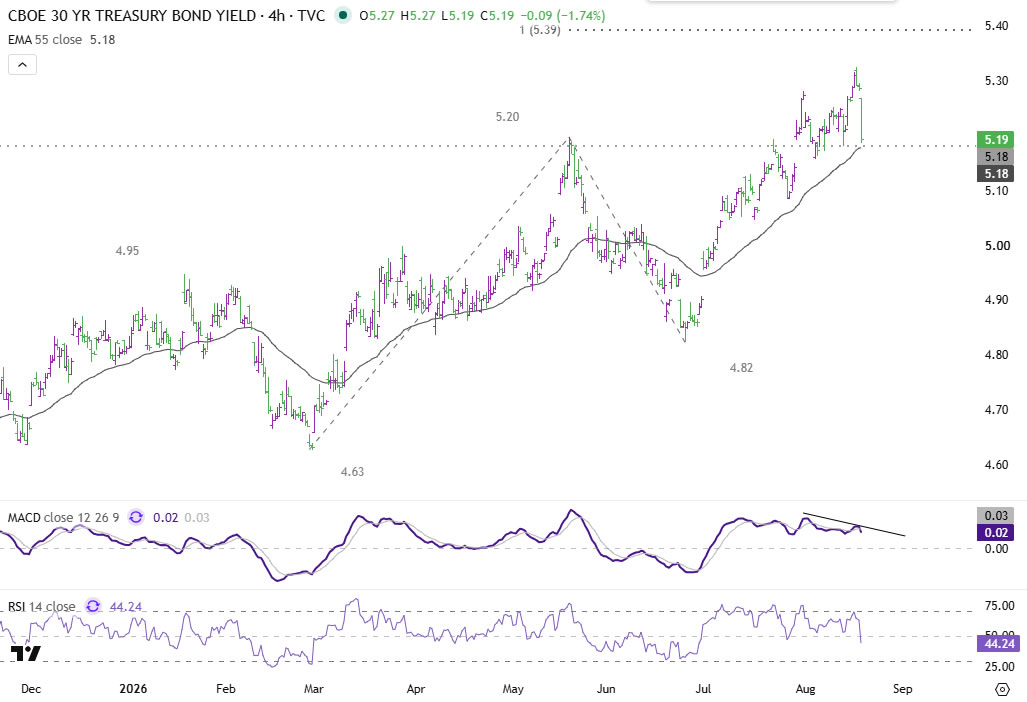
Trigger came from Treasury Department, which said it will at least double maximum size of its long-dated debt buyback operations from $2bn to at least $4bn, starting September 9 and running through November 4. Operations will target 10–20 year and 20–30 year sectors, precisely where selling pressure has been most intense since late June. Treasury said larger operations were intended to provide greater liquidity support in long-dated nominal securities, citing consistently strong participation from market counterparties.
Immediate market reaction is revealing because expanded buybacks do not begin for another three weeks. Investors nevertheless pushed long yields sharply lower as soon as future relief was announced. That suggests positioning in long end had become stretched enough that even prospect of greater Treasury absorption was sufficient to trigger substantial reversal.
Treasury’s Buyback Expansion
- Size: at least doubled, from $2bn to at least $4bn maximum per operation.
- Start date: September 9, running through November 4.
- Target sectors: 10-20 year and 20-30 year, where selling pressure has been most intense since late June.
- Stated rationale: greater liquidity support in long-dated nominal securities, citing strong counterparty participation.
Buybacks Offer Relief, Not a Fiscal Reset
The announcement changes near-term dynamics in long end, but it should not be confused with a solution to structural pressures that drove yields toward two-decade highs.
Treasury buybacks can improve liquidity and absorb selected long-dated securities, easing pressure in parts of curve that have struggled to attract buyers. But they do not remove underlying fiscal deficit or eliminate government financing needs. Treasury still needs to fund those requirements elsewhere across maturity spectrum.
That distinction sets up an important test. If 30-year yield remains contained after Wednesday’s move despite elevated oil prices and continued fiscal concerns, expanded buybacks may have materially altered near-term supply and liquidity balance. If yields quickly rebound once announcement is absorbed, this week’s deeper pressures—fiscal deterioration, inflation risk and higher term premium—would still appear dominant.
For Dollar, immediate effect is simpler: lower long yields have removed much of support that briefly interrupted recent selloff.
Fed Minutes Need to Reveal More Than Three Hawks
Attention now shifts to July FOMC minutes, where market-moving question is not whether Committee was divided. Headline vote already showed that clearly.
Fed held rates by 9–3, with Hammack, Kashkari and Logan dissenting in favor of a hike—the first unified three-way hawkish dissent of its kind since 2016. What markets do not know is whether those three were truly isolated or merely only officials prepared to register formal dissent.
That distinction matters for assessing risk for the rest of the year. If minutes show several of nine hold voters were sympathetic to immediate tightening but preferred waiting for another round of data, headline vote would understate underlying hawkishness. A 9–3 decision backed by broad majority opposition to tightening sends a very different signal from a 9–3 where several hold votes were close calls.
For Dollar to recover meaningfully from Wednesday’s yield-driven selloff, minutes may need to reveal exactly that kind of broader hawkish sympathy rather than merely repeat arguments already associated with three dissenters.
Two Readings of the 9-3 Vote
| Narrow Reading | Broader Reading | |
|---|---|---|
| Hawkish support | Limited to the three dissenters, Hammack, Kashkari and Logan | Several hold voters privately sympathetic, preferred waiting for more data |
| Signal for Dollar | Fed’s hawkish wing is genuinely isolated | Committee more hawkish beneath the surface than the vote count suggests |
| What would confirm it | Minutes largely repeat arguments already tied to the three dissenters | Minutes show “insurance hike” logic or supply-shock concern spreading to hold voters |
Watch the “Insurance Hike” and Supply-Shock Arguments
The reasoning behind dissent also matters.
Kashkari and Logan had framed tighter policy partly as an insurance strategy: modest action sooner could reduce risk that Fed eventually has to move much more aggressively. If that logic appears elsewhere in minutes among officials who ultimately voted hold, markets could conclude Committee is more willing to act pre-emptively than vote count suggests.
Supply-shock discussion will be another key area. Repeated shocks—from tariffs to Middle East energy disruption—raise question of whether inflation can continue being treated as temporary each time, particularly if those shocks begin affecting expectations or pricing behavior. AI-related investment and strong capital demand could also feature in discussion over how much spare capacity economy really has.
Labor market assessment is equally important. Hawkish case rested partly on argument that employment conditions were still resilient enough to tolerate tighter policy without excessive cost. Evidence that broader Committee was already concerned about weakening labor demand would work in opposite direction and make recent soft data even more significant.
But July Minutes Describe an Economy That No Longer Exists
There is one major limitation: minutes reflect Committee’s thinking as of July 30.
Since then, markets have received weaker employment data, softer CPI, subdued retail sales and flat PPI. Those releases have materially reduced expectations for September tightening and changed balance between inflation and growth risks.
That means minutes should not be treated as direct statement of what Fed would do today. Their value lies in revealing reaction function—what evidence hawks needed to see, how much labor-market weakness would make them hesitate, and whether officials voting hold were waiting for specific inflation triggers.
In that sense, most useful question is not whether July minutes look hawkish or dovish in isolation. It is whether thresholds described by policymakers have already been crossed by data released since meeting.
That also raises importance of Chair Warsh’s upcoming communication. His August 28 Jackson Hole keynote will incorporate information that July minutes could not, making it a potentially more relevant guide to current policy thinking.
FX Market Has One Clear Theme: Dollar Weakness
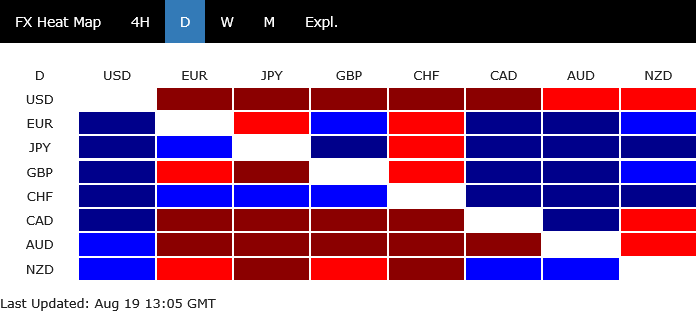
Broader currency ranking offers little evidence of a unified risk or commodity theme Wednesday. Dollar is weakest major currency, followed by Aussie and Loonie, while Swiss Franc leads, followed by Yen and Euro. Kiwi and Sterling sit closer to middle.
That mixed ranking makes it unnecessary to force a broader narrative. Clearest relationship is between Dollar and Treasury yields.
Related Coverage
Trade & Commodities Deep Dive
- Read why Trump’s three-day pause on the planned 50% Canada tariff eases immediate pressure on CAD without resolving broader trade tensions: Trump Pauses Canada Tariff — Relief for CAD, but No Trade Reset Yet.
- See why Silver is cracking as the Hormuz crisis shifts from an inflation shock into a broader stagflation trade, with 60.92 now key support: Hormuz Crisis Turns Stagflationary as Silver Starts to Crack.
Global Inflation Deep Dives
- Read why Eurozone’s finalized 2.9% CPI gives the ECB more than just an oil-driven headline to worry about, with core CPI firming to 2.5%: Eurozone CPI Finalized at 2.9% as Energy and Services Keep ECB on Guard.
- See why UK CPI’s rise to 2.9% masks easing services inflation, with housing costs doing most of the work on the headline: UK CPI Rises to 2.9%, but Services Inflation Moves Lower.
Central Bank Commentary
- Read why RBA Deputy Governor Hauser sharpened the case for another hike if disinflation stalls, citing oil, AI demand and weak productivity: RBA’s Hawkish Warning Gets Clearer: Disinflation Stalls, Rates Rise Again.
Asia-Pacific Data Deep Dives
- See why Australia’s annual wage growth easing to 3.2% suggests wages are cooling gradually rather than becoming a fresh inflation threat: Australia Annual Wage Growth Slows to 3.2% as Private-Sector Pay Moderates.
- Read why New Zealand’s Q2 input costs surging 2.9% against output prices up just 1.6% points to renewed pressure on business margins: New Zealand Input PPI Rises 2.9% in Q2, Output Prices Up 1.6%.
Frequently Asked Questions
Q: Why did Dollar fall on a buyback program that doesn’t start for three weeks?
A: Because positioning in the long end of the Treasury curve had become stretched enough that even the prospect of greater future Treasury absorption was sufficient to trigger a substantial reversal. The 30-year yield fell from above 5.33% to below 5.20% on the announcement alone, and since Dollar had been drawing support from those elevated yields, the reversal immediately removed that support.
Q: Do Treasury buybacks fix the structural pressure that pushed yields to two-decade highs?
A: Not on their own. Buybacks improve liquidity and absorb selected long-dated securities, but they don’t remove the underlying fiscal deficit or eliminate government financing needs, Treasury still has to fund those requirements elsewhere across the maturity spectrum. Whether 30-year yield stays contained despite elevated oil prices and fiscal concerns, or quickly rebounds once the announcement is absorbed, will show whether buybacks meaningfully altered the supply and liquidity balance or just delayed the pressure.
Q: What would July’s Fed minutes need to show to bring Dollar bulls back?
A: More than repeating the known arguments of the three dissenters, Hammack, Kashkari and Logan. Dollar would need minutes showing several hold voters were sympathetic to immediate tightening, sharing the “insurance hike” logic or supply-shock concerns, which would suggest the Committee is more hawkish beneath the surface than the 9-3 vote implies. Even then, the minutes reflect the Fed’s thinking as of July 30, before weaker jobs, softer CPI and flat PPI arrived, so Chair Warsh’s August 28 Jackson Hole keynote may end up mattering more.
Key Takeaways
- Treasury will at least double long-dated buybacks, from $2bn to at least $4bn, starting September 9: The announcement pulled 30-year yield back below 5.20% from above 5.33% earlier in the week.
- The market reaction arrived three weeks early: Since the program doesn’t start until September 9, the immediate yield reversal suggests long-end positioning had become stretched.
- Buybacks address liquidity, not the structural fiscal deficit: Whether 30-year yield stays contained once the announcement is absorbed is itself a test of whether this is durable relief or just a pause.
- The real question in Wednesday’s Fed minutes isn’t the 9-3 vote itself: It’s whether hawkish sympathy extends beyond the three dissenters, Hammack, Kashkari and Logan, to hold voters who saw it as a close call.
- Minutes reflect thinking as of July 30, before a run of softer data: Weaker employment, softer CPI, subdued retail sales and flat PPI since then may have already crossed thresholds officials described, making Chair Warsh’s August 28 Jackson Hole keynote a more current guide.
- FX ranking showed no unified theme beyond Dollar weakness: Franc led, Dollar was weakest, and the clearest relationship Wednesday was between Dollar and Treasury yields.
What to Watch Next
July FOMC minutes are the immediate test, specifically whether they reveal “insurance hike” logic or supply-shock concerns spreading beyond the three dissenters. Also watch whether 30-year yield stays contained below 5.20% as the buyback announcement is digested, and treat Chair Warsh’s August 28 Jackson Hole keynote as a potentially more current read on Fed thinking than the minutes themselves.





