

Live Comments
Japan Inflation Is Broadening Again — Core-Core at 1.9% Strengthens BoJ Hike Case
Japan’s inflation pressures strengthened in July, with headline CPI rising from 1.6% to 1.9% y/y, above 1.7% expected, while core CPI excluding fresh food accelerated from 1.6% to 1.8%, matching consensus. More importantly for underlying inflation, core-core CPI excluding fresh food and energy rose from 1.7% to 1.9%, bringing it close to BoJ’s 2% target even as core CPI remained below target for a seventh consecutive month.
Composition suggests pressure is broadening rather than coming solely from energy. Food excluding fresh items rose 3.0% y/y, only slightly slower than 3.1% in June. Services inflation picked up from 1.1% to 1.2%, consistent with gradual pass-through of higher labor costs. Goods prices remained firmer at 2.7%. Energy inflation also turned positive, moving from -0.4% to 0.6%, with propane gas and kerosene rising sharply even as electricity and gasoline prices remained slightly lower from a year earlier.
That mix matters because imported inflation risks are rebuilding just as domestic price pressure is becoming more persistent. Weak Yen continues to raise raw-material costs, while renewed Middle East tensions and higher crude prices threaten another increase in Japan’s energy import bill. Recent PMI data add to the picture: manufacturing and services both strengthened in August, while firms reported output-price inflation near record highs despite some easing in input-cost growth.
For BoJ, July CPI strengthens case for another rate increase at September 17–18 meeting. Core CPI is still below 2%, but core-core inflation at 1.9%, firmer services prices and renewed energy pressure make it harder to argue that inflation is fading cleanly. With private-sector activity strengthening at same time, conditions are supportive of a move from 1.0% to 1.25%, while focus will then shift to whether BoJ is prepared to accelerate tightening pace beyond roughly two increases a year.
Data Summary
| Indicator | Actual | Expected | Previous |
|---|---|---|---|
| National CPI y/y | 1.9% | 1.7% | 1.6% |
| Core CPI y/y | 1.8% | 1.8% | 1.6% |
| Core-Core CPI y/y | 1.9% | 1.7% | 1.7% |
| Food ex Fresh Food y/y | 3.0% | — | 3.1% |
| Services CPI y/y | 1.2% | — | 1.1% |
| Goods CPI y/y | 2.7% | — | — |
| Energy CPI y/y | 0.6% | — | -0.4% |
Key Takeaways
- Japan headline CPI accelerated from 1.6% to 1.9% y/y in July, beating expectations for 1.7%.
- Core CPI excluding fresh food rose from 1.6% to 1.8%, matching consensus and marking second straight monthly acceleration.
- More importantly, core-core CPI excluding fresh food and energy rose from 1.7% to 1.9%, pointing to firmer underlying inflation rather than an energy-only rebound.
- Services inflation edged higher from 1.1% to 1.2%, suggesting gradual pass-through of labor and domestic cost pressures.
- Food excluding fresh items remained elevated at 3.0%, while goods inflation stood at 2.7%.
- Energy inflation swung from -0.4% to 0.6%, with higher kerosene and propane costs adding fresh pressure.
- Weak Yen and renewed Middle East-driven energy costs remain upside risks to import prices, while government subsidies continue to restrain parts of headline inflation.
- For BoJ, mix strengthens case for a September 17–18 rate hike: underlying inflation is approaching 2% just as private-sector activity is strengthening.
Japan PMI Accelerates as Manufacturing Leads Broad-Based August Growth
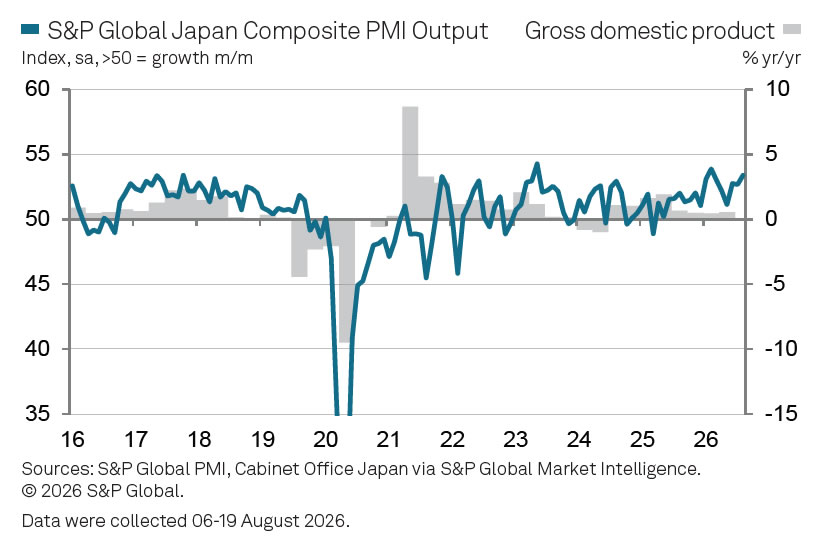
Japan’s private-sector expansion strengthened in August, with PMI Composite Output rising from 52.7 to 53.4, its fastest increase in output since February. PMI Services Business Activity improved from 51.2 to 52.3, while PMI Manufacturing climbed from 54.5 to 55.1. PMI Manufacturing Output remained especially strong at 56.1, only slightly below July’s 56.3, confirming factories continued to lead overall growth.
Demand details were particularly firm. S&P Global said manufacturers recorded sharp increases in production and new orders, while total sales and overseas demand rose at the fastest pace in more than eight-and-a-half years. Semiconductor and AI-related industries remained key sources of new business, strengthening evidence that Japan’s factory sector is benefiting from sustained technology investment and external demand. Employment also increased further, while overall business confidence improved.
Cost pressures eased slightly but remained elevated. Input-price inflation slowed to a five-month low, though firms still cited Middle East-related supply-chain disruption, higher energy costs and weak Yen as important drivers. Output-price inflation nevertheless stayed close to a record pace, suggesting companies remain reluctant to ease pricing while costs are still high. Overall, August PMI points to a stronger growth backdrop led by manufacturing, but persistent price pressure keeps inflation risks relevant alongside improving activity.
Data Summary
| Component | Current | Previous | Trend |
|---|---|---|---|
| PMI Composite Output | 53.4 | 52.7 | Growth accelerated |
| PMI Services Business Activity | 52.3 | 51.2 | Expansion strengthened |
| PMI Manufacturing | 55.1 | 54.5 | Stronger expansion |
| PMI Manufacturing Output | 56.1 | 56.3 | Very strong, slightly softer |
Key Takeaways
- Japan PMI Composite Output rose from 52.7 to 53.4 in August, marking the fastest increase in private-sector output since February.
- PMI Services Business Activity improved from 51.2 to 52.3, showing services growth gained momentum.
- PMI Manufacturing climbed from 54.5 to 55.1, while PMI Manufacturing Output stayed very strong at 56.1.
- Manufacturing remained the main growth engine, with sharp increases in production and new orders.
- Total sales and overseas demand recorded their strongest increase in more than eight-and-a-half years, supported by semiconductor and AI-related industries.
- Employment rose further and business confidence improved, reinforcing the broader expansion signal.
- Input-cost inflation eased to a five-month low, but remained elevated due to Middle East-related supply disruption, energy prices and weak Yen.
- Output-price inflation stayed near record highs, suggesting firms are still passing through elevated costs.
- Overall, August PMI points to stronger growth with persistent pricing pressure, keeping both activity and inflation relevant for BoJ outlook.
Australia PMI Expansion Continues, but Manufacturing Output Slips Back Into Contraction
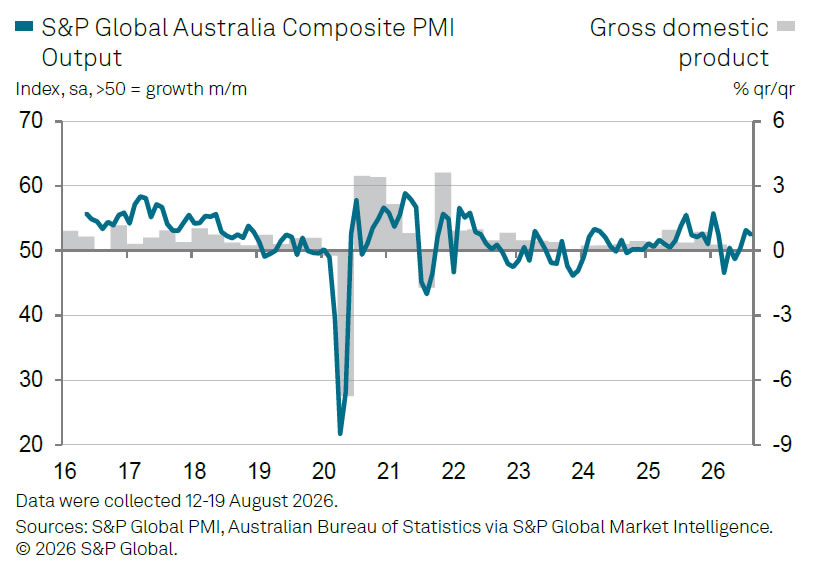
Australia private-sector activity continued to expand in August, although momentum eased slightly. PMI Composite Output fell from 53.2 to 52.5, while PMI Services Business Activity eased from 53.6 to 52.9. PMI Manufacturing held at 52.0, but PMI Manufacturing Output slipped from 50.3 to 49.7, indicating a marginal contraction in factory production even as broader manufacturing conditions stayed expansionary.
The details were mixed but still constructive. S&P Global said order books improved again, with manufacturing recording its strongest increase in new work since the start of the year. Employment also rose modestly, while business confidence strengthened to a six-month high. Services remained the main source of growth, though both activity and new business expanded at a softer pace than in July. Manufacturing output, meanwhile, was held back by supply-chain disruption and rising cost pressures.
Inflation signals were less comfortable. Input-cost inflation accelerated in August, ending the steady easing seen since April, while firms cut the pace of output-price increases to the slowest since the start of the year in an effort to support demand. S&P Global said businesses continued absorbing a large share of higher costs, pointing to ongoing margin pressure. Overall, August PMI still signals modest expansion, but with softer services momentum, weaker factory output and a less favorable cost environment.
Data Summary
| Component | Current | Previous | Trend |
|---|---|---|---|
| PMI Composite Output | 52.5 | 53.2 | Growth slowed |
| PMI Services Business Activity | 52.9 | 53.6 | Expansion eased |
| PMI Manufacturing | 52.0 | 52.0 | Stable expansion |
| PMI Manufacturing Output | 49.7 | 50.3 | Slipped into contraction |
Key Takeaways
- Australia PMI Composite Output eased from 53.2 to 52.5 in August, signaling continued private-sector expansion but at a slightly slower pace.
- PMI Services Business Activity fell from 53.6 to 52.9, keeping services in growth while momentum softened.
- PMI Manufacturing held at 52.0, but PMI Manufacturing Output slipped from 50.3 to 49.7, indicating a marginal contraction in factory production.
- Demand remained relatively resilient, with order books improving and manufacturing recording its strongest inflow of new work since the start of the year.
- Employment continued to rise modestly, while business sentiment improved to a six-month high.
- Cost pressures became less favorable as input-price inflation accelerated, ending the easing trend seen since April.
- Firms nevertheless slowed increases in selling prices to the weakest pace since the start of the year, suggesting businesses are absorbing more of higher costs to protect demand.
- Overall, August PMI points to continued but slower growth, stronger order books and renewed margin pressure.