Corbyn tells May to move red lines and give big offer on Brexit

    UK opposition Labour Jeremy Corbyn said there is no big offers from Prime Minister Theresa May on Brexit yet. An he urged May to move her red lines.

    Corbyn said “So far in those talks there’s been no big offer and the red lines are still in place.” “Its actually quite difficult negotiating with a disintegrating government, with cabinet ministers jockeying for succession rather than working for an agreement.”

    “Quite honestly, the government has to move its red lines. We cannot go on having MV1, MV2, MV3 and then coming on for possibly MV4 or a bill we have yet to actually see” he added.

    May’s spokesperson said there are significant work to do to reach a unified way forward to break a parliamentary impasse over Brexit. And the government is working hard to introduce the Brexit Withdrawal Agreement bill as soon as possible.

    China prepared to response to all possible outcomes of trade talks with US

      Chinese Ministry of Commerce spokesman Gao Fend said in a regular briefing that “the U.S. side has given many labels recently, ‘backtracking’, ‘betraying’ etc … China sets great store on trustworthiness and keeps its promises, and this has never changed.”

      Gao added, “we hope the U.S. can meet China halfway, take care of each others’ concerns, and resolve existing problems through cooperation and consultations”

      But he alsosaid that “China’s attitude has been consistent, and China will not succumb to any pressure”. Gao warned “China has made preparations to respond to all kinds of possible outcomes.”

      US jobless claims dropped to 228k, trade deficit at USD -50B

        US initial jobless claims dropped -2k to 228k in the week ending May 4, above expectation of 220k. Four-week moving average of initial claims rose 7.75k to 220.25k.

        Continuing claims rose 13k to 1.684M in the week ending April 27. Four-week moving average of continuing claims dropped -8k to 1.666M.

        PPI rose 0.2% mom, 2.2% yoy in April, versus expectation of 0.2% mom, 2.3% yoy. PPI core rose 0.1% mom, 2.4% yoy, versus expectation of 0.2% mom, 2.5% yoy.

        Trade deficit rose 1.5% to USD 50.0B in March, better than expectation of USD -51.4B. Exports rose 1.0% to USD 212.0B. Imports rose 1.1% to USD 262.0B.

        Trump vows not to back down on tariffs, China warns of countermeasures

          At a rally in Florida late Wednesday, Trump accused that China “broke the deal” as the trade negotiations entered the final stage. And he pledged no to back down on tariffs unless China “stops cheating our workers”. He said, “I just announced that we’ll increase tariffs on China and we won’t back down until China stops cheating our workers and stealing our jobs, and that’s what’s going to happen, otherwise we don’t have to do business with them”. And, ‘They broke the deal,” he added. “They can’t do that. So they’ll be paying. If we don’t make the deal, nothing wrong with taking in more than $100 billion a year.”

          In response to new tariff threats, China’s Ministry of Commerce said in a statement: “Escalating the trade conflict is not in the interest of the people in both countries and the world. China deeply regrets the move. But if the US tariff measures are implemented, China will have to take necessary countermeasures.” Chinese Vice Premier will be in Washington to try to save the trade deal while new round of tariffs will take effect in less than 24 hours.

          NIESR: Post-Brexit customs union means GBP 800 loss per person per year

            The National Institute of Economic and Social Research (NIESR) published a report regarding the economic impact of post-Brexit customs union solution for the UK. Comparing with staying with in EU, the customs solution way will means around GBP 800 loss per person per year after 10 years.

            The reported noted that “the terms on which the UK will trade with the EU after Brexit will not be as favorable to the UK as they are now”. And, “this would discourage investment in the UK and ultimately mean that UK workers were less productive than they would have been if the UK had stayed in the EU.”

            Also, NIESR economist Garry Young said “leaving the EU for a customs union will make it more costly for the UK to trade with a large market on our doorstep, particularly in services which make up 80 percent of our economy.”

            Full report here.

            Kuroda: BoJ won’t do anything on exchange-rate, it’s MOF’s job

              BoJ Governor Haruhiko Kuroda told parliament today that the biggest factor on markets’ trust in Yen is BoJ’s commitment to price stability. He said “currency rates move on various factors, so it’s hard to judge market trust in the yen by looking at exchange-rate fluctuations alone.” Instead, “confidence in the central bank’s policy is a big factor behind market trust in the country’s currency”.

              Kuroda also said BoJ is watching exchange-rate moves carefully. However, currency policy falls under the jurisdiction of the Ministry of Finance. Thus, “BOJ would not do something for exchange-rate stability”.

              RBNZ Orr: Get ahead of the curve with this week’s rate cut

                RBNZ Governor Adrian Orr toned down the chance of another rate cut after yesterday’s, as he addressed a parliamentary committee today. He noted that “at the moment we see in the outlook for interest rates as…balanced”. Regarding yesterday’s cut, Orr pointed out that “the reason for the cut is global economic growth has slowed.” “Growth has come off rapidly in Europe, in China, though that’s stabilized more recently, and Australia … so key trading partners.”

                Separately, Orr also told the Morning Report that the cut was “sensible” as our “forward projection [showed] a lower rate. And the question for the committee was “do we wait or do we move now”. Orr said “Moving now is the best choice for us as far as we consider because it means we get ahead of the curve – we aren’t chasing the economy in cycles, we’re actually getting ahead and removing the cycles.”

                Fed Brainard: Inflation make up policy unproven

                  Fed Governor Lael Brainard talked about the “new normal in the economy. One feature equilibrium interest rates will likely remain low in the future. That presents a “challenge” for “traditional ways” of conducting monetary policy. There would be “less room to cut interest rates” in recessions, and thus “less room to buffer” the economy using conventional tools. Also, inflation “doesn’t move as much with economy activity and employment” as it has in the past. The “very flat” Phillips curve makes it “more difficult to boost inflation” to target on sustainable basis.

                  Brainard explored some issues. One idea is so called “average inflation targeting”. That is, Fed would target inflation over a “longer period of time”. Thus, Fed would aim at inflation above target during recovery and expansion phase of a cycle, making up for the short fall during a recession. She warned that “While such approaches sound quite appealing on their face, they have not yet been implemented in practice. There is some skepticism that a central bank would in fact prove able to support above-target inflation over a sustained period without becoming concerned that inflation might accelerate and inflation expectations might rise too high.”

                  Another idea is that after short-term interest rates hit zero, Fed might turn to targeting “slightly longer-term interest rates”, using its balance sheet. And, similar to make-up policies, such an approach could help communicate publicly how long the Federal Reserve is planning to keep rates low.

                  The full speech here.

                  Separately, Richmond Federal Reserve president Tom Barkin said “it is hard to have a recession when unemployment is this low and interest rates are this low”. On the economy, he added “I still see us on a pretty strong course”.

                  ECB Draghi: Be patient and persistent with accommodative policy and inflation will come

                    Talking to students in Frankfurt, ECB President Mario Draghi noted people say “it’s been so long when we haven’t reached the below but close to 2 percent, why don’t you lower inflation to something lower and accept defeat”. He then emphasized ” that’s exactly why we are not doing it, because we don’t accept defeat.”

                    Draghi also admitted it’s “taking longer” for transmission of higher nominal wages growth into a higher inflation. And one of the reasons is that “profit margins are being compressed”. But he also reiterated “it’s a matter of being patient and persistent with the accommodative monetary policy and it will come, it will happen”.

                    Into US session: Sterling weakest on Brexit deadlock, Yen strongest on trade war risk aversion

                      Entering into US session, Sterling is overwhelmingly the weakest one for today, even worse that New Zealand Dollar. The Pound is weighed down by talks that the cross-party Brexit negotiation between Conservatives and Labour nearly collapsed. Prime Minister Theresa May insisted to the Commons that she’s still working on an agreement. But at least there won’t be a solution soon as UK is already prepare to take part in European Election on May 23. New Zealand Dollar follows as the second weakest after RBNZ cut interest rate to 1.50%. Though, Kiwi pared back much of the losses as the day goes.

                      Meanwhile, Yen remains the strongest one for today on risk aversion, over concern of US-China trade war. According to a Reuters report, China has backtracked on nearly all aspects of its commitments in the latest draft agreement sent to the US team last weekend. It’s unsure whether Vice Premier Liu He will withdraw those changes or offer something else. Swiss Franc follows as the second strongest, and then Canadian.

                      In Europe, currently:

                      • FTSE is down -0.28%.
                      • DAX is up 0.25%.
                      • CAC is down -0.10%.
                      • German 10-year yield is down -0.011 at -0.047.

                      Earlier in Asia:

                      • Nikkei dropped -1.46%.
                      • Hong Kong HSI dropped -1.23%.
                      • China Shanghai SSE dropped -1.12% to 2893.76, back below 2900.
                      • Singapore Strait Times dropped -0.87%.
                      • Japan 10-year JGB yield was flat at -0.05.

                      Sterling accelerates down as cross party Brexit talk said to be near to collapse

                        Sterling’s decline picks up momentum earlier on news that the UK government conceded that they couldn’t finish Brexit negotiation with opposition labor soon. And hence, Cabinet Minister David Lidington confirmed European parliament elections will go ahead in UK on May 23. Then there were even reports that the discussion between Prime Minister Theresa May and opposition leader Jeremy Corbyn was close to a collapse.

                        GBP/JPY is one of the weakest pair today on risk aversion too. The break of 143.72 support aligns its outlook with USD/PY and EUR/JPY. That is, rebound from 131.51 has completed at 148.87 already, ahead of 149.48 resistance. Further fall should be seen to 38.2% retracement of 131.51 to 148.87 at 142.23 next.

                        China backtracked on all aspects of trade commitments with US

                          According to a Reuters report, China has back tracked on nearly all aspects of their commitment in trade negotiation with the US. In each of the seven chapters of the 150-page draft trade deal, China deleted its comments regarding law changes that addresses US complaints. It’s seen by the US as undermining the “core architecture” of the trade deal. A private sector source said “China got greedy” and “on a dozen things, if not more.” And, China appears to be miscalculating with the US administration even after 20 years dealing with them.

                          Chinese Vice Premier Liu He will arrive in Washington of Thursday to save the trade agreement. At the same time, new round of tariffs will take effect at 0001 Friday, if no deal is agreed. There’s speculation that Liu could agree to scrap the latest proposed text changes and agree to making new laws. But at this point, it’s unsure what level of authority and constraints Liu has got from President Xi Jinping Thus, no one knows what results Liu could achieve.

                          China exports to US dropped -9.7% from Jan to Apr, imports dropped -30.4%

                            Latest trade data from China showed that growth in exports in other regions in 2019 so far was merely enough to offset contraction of -9.7% ytd yoy in exports to US. Total export grew a mere 0.2% ytd yoy. On the other hand, total exports contracted -2.5% ytd yoy, as dragged down by -30.4% ytd yoy contraction in exports from US. Trade with EU remained relatively healthy.

                            In USD terms, in April,

                            • Total trade grew 0.4% to USD 373.14B.
                            • Exports contracted -2.7% yoy to USD 193.49B.
                            • Import rose 4.0% yoy to USD 179.65B.
                            • Trade surplus came in at USD 13.84B

                            In USD terms, from January to April total:

                            • Total trade contracted -1.1% yoy to USD 1399.82B.
                            • Exports rose 0.2% yoy to USD 744.61B.
                            • Imports dropped -2.5% to USD 655.21B.
                            • Trade surplus came in at USD 894.0B.

                            With US, from January to April total

                            • Total trade contracted -15.7% yoy to USD 161.2.
                            • Exports to US contracted -9.7% yoy to USD 122.4B.
                            • Imports from US dropped -30.4% yoy to USD 39.8B.
                            • Trade surplus came in at USD 82.6B.

                            With EU, from January to April total:

                            • Total trade grew 5.9% yoy to USD 220.1B.
                            • Exports to EU rose 8.3% yoy to USD 131.5B.
                            • Imports from EU rose 2.5% yoy to USD 88.5B.
                            • Trade surplus came in at USD 43B.

                            With AU, from January to April total:

                            • Total trade grew 6.65 yoy to USD 51.1B.
                            • Exports to AU rose 3.4% to USD 14.3B.
                            • Imports from AU rose 7.9% to 36.8B.
                            • Trade deficit came in at USD -36.8B.

                            Summary release.

                            Trade data by region.

                            China trade surplus shrank again as exports contracted in April

                              China’s trade surplus shrank again in April to USD 13.84B, down from USD 32.67B and missed expectation of USD 34.56B. Exports dropped -2.7% yoy versus expectation of 3.0% yoy. On the other hand, imports rose 10.3% yoy versus expectation of -3.0% yoy.

                              In CNY terms, trade surplus narrowed sharply to CNY 93.57B, down from 221.23B, missed expectation of CNY 216.75B. Exports grew merely 3.1% yoy versus expectation of 8.0% yoy. Imports rose 10.3% yoy versus expectation of 3.0% yoy.

                              BoJ Minutes: Firm domestic demand offset drag from overseas slowdown

                                Minutes of the March 14/15 BoJ meeting noted that members “concurred” that the economy will continue to its “moderate expansion”. “domestic demand was likely to follow an uptrend”, including fixed investment and private consumption. That should offset weakness in exports and product as dragged down by overseas slowdown.

                                On prices, members reiterated that CPI ‘continued to show relatively weak developments compared to the economic expansion and the labor market tightening.” But CPI is still “likely to increase gradually” toward 2% target.

                                On monetary policy, members agreed that it was “appropriate” to persistently continue with the powerful monetary easing under the current guideline. On member warned of the “side effects” of maintaining current easing. One member warned that if downside risks were materializing, BoJ should be prepared to make policy responses. One member also noted the importance to “preemptive policy responses” in case of phase shift in developments.

                                Full minutes here.

                                NZDUSD and NZDJPY spike lower after RBNZ cut, more downside ahead

                                  Both NZD/USD and NZD/JPY spike lower after RBNZ rate cut even though they quickly pare back some losses. For NZD/USD, breach of 0.6551 support further affirms a bearish case. That is, consolidation pattern from 0.6422 has complete with three waves to 0.6938. And, larger down trend from 0.7558 (2017 high) might be ready to resume. For now, near term outlook in NZD/USD will stay bearish as long as 0.6629 resistance holds. 0.6422 low is next target.

                                  NZD/JPY’s sharp fall solidifies that case that corrective rebound from 69.18 has completed at 76.78 already. Near term outlook will stay bearish as long as 0.7340 resistance holds. Deeper decline should be seen back to retest 69.18 low. However, this level is close to a key long term fibonacci level. That is 50% retracement of 44.19 (2009 low) to 94.01 (2014 high) at 69.18. We’ll pay attention to bottoming signal there.


                                  RBNZ projects below target inflation for longer, sees need for more easing

                                    In the latest economic projections, RBNZ projected that inflation will stay below target for longer then in February MPS. CPI won’t breaks 2% level until 2022. CPI forecasts for 2019 and 2021 were both revised down. On growth, RBNZ sees slower GDP growth in 2019 and 2020. But GDP growth is expected to pick up solidly in 2021 before dipping in 2022.

                                    On the net, RBNZ sees the need for further rate cut with average OCR hitting 1.4% in 2021 before bottoming.

                                    OCR year average (vs Feb projections):

                                    • 2019 at 1.8% (unchanged);
                                    • 2020 at 1.6% (revised down from 1.8%);
                                    • 2021 at 1.4% (revised down from 1.8%);
                                    • 2022 at 1.6% (revised down from 2.2%);

                                    CPI (vs Feb projections):

                                    • 2019 at 1.5% (revised down from 1.6%);
                                    • 2020 at 1.9% (revised up from 1.7%);
                                    • 2021 at 1.9% (revised down from 2.1%);
                                    • 2022 at 2.1% (unchanged).

                                    GDP growth(vs Feb projections):

                                    • 2019 at 2.6% (revised down from 2.8%);
                                    • 2020 at 2.6% (revised down from 2.9%);
                                    • 2021 at 3.1% (revised up from 2.8%);
                                    • 2022 at 2.5% (revised up from 2.3%);

                                    Full MPS here.

                                    RBNZ cuts OCR to 1.50% as widely expected, full statement

                                      RBNZ lowers official cash rate by -25bps to 1.50% as widely expected. In the accompanying statement, RBNZ noted that:

                                      There was a “consensus” that lower path of OCR relative to February MPS was “appropriate”. That reflects “weaker domestic spending” and “projected ongoing growth and employment headwinds”. A key downside risk to growth was “larger than anticipated slowdown in global economic growth, particularly in China and Australia, New Zealand’s largest trading partners.”

                                      Meanwhile, outlook for inflation is below the target mid-point for “longer than projected” in the February MPS. Also, slower global growth would reduce “imported inflation”. That was a “downside risk” to the inflation outlook.

                                      Full statement below:

                                      Official Cash Rate Reduced to 1.5 Percent

                                      Tena koutou katoa, welcome all.

                                      The Official Cash Rate (OCR) has been reduced to 1.5 percent.

                                      The Monetary Policy Committee decided a lower OCR is necessary to support the outlook for employment and inflation consistent with its policy remit.

                                      Global economic growth has slowed since mid-2018, easing demand for New Zealand’s goods and services. This lower global growth has prompted foreign central banks to ease their monetary policy stances, supporting growth prospects.

                                      However, there is uncertainty about the global economic outlook. Trade concerns remain, while some other indicators suggest trading-partner growth is stabilising.

                                      Domestic growth slowed from the second half of 2018. Reduced population growth through lower net immigration, and continuing house price softness in some areas, has tempered the growth in household spending. Ongoing low business sentiment, tighter profit margins, and competition for resources has restrained investment.

                                      Employment is near its maximum sustainable level. However, the outlook for employment growth is more subdued and capacity pressure is expected to ease slightly in 2019. Consequently, inflationary pressure is projected to rise only slowly.

                                      Given this employment and inflation outlook, a lower OCR now is most consistent with achieving our objectives and provides a more balanced outlook for interest rates.

                                      Meitaki, thanks.

                                      Record of Meeting

                                      The Monetary Policy Committee agreed on the economic projections outlined in the May 2019 Statement in order to provide a sound basis on which to form its OCR decision.

                                      The Committee noted that inflation is currently slightly below the mid-point of the inflation target, and that employment is broadly at the targeted maximum sustainable level. However, the members agreed that given the recent weaker domestic spending, and projected ongoing growth and employment headwinds, there was a need for further monetary stimulus to meet its objectives.

                                      The Committee agreed that the risks to achieving its consumer price inflation and maximum sustainable employment objectives were broadly balanced around the projection. Possible alternative outcomes were noted on the upside and downside.

                                      A key downside risk relating to the growth projections was a larger than anticipated slowdown in global economic growth, particularly in China and Australia, New Zealand’s largest trading partners. The Committee agreed that the projections adequately captured the observed global slowdown and its impact on domestic employment and inflation.

                                      The Committee noted that additional stimulus from central banks had underpinned growth and reduced the likelihood of a more-pronounced slowdown. With some indicators of global growth improving in recent months, a faster recovery in global growth was possible. However, on balance, the Committee was more concerned about a continued slowdown rather than a faster recovery.

                                      The Committee discussed other potential risks to domestic spending. The members acknowledged the importance of additional spending from households, businesses, and the government, to meet their inflation and employment targets. However, they noted several important uncertainties.

                                      The Committee noted upside and downside risks to the investment outlook. Capacity pressure could see investment increase faster than assumed. On the downside, if sentiment remained low as profitability remains squeezed, investment might not increase as anticipated over the medium term. It was also noted that firms’ ability to invest is constrained by the current competition for resources.

                                      A potential source of additional demand discussed by the Committee included government spending being higher than currently projected, in view of the current strength of the Crown balance sheet. This view was balanced by the impact of any increase in government investment being delayed, for example due to timing of the implementation of new initiatives and current capacity constraints in the construction sector. The implications for monetary policy remain to be seen.

                                      Some members noted that with lower mortgage rates and easing of loan-to-value requirements, any possible pick-up in the housing market could support household spending growth more than anticipated. The Committee noted that employment is currently near its maximum sustainable level. However, it was agreed that the outlook for employment growth is more subdued and capacity pressure is expected to ease slightly in 2019.

                                      The Committee agreed that overall risks to the inflation projection were balanced. The Committee noted the outlook for inflation is below the target mid-point for longer than projected in the February Statement.

                                      The recent period of rising domestic inflation was discussed. The Committee noted that the near-term outlook was more subdued due to lower capacity pressure. It was also noted that cost pressures remain elevated, and that there is a risk firms may pass these costs on as higher consumer prices by more than assumed. However, it was agreed that inflation expectations remain well anchored at the mid-point of the target range.

                                      The Committee also noted the relatively subdued private sector wage growth, despite businesses suggesting that the inability to find labour is a significant constraint on their growth. The Committee noted the limited pass-through of the nominal wage growth to consumer price inflation.

                                      Some members noted slower global growth reducing imported inflation was a downside risk to the inflation outlook.

                                      The Committee reached a consensus that, relative to the February Statement, a lower path for the OCR over the projection period was appropriate. The lower path reflected the economic projections and the balance of risks discussed, and is consistent with both inflation and employment remaining near the Committee’s objectives.

                                      After discussing the relative benefits of holding the OCR and committing to a downward bias, versus cutting the OCR now so as to establish a more balanced outlook for interest rates, the Committee reached a consensus to cut the OCR to 1.50 percent.

                                      Attendees

                                      Reserve Bank staff: Adrian Orr, Geoff Bascand, Christian Hawkesby, Yuong Ha
                                      External: Bob Buckle, Peter Harris
                                      Observer: Gabriel Makhlouf
                                      Secretary: Chris McDonald
                                      Apologies: Caroline Saunders

                                      More Information

                                      Download the May 2019 Monetary Policy Statement (PDF 1.75MB)

                                      DOW and 10-year yield in steep decline again on trade concerns

                                        Risk aversion re-intensifies again in US session on trade war concerns. At the time of writing, DOW is down -1.46%. NASDAQ is down -1.75% and S&P 500 is down -1.44%. Yesterday, it appeared that DOW had drawn strong support from 55 day EMA and rebounded. But technically outlook turns rather bad with today’s steep decline.

                                        In the background, bearish divergence condition is already seen in daily MACD. 26696.96 is reasonably close to historical high at 26951.81, It’s an ideal timing for a near term reversal. A close below 55 day EMA (now at 26013) today, and sustained trading below there ahead, will suggest that rise from 21712.53 has completed. And even in the relatively bullish scenario, DOW should at least have a test on 38.2% retracement of 21712.53 to 26695.96 at 24792.28 ahead.

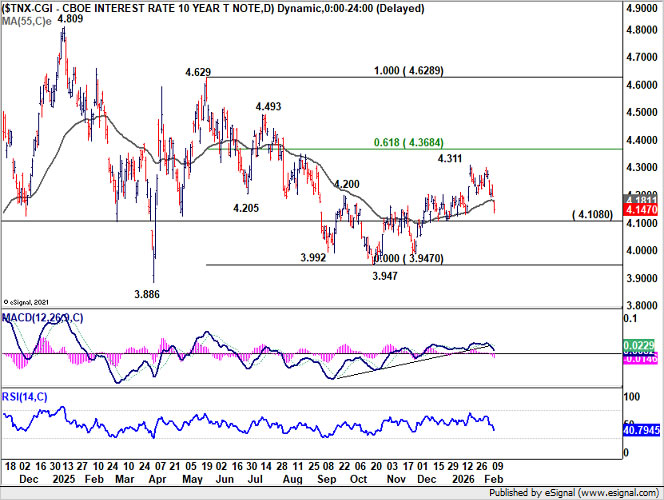
                                        Technical developments in 10-year yield also turns bad again after some false dawns. Rejection by 55 day EMA again dampened the case of bullish reversal. Meanwhile, 2.463 support is back in focus. A close below this level today should confirm completion of the corrective recovery from 2.356. And larger down trend would then be ready to resume through 2.356 low.

                                        Eurozone growth projected to bottom lower in 2019, but rebound still expected in 2020

                                          In the latest Spring Economic Forecasts, European Commission downgrade 2019 Eurozone GDP growth projections slightly by -0.1%. Though, it would be the seventh year of growth in a row. And despite continuing global uncertainties, domestic dynamics are expected to support the European economy. More importantly, the Commission expects growth to bottom in 2019 and pick up again in 2020.

                                          Eurozone projections (Winter forecasts):

                                          • 2019 GDP at 1.2% (downgraded from Winter forecast at 1.3%)
                                          • 2020 GDP at 1.5% (downgraded from 1.6%)
                                          • 2019 HICP at 1.4% (unchanged)
                                          • 2020 HICP at 1.4% (downgraded from 1.5%)

                                          Germany projections

                                          • 2019 GDP at 0.5% (downgrade from 1.1%)
                                          • 2020 GDP at 1.5% (downgraded from 1.7%)

                                          France projections

                                          • 2019 GDP at 1.3% (unchanged)
                                          • 2020 GDP at 1.5% (unchanged)

                                          Valdis Dombrovskis, Vice-President for the Euro and Social Dialogue, also in charge of Financial Stability, Financial Services and Capital Markets Union, said: “The European economy is showing resilience in the face of a less favourable external environment, including trade tensions. Growth is set to continue in all EU Member States and pick up next year, supported by robust domestic demand, steady employment gains and low financing costs. Yet risks to the outlook remain pronounced. On the external side, these include further escalation of trade conflicts and weakness in emerging markets, in particular China. In Europe, we should stay alert to a possible ‘no-deal Brexit’, political uncertainty and a possible return of the sovereign-bank loop.”

                                          Pierre Moscovici, Commissioner for Economic and Financial Affairs, Taxation and Customs, said:“The European economy will continue to grow in 2019 and 2020. Growth remains positive in all our Member States and we continue to see good news on the jobs front, including rising wages. This means that the European economy is holding up in the face of less favourable global circumstances and persistent uncertainty. Nonetheless, we should stand ready to provide more support to the economy if needed, together with further growth-enhancing reforms. Above all, we must avoid a lapse into protectionism, which would only exacerbate the existing social and economic tensions in our societies.”

                                          Full release here.