UK delays Brexit vote to Mar 12, EU mulls 21-month extensions

    UK Prime Minister Theresa May announced that a Brexit “meaningful vote” would not take place this week. Instead, the vote on the withdrawal agreement is rescheduled to March 12, just 17 days before the March 29 Brexit date. Though, the Parliament will still hold a series of Brexit votes on Wednesday. Also, May insisted that “we still have it within our grasp to leave the European Union with a deal on the 29th of March and that’s what I’m going to be working at”.

    On the other hand, Bloomberg reported that EU is mulling an Article 50 extension for as long as 21 months beyond March 29. The idea of a short three-month delay has been floating for some time. But it’s seen by EU as insufficient to break the deadlock. A three-month extension is only meaningful if for completing legal processes if UK Parliament approves the agreement.

    Trump delays new tariffs on China, Yuan jumps to 7-month high

      Trump tweeted on Sunday that there was “substantial progress” made in US-China trade talks on “important structural issues including intellectual property protection, technology transfer, agriculture, services, currency, and many other issues”. Hence he will be delaying the scheduled March 1 tariff increase. In other words, trade truce now extends beyond the date.

      Trump added that assuming there is additional progresses, he is planning a summit with Chinese President Xi Jinping at Mar-a-Lago resort in Florida to conclude the agreement.

      Twitter

      By loading the tweet, you agree to Twitter’s privacy policy.
      Learn more

      Load tweet

      Twitter

      By loading the tweet, you agree to Twitter’s privacy policy.
      Learn more

      Load tweet

      Later, Trump also said there could be “very big news over the next week or two” if all goes in well. He added that “China has been terrific. We want to make a deal that’s great for both countries and that’s really what we’re going to be doing.”

      China’s Xinhua also said the US and China have made “substantial progress” on specific issues in the latest round of trade talks.

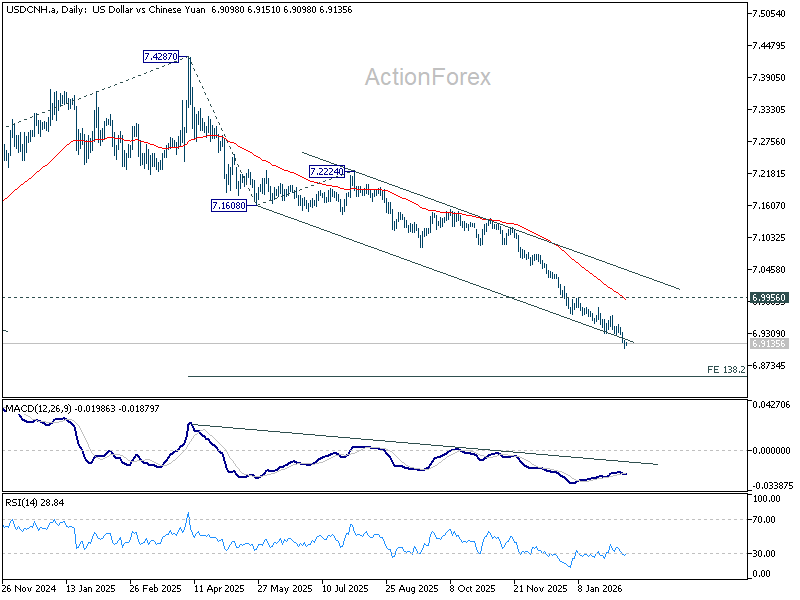
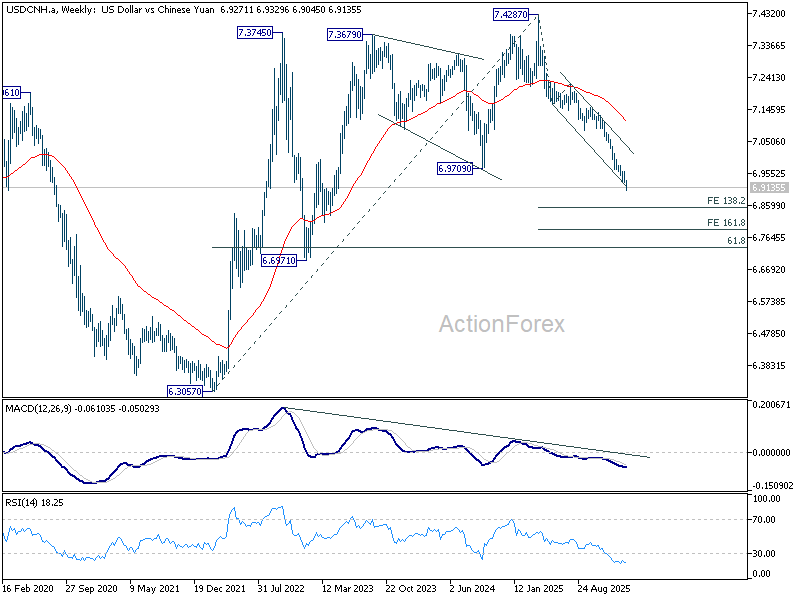
      USD/CNH (offshore Yuan), resumes recent decline and hits a seven month low after the news. It’s now heading back to 61.8% retracement of 6.2359 to 6.9804 at 6.5020.

      US-China trade talks extend through Sunday, no more MoUs

        US-China trade talks appeared to have made some important progress and are extended by two days through Sunday in Washington. In the Oval office while meeting Chinese Vice Premier Liu He, Trump said “we both feel there’s a very good chance a deal will happen.” He added that “both parties want to make this a real deal” and “we want to make this a deal that’s going to last for many, many years and a deal that’s going to be good for both countries.”

        The final deal would be signed off at a summit with Chinese President Xi Jinping and Trump said he hoped to meet with in the “not-too-distant future.”  The current March 1 trade truce deadline could be extended by another month. Meanwhile, the final agreement might extend beyond trade to encompass Chinese telecommunications companies Huawei Technologies and ZTE Corp. Treasury Secretary Steven Mnuchin said the summit is tentatively scheduled for late March at the Mar-a-Lago resort in Florida.

        Chinese Vice Premiere also said at the White House that there had been “great progress”. And, “from China, we believe that (it) is very likely that it will happen and we hope that ultimately we’ll have a deal. And the Chinese side is ready to make our utmost effort”. Later in a statement published by Xinhua, Liu said “the two countries have conducted fruitful negotiations and made positive progress in areas including the trade balance, agriculture, technology transfer, intellectual property protection, and financial services.”

        Both teams are now working on Trade Agreements directly, rather than Memorandum of Understandings, as Trump dislikes MoUs. The original idea was to have six MoUs covering  cyber theft, intellectual property rights, services, agriculture and non-tariff barriers to trade, including subsidies. It’s uncertain what the new structures of the agreement would be. Mnuchin also said both sides have made an agreement on currency, without details.

        YouTube

        By loading the video, you agree to YouTube’s privacy policy.
        Learn more

        Load video

        Fed Williams: Philips curve is alive and well

          New York Fed President John Williams said in a speech that the Philips curve is the “connective tissue” between the Fed dual mandate of maximum employment and price stability. It’s “alive and well” and remains an “empirical basis for forecasting and for monetary policy analysis.” He said he “wholeheartedly” agree that Fed “must not be complacent about inflation expectations becoming unmoored, whether at too high or too low a level.”

          He noted that Fed policymakers “must remain vigilant regarding a sustained takeoff in inflation.” That include the risk that “very tight labor markets could eventually lead to a resurgence of inflation and unmoor expectations, as in the 1960s.” But at the same time “We must be equally vigilant that inflation expectations do not get anchored at too low a level.” And the current “persistent undershoot of the Fed’s target risks undermining the 2 percent inflation anchor.”

          Full speech here.

          Canadian Dollar shrugs mixed retail sales, follows oil higher

            Canadian Dollar shrugs off mixed retail sales data, but follows oil prices higher. Headline retail sales dropped -0.1% mom in December versus expectation of -0.3% mom. Ex-auto sales dropped -0.5% mom versus expectation of -0.3% mom.

            WTI Crude oil’s rally resumes today and hits as high as 57.85 so far. Rise fro 42.05 is in progress and should target 61.8% projection of 42.05 to 55.85 from 51.49 at 60.01. For now, we’d continue to expect strong resistance around 60, which is close to 50% retracement of 77.06 to 42.05 at 59.55. 55 week EMA (now at 59.48). Upside should be capped there to bring near term reversal.

            German Ifo dropped to lowest since Dec 2014, economic situation remains weak

              German Ifo Business Climate dropped to 98.5 in February, down from 99.3 and missed expectation of 98.9. That’s also the lowest level since December 2014, and the sixth decline in a row. Expectations index dropped to 93.8, down from 94.2 and missed consensus of 94.2. Current Assessment index also dropped to 103.4, down from 104.3 and missed expectation of 103.9.

              Clemens Fuest, President of ifo Institute said “these survey results as well as other indicators point to economic growth of 0.2 percent in the first quarter. The economic situation in Germany remains weak.”

              Full release here.

              China denies banning Australian coal at Dalian ports

                Australian Dollar is lifted mildly after Chinese Ministry of Foreign Affairs spokesman Geng Shuang denied the report that Australian coal imports are banned by Dalian port. He said in a regular press briefing that china’s Australian coal imports continue as normal. Nevertheless, customs administration has stepped up environment and safety checks on foreign cargoes.

                Australia’s Minister for Trade, Simon Birmingham also said that “the application of those quotas combined with different testing and the quality assurance and environment is testing centres, may be slowing down the processing of costing data of coal in certain parts of China.” He added that “we have no basis to believe that there is a ban on Australian coal exports into China, or into any part of China.”

                Australian Prime Minister Scott Morrison also said “This is not the first time that on occasion local ports make decisions about these matters. “There is no evidence before me or us that would suggest it has the connotations that it has anything to do with anything more broadly than that. This happens from time to time.”

                According to Australian Bureau of Statistics, China is the largest buyer of Australian coal. Up to 89m tonnes were shipped last year, worth AUD 15B.

                Into European session: NZD weakest, AUD recovers

                  Entering into European session, New Zealand Dollar is the weakest one for today. RBNZ’s proposal to raise capital requirements for top banks apparent hurt sentiments towards the Kiwi. Such a move might tighten up financial conditions which eventually force the central bank to cut interest rates again. Yen is trading as the second weakest followed by Canadian. Rally in oil prices appear to be losing some momentum. Loonie will look into retail sales data today for renewed strength.

                  Australian is the strongest one for today, paring some of this week’s losses. Officials have been trying to talk down the importance of China Dalian port’s ban of Australian coal imports. Swiss Franc and Euro are the next strongest for now.

                  Over the week, Sterling is still the strongest one despite the lack of concrete breakthrough in Brexit impasse. Swiss Franc is the second strongest, followed by Euro. New Zealand Dollar, Australian Dollar and Yen are the worst performing ones.

                  In Asia:

                  • Nikkei closed down -0.18%.
                  • Hong Kong HSI is up 0.17%.
                  • China Shanghai SSE is up 1.62%.
                  • Singapore Strait Times is down -0.26%.
                  • Japan 10-year JGB yield is up 0.0018 at -0.038.

                  Overnight:

                  • DOW dropped -0.40%.
                  • S&P 500 dropped -0.35%.
                  • NASDAQ dropped -0.39%.
                  • 10-year yield rose 0.034 to 2.688

                  RBNZ to raise top banks’ capital requirement, might cut interest rate

                    New Zealand Dollar drops broadly today after RBNZ proposed to raise capital requirement for top banks of the country. Capital ratios would be increased to 16% of frisk-weighted assets. Combined the top four banks might need to raise NZD 20B over the next five years to meet the rule.

                    RBNZ Deputy Governor Geoff Bascand said the move would only lead to a “marginal tightening of monetary conditions”. But he added that the central could consider to loosen up monetary further is needed. Bascand said “when we set the OCR (Official Cash Rate), we set it with for a 18 month to 2 year look ahead. So let’s say we are making a decision in the third quarter of this year…we just have to feed that into our regular monetary policy decision making”. And, “if we were worried, and thinking we were undershooting inflation, undershooting maximum sustainable employment, then we would obviously look for an OCR change…that is the implication.”

                    AU FM Cormann: Dalian coal ban unrelated to bilateral relationship between Australia and China

                      Australian Dollar tumbles broadly yesterday on news that China’s Dalian port banned the countries’ coal import. But Australian offices are quick to talk down the implication. Mathias Cormann, Minister for Finance, said “when decisions like this have been made in the past at local port level, it was related to domestic supply related issues, environmental issues at a local level”. Cormann emphasized “it was unrelated with anything to do with the bilateral relationship between Australia and China.”

                      RBA Governor Philip Low said “I wouldn’t jump yet to the conclusion that this is something directed to Australia”. And, “It may well turn out to be that it’s being driven by concerns about the environment in China and the profitability of the coking coal industry in China.”

                      RBA Lowe: What’s of concern is accumulation of downside risks

                        RBA Governor Philip Lowe said today that the central scenario for 2019 is for growth of around 3%, inflation of around 2%and unemployment of around 5. And “this is not a bad set of numbers”. However, what is more of concern is the “accumulation of downside risks”.

                        The first major area of risks globally is “political risks” including US-China trade and technology tensions, Brexit, rise of populism and strains in some wester European countries. Second area of international risk is China slowdown. Domestically, RBA board has recently been paying “particularly close attention” to household spending and housing market. Lowe noted that ” underlying trend in consumption is softer than it earlier looked to be”. Decline housing prices could also affect overall spending.

                        On monetary policy, Lowe reiterated that “the probability that the next move is up and the probability that it is down are more evenly balanced than they were six months ago.”

                        Lowe’s full remarks here.

                        UK Barclay, Cox to meet EU Barnier again next week

                          There appears to be no breakthrough on Brexit for now. Brexit Minister Stephen Barclay and Attorney General Geoffrey Cox met EU chief Brexit negotiator Michel Barnier yesterday. They had “productive meeting” and discussed the “positions of both ides”. And it’s agreed that “talks should now continue urgently at a technical level”. Cox will explore “legal options” with the commission’s team. The trio will discuss again next week.

                          UK is seeking legal binding assurance that the Irish border backstop would be temporary if triggered. It’s believed that once this issue is solved, especially with the endorsement of Cox, the Brexit deal would get through the Commons. However, European Commission President Jean-Claude Juncker was “not very optimistic”. He noted that “in the British parliament every time they are voting, there is a majority against something, there is no majority in favor of something.”

                          US PMI composite rose to 8-month high, point to 2.5% annualized GDP growth

                            US PMI manufacturing dropped to 53.7 in February, down from 54.9 and missed expectation of 55.0. That’s the lowest in 17 months. PMI services, on the other hand, rose to 56.2, up from 54.2 and beat expectation of 54.3. That’s also the highest in 8-month. PMI composite rose to 55.8, up from 54.4, 8-month high.

                            Commenting on the flash PMI data, Tim Moore, Associate Director at IHS Markit said:

                            “February data provides a positive signal for first quarter economic growth, with US businesses reporting the fastest output expansion since the middle of 2018. Service sector firms led the way, supported by solid improvements in business and consumer spending. Private sector payroll numbers increased to the greatest extent for five months, which adds to hopes that robust domestic demand will act as a growth tailwind over the near-term.

                            “Historical comparisons suggest the latest survey data are indicative of an underlying economic growth rate of around 2.5% annualized, although the PMI is designed to monitor private sector companies so the impact of the government shutdown may not be fully captured.

                            “The main worrying development was the loss of momentum reported by manufacturing companies in February. Businesses that experienced a soft patch for production cited a range of factors holding back growth, including adverse weather, worries about the global economic outlook and ongoing international supply chain uncertainty.

                            “Nonetheless, relatively strong domestic business conditions mean that US manufacturers remain on a much more positive trajectory than the recent downbeat production trends signalled by IHS Markit’s Manufacturing PMI surveys across Europe and Asia.”

                            Full release here.

                            Also from the US, leading indicator dropped -0.1% in January. Existing home sales dropped to 4.94m annualized rate in January.

                            US initial claims dropped to 216k, but Dec durable goods missed

                              US headline durable goods orders rose 1.2% in December, below expectation of 1.8%. Ex-transport orders rose 0.1%, below expectation of 0.3% . Philadelphia Fed Business Outlook dropped to -4.1 in February, down from 17 and missed expectation of 14.8.

                              Initial jobless claims dropped -23k to 216k in the week ending February 16, between than expectation of 230k. Four-week moving average of initial claims rose 4k to 237.75k, highest since January 20, 2018. Continuing claims dropped -55k to 1.725M. Four-week moving average of continuing claims rose 2.75k to 1.755M.

                              Into US session: GBP and EUR strongest, AUD weakest

                                Entering into US session, Sterling is generally firm in tight range today, consolidating this week’s rally. UK and EU are working on an updated Brexit agreement, most likely with some legally firmer assurances outside of the main agreement. There is prospect of having another vote next week on February 27. Euro follows as the second strongest as PMI composite improved. But it should be noted that manufacturing did deteriorate while that’s offset by domestic strength in services only. ECB accounts provided nothing special.

                                On the other hand, Aussie is leading the way down, followed by Kiwi. Australian Dollar was firstly pressured as Westpac forecast two RBA cuts this year. Then, it suffered further selloff news that China’s Dalian port has banned imports of Australian coal. China’s foreign ministry spokesman Geng Shuang said the goals of the ban were to “better safeguard the legal rights and interests of Chinese importers and to protect the environment”.

                                A bunch of US data will be released today including Philly Fed survey, jobless claims, durable goods, PMIs, leading index and existing home sales. Traders will also want to know more about the multiple MOUs the US and China trade negotiation teams are working on.

                                In Europe, currently:

                                • FTSE is down -0.96%.
                                • DAX is up 0.12%.
                                • CAC is down -0.07%.
                                • German 10-year yield is up 0.0376 at 0.138.

                                Earlier in Asia:

                                • Nikkei rose 0.15%.
                                • Hong Kong HSI rose 0.41%.
                                • China Shanghai SSE dropped -0.34%.
                                • Singapore Strait Times dropped -0.01%.
                                • Japan 10-year JGB yield dropped -0.003 to -0.039.

                                ECB: Risk largely external but there were pass-through and spillovers

                                  In the accounts of January monetary policymeeting, ECB noted that “a stronger case could now be made for assessing the risks as having moved to the downside” In “large measure”, downside risks could be attributed to external environments including heightened protectionism and Brexit. But there were “pass-through and spillovers” to domestic demand.

                                  ECB also acknowledged that “slowdown in euro area growth appeared to be deeper and more broad-based than previously anticipated”. And, “negative developments had become more widespread across the euro area, and risked affecting several components of demand”. The slowdown has previously be related primarily to trade. But private consumption growth was weaker in Q3, and employment growth decelerated. ECB noted that “if exports and consumption were both weaker, this was likely to be transmitted to investment in the period ahead. ”

                                  All in all, “members concurred with the view that the risks to the euro area outlook had moved to the downside on account of the persistence of uncertainties related to geopolitical factors and the threat of protectionism, vulnerabilities in emerging markets and financial market volatility.” Outlook for economy would be “reassessed in more depth” in March meeting, when the new ECB staff projections would be available.

                                  Full ECB accounts here.


                                  UK Leadsom confirms schedule for next Brexit vote on Feb 27

                                    UK Leader of the House of Commons Andrea Leadsom confirmed to hold a vote on Brexit on Wednesday February 27. Prime Minister Theresa May will deliver a statement on Tuesday first. The vote will either be on an updated Brexit agreement, or on the other way ahead.

                                    Leadsom said “if the government has not secured a majority in this house in favor of a withdrawal agreement and a political declaration, the government will make a statement on Tuesday Feb. 26, and table an amendable motion relating to the statement and a minister will move that motion on Wednesday Feb. 27, thereby enabling the house to vote on it and any amendments to it on that day.”

                                    Fed Bullard: Monetary policy normalization is coming to and end

                                      St. Louis Fed President James Bullard said in a CNBC Squawk Box interview that Fed is already near the end of rate hikes and balance sheet rolloff. And, “the message from my point of view is the normalization process in the United States is coming to an end.”

                                      To him, interest rates are actually too high now. But this is a minority view in FOMC. He further explained that December rate hike was “a step too far” and he “argued against that Move”.

                                      After December’s hike, Bullard noted “a bad reaction in financial markets. I think the market started to think we were too hawkish, might cause a recession.”

                                      Eurozone PMIs: Eurozone to grow 0.1% in Q2, Germany 0.2%, France to stagnate

                                        Eurozone PMI manufacturing dropped to 49.2 in February, down from 50.5 and missed expectation of 50.3. That’s the lowest level in 69-month. PMI services, however, rose to 52.3, up from 51.2 and beat expectation of 51.3. PMI composite improved to 51.4, up from 51.0.

                                        Commenting on the flash PMI data, Chris Williamson, Chief Business Economist at IHS Markit said:

                                        “The Eurozone economy remained close to stagnation in February. The flash PMI lifted only slightly higher during the month, continuing to indicate one of the weakest rates of expansion since 2014. The survey data suggest that GDP may struggle to rise by much more than 0.1% in the first quarter.

                                        “Germany is on course to grow by 0.2%, buoyed by its service sector, but France looks set to stagnate or even contract very slightly. The rest of the region is meanwhile suffering its worst spell since late- 2013, with growth having slipped closer to stalling in February.

                                        “Some uplift was also seen as companies stepped up preparations ahead of Brexit and disruptions from the ‘yellow vest’ protests in France eased. However, the general picture remained one of a more subdued business environment than seen throughout much of last year.

                                        “Weaker order books were linked to a combination of intensifying headwinds and concerns, including global trade protectionism worries, Brexit, the downturn of the auto sector, increased political uncertainty and anxieties regarding the broader economic outlook. Rising risk aversion has consequently dampened demand, investment and spending.

                                        “The weakness is being led by manufacturing, which has now entered its first downturn since mid- 2013. With factory order books deteriorating at an increased rate, the rate of contraction in the goodsproducing sector will likely worsen in coming months.

                                        “Solid domestic demand in many countries, notably Germany, continued to help support service sector growth and offset the downturn of the manufacturing sector. However, the overall rate of service sector growth remained relatively moribund compared to that seen throughout much of last year.

                                        “Price pressures have meanwhile continued to ease alongside the more subdued demand environment.”

                                        Full release here.

                                        Germany PMIs: Manufacturing and services on very different paths

                                          Germany PMI manufacturing dropped to 47.6 in February, down from 49.7 and missed expectation of 49.9. That’ the lowest level in 74 months. PMI services, however, rose to 55.1, up from 53.0 and beat expectation of 52.9. PMI composite improved slightly to 52.7, up from 52.1.

                                          Commenting on the flash PMI data, Phil Smith, Principal Economist at IHS Markit said:

                                          “Germany’s manufacturing and service sectors remain on very different paths, according to February’s flash PMI data. While strong fundamentals in the domestic market are driving growth in services business activity, falling exports continue to weigh on the performance of the manufacturing sector. Measured overall, the data remain indicative of a very modest rate of underlying output growth.

                                          “The manufacturing PMI fell further into contractionary territory in February to its lowest in over six years, with sustained robust job creation at factories the only positive takeaway. The strength in employment is perhaps surprising given the order book situation and lack of pressures on capacity, but goods producers are seemingly looking through the current soft patch in demand.

                                          “In terms of the factors behind the slowdown in manufacturing order books, many of the usual suspects – the uncertainty relating to US-China trade tensions and weakness in the autos industry – were highlighted, although there were also reports of growing competitive pressures within Europe.”

                                          Full release here.