RBA downgrades growth and inflation forecast, cites increased risks

    Australian Dollar jumps after RBA left cash rate unchanged at 1.50% as widely expected. The conclusion of the statement was kept totally unchanged. And most importantly, RBA maintained “further progress in reducing unemployment and having inflation return to target is expected, although this progress is likely to be gradual.”

    There are some dovish tweaks in the statement, including mentioning of increased risks, downgrade of growth and inflation forecasts. But for now, the statement still suggests the next move is a hike rather than a cut. Just that it may take longer to happen.

    Globally, RBA said growth “remains reasonable” but “downside risks have increased”. In particular “trade tensions are affecting global trade and some investment decisions”. Headline inflation also “moved lower” due to fall in oil prices. Regarding financial markets, RBA also noted government bond yields have declined in most countries including Australia. Australia’s terms of trade are “expected to decline over time”

    Domestically, RBA expects Australian economy to growth by around 3% in 2019 and a little less in 2020. That’s a downward revision from prior expectation of growth at 3.5% in 2019. Further than that, RBA acknowledged weaker than expected growth in Q3 and said “some downside risks have increased”. And, “the main domestic uncertainty remains around the outlook for household spending and the effect of falling housing prices in some cities.”

    On inflation, RBA now expects underlying inflation to hit 2% in 2019 and 2.25% in 2020. Headline inflation is also expected to decline in the near term due to petrol prices. That’s also a downgrade as in previously, RBA expected inflation to hit 2.25% in 2019 and a bit higher in 2020.

    Full statement below.

    Statement by Philip Lowe, Governor: Monetary Policy Decision

    At its meeting today, the Board decided to leave the cash rate unchanged at 1.50 per cent.

    The global economy grew above trend in 2018, although it slowed in the second half of the year. Unemployment rates in most advanced economies are low. The outlook for global growth remains reasonable, although downside risks have increased. The trade tensions are affecting global trade and some investment decisions. Growth in the Chinese economy has continued to slow, with the authorities easing policy while continuing to pay close attention to the risks in the financial sector. Globally, headline inflation rates have moved lower due to the decline in oil prices, although core inflation has picked up in a number of economies.

    Financial conditions in the advanced economies tightened in late 2018, but remain accommodative. Equity prices declined and credit spreads increased, but these moves have since been partly reversed. Market participants no longer expect a further tightening of monetary policy in the United States. Government bond yields have declined in most countries, including Australia. The Australian dollar has remained within the narrow range of recent times. The terms of trade have increased over the past couple of years, but are expected to decline over time.

    The central scenario is for the Australian economy to grow by around 3 per cent this year and by a little less in 2020 due to slower growth in exports of resources. The growth outlook is being supported by rising business investment and higher levels of spending on public infrastructure. As is the case globally, some downside risks have increased. GDP growth in the September quarter was weaker than expected. This was largely due to slow growth in household consumption and income, although the consumption data have been volatile and subject to revision over recent quarters. Growth in household income has been low over recent years, but is expected to pick up and support household spending. The main domestic uncertainty remains around the outlook for household spending and the effect of falling housing prices in some cities.

    The housing markets in Sydney and Melbourne are going through a period of adjustment, after an earlier large run-up in prices. Conditions have weakened further in both markets and rent inflation remains low. Credit conditions for some borrowers are tighter than they have been. At the same time, the demand for credit by investors in the housing market has slowed noticeably as the dynamics of the housing market have changed. Growth in credit extended to owner-occupiers has eased to an annualised pace of 5½ per cent. Mortgage rates remain low and there is strong competition for borrowers of high credit quality.

    The labour market remains strong, with the unemployment rate at 5 per cent. A further decline in the unemployment rate to 4¾ per cent is expected over the next couple of years. The vacancy rate is high and there are reports of skills shortages in some areas. The stronger labour market has led to some pick-up in wages growth, which is a welcome development. The improvement in the labour market should see some further lift in wages growth over time, although this is still expected to be a gradual process.

    Inflation remains low and stable. Over 2018, CPI inflation was 1.8 per cent and in underlying terms inflation was 1¾ per cent. Underlying inflation is expected to pick up over the next couple of years, with the pick-up likely to be gradual and to take a little longer than earlier expected. The central scenario is for underlying inflation to be 2 per cent this year and 2¼ per cent in 2020. Headline inflation is expected to decline in the near term because of lower petrol prices.

    The low level of interest rates is continuing to support the Australian economy. Further progress in reducing unemployment and having inflation return to target is expected, although this progress is likely to be gradual. Taking account of the available information, the Board judged that holding the stance of monetary policy unchanged at this meeting would be consistent with sustainable growth in the economy and achieving the inflation target over time.

    EU Selmayr: Nobody is considering tweak on Irish backstop

      European Commission Secretary-General Martin Selmayr denied reports that the EU is considering tweaks on the Irish Backstop in Brexit Withdrawal Agreement. He tweeted that “On the EU side, nobody is considering this. Asked whether any assurance would help to get the Withdrawal Agreement through the Commons, the answers of MPs were inconclusive.” And he added that “the meeting confirmed that the EU did well to start its no deal preparations in December 2017.”

      Ireland’s Foreign Minister Simon Coveney also said he had heard of no “alternative arrangements” on Irish backstop that would work. He said “the problem has been that none of those ideas around alternative arrangements have actually stood up to scrutiny. We certainly haven’t seen any that have”. He added that “We spent well over a year looking at different ways of providing the guarantee of no physical border infrastructure on the island of Ireland to protect an all Ireland economy which reinforces a peace process. Many hours were involved with coming up with a legally credible and pragmatic solution,”

      And Coveny said, “I have yet to hear any new thinking that goes beyond what’s already been tested. What Ireland is being asked to do by some in Westminster is to essentially do away with an agreed solution between the UK government and EU negotiators and to replace it with wishful thinking. That is a very unreasonable request to ask the Irish government to be flexible on.”

      Into US session: Dollar strongest as recovery continues, Euro shrugs weak data

        Entering into US session, Dollar remains the strongest one for today as recovery continues. The second place is taken up by Euro, despite weak Sentix Investor Confidence and PPI. Canadian Dollar also remains firm as WTI crude oil edges higher to 55.85. Nevertheless, oil price is suffering some profit taking currently, which oil drags down the Loonie.

        Meanwhile, Australian Dollar is the weakest one for today, weighed down by poor housing data. Focus will turn to tomorrow’s RBA rate decision. No change in interest rate is expected. But RBA could give some hints on revisions on economic projections. Details will be published with the Statement on Monetary Policy on Friday. Yen is following as the second weakest, then Sterling.

        In European markets:

        • FTSE is up 0.28%.
        • DAX is down -0.16%.
        • CAC is down -0.53%.
        • German 10-year yield is down -0.001 at 0.166, staying far below 0.2 handle.

        Earlier in Asia:

        • Nikkei rose 0.46%.
        • Hong Kong HSI rose 0.21%.
        • China started lunar new year holiday already.
        • Singapore Strati Times dropped -0.13%.
        • Japan 10-year JGB yield rose 0.008 to -0.012, staying negative.

        ECB Nowotny: No perspective of a Eurozone recession

          ECB Governing Council member Ewald Nowotny said on the sidelines of a conference today that growth uncertainty in the Eurozone has increased. However, the economy is only going through a slow down. He’s optimistic that “we’ll be able to overcome these negative influences”. And more importantly, “there is no perspective of a recession.” He also noted positives signs in underlying inflation due to rising wages.

          Separately, Executive Board member Yves Mersch said “the best solution is to integrate financial stability concerns into monetary policy at the European level – including possible corrections with instruments at national levels.” However, he’s doubtful on a Eurozone wide authority to deal with stability. He said “I doubt that adding an additional European layer without a clear view of who is in charge with what instruments and for what objective will advance the issue”. And, “the time is not ripe for an operationalized standalone macroprudential approach.”

          UK PMI construction dropped to 50.6, growth shifted down a gear

            UK PMI construction dropped to 50.6 in January, down from 52.8 and missed expectation of 52.6. That’s the slowest rise in business activity for ten months. Also, commercial work remains weakest performing area and employment growth hits two-and-a-half year low

            Tim Moore, Economics Associate Director at IHS Markit, which compiles the survey:

            “UK construction growth shifted down a gear at the start of 2019, with weaker conditions signalled across all three main categories of activity. Commercial work declined for the first time in ten months as concerns about the domestic economic outlook continued to hold back activity. The latest survey also revealed a loss of momentum for house building and civil engineering, although these areas of the construction sector at least remained on a modest growth path.

            “Staff recruitment slowed to a crawl in January, with construction firms reporting the softest rate of job creation since July 2016. Delays to client decision making on new projects in response to Brexit uncertainty was cited as a key source of anxiety at the start of 2019. Difficulties converting opportunities to sales were reflected in a slowdown in total new business growth to its lowest since last May.

            “Business expectations for the year ahead slipped to a three-month low and remained subdued in comparison to historic trends in January. Positive sentiment towards the outlook for civil engineering work remains a key factor helping to support business sentiment across the construction sector, according to survey respondents.”

            Full release here.

            Eurozone Sentix investor confidence: Growth forces weakening dangerously quickly and strongly

              Eurozone Sentix Investor Confidence dropped to -3.7 in February, down from -1.5 and missed expectation of -1.1. That’s the sixth decline in a row and the lowest level since November 2014. Current situation index dropped to 10.8, down from 18.0. That’s also the sixth decline in a row and lowest since December 2016. Expectations index, however, improved from -19.3 to -17.3.

              Sentix noted that “the bad news for the economy in Euroland is not abating.” And, “at the current edge the growth forces seem to be weakening dangerously quickly and strongly.” The main reason for the development was likely the approaching Brexit. And, “The economy now has to deal with the contingency plans in view of the unresolved political situation. Many companies exposed to UK-EU trade are currently not aiming for growth; they would probably be satisfied with stable business in the coming months.”

              Full release here.

              Into European session: Dollar paring recent losses, Aussie tumbles on housing data

                Entering into European session, Dollar is trading broadly higher, recovery some of last week’s losses. Minneapolis Fed President Neel Kashkari urged not to tap the break prematurely with more rate hikes. But that prompted little reactions as Fed’s “patient” stance is now commonly known. New Zealand Dollar is the second strongest, followed by Canadian.

                On the other hand, Yen and Australian Dollar are the weakest, followed by Swiss Franc. The stock markets are rather quite today as lunar new year is approaching. Indeed, China is already on holiday. Slight rally in stocks is pressing Yen and Swiss Franc. Aussie, on the other hand, is weighed down by poor housing data, which daw dwelling approvals contracted sharply in December.

                In other markets:

                • Nikkei closed up 0.46%.
                • Hong Kong HSI is up 0.21%.
                • Singapore Strait Times is down -0.13%.
                • Japan 10-year JGB yield is up 0.0096 at -0.0011, staying negative.

                China Caixin PMI dropped to 50.9, hard to turn around without strong stimulus

                  China Caixin PMI services dropped to 53.6 in January, down from 53.9 but beat expectation of 53.3. PMI composite dropped to 50.9, down from 52.2. Caixin noted that “services activity continues to rise solidly, but manufacturing sector remains subdued”, “new orders rise only slightly, despite rebound in export sales”, “overall employment stabilises”.

                  Commenting on the China General Services PMI™ data, Dr. Zhengsheng Zhong, Director of Macroeconomic Analysis at CEBM Group said:

                  “The Caixin China General Services Business Activity Index came in at 53.6 in January, down slightly from the previous month. Demand for services remained solid as the increase in new business accelerated marginally. The sub-index of employment rose, pointing to a faster expansion of payroll number at service providers. The fall in the input prices sub-index was quicker than the decline seen for the prices charged sub-index, which helped ease the pressure on companies’ profit margins. However, the sub-index of business expectations declined from the previous month, indicating services providers’ weakening confidence in the outlook of their operation for the coming 12 months.

                  “The Caixin China Composite Output Index fell from the previous month to 50.9 in January. The increase in new orders softened while new export business rose for the first time after dropping for nine consecutive months. That suggested the downward pressure on domestic demand was growing while external demand was holding up. The sub-index of employment rebounded to the break-even point of 50 after staying in contraction territory for seven straight months, underlining that government efforts to stabilize employment have taken effect. The sub-indices of input prices and output prices both went down, while the sub-index of future output, which reflects business confidence, edged up for the second month in a row.

                  “Overall, China’s economic growth was weighed on by weakening domestic demand in January, although exports improved marginally as the Sino-U.S. trade negotiations flagged signs of progress. The effects of China’s policies to support domestic demand and the development of the trade war between the country and the U.S. will remain key to the prospects of the Chinese economy. Given that the government has refrained from taking policies of strong stimulus, the downward trend of the economy may be hard to turn around for the time being.”

                  Full release here.

                  UK PM May, armed with fresh mandate, to go back to EU with pragmatic Brexit solution

                    UK Prime Minister Theresa May said she is seeking a “pragmatic solution” for the Brexit withdrawal agreement. She wrote in The Sunday Telegraph that ” with changes to the Northern Ireland backstop, they would support the deal that I agreed with Brussels to take us out of the EU”. And, “when I return to Brussels I will be battling for Britain and Northern Ireland, I will be armed with a fresh mandate, new ideas and a renewed determination to agree a pragmatic solution that delivers the Brexit the British people voted for.”

                    May’s office also said that the government is establishing an “Alternative Arrangements Working Group” to work on alternative arrangement to the Irish border backstop arrangement. Brexit Minister Stephen Barclay will lead the group involving pro-Brexit lawmakers Steve Baker, Marcus Fysh and Owen Paterson, as well as pro-EU Conservatives Damian Green and Nicky Morgan. The first meeting will start today.

                    Trade Minister Liam Fox said EU would be irresponsible if they insist on refusing to reopen negotiation. He told Sky News that “are they really saying that they would rather not negotiate and end up in a ‘no-deal’ position?” And, “it is in all our interests to get to that agreement and for the EU to say we are not going to even discuss it seems to me to be quite irresponsible.”

                    Fed Kashkari: Let’s not tap the brakes prematurely

                      Minneapolis Fed President Neel Kashkari said the US economy is “fundamentally healthy”. While “we at the Fed cannot control if Europe has a crisis, or if China has a hard landing”, “we can control our own mistakes”. He added that ” if we can avoid tapping the brakes prematurely, I think the expansion can continue.”

                      Kashkari also noted that”let’s let the economy continue to strengthen and if we see signs then, wages pick up, inflation picks up, we can always tap the brakes then; let’s just not tap the brakes prematurely.”

                      ISM manufacturing rose to 56.6, reversing December’s weak expansion

                        US ISM manufacturing rose to 56.6 in January, up from 54.1 and beat expectation of 54.3. Price paid index dropped to 49.6, below expectation of 58.0. Employment component dropped slightly to 55.5. Of the 18 manufacturing industries, 14 reported growth.

                        ISM noted that “Comments from the panel reflect continued expanding business strength, supported by strong demand and output. Demand expansion improved with the New Orders Index reading returning to the high 50s, the Customers’ Inventories Index remaining too low, and the Backlog of Orders remaining at a near-zero-expansion level. Consumption continued to strengthen, with production expanding strongly and employment continuing to expand at previous-month levels. Inputs — expressed as supplier deliveries, inventories and imports — continued to improve, but are negative to PMI® expansion. Inputs reflect an easing business environment, confirmed by Prices Index contraction.

                        “Exports continue to expand, but at the lowest level since the fourth quarter of 2016. Prices contracted for the first time since the first quarter of 2016. The manufacturing sector continues to expand, reversing December’s weak expansion, but inputs and prices indicate fundamental changes in supply chain constraints.”

                        Full release here.

                        NFP grew 304k… but wage growth missed, unemployment rate rose

                          Dollar shows rather little reactions to non-farm payroll report. It spikes initial on very strong headline number. But the greenback is quickly pare the little gains as the overall set of data is just mixed. In particular, wage growth is rather disappointing.

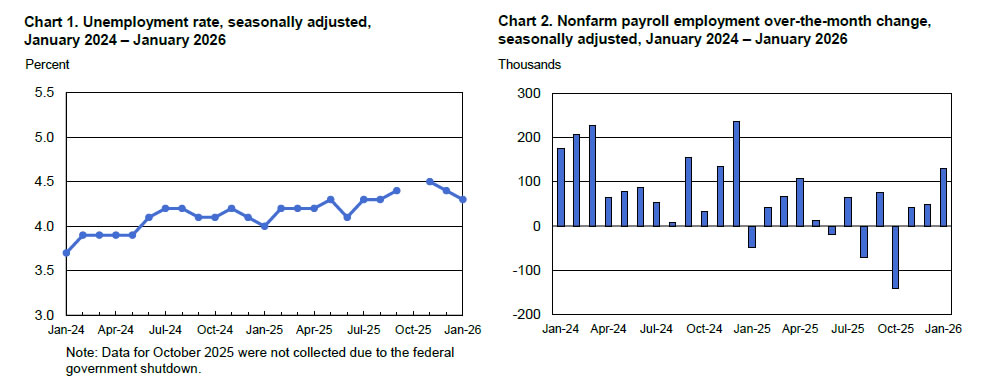
                          US non-farm payroll grew 304k in January, well above expectation of 165k. However, prior month’s figure was revised sharply down from 312k to 222k. Unemployment rate rose to 4.0% versus expectation of 3.8%. But labor force participation rate also rose to 63.2%, up from 63.1%. Wage growth is a clear miss with average hourly earnings rose 0.1% mom versus expectation of 0.3% mom.

                          Full release here.

                          Eurozone CPI slowed to 1.4%, but core edged up to 1.1%

                            Eurozone CPI slowed to 1.4% yoy in January, down from 1.6% yoy, matched expectation. Core CPI, rose to 1.1% yoy, up from 1.0% yoy and beat expectation of 1.0% yoy.

                            Looking at the main components of euro area inflation, energy is expected to have the highest annual rate in January (2.6%), followed by food, alcohol & tobacco (1.8%), services (1.6%) and non-energy industrial goods (0.3%).

                            Full release here.

                            UK PMI manufacturing dropped to 52.8, stocks up on Brexit preparations

                              UK PMI manufacturing dropped to 52.8 in January, down from 54.2 and missed expectation of 53.5. That’s also a 3-month low. Markit noted that “stocks of purchases rise at survey-record rate”. And, “employment falls for only the second time in past 30 months”.

                              Rob Dobson, Director at IHS Markit, which compiles the survey:

                              “The start of 2019 saw UK manufacturers continue their preparations for Brexit. Stocks of inputs increased at the sharpest pace in the 27-year history, as buying activity was stepped up to mitigate against potential supply-chain disruptions in coming months. There were also signs that inventories of finished goods were being bolstered to ensure warehouses are well stocked to meet ongoing contractual obligations.

                              “Despite the temporary boost provided by clients’ prepurchases and efforts to build-up stocks, the underlying trends in output and new orders remained lacklustre at best. Growth of new order inflows slowed sharply, and new export orders were near-stagnant, contributing to the weakest trend in output since the month following the EU referendum (July 2016). Based on its historical relationship against official data, the January survey is consistent with a further solid contraction of production volumes, meaning manufacturing will likely act as a drag on the economy in the first quarter.

                              “January also saw manufacturing jobs being cut for only the second time since mid-2016 as confidence about the outlook slipped to a 30-month low, often reflecting ongoing concerns about Brexit and signs of a European economic slowdown. With neither of these headwinds likely to abate in the near-term, there is a clear risk of manufacturing sliding into recession.”

                              Full release here.

                              Ireland: UK needs a purpose for Article 50 extension

                                Ireland’s Europe Minister Helen McEntee said today that UK’s Article 50 extension, if sought, will need to have a purpose. She said “If they were to ask for an extension I think it would be approved … but there is no point in looking for an extension if we end up back to the same place as we are now in three months’ time”.

                                Austrian Foreign Minister Karin Kneissl now said “there are lots of signs that indicate a hard Brexit.” And, she added “that is my estimation”.

                                Eurozone PMI manufacturing finalized at 50.5, adds to likelihood of recession

                                  Eurozone PMI manufacturing was finalized at 50.5 in January, unrevised, down from December’s 51.4. It’s the six consecutive months of decline and the lowest level since November 2014. Markit noted that “output up marginally, but sharpest fall in new work recorded since April 2013”. Also, “growth sustained via reduction in backlogs and fastest accumulation of stocks in survey history”.

                                  Among the countries, Italy PMI manufacturing hit 47.8, a 68-month low. Germany reading was also in contraction at 49.7, a 50-month low. Franc reading recovered mildly to 3-month high of 51.2. But Ireland reading hit 27-month low, Austria reading hit 29-month low and the Netherlands reading hit 28-month low.

                                  Commenting on the final Manufacturing PMI data, Chris Williamson, Chief Business Economist at IHS Markit said:

                                  “The January PMI adds to the likelihood that the manufacturing sector is in recession and will act as a drag on the economy in the first quarter.

                                  “Some temporary factors remain evident, including an auto sector that is struggling to regain momentum after new emissions regulation and some signs of ‘yellow vest’ disturbances dampening demand in France. However, there appears to be a more deep-rooted malaise setting in, which reflects widespread concerns about the destabilising effect of political uncertainty and the damage to exports from rising trade protectionism.

                                  “Worryingly, weaker than anticipated sales mean warehouses are filling up with unsold stock at a rate not previously recorded over the two decades of prior survey history, suggesting firms will need to cut operating capacity in coming months unless demand revives, boding ill for future production growth.

                                  “While there is some evidence that firms are hoarding labour in the hope of sales picking up again, and business optimism did perk up from December’s six-year low, jobs growth is starting to deteriorate as increasing numbers of firms seek to cut costs and raise productivity. Any such downturn in the labour market will in turn potentially drive consumer sentiment lower, and adds further to the risk that economic growth will continue to slow in coming months.”

                                  Full release here.

                                  Into European Session: Dollar regains some ground, commodity currencies weak

                                    Entering into European session, Dollar continues to pare back post FOMC losses and is trading as the strongest for today. The boost from Fed’s dovish turn on equities was rather brief. Yen follows as the second strongest as overall market sentiments turned mixed. On the other hand, commodity currencies turned lower, as lead by Australian Dollar, after poor manufacturing data from China.

                                    The two-day US-China trade talks ended without anything concrete, expect China’s pledge to buy 5M tons of soybeans per day. The demand on enforcement of the agreement was emphasized throughout. And China seemed to have listened. But even Trump admitted it’s not yet at the stage to set up a meeting with Chinese Xi to seal the deal yet. The next milestone will be USTR Lighthizer’s visit to Beijing after Chinese New Year. For now, Dollar and stocks will turn to today’s non-farm payroll first.

                                    For the week, Sterling is the weakest one on Brexit uncertainty. The EU, Britons and the markets are awaiting UK’s alternative proposals on Irish backstop. Swiss Franc is the second weakest. Despite today’s pull back, commodity currencies are the strongest ones this week together with Yen.

                                    In Asia,

                                    • Nikkei closed up 0.07% at 20788.39.
                                    • Hong Kong HSI is down -0.21%.
                                    • China Shanghai SSE is up 1.30%.
                                    • Singapore Strait Times is down -0.02%.
                                    • Japan 10-year JGB yield is down -0.0188 to -0.016.

                                    Overnight,

                                    • DOW dropped -0.06%.
                                    • S&P 500 rose 0.86%.
                                    • NASDAQ rose 1.37%.

                                    Long term US treasury yields tumbled sharply.

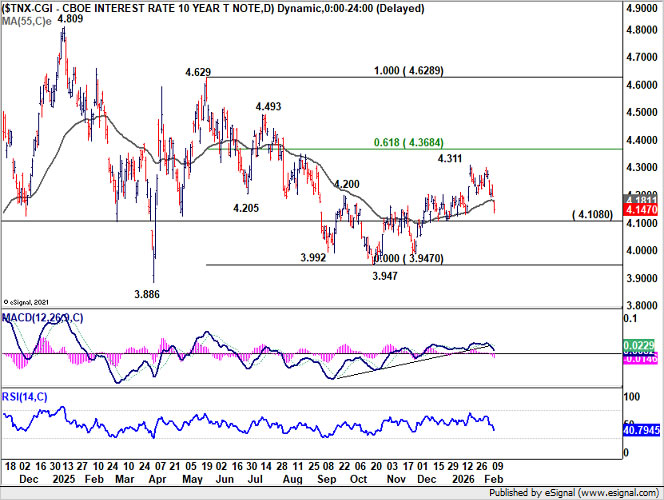
                                    • 10-year yield dropped -0.60 to 2.635, moved further away from 2.7 handle.
                                    • 30-year yield dropped -0.048 to 3.005, threatening 3.0 handle.

                                    China Caixin PMI manufacturing dropped to 48.3, no significant effect from countercyclical economic policy

                                      China Caixin PMI manufacturing dropped to 48.3 in January, down from 49.7 and missed expectation of 49.7. That’s the lowest reading since February 2016 and points to continued softening in the health of China’s manufacturing sector. Markit also noted that underlying trend in production weakens. Export sales increase slightly, but overall new work softens. Though, a positive note is that business confidence rose to eight-month high.

                                      Commenting on the China General Manufacturing PMI™ data, Dr. Zhengsheng Zhong, Director of Macroeconomic Analysis at CEBM Group said:

                                      “The Caixin China General Manufacturing PMI fell further to 48.3 in January, the lowest since February 2016.

                                      “The subindex for new orders dipped further into contractionary territory, pointing to a moderate contraction in demand across the manufacturing sector. Yet the gauge for new export orders rose notably above the 50 level, the dividing line that separates contraction from expansion, reaching its highest point since March 2018, showing that companies’ export orders have obviously rebounded since the truce in the China-U.S. trade war.

                                      “The output subindex dropped, highlighting the drag effect of softer demand on production. The employment subindex continued to rise moderately despite staying in negative territory, which could be due to the effect of government policies to stabilize the job market. The measure for stocks of finished goods fell into contractionary territory, while the subindex for stocks of purchased items dropped further, suggesting that manufacturers tended to reduce their inventories. The subindex for suppliers’ delivery times returned to negative territory, indicating that pressure on capital turnover, though less than in the months before December, still existed.

                                      “Both gauges for input costs and output charges dropped only slightly. While companies have reduced their inventories, prices of domestic industrial products have since the start of the month recovered some of the losses seen in December. We expect that year-on-year growth in the producer price index is likely to slide closer to zero.

                                      “On the whole, countercyclical economic policy hasn’t had a significant effect. While domestic manufacturing demand shrank, external demand turned positive and became a bright spot amid positive progress in Sino-U.S. trade talks. As companies were more willing to reduce their inventories, their output declined, indicating notable downward pressure on China’s economy. China is likely to launch more fiscal and monetary measures and speed up their implementation. Yet the stance of stabilizing leverage and strict regulation hasn’t changed, which means the weakening trend of China’s economy will continue.”

                                      Full release here.

                                      Full release in simplified Chinese.

                                      Japan PMI manufacturing finalized at 29-month low, bad news for global trade cycle

                                        Japan PMI manufacturing was finalized at 50.3 in January, revised up from 50.0. But that’s still the lowest level in 29 months. And, new export orders decline at sharpest pace since July 2016. Also, business confidence falls for the eighth month running.

                                        Commenting on the Japanese Manufacturing PMI survey data, Joe Hayes, Economist at IHS Markit, which compiles the survey, said:

                                        “Japan Manufacturing PMI data brought bad news for the global trade cycle at the start of 2019, with new export orders falling at the sharpest rate in two-and-a-half years. Anecdotal evidence suggested that sales of goods relating to semi-conductors had particularly suffered, which bodes ill for other Asian exporters. Meanwhile, domestic markets also showed signs of frailty as total demand declined for the first time since September 2016.

                                        “With Abe set to levy the consumption tax this year, and Sino-US trade tensions still lurking, domestic weakness in Japan further adds to already existing challenges. Business sentiment continued to drop, with survey data registering an eighth straight month where confidence has slipped. Falling inventories and cut backs to production suggest that manufacturers are bracing for further economic difficulty.”

                                        Full release here.

                                        Also from Japan, jobless rate dropped to 2.4% in December, below expectation of 2.5%.

                                        Trump: Not quite at the stage to meet Xi to seal trade deal yet

                                          Trump met with Chinese Vice Premier Liu He in the oval office yesterday as the two-day top level US-China trade talks concluded. Trump said in during the meeting that “we’re not quite at that stage yet”, referring to the meeting with Chinese President Xi JinPing. He noted the representatives of both sides were “coming to a conclusion, except for certain very important points.” When he and Xi meets, “we want to have it down so that we have certain points that we can discuss and, I would say, agree to.” For now the meeting wasn’t set up yet.

                                          Nevertheless, Trump hailed that Liu’s promise to buy five millions tons of soybeans per days. He said ” it really is a sign of good faith for China to buy that much of our soybeans and other product that they’ve just committed to us prior to the signing of the deal — is something that makes us very proud to be dealing with them.”

                                          On the March 1 negotiation dead line, Trump said it has stayed and “we haven’t talked about extending the deadline.” But he added that “at a certain point, you’re going to have — this is a very complex, and a very large — it’s the largest transaction ever made, to be perfectly straight.” Regarding Huawei’s case Trump said “it will be discussed” at some point. And it’s “very small compared to the overall deal, but that will be discussed.”

                                          US Trade Representative Robert Lighthizer reiterated in the meeting that ” We focused on the most important issues, which are the structural issues and the protection of U.S. intellectual property, stopping forced technology transfer, intellectual property protection, agriculture and services issues, and enforcement, enforcement, enforcement.” And, “both sides agree this agreement is worth nothing — if we can get an agreement, it’s worth nothing without enforcement.” Lighthizer will go to China shortly, after Chinese Year Year.

                                          During the meeting, Liu also noted the need to establish three key themes, including “enforcement or implementation.”

                                          Full transcript of the meeting.

                                          White House statement after the meeting.