US PMI composite falls to 9-mth low, optimism holds despite slowing growth and rising costs

    US PMI data for January painted a mixed picture. PMI Manufacturing rose from 49.4 to 50.1, reaching a seven-month high and signaling a return to slight expansion. However, PMI Services dropped sharply from 56.8 to 52.8, a nine-month low, dragging PMI Composite down from 55.4 to 52.4, also a nine-month low.

    Chris Williamson, Chief Business Economist at S&P Global Market Intelligence, highlighted that US businesses are starting 2025 in an “upbeat mood,” with optimism about the new administration driving stronger economic growth. Despite the slowdown in output growth, “sustained confidence” among businesses suggests this deceleration may be temporary. Encouragingly, hiring has surged, with job creation reaching its fastest pace in two and a half years, signaling resilience in the labor market.

    However, inflationary pressures are resurfacing, posing risks to the economic outlook. Companies have reported “supplier-driven price hikes” and “wage growth amid poor staff availability.” Inflation in input costs and selling prices has been “broad-based across goods and services,” which, if sustained, could fuel concerns about hawkish policy approach from the Fed.

    Full US PMI flash release here.

    UK PMI composite edges higher to 50.9, but stagflation risks cloud economic outlook

      UK PMI Composite rose slightly from 50.4 to 50.9 in January, indicating marginal growth. Manufacturing PMI improved from 47.0 to 48.2, while services PMI ticked up from 51.1 to 51.2. Despite these increases, the overall outlook remains gloomy, with underlying concerns about economic weakness and inflationary pressures persisting.

      Chris Williamson, Chief Business Economist at S&P Global Market Intelligence, warned that the data “add to the gloom” surrounding the UK economy.

      Companies are cutting jobs at the fastest rate since the global financial crisis in 2009, reflecting falling sales and bleak business prospects. Business optimism remains at its lowest levels in two years, accompanied by subdued activity across sectors.

      Inflationary pressures have also “reignited,” creating what Williamson described as a “stagflationary environment” and a “policy quandary” for BoE.

      Full UK PMI flash release here.

      Eurozone PMI composite hits 50.2 as Germany returns to growth

        Eurozone PMI data for January showed cautious improvement, with PMI Composite rising from 49.6 to 50.2, a five-month high, signaling a return to marginal growth. Manufacturing PMI increased to 46.1, its highest in eight months, while services PMI slipped slightly to 51.4 but remained in expansion.

        Germany led the improvement, with its PMI Composite climbing from 48.0 to 50.1, marking a seven-month high and a return to expansionary territory. Meanwhile, France lagged behind, with its PMI Composite increasing to 48.3 but remaining below the 50 threshold, indicating continued contraction.

        Cyrus de la Rubia, Chief Economist at Hamburg Commercial Bank, described the data as “mildly encouraging.” He noted that the private sector had entered a phase of cautious growth, with reduced drag from manufacturing and moderate expansion in services. Germany’s strong rebound played a key role in offsetting the continued weakness in France.

        Inflationary pressures, however, remain a concern ahead of next week’s ECB meeting. Input prices in manufacturing rose for the first time in four months, driven by a weaker euro and Germany’s increased CO2 tax. In the services sector, cost inflation persisted, largely due to higher wages. Selling prices in services also remained elevated.

        Due to persistent inflation risks and the fragile state of the economy, ECB is likely stick to its gradual pace of cutting interest rates.

        Full Eurozone PMI flash release here.

        BoJ delivers expected rate hike, upgrades core inflation forecasts

          BoJ raised its uncollateralized overnight call rate by 25bps to 0.50% as widely expected, marking the highest level since 2008. The decision, made by an 8-1 vote, saw dissent from board member Nakamura Toyoaki, who advocated for a delay until March.

          In the new economic projections, core CPI forecasts were significantly revised upward from 1.9% to 2.4% for fiscal 2025, and slightly from 1.9% to 2.0% for fiscal 2026. Core-core CPI (excluding energy and fresh food) forecast was also raised from 1.9% to 2.1% for fiscal 2025, remaining unchanged at 2.1% for fiscal 2026. Real GDP growth projections were left steady at 1.1% for fiscal 2025 and 1.0% for fiscal 2026.

          At the post-meeting press conference, Governor Kazuo Ueda downplayed the sharp inflation forecast revisions, stating, “The rise in underlying inflation is moderate. I don’t think we are seriously behind the curve in dealing with inflation.”

          He reiterated the importance of a gradual approach to policy adjustments, and there no “preset idea” on the timing and pace of rate hikes. He also highlighted the estimated neutral range of 1%-2.5%, emphasizing that the current rate of 0.5% still has “some distance” to reach neutral.

          Also released, CPI core (ex-food) jumped from 2.7% yoy to 3.0% yoy in December, marking the highest rate in 16 months. CPI core-core (ex-food & energy) was unchanged at 2.4% yoy. Headline CPI rose from 2.9% yoy to 3.6% yoy.

          Full BoJ statement and outlook for economic and prices.

          Canada’s retail sales stagnate in Nov as core sales down -1% mom

            Canada’s retail sales were flat in November, falling short of the expected 0.2% mom increase. The data revealed mixed performance across sectors, with declines in six out of nine subsectors.

            Sales at food and beverage retailers dropped by -1.6% mom, driving much of the weakness in the report. However, gains in motor vehicle and parts dealers (+2.0% mom) and gasoline stations and fuel vendors (+0.7% mom) helped offset the broader declines, preventing an outright contraction in overall retail activity.

            Core retail sales, which exclude the more volatile categories of motor vehicles and gasoline, declined by a notable -1.0% mom.

            Full Canada retail sales release here.

            US initial jobless claims rises to 223k, above exp 220k

              US initial jobless claims rose 6k to 223k in the week ending January 18, above expectation of 220k. Four-week moving of initial claims rose 750 to 213.5k.

              Continuing claims rose 46k to 1899 in the week ending January 11, highest since November 13, 2021. Four-week moving average of continuing claims rose 500 to 1866k.

              Full US jobless claims release here.

              Gold surges on Dollar weakness, Silver lags

                Gold prices surged past 2750 mark this week, supported largely by a weaker Dollar. The overall market sentiment is on a relatively calmer backdrop, with US President Donald Trump’s decision to delay tariff implementations contributed to easing trade-related fears. Additionally, geopolitical tensions receded as a ceasefire between Israel and Hamas took hold earlier in the week.

                Hence, as whether Gold can break its record high of 2789 will depend largely on the depth of Dollar’s correction in the coming days.

                Technically, Gold’s rebound from 2536.67 is currently seen as the second leg of the corrective pattern from 2789.92 high. Strong resistance could be seen from this resistance to limit upside. Break of 2689.21 support will argue that the third leg of the pattern has started back towards 2536.67 support. Nevertheless, decisive break of 2789.92 will confirm up trend resumption.

                Silver’s performance, by comparison, has been relatively subdued. Its recovery from 28.74 remains weak and corrective in nature. For now, as long as 32.30 resistance holds, fall from 34.84 is still in favor to resume at a later stage, to 26.44 cluster support zone.

                Japan posts first trade surplus in six months

                  Japan recorded a trade surplus of JPY 130.9B in December, the first surplus in six months, driven by a 2.8% yoy rise in exports to JPY 9.91T. Imports also jumped, rising 1.8% yoy to JPY 9.8T.

                  However, exports to the two largest trading partners saw declines, with shipments to China falling by -3.0% yoy and to the US by 2.1% yoy.

                  On a month-on-month seasonally adjusted basis, exports rose 6.3% mom to JPY 9.44T. Imports increased 2.2% mom to JPY 9.47T, resulting in a seasonally adjusted trade deficit of JPY 33B.

                  For the entirety of 2024, Japan’s trade deficit narrowed significantly, shrinking by 44% from the previous year to JPY -5.33T. Exports reached a record high of JPY 107.09T, up 6.2%, bolstered by strong demand for vehicles and semiconductor-related products. Imports also rose by 1.8% to JPY 112.42T.

                  SNB’s Schlegel: Negative rates remain a tool, despite being unpopular

                    SNB Chair Martin Schlegel said today at the World Economic Forum in Davos that with the policy rate currently at 0.50%, “we still have some room” for adjustments. But he ruled out any firm commitment on future rate moves.

                    While negative rates remain an unpopular tool in Switzerland, Schlegel noted that the SNB would reintroduce them if deemed necessary to stabilize monetary conditions.

                    Looking ahead to the SNB’s next policy meeting in March, Schlegel indicated that the central bank will evaluate whether further rate adjustments are warranted.

                    “At the moment monetary conditions are appropriate. We decide from quarter to quarter and then we will see,” he said, refraining from estimating the likelihood of rates turning negative again.

                    Schlegel also addressed risks stemming from global uncertainties, particularly the tariff hikes proposed by Trump administration. While he downplayed the direct impact of such measures on Swiss inflation, he acknowledged that heightened global risks could bolster the safe-haven appeal of the Swiss Franc.

                    “Whenever there is a crisis, investors tend to buy the Swiss Franc,” Schlegel said, highlighting the currency’s role in monetary conditions alongside interest rates.

                    ECB’s Lagarde highlights regular, gradual rate cuts as policy diverges from Fed

                      ECB President Christine Lagarde emphasized the central bank’s commitment to a “regular, gradual path” of monetary easing, citing progress in disinflation across the Eurozone.

                      Speaking to CNBC, Lagarde reiterated that the pace of rate cuts will depend on incoming data. Meanwhile, she described the neutral rate — where monetary policy neither stimulates nor restricts the economy — as between 1.75% and 2.25%.

                      Lagarde also acknowledged the divergence in monetary policy paths between ECB and Fed. She attributed this gap to differing economic circumstances, noting that the two central banks “did not reduce rates at the same pace.” Markets, she said, are pricing in “vastly different monetary policy moves” over the next few months, reflecting these fundamental differences.

                      On external risks, Lagarde played down concerns about inflation being exported to Europe from the US, suggesting that any reigniting of U.S. inflation would primarily impact the U.S. economy. She added, “We are not overly concerned by the export of inflation to Europe.” However, she acknowledged potential spillover effects through the exchange rate, which “may have consequences.”

                      ECB’s Knot supports near-term rate cuts, not convinced of of stimulus mode

                        Dutch ECB Governing Council member Klaas Knot expressed agreement with market expectations for rate cuts at the January and March meetings, saying he is “pretty comfortable” with them. However, he added it is “too early to comment” on further cuts beyond March.

                        “As long as the incoming data is in line with our projected return of inflation to target later this year then I think there is little obstacle to making another rate cut,” Knot said. “To change my mind for next week, it’s rather unlikely.”

                        Knot reiterated ECB’s trajectory toward a neutral policy stance. But he emphasized, “I’m not convinced yet that we need to go into stimulative mode as well.”

                        He expressed optimism that recent inflation data is “encouraging”. “It confirms the broad picture that we will return to target in the remainder of the year, and hopefully the economy will also finally recover a bit,” he added.

                        However, Knot flagged risks posed by US trade policies, describing punitive tariffs as a “clear downside risk on the horizon.”

                        Australia’s Westpac Leading Index falls to 0.25%, signals gradual growth pickup

                          Westpac Leading Index for Australia dipped slightly in December, moving from 0.33% to 0.25%. Westpac noted that while the growth signal remains modest, it reflects a marked improvement from the consistently negative and below-trend readings observed over the past two years. This uptick hints at a gradual lift in economic momentum through the first half of 2025.

                          Westpac forecasts GDP growth to improve steadily over the course of 2025, projecting a year-end expansion of 2.2%—a notable recovery from the weak 0.8% growth recorded in the year to September 2024. However, the bank noted that while this represents progress, it remains below the economy’s long-term potential.

                          Westpac highlighted that recent improvements in the Leading Index coincide with mixed signals on broader economy. A key concern for RBA is the labor market, where the “rebalancing” stalled in H2 2024.

                          “A further slowdown in underlying measures of inflation could still see the Bank ease in February or April but we suspect the RBA will need to be more comfortable about some of these risks before it is prepared to begin easing,” Westpac noted.

                          Full Australia Westpac leading index release here.

                          New Zealand CPI unchanged at 2.2% yoy, non-tradeable pressures persist

                            New Zealand’s CPI rose 0.5% qoq in Q4 2024, in line with expectations, as tradeable inflation increased 0.3% qoq and non-tradeable inflation rose 0.7% qoq. Annually, CPI was unchanged at 2.2% yoy, slightly exceeding the anticipated 2.1% yoy. This marks the second consecutive quarter that inflation has stayed within RBNZ’s target range of 1% to 3%.

                            The data highlights diverging trends within inflation components. Non-tradeable inflation, which reflects domestic demand and supply conditions and excludes foreign competition, stood at 4.5% yoy, highlighting persistent internal price pressures. Tradeable inflation, influenced by global factors, recorded a -1.1% yoy decline.

                            Rent prices were the largest contributor to the annual CPI increase, rising 4.2% and accounting for nearly 20% of the overall 2.2% gain. Lower petrol prices, down -9.2% yoy, offset some of the upward momentum, with CPI excluding petrol increasing 2.7% yoy.

                            Full NZ CPI release here.

                            Canada’s Inflation Slows to 1.8% in Dec Amid Food Price Decline

                              Canada’s annual inflation rate eased to 1.8% yoy in December, down from 1.9% yoy in November and slightly below expectations of 1.9% yoy. The deceleration was largely driven by declines in food prices and alcohol-related expenses.

                              Canadians paid 1.6% less for food purchased from restaurants on a year-over-year basis, marking the first annual decline in this index. Excluding food, CPI rose by 2.1% yoy.

                              Gasoline prices, for example, rose 3.5% yoy in December, reversing a -0.5% yoy decline in November. The increase was attributed to a base-year effect, as December 2023 saw a sharp -4.4% monthly decline due to concerns about oil demand amid high supply levels. However, on a month-over-month basis, gasoline prices edged down by -0.6% mom.

                              Looking at the core measures, CPI median slowed from 2.6% yoy to 2.4% yoy versus expectation of 2.5% yoy. CPI trimmed slowed from 2.6% yoy to 2.5% yoy, matched expectations. CPI common was unchanged at 2.0% yoy, above expectation 1.9% yoy.

                              Full Canada CPI release here.

                              German ZEW falls to 10.3 as Eurozone shows relative resilience

                                German ZEW Economic Sentiment fell sharply in January, dropping from 15.7 to 10.3 and missing market expectations of 15.1. In contrast, Current Situation Index showed slight improvement, rising from -93.1 to -90.4, slightly better than forecasts of -93.0.

                                Meanwhile, Eurozone ZEW Economic Sentiment painted a more optimistic picture, climbing from 17.0 to 18.0, exceeding expectations of 16.9. Current Situation Index for the Eurozone also rose, gaining 1.2 points to -53.8.

                                ZEW President Achim Wambach attributed the decline in Germany’s sentiment to persistent economic headwinds. He noted, “The second consecutive year of recession caused economic expectations in Germany to fall.”

                                Key factors include weak private household spending and low demand in the construction sector. Wambach warned that if these trends persist, “Germany will fall further behind the other countries of the Eurozone.”

                                Adding to the challenges, Wambach highlighted growing political uncertainty in Germany due to the complexities of coalition-building and the unpredictability of economic policies under the new Trump administration in the US.

                                Full German ZEW release here.

                                UK payrolled employment falls -47k in Dec, unemployment rate rises to 4.4% in Nov

                                  UK payrolled employment fell -47k or -0.2% mom in December. Median monthly pay rose 5.6% yoy, down from 6.4% yoy in November and 7.9% yoy in October. Claimant count rose 0.7k, below expectation of 10.3k.

                                  In the three months to November, unemployment rate ticked up to 4.4%, above expectation of 4.3%. Average earnings excluding bonus rose 5.6% yoy, up from 5.2% yoy, and above expectation of 5.5% yoy. Average earnings including bonus rose 5.6% yoy, up from 5.2% yoy, matched expectations.

                                  Full US labor force survey release here.

                                  NZ BNZ services fall to 47.9, contracts for 10th month

                                    New Zealand’s BNZ Performance of Services Index declined from 49.1 to 47.9 in December, well below historical average of 53.1. This also marks the 10th consecutive month of contraction.

                                    The breakdown of the data highlights broad weakness: activity/sales fell from 48.3 to 46.2, and supplier deliveries dropped sharply from 52.5 to 47.7. New orders/business remained stagnant at 49.5, just below the threshold for expansion, while employment showed a marginal improvement, rising from 46.7 to 47.4. Stocks/inventories also slipped into contraction territory, falling from 52.0 to 48.8.

                                    Negative sentiment among respondents increased to 57.5% in December, up from 53.6% in November, with cost-of-living pressures and concerns about the general economic climate dominating feedback.

                                    BNZ’s Senior Economist Doug Steel remarked, “Comparing across our key trading partners, New Zealand has the only PSI in contraction. Our neighbour Australia is the closest comparison, but their equivalent PSI is sitting more comfortably at 50.8.”

                                    Full NZ/BNZ PSI release here.

                                    ECB’s Vujcic sees market pricing of rate cuts as “reasonable”

                                      Croatian ECB Governing Council member Boris Vujcic commented on market expectations for rate cuts during a webinar today, noting that the recent repricing from four to five cuts this year to three to four cuts seems “reasonable.”

                                      He added, “I don’t feel uncomfortable with the current market pricing,” acknowledging the alignment between market sentiment and economic conditions.

                                      However, Vujcic emphasized ECB’s data-driven approach, stating, “Markets have to make these predictions, we don’t. We can always wait for the data and then decide.”

                                      Vujcic also highlighted ECB’s achievement in taming inflation without triggering a recession, often referred to as a “soft landing.” However, he cautioned that while the worst-case economic outcomes have been avoided, the lack of significant growth momentum raises concerns about stagnation.

                                      ECB’s Holzmann: January rate cut not as certain with elevated inflation risks

                                        Austrian ECB Governing Council member Robert Holzmann expressed skepticism over a potential rate cut at ECB’s upcoming January meeting. In an interview with Politico, Holzmann stated, “A cut is not a foregone conclusion for me at all,” emphasizing his commitment to approaching the discussion with an “open mind.”

                                        Holzmann highlighted that ECB decisions are fundamentally data-driven and noted that inflation remained “well above” 2% in December, with January figures expected to reflect similar levels. He cautioned that “cutting interest rates when inflation rises faster than anticipated, even temporarily, risks hurting credibility.”

                                        As a known policy hawk, Holzmann also revealed increased doubts about inflation settling around ECB’s 2% target by the end of the year. He cited unexpected developments since the December decision, including faster-than-expected depletion of gas reserves due to colder weather, the effective closure of the Ukraine gas transit, and the risks of persistently high energy prices.


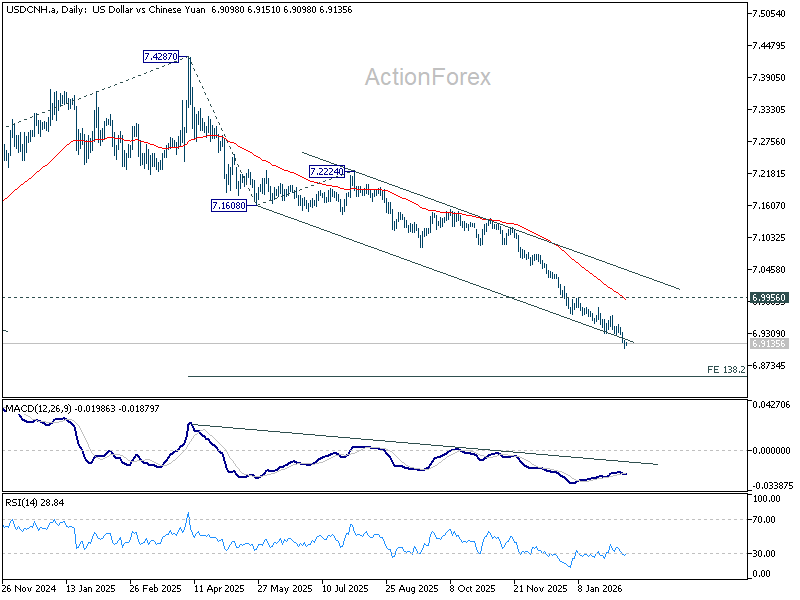
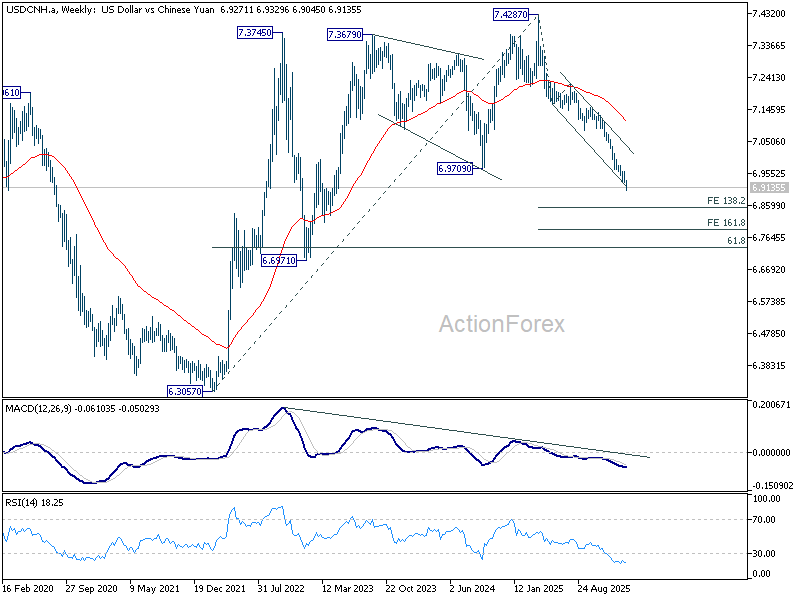
                                        China maintains LPR as offshore Yuan recovers ahead of key support

                                          China’s central bank maintained its benchmark lending rates unchanged on Monday. The one-year loan prime rate was steady at 3.1%, while the over-five-year LPR, which influences mortgage rates, remained at 3.6%.

                                          The offshore Yuan strengthened notably against the Dollar, continuing to draw support from a a key long-term level. This comes despite market speculation that China might allow Yuan to weaken further to counteract the economic effects of new tariffs introduced under Donald Trump’s presidency.

                                          A weaker currency would bolster export competitiveness by making Chinese goods more affordable internationally. However, Beijing faces a dilemma: while a controlled depreciation could help exporters, an uncontrolled fall could lead to heightened volatility in domestic financial markets and reduced investor confidence.

                                          Acknowledging these risks, PBOC Governor Pan Gongsheng reaffirmed the central bank’s commitment to exchange rate stability last week, stating, “We will resolutely prevent the risk of the exchange rate overshooting, ensuring that the Yuan exchange rate remains generally stable at a reasonable, balanced level.”

                                          Technically, a short term top should be confirmed at 7.3694 in USD/CNH with today’s dip. But it’s early to call for bearish reversal as long as 55 D EMA (now at 7.2797) hits. Further rally remains in favor through 7.3745 (202 high) to resume the long term up trend.

                                          Nevertheless, firm break of 55 D EMA should bring deeper pull back to 38.2% retracement of 6.9709 to 7.3694 at 7.2172, which is close to 55 W EMA (now at 7.2097) even just as a correction to rise from 6.9709.