US ISM manufacturing improves to 49.3, but remains in contraction territory

    US ISM Manufacturing PMI edged up from 48.4 to 49.3 in December, exceeding market expectations of 48.3. Despite the improvement, the index remained below the 50.0 threshold, signaling contraction for the ninth consecutive month and for the 25th time in the past 26 months.

    The ISM highlighted that the December reading corresponds to an annualized 1.9% growth in real GDP, indicating a modest contribution to the broader economy.

    Delving into the subcomponents, new orders climbed from 50.4 to 52.5, while production improved notably, rising from 46.8 to 50.3. However, employment fell sharply from 48.1 to 45.3. Additionally, prices accelerated, increasing from 50.3 to 52.5, pointing to renewed input cost pressures.

    Full US ISM manufacturing release here.

    Yuan Pressure Against Dollar, But Rises Against CFETS Basket

      The Chinese Yuan presented an interesting paradox in today’s market action. Onshore Yuan sank below 7.3 mark against US Dollar, registering a 14-month low. This decline has intensified speculation that the People’s Bank of China might be adopting a more lenient stance toward currency depreciation. Such a move could be part of broader efforts to bolster economic growth amid mounting headwinds. The downward bias has been further fueled by the possibility of a renewed “Trade War 2.0” under the incoming US administration.

      Conversely, the CFETS RMB Index—a measure of the Yuan’s trade-weighted performance against a basket of currencies—surged to its highest level since October 2022. Although primarily driven by the relative weakness of major currencies versus the Dollar, this uptick hints at potential challenges for China’s export competitiveness to other key markets.

      These moves also coincide with CFETS basket weighting adjustments for 2025, including reductions in the weightings of Dollar (from 19.46% to 18.903%), Euro (from 18.08% to 17.902%), and Yen (from 8.963% to 8.584%).

      The larger question remains: How far is China willing to let Yuan depreciate? This is a mounting question given the uncertainty surrounding any trade measures the US might impose after Donald Trump’s January 20 inauguration. Beijing’s true intentions would become clearer after that.

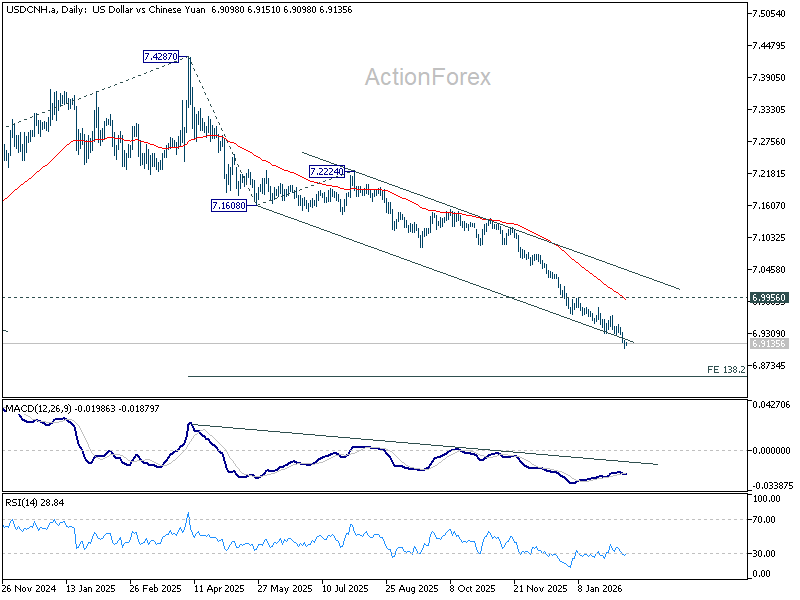
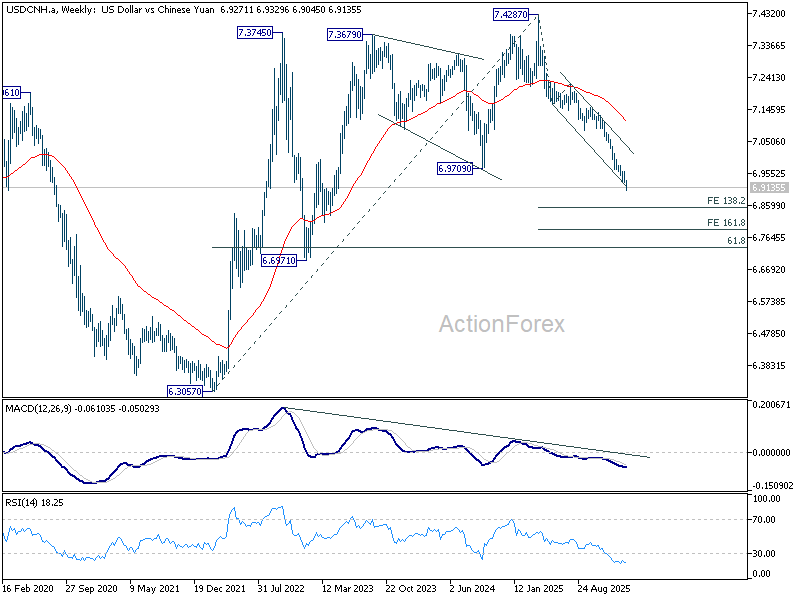
      Technically, it does look like that USD/CNH (Dollar vs offshore Yuan) is ready to resume it’s long term up trend from 6.3057 (2022 low). Decisive break of 7.3745 (2022 high) will pave the way to 100% projection of 6.6971 to 7.3673 from 6.9709 at 7.6411.

      US PMI manufacturing finalized at 49.4, optimism wanes on inflation worries

        US PMI Manufacturing Index was finalized at 49.4 in December, a slight dip from November’s 49.7, marking the sixth consecutive month of contraction in the sector. Although the decline in manufacturing health remains modest overall, the pace of deterioration has quickened slightly compared to the prior month.

        Chris Williamson, Chief Business Economist at S&P Global Market Intelligence, highlighted the challenges: “US factories reported a tough end to 2024, and have scaled back their optimism for growth in the year ahead.”

        He pointed to rising production cuts in December as inflows of new orders disappointed. The fleeting boost in customer demand seen after the election in November has faded, leaving factories to contend with subdued sales, particularly in export markets.

        Despite the downturn, many manufacturers are cautiously optimistic about the New Year, hoping that the incoming administration’s policies might spur growth. Expectations of reduced regulations, lower taxes, and increased demand for US goods via potential tariffs are contributing to this sentiment. Confidence, which hit a low in June, received a notable boost following the election result in November.

        However, firms are increasingly wary of rising input costs and the resurgence of inflation, which could limit the scale of Fed rate cuts in the coming year.

        Full US PMI manufacturing final release here.

        US initial jobless claims falls to 211k, vs exp 223k

          US initial jobless claims fell -9k to 211k in the week ending December 28, below expectation of 223k. Four-week moving average of initial claims fell -3.5k to 223k.

          Continuing claims fell -52k to 1844k in the week ending December 21. Four-week moving average of continuing claims fell -7k to 1871k.

          Full US jobless claims release here.

          UK PMI manufacturing finalized at 47, sentiment at two-year low

            UK PMI Manufacturing was finalized at 47.0 in December, down from 48.0 in November, marking the third consecutive month of contraction. Persistent challenges, both domestic and international, weighed heavily on the sector, resulting in the sharpest production decline in nearly a year.

            Rob Dobson, Director at S&P Global Market Intelligence, highlighted a “stalling domestic economy, weak export sales, and future cost concerns” as key drivers of the downturn. Business confidence fell to its lowest point in two years.

            Small and medium-sized enterprises have been hit hardest during the downturn, while labor market pressures intensify. December saw the steepest job cuts since February, as firms moved to restructure in anticipation of 2025 National Insurance and minimum wage increases. Export sales also suffered due to weaker demand from Europe, Asia, and the US.

            Input costs continued to rise, fueled by higher transportation, labor, and material expenses, with some increases linked to ongoing supply chain challenges. Looking ahead, the impact of Budget 2025 measures is expected to drive costs higher, potentially complicating BoE’s decision on further rate cuts despite mounting signs of economic stress.

            Full UK PMI manufacturing final release here.

            Eurozone PMI manufacturing finalized at 45.1, Spain outshines peers with low China exposure

              Eurozone PMI Manufacturing was finalized at 45.1 in December, down from November’s 45.2, marking the sector’s 30th consecutive month of contraction. Key indicators, including new orders and inventory levels, signaled ongoing struggles across the bloc.

              Cyrus de la Rubia, Chief Economist at Hamburg Commercial Bank, emphasized the continued downturn: “New orders have dropped even more than in the previous two months, crushing any hopes for a quick recovery.” Inventories of intermediate and finished goods declined sharply, reflecting weak demand expectations.

              Job cuts persisted across Eurozone, with the pace of reductions remaining significant, despite a slight deceleration. This trend is expected to continue as companies restructure operations amid weak industrial activity.

              Spain remained a bright spot, with its PMI rising to 53.3, indicating robust expansion. Greece also posted growth at 53.2, a five-month high. However, the largest economies continued to struggle: Germany (42.5) reached a three-month low, France (41.9) fell to a 55-month low, and Italy (46.2) managed only a slight improvement.

              Spain’s relative resilience stems from its low export exposure to China (2%) and benefits from lower energy costs, which have helped it weather the industrial crisis better than its peers. However, with Spain accounting for only 12% of Eurozone GDP, its strength alone cannot offset the widespread industrial recession.

              Full Eurozone PMI manufacturing final release here.

              China’s Caixin PMI manufacturing falls back to 50.5 as downward pressures persist

                China’s Caixin Manufacturing PMI dropped to 50.5 in December, down from 51.5 and below market expectations of 51.6, signaling a moderation in the sector’s growth.

                While supply and demand expanded modestly, external demand remained a significant drag, according to Wang Zhe, Senior Economist at Caixin Insight Group.

                Zhe highlighted several challenges, noting that external demand was “sluggish”, while job market suffered a “notable contraction.” Additionally, sales prices were weak, and market optimism continued to decline.

                The survey pointed to “prominent downward pressures”, stemming from subdued domestic demand and challenging external conditions, which have squeezed profit margins and dented confidence.

                The report also suggested that the impact of previous policy stimulus measures has yet to yield consistent results, with more time needed to gauge their effectiveness.

                Full China Caixin PMI manufacturing release here.

                Swiss KOF falls below average, signals dampened outlook

                  Swiss KOF Economic Barometer fell to 99.5 in December, down from 102.9 in November and below market expectations of 101.1. This decline brings the indicator slightly below its medium-term average, signaling a “dampened” outlook for the Swiss economy .

                  KOF Economic Institute attributed the drop to weaker performance across multiple sectors. In particular, indicators for manufacturing, other services, the hospitality industry, foreign demand, and private consumption showed significant declines, collectively driving the overall decrease.

                  Full Swiss KOF release here.

                  Japan’s PMI manufacturing finalized at 49.6, nears stabilization and cost pressures persist

                    Japan’s Manufacturing PMI for December was finalized at 49.6, an improvement from November’s 49.0, indicating a gradual move toward stabilization in the sector.

                    According to Usamah Bhatti of S&P Global Market Intelligence, the data “painted a picture of a near-stabilization” in manufacturing conditions as declines in both production and new orders softened.

                    Encouraged by these improvements, firms increased hiring, partly to address existing labor shortages and in anticipation of future demand recovery.

                    However, price pressures remained elevated, with input costs rising at their fastest pace since August due to higher raw material and labor costs, compounded by Yen’s weakness. To manage these cost burdens, manufacturers passed on higher prices to clients, resulting in the strongest output charge increases in five months.

                    Full Japan PMI manufacturing final release here.

                    US goods exports rise 6.1% yoy in Nov, imports surge 9.6% yoy

                      US goods exports rose 6.1% yoy to USD 176.4B in November. Goods imports rose 9.6% yoy to USD 279.2B. Trade deficit widened from October’s USD -98.3B to USD 102.9B. larger than expectation of USD -100.9B.

                      Wholesale inventories fell -0.2% mom to USD 901.6B. Retail inventories rose 0.3% mom to USD 827.5B.

                      Full US good trade balance release here.

                      BoJ summary highlights division on timing of rate hikes

                        BoJ Summary of Opinions from its December 18–19 meeting revealed a divided board on the timing of monetary policy normalization. While some members advocated for action soon, citing upside risks to prices, others expressed caution due to slow wage growth, soft overseas demand, and heightened uncertainties.

                        One member emphasized that with economic activity and prices aligning with BoJ’s outlook, risks to inflation were becoming “skewed to the upside.” The member argued for a “forward-looking, timely, and gradual” adjustment of monetary policy. Similarly, another member noted that the sustained increase in prices over the past three years, partly driven by Yen’s depreciation, would likely contribute to higher underlying inflation, warranting “preemptive” rate hikes.

                        Conversely, more dovish members maintained that the current risks to prices “do not suggest a pressing need” for rate hike. One member cited uncertainties surrounding tax and fiscal policies in Japan and the stance of the incoming US administration as reasons to maintain the current policy stance, emphasizing a risk management approach.

                        Overall, the BoJ board appears focused on assessing the outcomes of next year’s spring wage negotiations and the impact of US policy shifts before making further moves toward policy normalization.

                        Full BoJ Summary of Opinions here.

                        Japan’s industrial output slips -2.3% mom in Nov, indecisive fluctuation continues

                          Japan’s industrial production declined -2.3% mom in November, outperforming expectations of a -3.4% mom drop, but marking the first contraction in three months.

                          The decrease was driven by weaker exports of semiconductor manufacturing devices and cars, highlighting challenges in external demand. Out of 15 industrial sectors, 11 recorded declines, while 3 sectors reported gains.

                          Production machinery saw a significant -9.1% drop, largely due to falling exports of chip-making equipment to China and Taiwan, while motor vehicle output fell -4.3%, and fabricated metal products dropped -5.7%.

                          Despite the slump, the Ministry of Economy, Trade, and Industry maintained its view that industrial production “fluctuates indecisively,” while warning of risks tied to the economic outlooks of the US and China.

                          Looking ahead, METI’s poll of manufacturers predicts a rebound, with output expected to rise 2.1% in December and an additional 1.3% in January.

                          Separately, retail sales posted a robust 2.8% yoy gain, exceeding expectations of 1.5%, signaling resilience in domestic demand.


                          Japan’s Tokyo CPI core rises to 2.4% in Dec, but core-core dips to 1.8%

                            Japan’s Tokyo core CPI (excluding food) rose from 2.2% yoy to 2.4% yoy in December, marking its highest level since August but falling short of expectations for 2.5%. The increase was largely driven by a 13.5% yoy surge in energy prices, reflecting the phase-out of government subsidies for gas and electricity bills. However, when excluding utility costs, inflation pressures appear steady.

                            Core-core CPI (excluding food and energy) softened to 1.8% yoy from 1.9% yoy, while services inflation edged up slightly from 0.9% to 1.0%. Meanwhile, headline inflation accelerated to 3.0% yoy from 2.6% yoy, with energy and food prices, including rice, contributing significantly to the increase too.

                            The uptick in Tokyo inflation highlights lingering pressures from rising utility and food costs, which may weigh on consumer spending and deter firms from implementing further price hikes. These factors, coupled with broader signs of economic weakness, could delay BoJ ’s timeline for raising interest rates.

                            Full Japan’s Tokyo CPI release here.

                            US initial jobless claims falls -1k to 219k

                              US initial jobless claims fell -1k to 219k in the week ending December 21, slightly higher than expectation of 218k. Four-week moving average of initial claims rose 1k to 227k.

                              Continuing claims rose 46k to 1910k in the week ending December 14, highest since November 3, 2021. Four-week moving average of continuing claims rose 3k to 1881k.

                              Full US jobless claims release here.

                              US consumer confidence slides to 104.7 as future outlook weakens

                                US Conference Board Consumer Confidence dropped to 104.7 in December, falling short of expectations for 113.2 and down from 112.8 in November. Present Situation Index slipped by -1.2 points to 140.2. The more forward-looking Expectations Index plunged -12.6 points to 81.1, nearing the critical 80 threshold that often signals recession risks.

                                Dana M. Peterson, Chief Economist at The Conference Board, highlighted the nature of the decline: “The recent rebound in consumer confidence was not sustained in December.”

                                She attributed the drop primarily to weaker future expectations, adding, “Consumers in December were substantially less optimistic about future business conditions and incomes, with pessimism about employment prospects returning after brief optimism in October and November.”

                                Full US consumer confidence release here.

                                US durable goods orders slump -1.1% mom, transportation sector leads decline

                                  US durable goods orders dropped -1.1% mom in November to USD 285.1B, significantly missing market expectations of a -0.3% mom decline. This also marks the third decline in the last four months.

                                  Excluding transportation, orders edged down -0.1% mom to USD 189.6B, while orders excluding defense fell -0.3% mom to USD 267.4B. The transportation equipment category, which has also fallen in three of the past four months, accounted for the largest share of the decline, with a -2.9% mom drop to USD 95.5B.

                                  Full US durable goods orders release here.

                                  Canada’s GDP beats Oct expectations, but Nov decline looms

                                    Canada’s GDP rose 0.3% mom in October, surpassing expectations of 0.2% mom, with 12 out of 20 sectors contributing to the growth.

                                    This marked a rebound for the goods-producing industries, which expanded by 0.9% mom after four months of contraction, driven primarily by mining, quarrying, and oil and gas extraction.

                                    The services-producing industries edged up by 0.1% mom, supported by growth in real estate and rental and leasing, which saw its fifth consecutive month of expansion.

                                    However, preliminary data for November suggests a -0.1% mom contraction in real GDP, with declines in mining, quarrying, and oil and gas extraction, as well as transportation, warehousing, and finance and insurance. These losses were partly offset by gains in accommodation and food services and continued strength in real estate and rental and leasing.

                                    Full Canada GDP release here.

                                    Natural gas prices surge on winter demand and long-term power trends

                                      Natural gas prices climbed to a nearly two-year high, driven by immediate weather-related demand and a bullish long-term outlook for global energy consumption.

                                      In the short term, forecasts for below-average temperatures across the northern hemisphere—including North America, Europe, China, and Japan—are expected to significantly increase daily heating demand as these regions, which account for more than two-thirds of global gas consumption, enter their peak heating season. This has bolstered sentiment, with limited downside for prices likely until well into 2025.

                                      Beyond the seasonal factors, the long-term outlook for natural gas remains robust. Rising electricity demand as the race for artificial intelligence accelerates, is projected to grow power consumption for such facilities by 10–15% annually through 2030, potentially accounting for up to 5% of global power demand by that time.

                                      Natural gas is expected to play a pivotal role as a baseload energy source in this transition, given its current dominance in power generation. In the US, natural gas powers approximately 40–45% of electricity production, while globally, that share is closer to 25%. However, as more countries transition from coal to gas, the share of gas in electricity generation is anticipated to increase.

                                      Technically, the break of 3.446 resistance last week was an important sign of underlying medium term momentum. Rise from 1.570 (Feb low) is now expected to continue to 161.8% projection of 1.570 to 3.024 from 1.852 at 4.204.

                                      Nevertheless, momentum should target to wane above 4.204, and, in particular, as it approaches 38.2% retracement of 10.03 to 1.570 at 4.80.

                                      ECB’s Lagarde: Inflation target within reach, services inflation still stubborn

                                        In an interview with the Financial Times, ECB President Christine Lagarde expressed optimism about nearing the inflation target.

                                        She remarked that ECB is “very close” to declaring that inflation has been “sustainably” brought back to its 2% medium-term target.

                                        The latest inflation reading of 2.2% reflects the success of ECB’s restrictive monetary policy. However, she highlighted persistent concerns in the services sector, where inflation remains high at 3.9%, describing it as “not budging much” despite showing slight signs of decline.

                                        On the topic of US tariff threats, Lagarde emphasized the economic risks of retaliatory trade measures, stating, “Retaliation was a bad approach.” She warned that tit-for-tat trade conflicts could harm the global economy.


                                        US PCE inflation ticks up to 2.4% yoy, core unchanged at 2.8% yoy

                                          US headline PCE price index rose 0.1% mom in November, below expectation of 0.2% mom. Core PCE price index (excluding food and energy) also rose 0.1% mom, below expectation of 0.2% mom. Prices for goods increased less than 0.1% mom and prices for services increased 0.2% mom. Food prices increased 0.2% mom and energy prices also increased 0.2% mom.

                                          From the same month one year ago, headline PCE index ticked up from 2.3% yoy to 2.4% yoy, below expectation of 2.5% yoy. Core PCE was unchanged at 2.8% yoy, below expectation of 2.9% yoy. Prices for goods decreased -0.4% yoy and prices for services increased 3.8% yoy. Food prices increased 1.4% yoy and energy prices decreased -4.0% yoy.

                                          Personal income rose 0.3% mom or USD 71.1B, below expectation of 0.4% mom. Personal spending rose 0.4% mom or USD 81.3B. below expectation of 0.5% mom.

                                          Full US personal income and outlays release here.