ECB fully prepared to expand PEPP in June

    Accounts of April 29-30 ECB monetary policy meeting indicated that it’s ready to expanding easing measures in the upcoming June meeting. The Governing Council was “fully prepared to increase the size of the PEPP and adjust its composition, and potentially its other instruments, if, in the light of information that became available before its June meeting, it judged that the scale of the stimulus was falling short of what was needed.”

    The minutes also said that it’s Eurozone economy was “heading towards a decline in activity that was unprecedented in recent history.” June’s Eurosystem staff economic projections would be “revised down significantly” compared with March ECB staff projections. Present situations was also “characterised by Knightian or ‘radical’ uncertainty, implying unquantifiable risks.”

    Also, it’s generally considered that, of the three coronavirus scenarios, the “mild” scenario was probably already too optimistic. But it’s “too early” to conclude that the “severe” scenario” was the “most likely. Still a “swift V-shaped recovery could probably already be ruled out at this stage.”

    Full minutes here.

    US PMI composite rises to 52.3, marked growth acceleration and sharp inflation cooling

      US PMI Manufacturing rises from 47.9 to 50.3 in January, back in expansion, and the highest level in 15 months. PMI Services rose from 51.4 to 52.9, a 7-month high. PMI Composite rose from 50.9 to 52.3, a 7-month high.

      Chris Williamson, Chief Business Economist at S&P Global Market Intelligence, highlights this as an “encouraging start” to the year, with companies reporting “marked acceleration of growth” alongside “sharp cooling of inflation pressures”.

      Growth momentum has notably intensified, driven by improved demand conditions and steady increase in new orders over the past three months, which has in turn enhanced business confidence to its most optimistic level since May 2022.

      Furthermore, there’s an air of optimism regarding lower inflation in 2024, anticipated to ease the cost of living pressures and potentially pave the way for lower interest rates.

      Notably, the rate of price increases has slowed to its lowest since the early pandemic lockdowns of 2020. Companies report that the current pace of selling price inflation has fallen to “below the pre-pandemic average,” aligning with projections of consumer price inflation descending below Fed’s 2% target.

      Full US PMI release here.

      Eurozone CPI finalized at 2.6% in May, core at 2.9%

        Eurozone CPI was finalized at 2.6% yoy in May, up from April’s 2.4% yoy. CPI core (ex energy, food, alcohol & tobacco) was finalized at 2.9% yoy, up from prior month’s 2.7% yoy. The highest contribution to the annual inflation rate came from services (+1.83 percentage points, pp), followed by food, alcohol & tobacco (+0.51 pp), non-energy industrial goods (+0.18 pp) and energy (+0.04 pp).

        EU CPI was finalized at 2.7% yoy, up from April’s 2.6% yoy. The lowest annual rates were registered in Latvia (0.0%), Finland (0.4%) and Italy (0.8%). The highest annual rates were recorded in Romania (5.8%), Belgium (4.9%) and Croatia (4.3%). Compared with April, annual inflation fell in eleven Member States, remained stable in two and rose in fourteen.

        Full Eurozone CPI final release here.

        New Zealand ANZ business confidence rose to -33, still a huge tourism-shaped hole

          New Zealand ANZ Business Confidence rose another 9 pts to -33 in June’s preliminary reading, up from may’s -41.8. Activity outlook rose to -29.1, up from -38.7. Looking at some details, export intentions rose to 17.1, from -32.2. Investment intentions rose to -21.6, up from -31.7. Employment intentions rose to -34.0, from -42.4.

          The improvement reflected New Zealand’s “continued steady progress out of lockdown”, but “levels remain very low”. ANZ also noted, emerging into Level 1 lockdown, “disruption has waned, and normality beckons”. But “there is a huge tourism-shaped hole” in the economy. Also, “people will feel comfortable going into a shop or restaurant – that’s a huge win – but whether they’ll feel comfortable spending money is another question again.”

          Full release here.

          Eurozone retail sales dropped -11.7% in Apr, EU sales dropped -11.1%

            Eurozone retail sales dropped -11.7% mom in April, better than expectation of -15.0% mom. The volume of retail trade decreased by -27.7% mom for automotive fuels, by -17.0% mom for non-food products and by 5.5% for food, drinks and tobacco.

            EU retail sales dropped -11.1% mom. Among Member States for which data are available, the largest decreases in the total retail trade volume were registered in Malta (-25.1%), Romania (-22.3%) and Ireland (-21.9%). The only increase was observed in Finland (+0.3%), while the volume in Sweden remained stable.

            Full release here.

            Canada CPI rose to 0.7% yoy in Oct, mainly due to food component

              Canada CPI accelerated to 0.70% yoy in October, up from 0.50% yoy, above expectation of 0.4% yoy. CPI common rose to 1.6% yoy, up from 1.5% yoy, above expectation of 1.50% yoy. CPI median was unchanged at 1.9% yoy while CPI trimmed was unchanged at 1.8% yoy, both match expectations.

              StatCan noted: “Prices rose in five of the eight major components on a year-over-year basis in October. While the shelter component contributed the most to the year-over-year increase, the all-items index rose at a faster pace in October compared with September, mainly due to the food component. ”

              Full release here.

              US PPI down -0.1% mom in Feb, goods fell -0.2% mom, services dropped -0.1% mom

                US PPI for final demand dropped -0.1% mom in February, below expectation of 0.3% mom. Prices for goods dropped -0.2% mom while prices for services was down -0.1% mom. Prices less foods, energy, and trade services rose 0.2% mom.

                For the 12 months ended in February, PPI slowed from 5.7% yoy to 4.6% yoy, below expectation of 5.1% yoy. Prices for final demand less foods, energy, and trade services advanced 4.4yoy .

                Full release here.

                BoE Bailey sent another signal that “we have to act”

                  BoE Governor Andrew Bailey warned that rising energy prices means inflation will “last longer” and “get into the annual numbers for longer as a consequence.” The development raised the “fear and concern of embedded expectations.”

                  “Monetary policy cannot solve supply-side problems,” he noted. “But it will have to act and must do so if we see a risk, particularly to medium-term inflation and to medium-term inflation expectations”

                  “That’s why we, at the Bank of England have signaled, and this is another signal, that we will have to act”, he said. “But of course that action comes in our monetary policy meetings.”

                  FTSE pushes toward 10k, GBP/CHF vulnerable, next hinges on UK GDP

                    Markets are increasingly convinced the BoE will deliver a rate cut next month, after weak labour data showed the UK economy is losing traction. The shift in sentiment has sent the FTSE 100 powering to fresh record highs, with 10,000 level now within reach. Sterling has come under broad pressure, particularly against its European peers. The labor market’s deterioration—rising unemployment, slower pay growth, and growing slack—suggests more weakness than the MPC’s November forecast assumed.

                    Attention now turns to Thursday’s Q3 GDP report, expected to show a modest 0.2% qoq expansion and stagnation in September. Such subdued momentum could persist into next year, reinforcing calls for the BoE to resume its gradual easing cycle. The Bank is seen returning to a quarterly cut rhythm, delayed only by uncertainty surrounding last week’s Autumn Budget. A weaker-than-expected GDP print would likely fuel talk of a deeper, more sustained rate-cut trajectory into 2026.

                    In markets, FTSE’s decisive break above its recent channel signals strong bullish acceleration. Near term outlook will stay bullish as long as 9638.98 support holds. Further rise should be seen through 10k psychological level at 100% projection of 8707.65 to 9577.08 from 9276.91 at 10146.34.

                    GBP/CHF is still bounded in range above 1.0499 support despite yesterday’s dip. Yet, outlook remains bearish with 1.0658 support turned resistance intact. Firm break of 1.0499 will resume the larger down trend to 100% projection of 1.1204 to 1.0658 from 1.0959 at 1.0413.

                    May’s new Brexit plan received terrible responses

                      Sterling was lifted briefly by UK Prime Minister Theresa May’s “new” Brexit plan. But recovery in Pound quickly faded as the plan was terribly received by MPs across the House. In short, under the new 10-point plan, the most important part is guaranteeing a vote on whether to call a second referendum on the Brexit deal. However, the pre-condition for the vote on referendum is the passage of the Brexit deal itself in the Commons.

                      Labour leader Jeremy Corbyn was quick to reject the proposal as “largely a rehash” and pledged “we won’t back a repackaged version of the same old deal”. Former foreign minister Boris Johnson and ex Brexit minister Dominic Raab said they’d oppose the deal. Pro-Brexit Cabinet ministers including Michael Gove, Andrea Leadsom and Chris Grayling opposed the idea of a “free vote”. Northern Ireland’s Democratic Unionist Party was concerned that “fatal flaws” of the original Brexit deal remained, which could split Northern Ireland with the rest of UK.

                      Despite the desperate final gamble, there is still practically no chance for May to get her Brexit deal through Commons in the June. A fourth humiliating defeat is more likely than not.

                      U.S. PPI falls -0.1% mom in August, annual rate cools to 2.6% yoy

                        U.S. producer prices unexpectedly fell in August, with PPI slipping -0.1% mom versus expectations of a 0.3% mom gain. The decline was driven by a -0.2% mom drop in final demand services, while goods prices edged higher by 0.1% mom.

                        On a year-over-year basis, PPI slowed sharply to 2.6% yoy from yoy 3.3% in July, undershooting forecasts of 3.3% yoy and signaling easing price pressures at the factory gate. The slowdown will be welcomed by markets seeking evidence that inflationary pressures are moderating.

                        However, underlying measures stayed firmer. Core PPI, excluding food, energy, and trade services, rose 0.3% mom, a fourth straight month of increase, leaving the annual rate at 2.8% yoy — the fastest since March.

                        Full US PPI release here.

                        Fed to hold its cards until September

                          FOMC rate decision is a major focus today but there is little expectation on anything dramatic there. Fed funds rate will be held at 0.00-0.25%. The unlimited asset purchase program will continue at a pace of USD 80B for treasuries and USD 40B for MBS. There might be change to forward guidance though, to tie future rate hike to employment and inflation. But the big changes will be held until September.

                          By September meeting, Fed should have completed the policy framework review. Congress should have passed any additional fiscal stimulus. More information will be obtained regarding the economy, in particular with second wave of coronavirus infections in effect. Updated economic projections will also be completed.

                          Some suggested readings on FOMC:

                          SNB Schlegel: No target for Franc exchange rate, intervenes as necessary

                            SNB Vice President, Martin Schlegel, clarified overnight that the central bank does not adhere to a specific target for Swiss Franc’s exchange rate. Instead, Schlegel reiterated the usual stance that the bank “monitors the exchange rate closely and intervenes in the foreign-exchange market as necessary.”

                            Separately, in its Quarterly Bulletin, SNB noted that “Many economic indicators suggest that economic activity was slightly more dynamic in the first quarter of 2024 than in the preceding quarters.”

                            The report attributed this “moderate” growth primarily to the service sector’s resilience, while highlighting continued stagnation in the manufacturing sector. SNB acknowledged that “persistently weak global demand” remains a significant hurdle for manufacturing, with Swiss Franc’s exchange rate increasingly being cited by companies as a contributing challenge.

                            Full SNB Quarterly Bulletin here.

                            SNB Maechler sees risk of more persistent inflation

                              SNB board member Andrea Maechler said yesterday, “our mandate is to bring down inflation and we will use the tools we have to do so… If we see our inflation forecast above 2 percent, we will continue to raise rates.”

                              “Inflation started with shocks but it’s no longer just shock-driven,” Maechler said. “We see inflation as having the risk of being more persistent.”

                              “It’s very important that we maintain the focus on implementing the policies to reach price stability in a consistent and sustainable way.”

                              Regarding Swiss Franc exchange rate, she said the appreciation “has been actually helping us keep our inflation much lower than in some of our neighboring countries.”

                              Yet, she added, “We’re willing – if the exchange rate were to rise too rapidly, too high – to use intervention to buy foreign exchange… We’re also willing, if the exchange rate were to become too weak, to sell exchange rate but we’re not yet ready to reduce our balance sheet as a policy in itself. This is not the right time.”

                              US PMI manufacturing finalized at 49.4, optimism wanes on inflation worries

                                US PMI Manufacturing Index was finalized at 49.4 in December, a slight dip from November’s 49.7, marking the sixth consecutive month of contraction in the sector. Although the decline in manufacturing health remains modest overall, the pace of deterioration has quickened slightly compared to the prior month.

                                Chris Williamson, Chief Business Economist at S&P Global Market Intelligence, highlighted the challenges: “US factories reported a tough end to 2024, and have scaled back their optimism for growth in the year ahead.”

                                He pointed to rising production cuts in December as inflows of new orders disappointed. The fleeting boost in customer demand seen after the election in November has faded, leaving factories to contend with subdued sales, particularly in export markets.

                                Despite the downturn, many manufacturers are cautiously optimistic about the New Year, hoping that the incoming administration’s policies might spur growth. Expectations of reduced regulations, lower taxes, and increased demand for US goods via potential tariffs are contributing to this sentiment. Confidence, which hit a low in June, received a notable boost following the election result in November.

                                However, firms are increasingly wary of rising input costs and the resurgence of inflation, which could limit the scale of Fed rate cuts in the coming year.

                                Full US PMI manufacturing final release here.

                                WTI oil and gold pare gains on Russia-Ukraine de-escalation

                                  WTI crude oil tumbles sharply today on de-escalation in Russia-Ukraine situation. Technically, a short term top should be in place at 95.98. Immediate focus is now on 55 day EMA (now at 91.18). Sustained trading below this level will argue that WTI is already in correction to whole rally from 66.46. In this case, deeper correction would be seen through 88.66 support to 38.2% retracement of 66.46 to 95.98 at 84.70, which is inside 82.42/87.70 support zone, and then be close to 55 day EMA.

                                  Gold of also retreated sharply from 1879.24, after failing to sustain above 1877.05 resistance. The development dampened the immediate bullish case, and some consolidations could be seen first. But further rally will remain in favor as long as 1820.72 support holds. Break of 1879.24 will resume the rise from 1752.12, and that from 1682.60. Next target is 1916.30 resistance, and then 100% projection of 1682.60 to 1877.05 from 1752.12 at 1946.57.

                                  Japan intervenes as USD/JPY breaks149

                                    USD/JPY is knocked down heavily after edging higher to 149.28. At the time of writing, it’s trading slightly below 149. Apparently, the unexpected excessive volatility is due to intervention by Japan. For now, it’s unsure if 149 is the level Japan would defend, or is it going to be 150. In either case, as USD/JPY looks rather resilient, it’s not a wise choice to sell it to ride on the intervention. It’s an avoid for the moment.

                                    Earlier today, Japanese Finance Minister Shunichi Suzuki said, “We cannot tolerate excessive currency moves driven by speculators. We are closely watching currency moves with a sense of urgency.”

                                    “Generally speaking, there are times when we intervene by making announcements and some other times when we do without it,” Suzuki also noted.

                                    Canada employment rose 21.8k, unemployment rate unchanged at 5.0%

                                      Canada employment rose 21.8k in February, well above expectation of 2.5k. Unemployment rate was unchanged at 5.0%, versus expectation of 5.1%. But that’s just shy of record-low 4.9% in June and July 2022. Labor force participation rate held steady at 65.7%. Total hours worked rose 0.6% mom. Average hourly waves rose 5.4% yoy

                                      Full release here.

                                      US CPI in focus as DOW vulnerable with double top breakdown

                                        Market sentiment in the US remains fragile ahead of today’s CPI data for February, which is expected to be a major market-moving event. The challenge, however, lies in interpreting the impact of inflation data given the complex interplay between inflation trends, economic conditions, and Fed expectations. More importantly, the interaction is further complicated by the unpredictable shifts in US tariff policies. In the end, while traders may react initially to the numbers, they’re more likely to revert to pre-existing trends once the CPI risk is cleared.

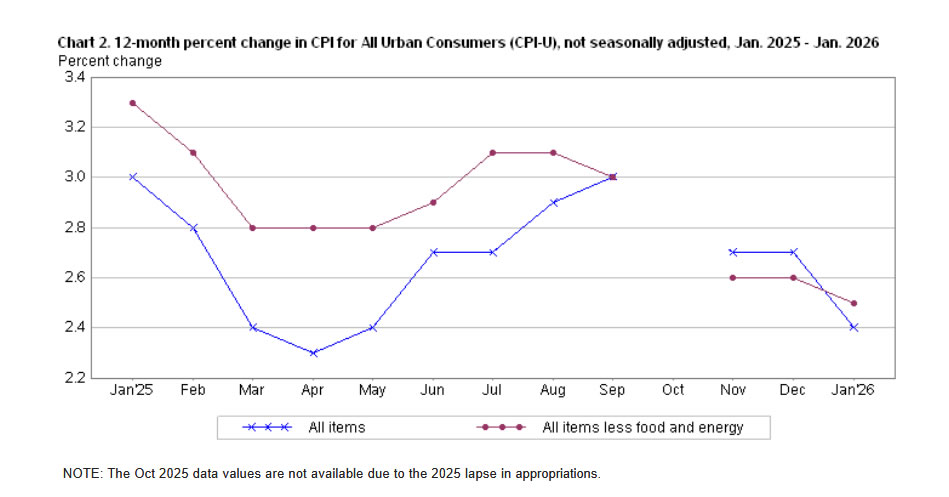
                                        Consensus forecast sees headline CPI dipping slightly from 3.0% to 2.9%, signaling that the uptrend from September’s low of 2.4% has finally ended. Meanwhile, core CPI is expected to ease marginally from 3.3% to 3.2%, but remains stuck in a narrow 3.2%-3.3% range since last June.

                                        If the data confirms these expectations, it would reinforce the view that disinflation progress continued to stall. This, in turn, supports Fed’s cautious stance. Fed Chair Jerome Powell has repeatedly stressed that the central bank is in no rush to lower interest rates, and today’s inflation data is unlikely to change that narrative.

                                        Fed fund futures are currently pricing in a 97% probability that Fed will hold rates at 4.25%-4.50% in its upcoming March 19 meeting, making it almost a certainty. However, the outlook for Q2 is much murkier. Traders are factoring in a 38% probability of a cut in May and an 85% chance of a reduction in June.

                                        Beyond the near term, the real test will come in April when reciprocal tariffs are formalized. Given recent stock market volatility, where recession concerns have already led to deep selloffs, any additional economic stress from tariffs could further push Fed toward an aggressive easing cycle.

                                        Some economists have already noted that the May or June rate cut could indeed start a series of swift reductions in the second half of the year, if confidence deteriorates further—especially if the labor market weakens significantly.

                                        Technically, DOW should have completed a double top pattern (45073.63, 45054.36) after breaking through 41844.89 support. While deeper pull back is now in favor, strong support could be seen around 40k zone to contain downside, at least on first attempt.

                                        The 40k zone represents 39889.05 resistance turned support, as well as 38.2% retracement of 32327.20 to 45054.36 at 40192.58. This development would keep price actions from 45054.36 as a correction to rise from 32327.20 only, likely a sideway pattern.

                                        However, decisive break of 40k will argue that DOW is already in an even larger scale correction, or enter a bear market as some would describe.

                                        Fed Clarida: Inflation at lower end of range of price stability

                                          Fed Vice Chair Richard Clarida said in a speech that inflation is estimated to have been “a little bit below 2 percent of late”, largely because of “recent decline in energy prices”. But the better indicator of future inflation, core PCE, is estimated to have been “about 2 percent”. AT the same time, market-base measures of inflation compensation have “moved lower, on net”. Some survey-based measures of longer-term inflation expectations are little changed. Taken together, Clarida said “evidence suggests that measures of expected inflation are at the lower end of a range that I consider to be consistent with our price-stability goal of 2 percent PCE inflation.”

                                          But he also noted that “a number of crosscurrents that are buffeting the economy bear careful scrutiny”. He echoed Fed Chair Jerome Powell’s comments and pointed to slowing global growth, “in particular in China an Europe”, global policy uncertainty, volatile financial market conditions. And they are “making efforts to extract signal from noise more challenging.”

                                          Clarida also reiterated Fed’s position that “with employment and inflation now at or close to our dual-mandate objectives, the FOMC in its January statement indicated it can afford to be patient as we assess the need for further adjustments in our policy stance”.

                                          He added that going forward, Fed needs to be “cognizant of the balance we must strike between (1) being forward looking and (2) maximizing the odds of being right given the reality that the models that we consult are not infallible.”

                                          Clarida’s full speech here.