


As the dust settles on a tumultuous 2025, traders are left catching their breath after a year that defied the typical post-election script.
If 2024 was the prelude, 2025 was the main event—a year defined by a stark pivot toward American exceptionalism and the revamp of global trade volatility.
The year was dominated by the Trump administration’s aggressive “America First” policies, which paradoxically accelerated a global move away from reliance on the US Dollar.
While Washington secured new bilateral trade deals with partners, the broader message to the world was clear: the way the global economy functioned the past 50 years is changing.
Geopolitically, the “peace through strength” doctrine faced severe tests.
The conflicts in the Middle East and Ukraine did not cease; they merely mutated.
While high-level summits—including the Trump-Xi meeting in Busan—offered temporary truces, the underlying friction points remained hot.
Meanwhile, central banks across the developed world continued their rate-cutting cycles, providing a liquidity backstop that kept equity markets buoyant despite the political chaos.
And who could forget the drama in Tokyo? The “Takaichi Yen-run” will be studied by FX traders for decades.
The market positioned aggressively for continued loose monetary policy under Prime Minister Sanae Takaichi – After an 11% drop in USD/JPY throughout the first half of the year, the resulting volatility saw the pair get back to down only 1%.
Other currencies which had already strengthened against the dollar saw even wilder runs against the yen. Check out EUR/JPY!
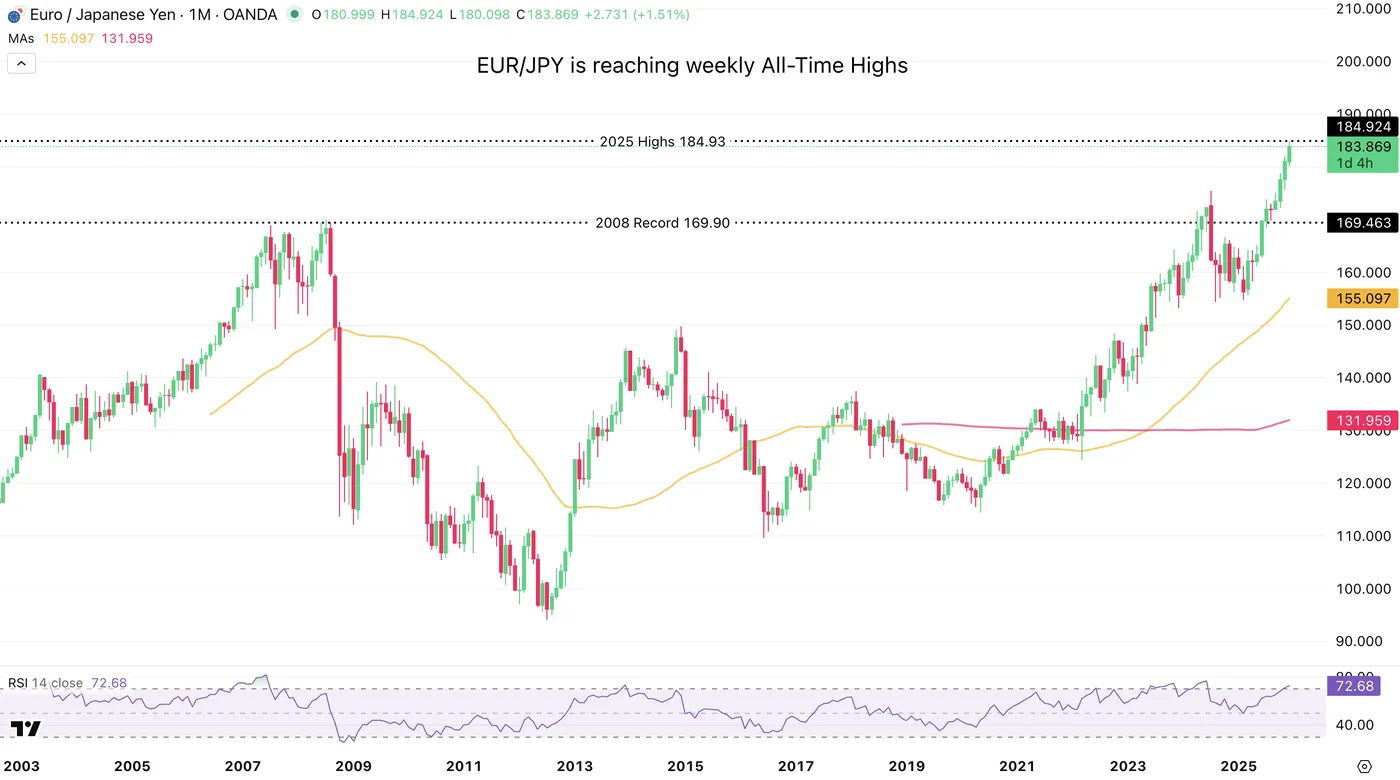
EUR/JPY Weekly Chart, December 30, 2025. Source: TradingView
As we turn the page to 2026, the trading landscape shifts from reaction to anticipation. Here is what to expect.
Economics: Inflation Fears and Doubts in the US
Will Global Inflation Maintain its Path?
Will there really be a Soft Landing or just no Landing? While headline inflation moderated in 2025, with doubts regarding to the latest US CPI release, 2026 might reserve some surprises.
The full pass-through of 2025’s tariffs should see its effect in the first half of next year.
The question for traders is whether this is a one-off level adjustment or the start of a sticky, upward-pressured path. If the latter, the bond market is drastically mispriced.
US Economy: Downside Risk vs. AI Productivity
The US economy is a tale of two sectors. Manufacturing is struggling under the weight of trade disputes, but services—buoyed by the AI boom—remain robust. The wildcard for 2026 is jobs.
We are moving past the “AI investment” phase into the “AI implementation” phase. If AI begins to displace white-collar labor at scale, consumer confidence could crack further, tipping the US into a shallow recession by mid-year.
Central Banks: The Pivot Point
The US: The Federal Reserve is in a bind. The market is pricing in cuts, but if tariff-driven inflation spikes, the Fed may be forced to hold.
Japan: The BoJ remains the outlier. Despite the market’s disbelief, Governor Ueda—backed by a government desperate to defend purchasing power—may deliver further hawkish surprises. The “carry trade” is not dead, but it is dangerous. Watch for a potential hike to 1.0% by Q3, which would send shockwaves through global liquidity.
Macroeconomics: The Commodity Scramble
The Metal Demand Winners
As the Debasement Trade evolves, capital is hunting for resource-rich nations with stable governance.
Canada could stand out as a primary beneficiary, conditional to a solid US deal.
With oil prices stabilizing and a massive surge in demand for critical minerals (copper, nickel, uranium) needed for AI data centers and defense, the Canadian economy could outperform. The Loonie (CAD) could see nice momentum if they manage
FX Trends: The Rise of Regional Blocs
The era of global currency correlation is fading. In 2026, keep an eye on whether Multi-Regional Trends persist:
- North American Bloc: The US and Canada may move in lockstep depending on if the USDMCA Deal gets anchored well.
- Pacific Bloc: The AUD and NZD should stick together, particularly if the Royal Bank of New Zealand manages to.
- The Old Continent: European currencies have managed to attract quite strong flows between the CHF reaching multi-decade highs against the US Dollar, without mentioning the Euro and Pound having a stellar run. The question stands: Will European currencies hold strong or is their run over? For clues, keep an eye on the US Dollar.
De-dollarization: Slow Burn or Forest Fire?
The “sell the Dollar” trade was crowded yet successful trade in 2025, but 2026 may see a pause.
Now, eyes will be on the US politics and whether dollar sales persist or if the de-dollarization sees an actual slow down or reversal. Keep an eye on the US trade policies, metals and if the Federal Reserve holds rates high.
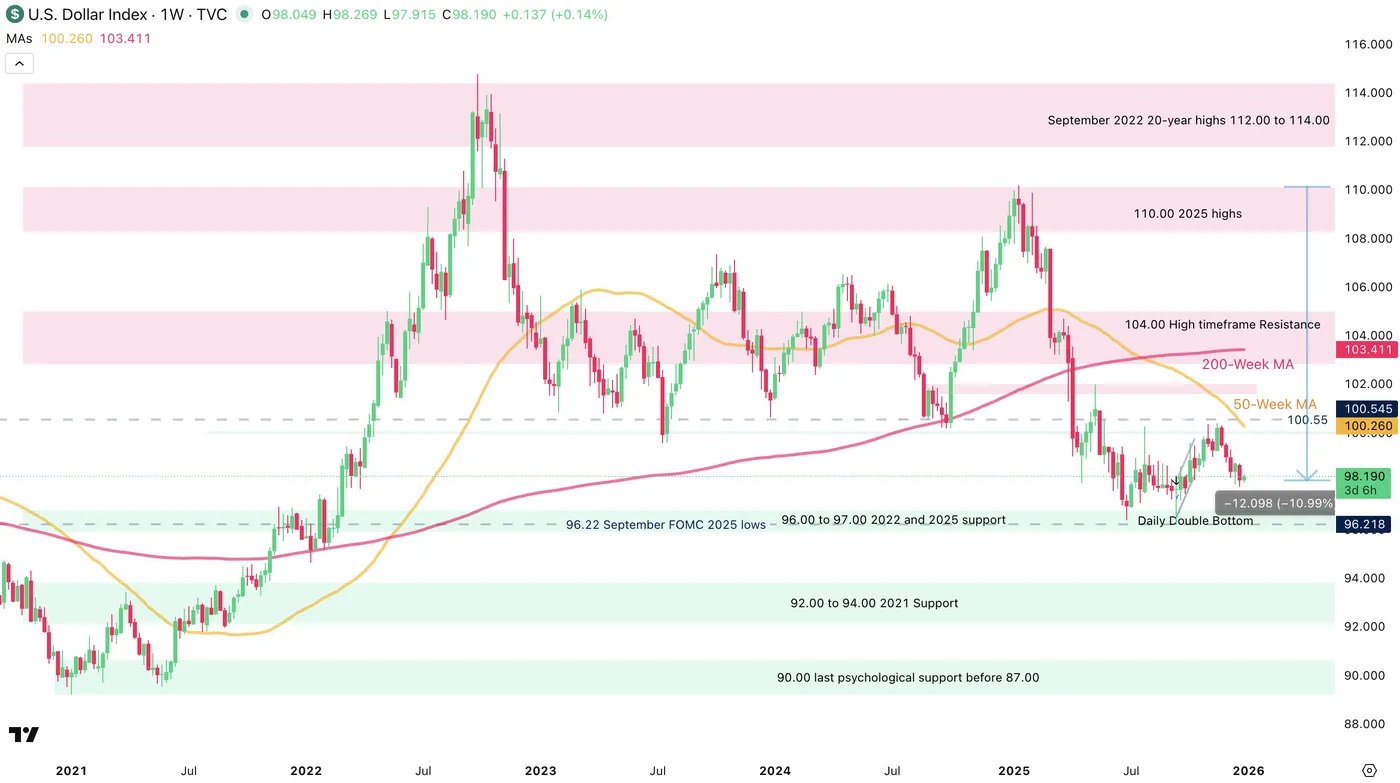
Dollar Index (DXY) Weekly Chart, December 30, 2025. Source: TradingView
Politics: The Year of the Ballot and the Bench
The Federal Reserve Appointment
This is the single most critical event of Q1. With Jerome Powell’s term ending in May 2026, the nomination process in January will be a market-moving spectacle. President Trump has made no secret of his desire for lower rates.
- The Scenario: If a loyalist like Kevin Hassett or Kevin Warsh is nominated, expect a massive “risk-on” rally in equities and a sharp sell-off in the Dollar, as markets price in a politicized, dovish Fed. The Senate confirmation hearings will be the volatility event of the spring.
The Supreme Court & Tariffs
Legal challenges to the administration’s “Reciprocal Tariff” executive orders are heading to the Supreme Court. A ruling is expected by June. If the Court strikes down the President’s authority to unilaterally set broad tariffs, we could see a massive deflationary unwind and a rally in global trade proxies (shipping, emerging markets).
US Mid-Terms
The 2026 Mid-terms will dominate the H2 narrative. The Senate map puts the Republican majority at risk, with key races in Georgia, North Carolina, and Michigan. If polls suggest a “Blue Wave” that could gridlock the Trump agenda, markets may actually cheer the return of legislative paralysis—Wall Street loves a divided government.
Geopolitics: Some Volatile Flashpoints
Oil: Center Stage
After a bearish 2025, oil might be on the brink of a reversal. The catalyst likely won’t be demand, but supply disruption.
- Venezuela: The détente is over. The US administration’s patience with Caracas has run out. Expect a return to “maximum pressure” sanctions, effectively removing Venezuelan heavy crude from the Western market. This puts a floor under Brent crude prices.
- Iran: Tensions are escalating. With Tehran conducting more frequent ballistic missile tests and enriching uranium to near-weapons grade, the risk of a preemptive strike by Israel (or a US-led coalition) is higher than at any point in the last decade. A closure of the Strait of Hormuz remains the ultimate “black swan.”
The Taiwan Strait
While the Busan meeting cooled temperatures temporarily, the underlying thermodynamics are heating up. Intelligence suggests China is moving its timeline for “reunification readiness” forward. 2026 will likely see an increase in “grey zone” warfare—cyberattacks, blockades, and airspace incursions. For traders, this could see major repricing in risk-assets and the US dollar.
Any kinetic escalation around Taiwan would make the 2025 volatility look like a warm-up.
Summary
2026 will be a year where economics and politics are inseparable. The “pure” trades are gone. Every position—whether in FX, bonds, or equities—is now a bet on a geopolitic outcomes.
Stay nimble, keep an eye on the Supreme Court, and never fight the tape when the Fed Chair changes guard.
Safe Trades and Happy New Year!

