


- Euro Area annual inflation cooled to 1.7% in January 2026, the lowest level since September 2024.
- Core inflation, stripping out volatile items like energy and food, dropped to 2.2%, its lowest point since October 2021.
- The EUR/USD pair is struggling for direction around the 1.1800 handle, with its next move dependent on the US dollar’s strength and central bank commentary.
EUR/USD has continued to struggle for direction around the 1.1800 handle. For the last 5 days EUR/USD has traded between the 1.1840-1.1740 handles with breakout not yet forthcoming.
Market participants had eyed the Euro CPI release as a potential catalyst for a breakout, however the data failed to inspire a bullish move for the Euro. The MoM inflation was actually worse than expected in the final number, dropping to -0.6% compared to the forecast of -0.5%.
Euro Area inflation at lowest level since September 2024
In January 2026, the Euro Area saw a notable cooling in cost pressures as annual inflation was confirmed at 1.7%, a drop from the 2.0% recorded in December.
This mark represents the lowest inflation level since September 2024, a shift that occurred alongside a significant strengthening of the euro, which surpassed the $1.20 threshold, its highest valuation in over four years.
This currency appreciation helped dampen price growth across several sectors; specifically, services inflation moderated to 3.2%, and the cost of processed food, alcohol, and tobacco slowed slightly to 2.0%. The most dramatic downward pressure came from energy prices, which plummeted by 4.0% in January, more than doubling the pace of the decline seen the previous month.
Despite the general downward trend, some sectors experienced upward pressure. Inflation for unprocessed food climbed to 4.2%, up from 3.5% in December, while non-energy industrial goods saw a marginal uptick to 0.4%.
However, the underlying trend remained soft, as evidenced by core inflation which strips out volatile items like energy and food, falling to 2.2%. This is a significant milestone, marking its lowest point since October 2021.
The slowdown was visible across most of the bloc’s major economies, though the intensity varied by country.
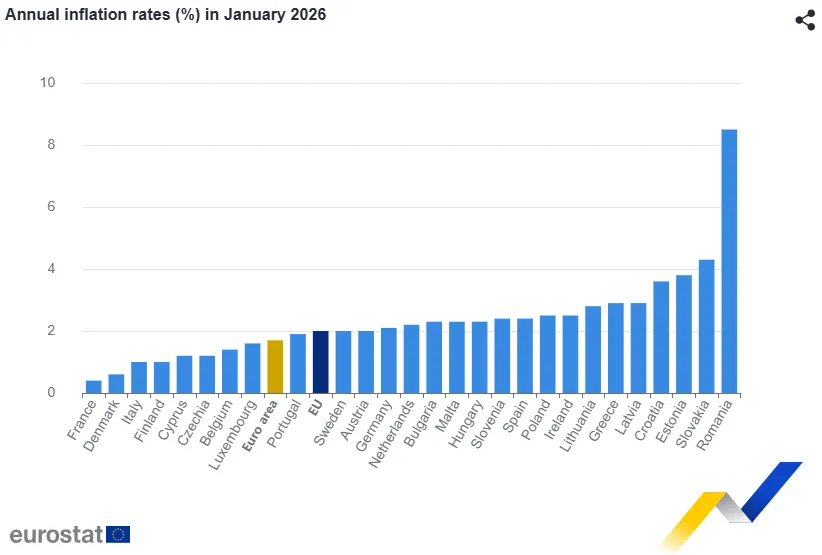
Source: EuroStat
What comes next for EUR/USD?
EUR/USDs next move may depend on the US dollar which has been seeing a resurgence of late. If this persists coupled with the low inflation the EU, EUR/USD could continue its grind lower.
Chatter from Federal Reserve policymakers yesterday aided the USD as they adopted a more hawkish rhetoric. Later in the US session we have a host of Fed policymakers speaking. Are we going to get a similar story to yesterday?
Tomorrow’s speech by ECB President Lagarde at the EU Parliament is the only potential domestic driver for the euro this week, ahead of flash CPI figures on Friday.
As much as chatter around the end of the ‘Trump trade’ has intensified, there are still concentration risks around the US which could hamper the US dollar and thus keep EUR/USD holding the line for now.
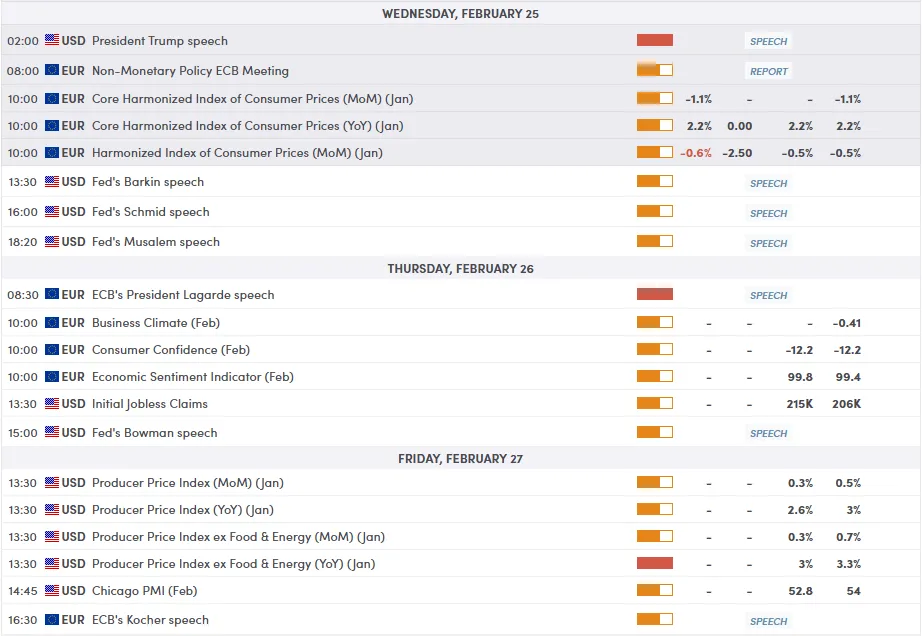
For all market-moving economic releases and events, see the MarketPulse Economic Calendar. (click to enlarge)
Technical Analysis on EUR/USD
EUR/USD is currently in a consolidation phase following a significant rally and subsequent sharp rejection from the 1.2000 psychological resistance level.
Price action is currently being squeezed between a descending trendline and a key horizontal support zone with price right at the apex meaning a breakout is imminent.
This descending triangle pattern suggests that selling pressure is gradually increasing. However, the horizontal support at 1.1769 is holding firm for now.
The pair is trading slightly above its 100-day SMA. This moving average is sloping upward, suggesting that the broader medium-term trend still has a bullish bias, even if the short-term momentum is cooling off.
A few mixed signals but a breakout to the upside of the triangle pattern could facilitate a move higher as the 100-day SMA does hint a overall bullish bias.
Immediate resistance rests at the 1.1840 handle before the 1.1920 and 1.2000 psychological level come into focus.
A move to the downside may find support at the 1.1700 handle. The next target to the downside is the long-term ascending trendline near 1.1600.
EUR/USD Daily Chart, February 25, 2026
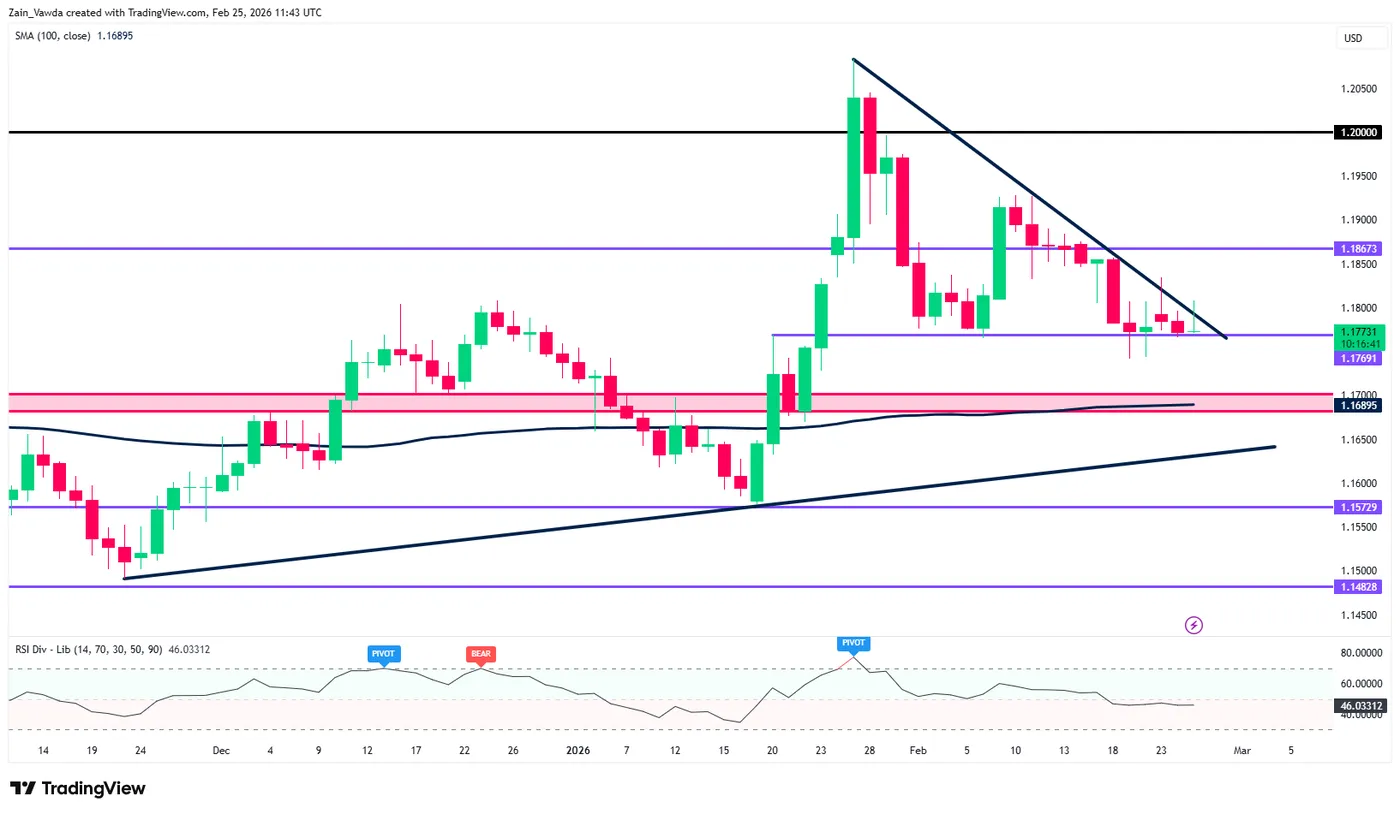
Source:TradingView.com

