- We expect the ECB to raise policy rates by 25bp on Thursday 10 September, taking the deposit rate to 2.50%, in line with consensus and market pricing.
- We expect Lagarde to retain full optionality on the future rate path and offer no firm guidance, limiting the market reaction.
- New staff projections to send mixed signals, while scenarios on core inflation could prove dovish.
We expect the ECB to raise policy rates by 25bp on Thursday 10 September, taking the deposit rate to 2.50%, in line with consensus and market pricing. The move has been well telegraphed by recent comments from GC members and the July minutes. With headline inflation at 3.3%, growth near potential and inflation risks tilted to the upside, the decision is straightforward according to the ECB. Attention will instead focus on signals about further tightening beyond September, which is not as straightforward in our view.
We expect Lagarde to retain full flexibility, leaving the door open to further tightening without pre-committing to additional hikes. Having moved away from forward guidance, she will likely restate the ECB’s reaction function rather than signal a specific rate path. Market rates have risen sharply over the past month amid renewed US-Iran tensions, with short-term pricing implying a peak deposit rate near 3.00% in 2027. While we view these expectations as excessive, we do not expect Lagarde to push back, given persistent upside inflation risks and a solid growth outlook despite tighter financial conditions.
According to the July minutes, some GC members favour moving rates into “mildly restrictive territory”. As a 2.50% deposit rate is generally seen as the upper bound of the neutral range (1.75%-2.50%), another hike cannot be ruled out, posing an upside risk to our call for no further tightening beyond September. However, moving beyond neutral would deliberately curb demand rather than mainly containing upside risks to medium-term inflation. We believe the lack of spillovers from energy to non-energy inflation means the ECB need not enter restrictive territory. An ECB blog post this week argued that unlike in 2022, energy supply has accounted for 90% of the 2026 inflation episode so far, warranting “a more measured monetary policy response”. We thus expect the ECB to keep the deposit rate at 2.50% from September in both 2026 and 2027.
New Staff Projections to Send Mixed Signals, While Scenarios on Core Inflation Could Prove Dovish
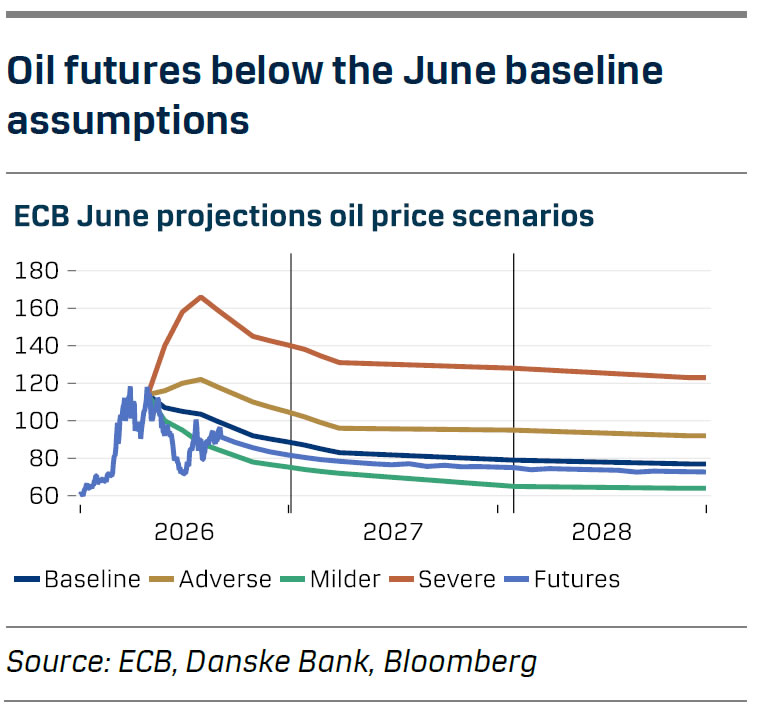
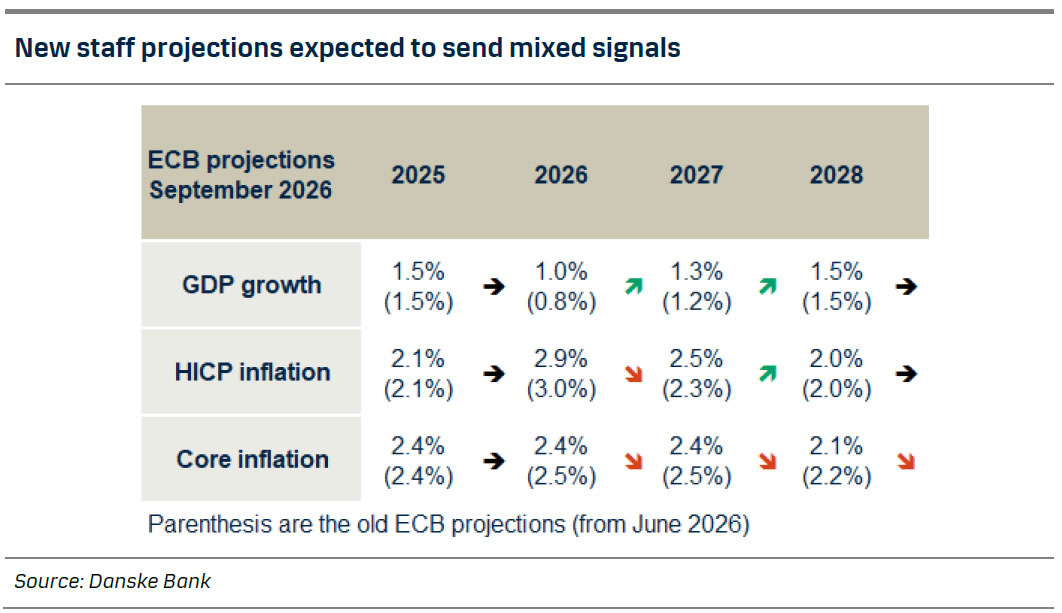
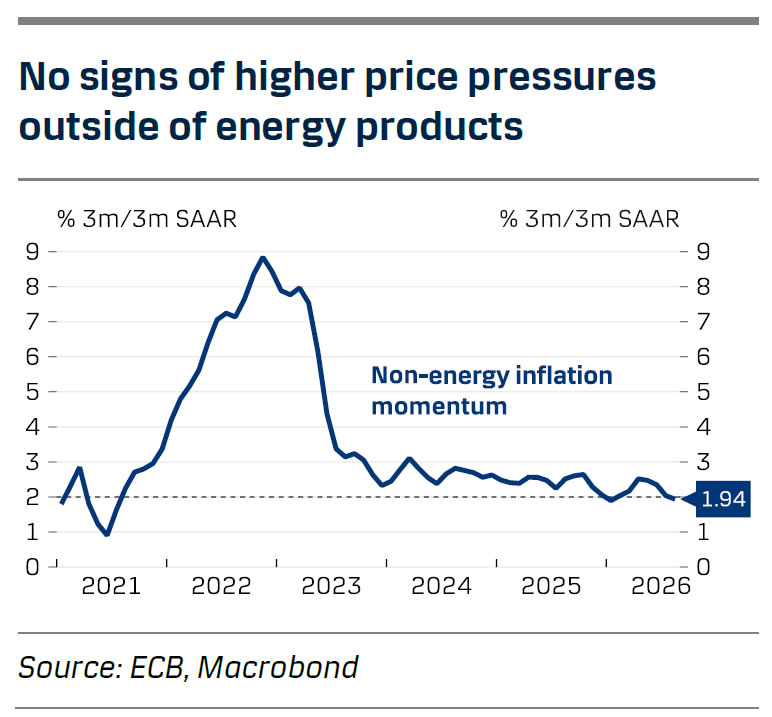
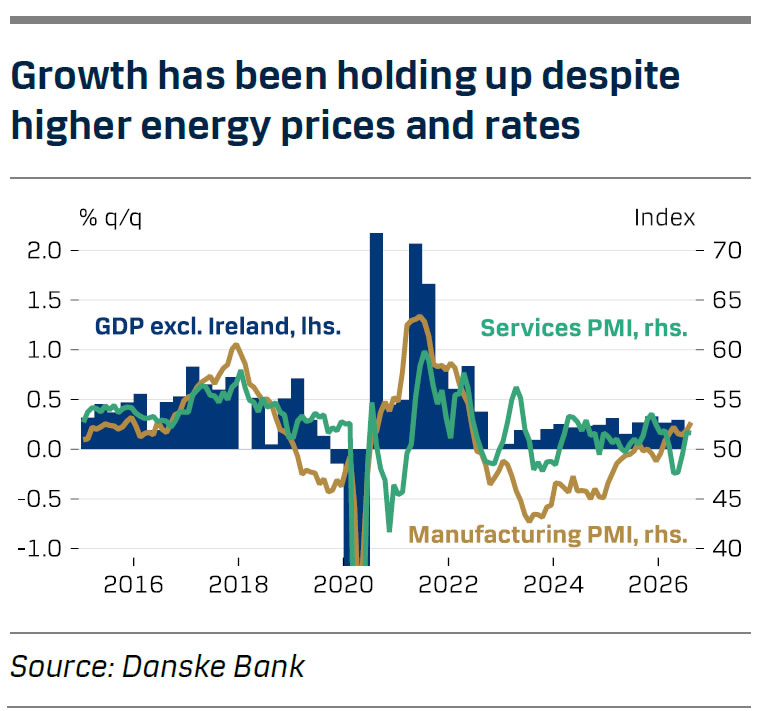
The new staff projections are likely to send mixed signals for the rate outlook: growth may be revised up and core inflation down, while headline inflation could be lowered for 2026 but raised for 2027 (see table below). Growth surprised to the upside in Q2, and the latest PMIs suggest Q3 may also exceed ECB expectations. By contrast, inflation has been weaker than expected over the summer, reflecting oil prices well below the baseline assumptions, softer core inflation and no evidence of spillovers from energy to non-energy prices (see chart). Technical assumptions are likely to include slightly lower oil prices for 2027-28 but markedly higher gas futures – lifting the 2027 inflation forecast.
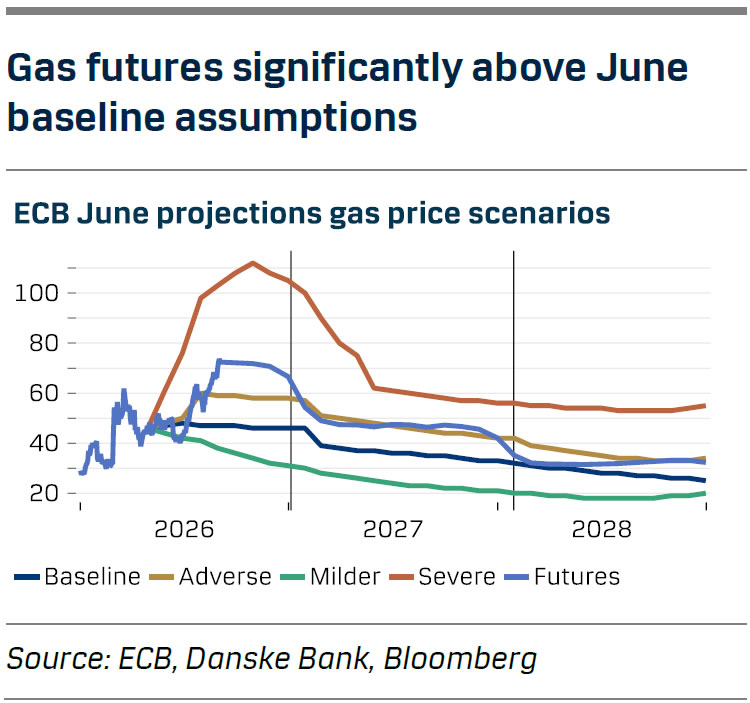
We will also receive a new set of projection scenarios, with particular focus on core inflation. To account for the scale of the energy shock, ECB staff previously assumed a stronger pass-through from energy to core inflation than implied by standard model elasticities. Given the near-absence of pass-through so far, the key question is whether these assumptions will be revised. A downward shift in the core inflation scenarios would lower the assessed risks to medium-term inflation and could be a dovish signal.