


The Global Technology Selloff Showed Signs of Easing on Friday, but Oil and French Sovereign Risks Remain Unresolved
Today’s themes:
- Tech selloff eases: Asian equities recovered from early losses, with KOSPI closing 0.3% higher and the Hang Seng up around 0.7%, while the US 10-year yield rebounded toward 5%.
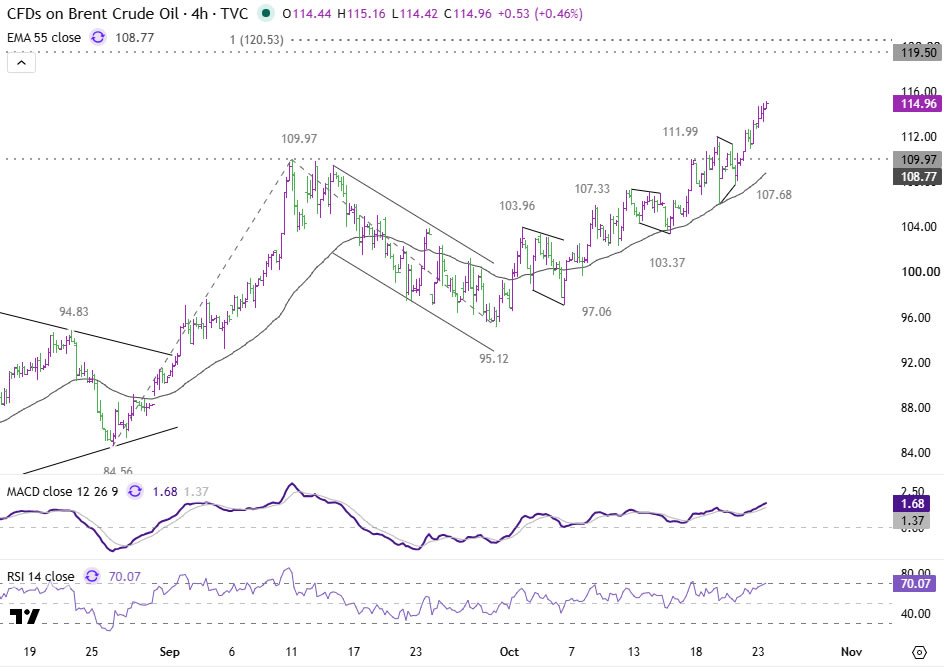
- Brent nears $115: Oil hit its highest level since May and is on course for a third weekly gain, as reports of possible US-Israeli strikes on Iran after the November 3 midterms and Saudi security threats build a geopolitical premium.
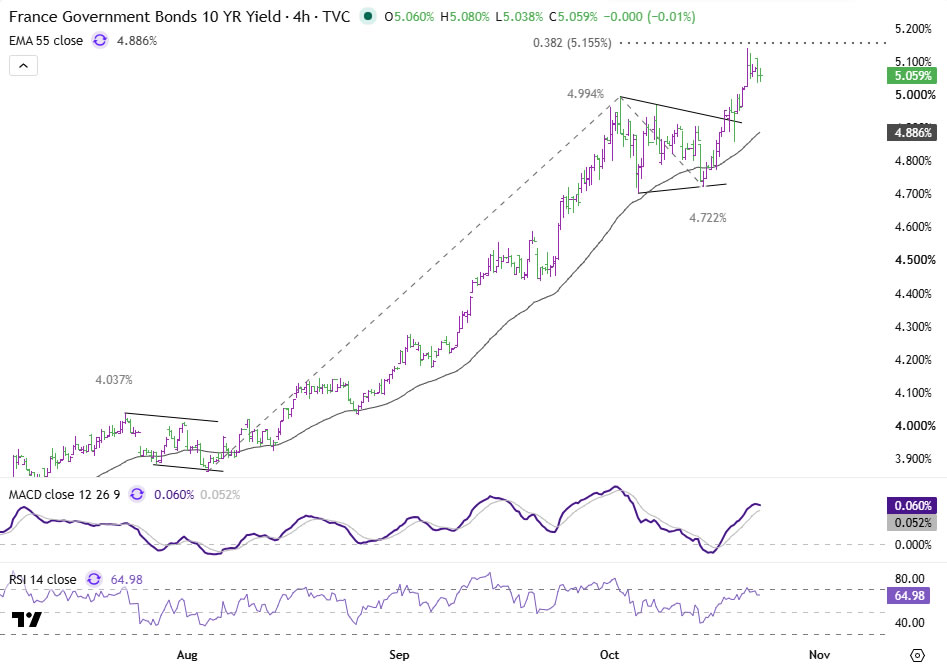
- French stress persists: The 10-year yield is around 5.06%, the spread over Bunds is 172–173bps, and PMI Composite fell to 48.4, with Moody’s review later Friday and Euro the weakest major over the week.
The immediate equity-market retreat may be stabilizing, but geopolitical and sovereign risks have yet to ease materially.
The global technology selloff showed signs of easing on Friday, with Asian equities recovering from earlier losses and the US 10-year yield recovering toward 5%. However, the improvement in broader market sentiment has done little to remove two persistent sources of uncertainty. Brent approached $115 amid renewed Middle East tensions, while Euro remained the weakest major currency over the week as French sovereign risk continued weighing on confidence.
Oil markets are increasingly concerned with reports of possible US-Israeli strikes against Iran after the November 3 midterm elections, particularly as supply buffers remain limited and regional security threats continue. In Europe, France’s private-sector activity has returned to contraction, compounding fiscal and political concerns ahead of Moody’s scheduled rating review. The contrast suggests that the immediate equity-market retreat may be stabilizing, but geopolitical and sovereign risks have yet to ease materially.
Technology Selloff Moderates as Asian Stocks Recover
The technology-led equity selloff began losing momentum during Friday’s Asian session, following Thursday’s sharp losses on Wall Street. Concerns over the financing and eventual returns of large-scale AI investment had triggered heavy selling in semiconductor and technology shares, sending Nasdaq Composite down approximately 2.6%. However, Asian markets recovered significantly from their early declines, suggesting that immediate selling pressure was easing.
Asian Markets: Early Loss vs Close
| Index | Friday’s move |
|---|---|
| KOSPI | Closed 0.3% higher |
| Nikkei | Narrowed its decline to approximately 0.3% |
| Hang Seng | Gained around 0.7% |
US equity futures were comparatively stable, although European stock markets remained under pressure.
The stabilization was also reflected in government bonds. Following Thursday’s sharp Treasury rally, the US 10-year yield rebounded toward 5%, while Dollar recovered modestly. The movements suggest that the immediate flight toward defensive assets was moderating, although they do not establish that concerns over AI investment valuations and funding requirements have been resolved. Against this backdrop, the continued strength in oil and persistent weakness in French government bonds stand out as more independent sources of market uncertainty.
Brent Approaches $115 as Iran Risks Build Ahead of US Midterms
Brent extended its rally toward $115, reaching its highest level since May and remaining on course for a third consecutive weekly gain. The latest advance reflects a growing geopolitical supply-risk premium, supported by renewed attacks on Saudi Arabian infrastructure and reports that the US and Israel have prepared options for another round of military strikes against Iran following the November 3 midterm elections.
Middle East Supply Risks
- Saudi infrastructure: Houthi attacks and claims involving the Shaybah oilfield, the Red Sea port of Yanbu and Dammam airport have reinforced fears of further disruption
- Saudi Aramco: evacuated personnel from its Dhahran headquarters
- US personnel: Washington ordered non-emergency US government employees and their families to leave Saudi Arabia
- Iran: US and Israeli planners reportedly developed options for a short, intensive campaign, with possible targets including nuclear facilities, missile and drone capabilities, and possibly energy infrastructure
- Authorization: no new operation has been approved, and President Donald Trump has reportedly declined to authorize previous proposals
Recent security incidents have heightened concerns about Saudi Arabia’s energy infrastructure and regional transport routes. A separate report that US and Israeli military planners have developed options for a short, intensive campaign against Iran has added another dimension to the oil market’s concerns. The preparations have heightened attention on the period immediately following the US elections, particularly in the absence of a diplomatic breakthrough.
However, military planning should not be confused with a decision to launch strikes. The November 3 election therefore represents a potential escalation window rather than a confirmed deadline for renewed military action. Nevertheless, with the existing Saudi security threats unresolved, the possibility of further confrontation is helping build up oil’s geopolitical premium.
Limited Supply Buffers Keep Oil Sensitive to Further Disruption
The underlying oil balance helps explain why geopolitical developments continue having a substantial market impact despite recovering production and weakening demand.
IEA Oil Balance: Supply Risks vs Demand Counterweight
| Factor | IEA data | Market implication |
|---|---|---|
| Supply | Global supply rose 2.5 million bpd in September to 102.3 million bpd on recovering Gulf production | Recovering production, but no substantial buffer restored |
| Inventories | Observed global inventories about 509 million barrels below end-February levels | Depleted stocks leave markets sensitive to disruption |
| Spare capacity | Effective OPEC+ spare capacity estimated at just 0.27 million bpd | Further attacks could have a disproportionate impact on expectations |
| Demand | Forecast to contract by 2.6 million bpd in 2026 | High prices are already restraining consumption, a longer-term counterweight to the geopolitical premium |
The recovery in production has therefore not restored a substantial buffer against further supply disruptions. Additional attacks on Saudi facilities or renewed confrontation involving Iranian energy infrastructure could have a disproportionate impact on market expectations, particularly while inventories remain depleted.
For now, however, the immediate supply risks appear to be outweighing concerns about weakening demand. Brent’s resilience reflects the market’s sensitivity to potential disruption, rather than evidence that the latest incidents have already caused another major reduction in production.
French Bond Stress Persists as Economic Weakness Deepens
In Europe, sovereign-bond pressure remains concentrated in France, with Euro finishing the week as the weakest major currency on the currency heat map.
French Bond Market
- France 10-year yield: eased only modestly to around 5.06%, compared with Thursday’s 24-year high near 5.14%
- OAT–Bund spread: elevated around 172–173 basis points
The spread remaining elevated indicates that investors continue demanding a substantial premium for holding French government debt.
The concern has broadened beyond fiscal and political uncertainty to include renewed weakness in economic activity. France’s October PMI Composite fell sharply from 51.1 to 48.4, reversing September’s brief return to expansion. PMI Services declined from 51.2 to 48.4, while PMI Manufacturing dropped from 50.6 to 49.3, placing both sectors in contraction.
October PMIs: Previous vs Actual
| Measure | Previous | Actual |
|---|---|---|
| France PMI Composite | 51.1 | 48.4 |
| France PMI Services | 51.2 | 48.4 |
| France PMI Manufacturing | 50.6 | 49.3 |
| Eurozone PMI Composite | 53.1 | 51.9 |
| Germany PMI Composite | 53.8 | 52.8 |
The deterioration contributed to a broader Eurozone slowdown, while Germany continued expanding. Meanwhile, French business confidence weakened sharply amid continuing political instability and uncertainty over the economic outlook.
The latest survey adds another complication for France’s fiscal position. Weaker economic activity could make deficit reduction more difficult, particularly if it restrains tax revenues or increases pressure for government support. However, the PMI does not establish that higher bond yields have directly caused the downturn. The more immediate concern is that economic weakness and sovereign-market pressure are developing simultaneously, reinforcing investor uncertainty about France’s ability to restore fiscal stability.
Moody’s Review and Weekend Protests Present Further Risks
Attention now turns to Moody’s scheduled review of France’s sovereign credit rating later Friday. France currently holds an Aa3 rating with a negative outlook, and a one-notch downgrade to A1 is widely anticipated.
With investors already pricing in substantial fiscal and political uncertainty, the accompanying assessment may prove more consequential than the rating change itself. A downgrade that broadly confirms existing expectations may have limited additional market impact. However, a more negative assessment of fiscal consolidation prospects, political fragmentation or debt sustainability could sustain pressure on French borrowing costs.
Weekend protests present another source of uncertainty. Further demonstrations are planned amid public dissatisfaction and political divisions, while the government faces difficult decisions over spending restraint and deficit reduction. Parliament’s return to budget discussions next week will provide another test of its ability to secure support for fiscal measures.
For now, French sovereign stress remains largely a France-specific problem rather than evidence of a broader Eurozone debt crisis. Nevertheless, persistent yield-spread widening and further deterioration in economic confidence could increase concerns about potential spillovers.
Equities Stabilize, but Oil and French Risks Remain Unresolved
The immediate easing of technology-related selling has helped stabilize broader market sentiment, but the more persistent risks remain concentrated in oil and French sovereign debt.
For oil, the next developments will depend on whether Saudi security threats intensify and whether reported preparations for post-election strikes against Iran progress toward an approved military operation. Diplomatic progress or a clear decision against renewed strikes could reduce the geopolitical premium, while further attacks would reinforce supply concerns.
For France, Moody’s review and the weekend political developments will determine whether the modest retreat in bond yields can develop into more meaningful stabilization. The direction of the OAT–Bund spread will remain important for assessing whether sovereign concerns continue weighing on Euro.
The central distinction is that broader risk aversion has eased, but neither the geopolitical risks supporting Brent nor the fiscal and political concerns weighing on France have been resolved. That divergence leaves markets vulnerable to renewed volatility even if the technology-led equity correction continues stabilizing.
Related Coverage
Gold and Canada
- Gold’s $4,000 Looks Indefensible as Liquidation Fears Overshadow Treasury Rally: Gold is falling below $4,000 even as Treasury yields decline sharply. The AI-driven technology selloff has boosted demand for government bonds, but Gold keeps weakening despite lower nominal and real yields. Analysts point to potential cash-raising and leveraged-position liquidation as explanations, though direct evidence remains limited. Gold’s technical breakdown below $4,066 has brought the $3,924 support region into focus, while Nasdaq’s approaching support at 25,803 could show whether broader market stress is intensifying.
- Canada Retail Sales Rise 1.2% Across All Nine Sectors, September Seen Higher: August retail sales rebounded 1.2% m/m to CAD 74.6 billion, with all nine subsectors recording gains. Core retail sales rose 1.1% and inflation-adjusted volumes increased 1.2%, confirming that the recovery extended beyond automobiles and price-driven fuel spending, with food, household goods and health-related retailers contributing. Statistics Canada’s preliminary September estimate points to another 0.7% increase, although the advance figure remains subject to revision.
Europe and the UK
- Eurozone PMI Composite Slows to 51.9 as France Slips Back into Contraction: PMI Composite fell from 53.1 to 51.9 in October, its lowest in four months, as manufacturing and services growth both weakened. France was the main source of deterioration, with its composite plunging from 51.1 to 48.4 as both sectors returned to contraction, while Germany remained in expansion at a moderating pace. Across the Eurozone, new orders slowed, hiring virtually stalled and manufacturing input inflation accelerated to its fastest since May, pointing to increasingly uneven growth and persistent industrial cost pressures.
- UK PMI Composite Hits Eight-Month High as Hiring Returns After Two Years: PMI Composite rose from 52.0 to 53.1, its highest in eight months, with manufacturing and services both strengthening and new orders growing at their fastest pace in 25 months. Employment returned to growth for the first time since September 2024, driven by services hiring, although input cost inflation accelerated to its highest since June and supply-chain disruptions persisted, leaving the hiring recovery tentative.
- UK Retail Sales Fall 0.4%, but Q3 Growth Holds Up Despite September Weakness: September volumes fell 0.4% m/m, missing the expected 0.1% decline, with annual growth slowing to 0.8% as unusually warm weather disrupted clothing sales and supermarkets and non-store retailers reported weaker demand. Q3 volumes still rose 0.7% on recovering fuel purchases and stronger food sales earlier in the quarter, and upward revisions to July and August suggest consumer spending retained some resilience despite weaker momentum entering Q4.
Asia-Pacific Data
- Japan Core CPI Returns Above 2% as Underlying Inflation Broadens: core CPI accelerated from 1.7% to 2.1% y/y in September, matching expectations and returning above the BoJ’s 2% target for the first time since December 2025. Underlying inflation excluding fresh food and energy rose more sharply from 1.9% to 2.4%, despite continued energy deflation and falling rice prices. The data reinforce the case for further BoJ tightening, although an immediate October hike is not necessarily warranted.
- Japan PMI Composite Holds at 52.3, but Hiring Slows to 14-Month Low: composite unchanged at 52.3 for a second month in October, as PMI Services improved from 51.3 to 52.0 and PMI Manufacturing fell from 54.1 to 53.3. Hiring slowed to a 14-month low, with services employment declining for the first time since August 2025, new orders growth weakened and input cost inflation accelerated even as selling-price inflation eased to a four-month low.
- Australia PMI Composite Slumps to 47.7 as Price Pressures Intensify: activity returned to contraction in October, with the composite falling from 51.3 to 47.7, its lowest since March, and PMI Services dropping from 51.9 to 47.8 in its first contraction since May. New business growth slowed to near stagnation, yet input cost inflation accelerated to its fastest since May and selling price inflation rose for a second month, pointing to weakening demand that is failing to ease business price pressures.
FAQ
Is the technology selloff over?
It showed signs of easing on Friday. KOSPI reversed an early loss of around 1.7% to close 0.3% higher, the Nikkei narrowed its decline to about 0.3% and the Hang Seng gained around 0.7%, while the US 10-year yield rebounded toward 5%. That suggests the flight toward defensive assets is moderating, but it does not establish that concerns about AI investment valuations and funding have been resolved.
Why is Brent near $115?
Brent is at its highest level since May and on course for a third consecutive weekly gain, reflecting a growing geopolitical supply-risk premium. Drivers include attacks on Saudi Arabian infrastructure and reports that the US and Israel have prepared strike options against Iran after the November 3 midterms, though none has been approved. Thin buffers amplify the effect: observed inventories are about 509 million barrels below end-February levels and OPEC+ spare capacity is just 0.27 million bpd.
What is happening with French bonds and Euro?
France’s 10-year yield eased only modestly to around 5.06% from Thursday’s near 5.14%, and the OAT–Bund spread stays around 172–173bps. October PMI Composite fell from 51.1 to 48.4, putting services and manufacturing in contraction, and Euro finished the week as the weakest major currency. Moody’s reviews France’s Aa3 rating, which has a negative outlook, later Friday, with a downgrade to A1 widely anticipated.
Key Takeaways
- The technology selloff eased on Friday, with KOSPI closing 0.3% higher after an early 1.7% loss and the Hang Seng up around 0.7%, after Nasdaq Composite fell about 2.6% on Thursday.
- The US 10-year yield rebounded toward 5% after Thursday’s sharp Treasury rally, suggesting the flight to defensive assets is moderating.
- Brent approached $115, its highest since May, and is heading for a third consecutive weekly gain on Saudi security threats and reported US-Israeli strike options on Iran after the November 3 midterms.
- Military planning is not a decision to strike: no operation has been approved, and the election is a potential escalation window rather than a confirmed deadline.
- IEA data show thin buffers, with inventories about 509 million barrels below end-February and OPEC+ spare capacity at 0.27 million bpd, while demand is forecast to contract by 2.6 million bpd in 2026.
- France’s 10-year yield is around 5.06% with a 172–173bps spread over Bunds, and October PMI Composite fell from 51.1 to 48.4 as both sectors contracted.
- Moody’s reviews France’s Aa3 rating later Friday with a one-notch downgrade to A1 widely anticipated, and Euro was the weakest major currency over the week.
What to Watch Next
For France, the Moody’s outcome, weekend protests and Parliament’s return to budget discussions next week will show whether the modest retreat in yields can become real stabilization, with the OAT–Bund spread the key gauge for Euro.
For oil, watch whether Saudi security threats intensify and whether reported preparations for post-election strikes against Iran move toward an approved operation, since diplomatic progress could reduce the premium while further attacks would reinforce supply concerns.