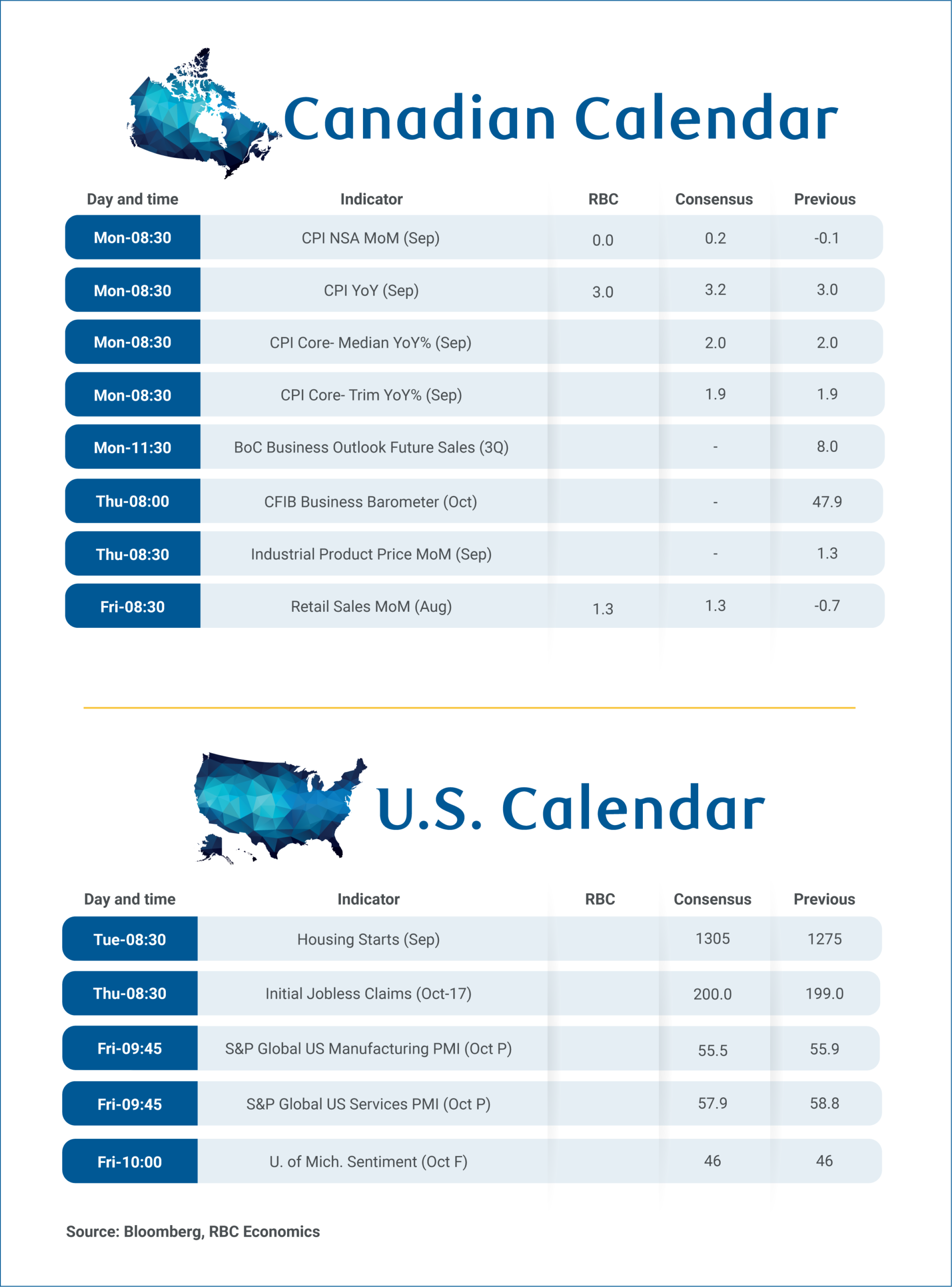
Canadian inflation data and the Bank of Canada’s Q3 Business Outlook Survey on Monday will be watched closely for signs on whether inflation pressures from persistently elevated energy prices are broadening and permeating across the economy.
These releases will serve as key inputs for the BoC’s next interest rate decision on Oct. 28, as policymakers are wary that high oil prices could spill beyond gasoline prices into non-energy components and/or feed into rising business and consumer inflation expectations.
Inflation risks, however, must be balanced against a gradually improving economy that remains soft. Progress has been choppy—GDP growth is set to slow in the second half of 2026 from the stronger pace in Q2, jobs have declined consecutively in August and September, and the unemployment rate has plateaued around 6.5% over the last three months after falling in the prior year.
For now, we continue to expect a somewhat contentious trade-off between inflation and growth risks to keep the BoC uncomfortably on hold through the rest of 2026.
Inflation held up by persistently elevated energy prices
We expect the headline Consumer Price Index in Canada to hold at 3% year-over-year in September for a third consecutive month. Energy inflation likely accelerated as gasoline and furnace oil prices rose significantly from August. Food inflation, however, is expected to continue moderating.
Excluding food and energy, core inflation is expected to have edged down to 1.8% in September from 2.1% in August. We continue to expect limited pass-through of energy inflation in core components outside of airfares, but will watch transportation categories closely since they are most at risk.
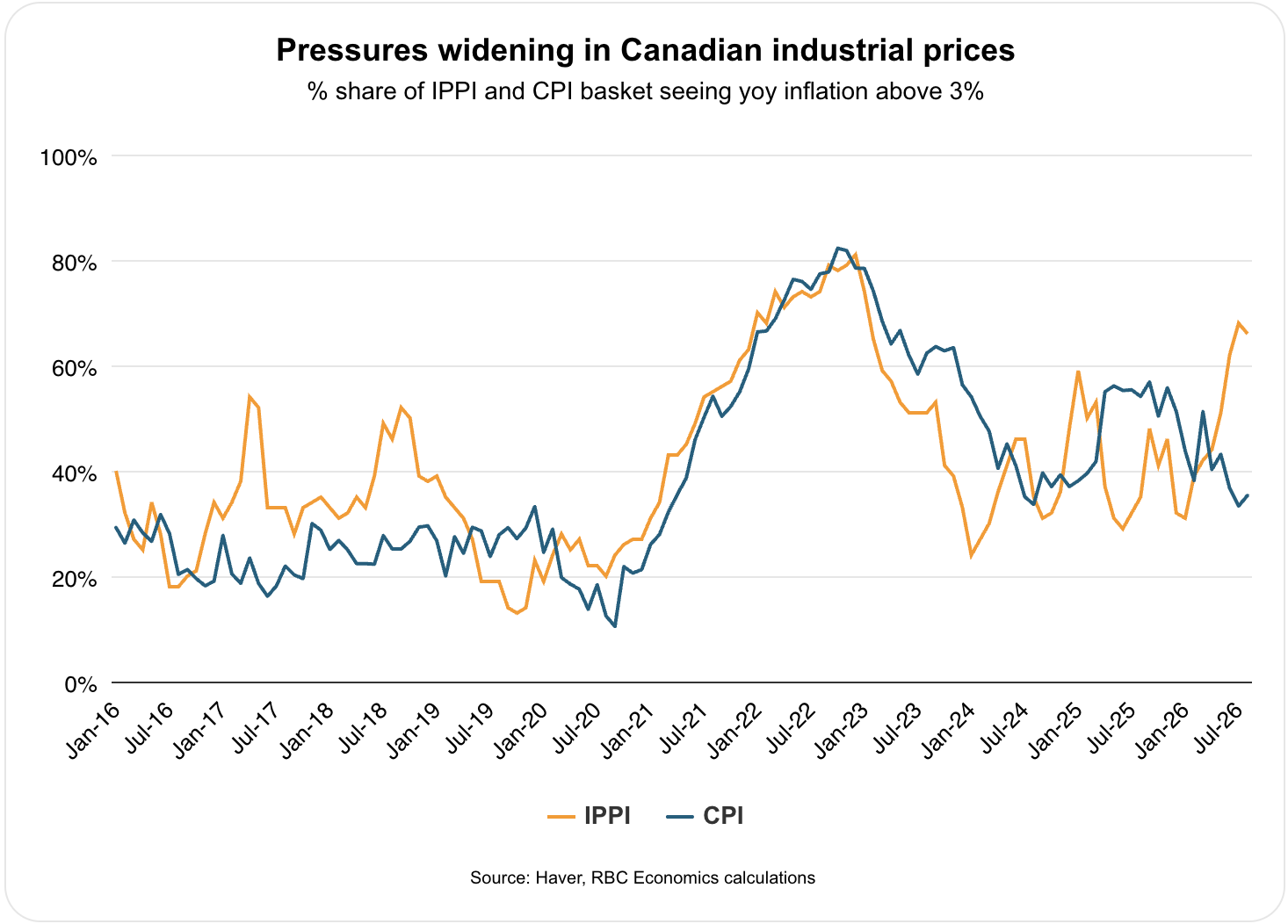
Our CPI diffusion index— a gauge of the breadth of inflation pressures—hasn’t pointed to problematic broadening of scope so far. The share of the consumer basket that has seen annual price growth above 3% remained narrow in August at 35%, well below 54% a year ago.
Still, the same diffusion index for industrial production prices has already pointed to a concerning spread, but there’s a long way to go before price increases get passed down production layers to reach consumer prices on store shelves. Energy prices will need to remain high in between.
Business survey to unveil shifting inflation expectations
Complementing the consumer price data, the third-quarter Business Outlook Survey will offer qualitative signals on the impact of elevated energy inflation, including how it has shaped firms’ expectations.
Business sentiment weakened in Q2 due to higher fuel costs and lingering trade uncertainty. In Q3, those risks escalated instead of receding—the survey period (early to mid-August) coincided with rising oil prices and re-escalations in trade tensions with the imposition of new U.S. Section 338 measures on Aug. 22. We expect these uncertainties to have further weighed on business outlooks.
Changes in firms’ future sales outlooks, investment and hiring intentions, their reports on input and selling price increases, along with shifts in inflation expectations will be watched for details. We expect to see another uptick in firms’ short-term inflation expectations, while medium- to longer-term expectations remain relatively better anchored near the 2% target.
On Monday October 19, Albertans vote on whether to initiate a process toward a future binding referendum on provincial separation. Advance polling opened Tuesday.
Next Friday’s retail sales is expected to align with Statistics Canada’s advance estimate of a 1.3% increase in August. With gas prices flat month-over-month, the expansion was likely driven by increasing sales volumes, consistent with RBC card transactions showing solid spending trends over the summer and continued growth in September, albeit at a slower pace.