


Recent political and fiscal turmoil in the euro area, and the related rise of intra-EMU sovereign spreads has reignited the discussion about the role and independence of the ECB. The most recent example was the proposal of French presidential candidate Mélenchon that the Banque de France should cancel French government bonds on its balance sheet or restructure them into zero-interest perpetual bonds, which would economically amount to the same thing. Political pressure also has been exercised on an almost structural basis in the US, with US president Trump claiming a say in the setting of interest rates. What is at stake is whether central banks can be pressured into facilitating an ‘easy way out’ of (European) fiscal problems, by violating central bank’s independence in pursuing medium-term price stability. Respecting the prohibition of monetary financing of public debt (‘printing money’) is particularly important in this respect, as in in past during the period of Quantitative Easing the red lines have not always been entirely clear.
“[…] we are not here to close spreads. This is not the function or the mission of the ECB. […] there are other actors to actually deal with those issues.” These were the words of ECB president Lagarde at the policy press conference in March 2020. Nevertheless, in July 2021, she oversaw the introduction of the Transmission Protection Instrument (TPI) to intervene, under well-defined conditions, if disorderly and unwarranted sovereign bond market dynamics threaten financial stability in the euro area. The question today is to what extent the ‘moral hazard’ problem has already led the fiscal authorities to take this ECB backstop for granted.
Echo of the ‘Modern Monetary Theory’
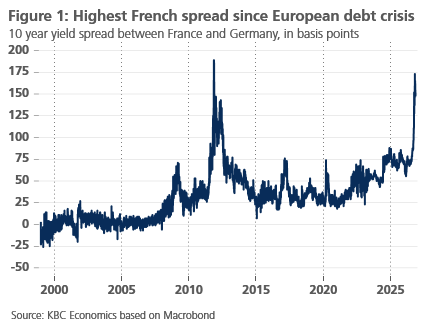
Recent political and fiscal turmoil in the euro area, starting in France, has led to a rise of intra-EMU sovereign spreads (Figure 1).
Against this background, French presidential candidate Mélenchon called on the Banque de France to either cancel (“throw into the fire”) the French government bonds it bought on behalf of the ECB during the period of Quantitative Easing, or to restructure them into zero-interest perpetual bonds. Former Greek Minister of Finance Varoufakis endorsed this proposal.
When Banque de France president Moulin replied that the economic problems at hand should be addressed by the budgetary authorities, Mélenchon used the combination of denying democratic legitimacy of the central bank (“elected by no one”) and personal threats (“act of treason”, hinting at a potential future prosecution).
Although this is an extreme way of putting it, the disagreement fits into a longer-standing debate on central bank independence and the relationship between monetary and fiscal policy. More specifically, Mélenchon’s arguments reminds of the so-called ‘Modern Monetary Theory (MMT)’ (see also KBC Economic Opinions of 21 June 2019 and of 11 June 2021), asserting the prevalence of fiscal policy over monetary policy. According to the MMT, monetary policy only serves to accommodate the public budget balance, while it is the role of fiscal policy to pursue price stability by running appropriate budget surpluses or deficits. In other words, in a MMT framework, there is no independent macro-economic role for monetary central banks other than financing the public budget balance and debt.
The case for independent monetary policy
Debt cancellation by the central bank, as proposed by Mélenchon and Varoufakis, is legally not allowed by the statute of the French central bank and the ECB. Thus prohibits monetary financing of public budget deficits and debts. This by itself is only a formal argument, which says nothing about whether or not the proposal would make economic sense.
From an economic point of view, the reasoning is flawed because it leaves a central piece of how Quantitative Easing works out of the picture. Mélenchon’s claim is that cancelling the bonds from the central bank’s balance sheet would have no economic consequences for anyone, i.e. it would be completely inconsequential, a true free lunch.
However, this reasoning ignores the money created by the ECB (or the euro area national banks) to buy the bonds in the first place during the Quantitative Easing (QE) process. QE was intended as a temporary process, because of the impact on the money supply and the inflationary risks associated with it.1 This is why the ECB is currently running-down its policy portfolios, thereby ‘mopping up’ the previously injected money. Hence, if the purchased bonds are cancelled as proposed, the ECB loses its ‘munition’ to withdraw the money from the system again. It follows that the cancellation would be far from being inconsequential, but rather inflationary in the medium term. Hence, this is a case for central bank independence, shielding it from short-sighted political interference.
The case for independence is more general than just with respect to outright monetary financing of public debt (see also KBC Economic Opinion of 22 January 2019). The painful inflationary experience of the 1970s significantly contributed to this view. Against the explicit wish of the US administration, former Fed Chair Volcker raised US policy rates sharply in the early 1980s, and successfully brought inflation back under control. This policy example contributed to the growing consensus that central bank independence is the most effective way of achieving medium term price stability.
The trend towards more independent central banks since the 1980s was not only driven by empirical evidence, but also by new theoretical insights in the 1970s. The most influential one was Kydland and Prescott’s argument2 that political authorities who are dependent on the electoral cycle have an incentive to boost short term economic growth at the expense of ever-higher inflation (exploiting the so-called Phillips curve). The problem is that, even if the government has no intention to do so, it does not have the means to credibly commit itself for the future. As a result, rational and forward-looking agents will anticipate this inflationary policy bias anyway. This adversely affects current investment expenditure and hence potential growth in the longer term. The only workable solution to avoid this problem is to delegate monetary policy to a politically independent central bank.
Uncertain political environment
Finally, the political debate about public finances and potential implications for the ECB comes at a time of large upcoming personnel changes both with respect to governments and the ECB. This may make defending the ECB’s position harder. On governments’ side, mainly the French presidential elections in April and May 2027 matter, likely followed by parliamentary elections. The fear of the political impact of a new French president has probably been sufficiently large that ECB president Lagarde cut short her mandate by eight months to allow the incumbent politicians to choose her successor before the election. Moreover, there are parliamentary elections in Spain in November 2026, and the political landscape in Germany is far from stable. On the ECB’s side, 2027 will bring the replacement of three senior policy makers: as mentioned ECB president Lagarde and executive board members Schnabel (responsible for market operations), and Chief Economist Lane. The appointment of the successors will be decided by the euro area members of the European Council. The two candidates to succeed Lagarde are Klaas Knot, former president of the Dutch central bank, and Pablo Hernández de Cos, general manager of the Bank for International Settlements. It is unlikely that this personnel choice will be free of any political considerations with respect to the fundamental future policy approach by the ECB.
1 For this reason, the Pandemic Emergency Purchase Programme (PEPP) was a dangerous precedent that should not be repeated. It bordered on monetary financing pandemic-related fiscal expenditure.
2 Kydland and Prescott (1977), “Rules Rather than Discretion: The Inconsistency of Optimal Plans”, Journal of Political Economy, Vol. 85, No. 3





 fiscal problems, by violating central bank’s independence in pursuing medium-term price stability. Respecting the prohibition of monetary financing of public debt (‘printing money’) is particularly important in this respect, as in in past during the period of Quantitative Easing the red lines have not always been entirely clear.)