USD/JPY rose to 159.73 on Monday. The Japanese yen has fallen for a third consecutive day due to a fresh surge in oil prices following the failure of the United States and Iran to reach an agreement at talks in Islamabad.
US President Donald Trump has announced plans to block the Strait of Hormuz and is considering resuming attacks on Iran, dramatically increasing the risks of an escalating global energy crisis.
The protracted conflict is narrowing the Bank of Japan’s room for manoeuvre. A split remains within the regulator: some members are concerned about rising inflation, while others worry about the risks of an economic slowdown. The BoJ is scheduled to meet on 27-28 April.
Economy Minister Ryosei Akazawa noted that monetary policy could be used to curb inflation through support for a stronger yen.
The exchange rate is now approaching the key level of 160 per dollar. Previously, this area served as a trigger for currency interventions by the Japanese authorities.
Technical Analysis
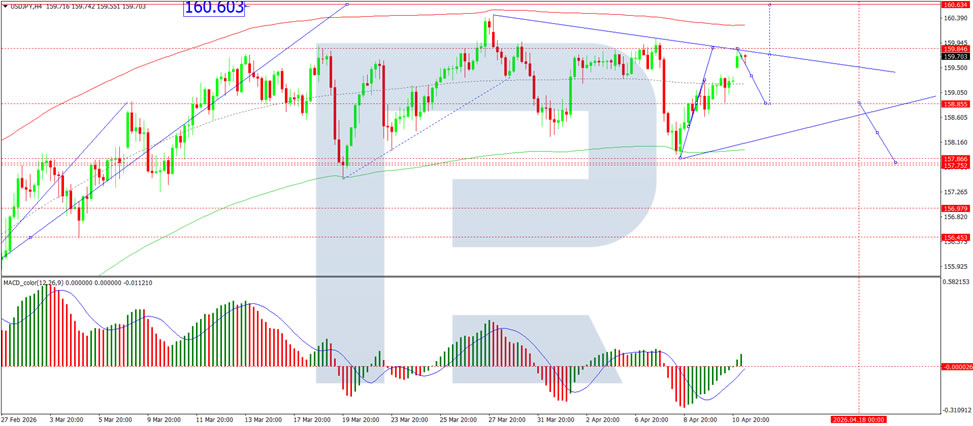
On the H4 chart, USD/JPY formed a consolidation range around the 158.88 level and, with an upside breakout, completed a growth wave to 159.82. Today, the beginning of a correction to the 158.88 level is expected, followed by a rise to 160.60. Subsequently, a new downward impulse to 157.70 is anticipated, with the prospect of a continued correction to 156.00. Technically, this scenario is confirmed by the MACD indicator-its signal line is below the zero level and pointing strictly upwards, reflecting the potential for the wave to continue.
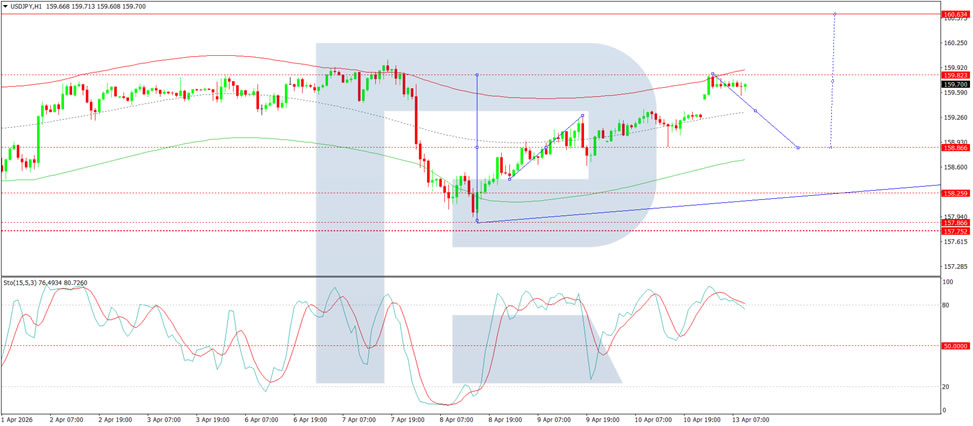
On the H1 chart, the market completed a growth wave structure to 159.82. Today, the probability of the next downward wave developing to the 158.88 level (testing from above) will be considered. The scenario is confirmed by the Stochastic oscillator-its signal line is above the 80 level and pointing strictly downwards to 20, indicating that downside potential remains in the short term.
Conclusion
USD/JPY continues its three-day rally as failed US-Iran talks in Islamabad triggered a fresh spike in oil prices, with President Trump threatening to block the Strait of Hormuz and resume attacks. The yen remains under pressure, while the Bank of Japan faces internal divisions over how to respond to competing inflation and growth risks. With the pair approaching the psychologically significant 160 level-a previous intervention trigger-markets are on high alert for potential action from Japanese authorities. Technical indicators suggest a possible near-term correction before further upside, but the yen’s fate ultimately hinges on whether geopolitical tensions escalate or ease in the coming days.