GBP/CAD is entering a decisive moment as markets prepare for two key economic releases today: UK January GDP and Canada’s February employment report. The data arrives just days before the BoC’s policy decision on March 18 and the BoC’s meeting on March 19, making the numbers particularly influential for near-term policy expectations.
Additionally, these events are unfolding against an unusually volatile global backdrop. The Iran war continues to drag on while oil prices have surged back toward the $100 level, as traders increasingly price the risk of prolonged supply disruptions. For central banks, this environment complicates the policy outlook by raising inflation risks even as growth remains fragile.
For the BoE, market expectations have already shifted dramatically over the past two weeks. Investors previously anticipated a 25bps rate cut from the current 3.75% policy rate. However, the energy shock and renewed inflation fears have pushed consensus toward a hold at next week’s meeting.
That shift places even greater emphasis on today’s UK GDP report. Expectations are already modest, with forecasts centered around a monthly gain of roughly 0.1% to 0.2%. A result in line with those estimates would likely provide relief for BoE policymakers by confirming that the economy is at least maintaining modest growth.
Such an outcome would allow the BoE to keep policy steady while waiting to see how the oil shock affects inflation dynamics. In that scenario, the central bank could delay easing until later in the year once the immediate energy volatility subsides.
However, a negative GDP print would represent a far more troubling outcome. Contraction even before the recent oil surge would strengthen the argument that the UK economy is drifting toward stagflation—an environment where growth weakens while inflation rises due to external energy shocks.
In such a situation, the BoE could find itself effectively paralyzed. Cutting rates to support growth would risk pushing Sterling lower, which would further raise the cost of energy imports and intensify inflation pressures.
On the other hand, the BoC faces a different but equally complex challenge. Markets widely expect the BoC to remain on hold at 2.25% for an extended period, but the oil shock adds a unique twist for Canada as a major energy exporter.
Higher oil prices tend to support Canada’s national income and strengthen the currency, even though they can simultaneously hurt household purchasing power through higher fuel costs. This dual effect makes interpreting economic data particularly important for policymakers.
Expectations for today’s employment report point to job gains of roughly 10,000 to 15,000, with the unemployment rate edging up from 6.5% to 6.6%. Stronger-than-expected employment would reinforce the case for the BoC to maintain its pause while allowing the oil-driven boost to support the economy.
Conversely, a sharp deterioration—particularly if unemployment climbs toward 6.7% or even 6.8%—could force policymakers to reconsider whether an additional “insurance” rate cut might be necessary to support the labor market.
In terms of immediate market reaction, the more volatile and relatively unpredictable Canadian employment report is likely to be the main volatile driver for GBP/CAD. Additionally, the directional bias leans slightly toward further downside in GBP/CAD. If Canadian data holds up, Loonie is well positioned to ride the wave of high oil prices.
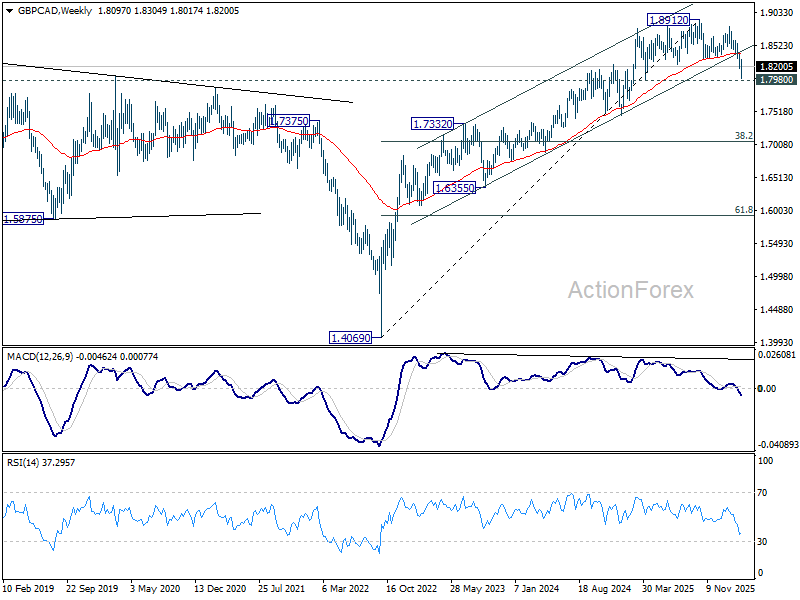
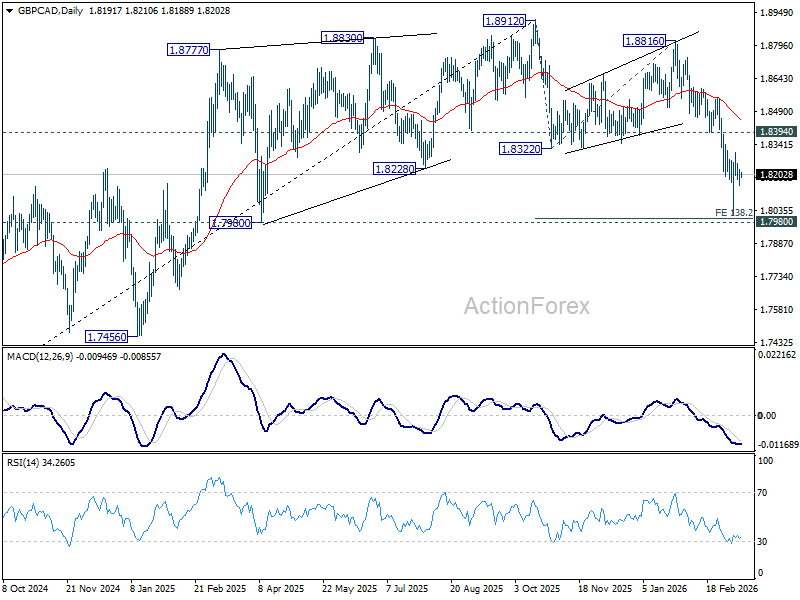
Technically, GBP/CAD is approaching a critical inflection point. The pair is now testing the major psychological and structural support zone around 1.80, near the 1.7980 level 1.382% projection of 1.8912 to 1.8322 from 1.8816 at 1.8001.
The importance of this level is amplified by broader technical signals. GBP/CAD has already broken below its 55 W EMA and the lower boundary of a multi-year rising channel, while bearish divergence has appeared on the weekly MACD indicator.
A decisive break below 1.80 would suggest that the decline from 1.8912 is evolving into a deeper correction of the entire uptrend from 1.4069 (2022 low). Such a move would open the door to a slide toward 38.2% retracement of 1.4069 to 1.8912 at 1.7062 in the medium term.
However, if the pair manages to hold above the 1.80 region and stage a strong rebound, the current move could instead be interpreted as a near term sideway consolidation within the broader uptrend that has defined GBP/CAD since 2022.