


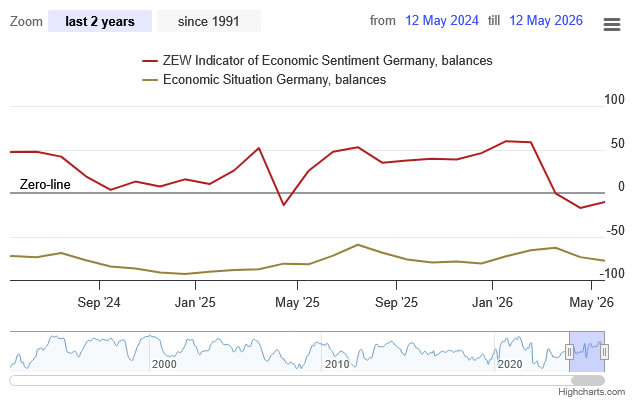
Germany’s ZEW Economic Sentiment index improved from -17.2 to -10.2 in May, beating expectations of -20.5 and signaling a modest improvement in investor confidence despite ongoing economic pressures linked to the Middle East conflict. Eurozone ZEW Economic Sentiment also rose sharply from -20.4 to -9.1, while the Eurozone current conditions gauge improved slightly by 1.6 points to -41.4.
However, the underlying picture for Germany’s economy remained weak. The Current Situation index deteriorated further from -73.7 to -77.8, slightly worse than expectations, highlighting the continued strain from weak industrial production, elevated energy costs, and soft domestic demand.
ZEW President Achim Wambach said financial market experts are increasingly hoping the Iran war will end soon, but warned that rising energy prices and inflation above 2% continue to burden the German economy.
The industry breakdown showed a highly uneven recovery outlook. Germany’s automotive sector deteriorated sharply, with the industry indicator falling to -57.2, while mechanical engineering also weakened further to -32.1. Private demand conditions remained deeply negative and deteriorated further.
By contrast, sentiment improved strongly in information technology, where the indicator jumped to 56.6, while construction and metal production also showed signs of stabilization.
ZEW said there is “cautious hope” for a recovery in the second half of 2026 if Middle East tensions ease and government stimulus measures begin supporting growth more effectively.
| Indicator | Previous | Latest | Expectation |
|---|---|---|---|
| German ZEW Economic Sentiment | -17.2 | -10.2 | -20.5 |
| German Current Situation | -73.7 | -77.8 | -77.5 |
| Eurozone ZEW Economic Sentiment | -20.4 | -9.1 | |
| Eurozone Current Situation | -43.0 | -41.4 | |
| German Automotive Sector Indicator | -44.2 | -57.2 | |
| Mechanical Engineering Indicator | -22.9 | -32.1 | |
| Private Demand Indicator | -33.4 | -41.6 | |
| Information Technology Indicator | 44.5 | 56.6 |





