Bank of Japan left its policy rate unchanged at 1.00%, as widely expected, but delivered a policy package that reinforced its gradual normalization message. The decision was approved by an 8-1 vote, with Takata Hajime dissenting in favor of an immediate 25 basis point hike to 1.25%. Takata argued that Japan had entered “a new phase” requiring “a nimble approach” to address upside inflation risks arising from overseas demand shocks and changes in global financial conditions. While the majority opted to wait, the dissent underscored growing confidence within the Policy Board that inflation risks are becoming increasingly skewed to the upside.
The updated Outlook Report painted a nuanced but constructive picture. The BoJ modestly raised its median GDP forecasts for fiscal 2026 and 2027 while lowering its fiscal 2026 core CPI projection to 2.5% from 2.8%, reflecting an expectation that the impact of higher crude oil prices will gradually fade. At the same time, the Bank lifted its fiscal 2027 inflation forecast to 2.4% from 2.3%, suggesting policymakers see inflation becoming more durable rather than simply driven by temporary energy shocks.
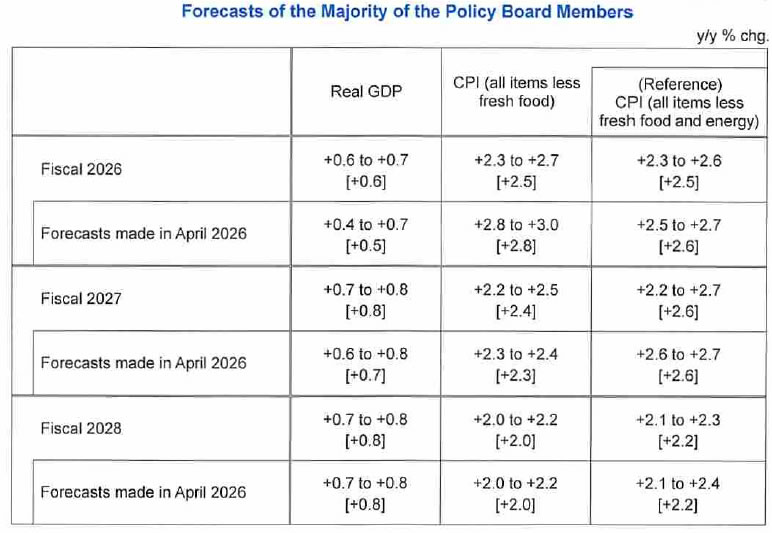
The report stated that CPI inflation is “likely to accelerate to a level clearly above 2 percent” in the second half of fiscal 2026 before easing toward the target as oil effects fade. More importantly, it emphasized that “the mechanism in which wages and prices rise moderately in interaction with each other will be maintained,” allowing underlying inflation to gradually converge with the Bank’s price stability objective.
Perhaps the strongest signal came from the Bank’s forward guidance. The BoJ reiterated that “risks to the outlook for the CPI are skewed to the upside” and warned of the risk that inflation could “deviate upward to a level above the 2 percent price stability target” as firms continue raising wages and prices. It also stated explicitly that it “will continue to raise the policy interest rate and adjust the degree of monetary accommodation” while assessing economic activity, prices and financial conditions. Policymakers highlighted the Middle East, AI-related global demand and exchange-rate developments as key uncertainties.
Taken together, the decision was less about today’s unchanged rate than reinforcing the direction of travel. The BoJ stopped short of signaling when the next move will come, but it made clear that further normalization remains the baseline rather than merely a possibility.
Key Takeaways
- BoJ kept the policy rate unchanged at 1.00%, as widely expected. The decision was approved by an 8-1 vote, but the lone dissent made the meeting more hawkish than the headline suggests.
- Takata Hajime voted for an immediate rate hike to 1.25%. He argued Japan has entered “a new phase” requiring “a nimble approach” to address upside inflation risks stemming from overseas demand shocks and changes in global financial conditions.
- The medium-term inflation outlook improved despite a lower FY2026 forecast. While the median FY2026 core CPI forecast was lowered from 2.8% to 2.5%, the FY2027 projection was raised from 2.3% to 2.4%, indicating the BoJ sees inflation becoming more durable rather than merely driven by temporary energy shocks.
- The BoJ expects inflation to stay above target in the near term. The Outlook Report said CPI is “likely to accelerate to a level clearly above 2 percent” in the second half of fiscal 2026 before gradually easing toward the target as oil-price effects fade.
- The wage-price cycle remains central to the BoJ’s confidence. The Bank said “the mechanism in which wages and prices rise moderately in interaction with each other will be maintained,” supporting a gradual rise in underlying inflation.
- Policy guidance became more explicit. The BoJ stated it “will continue to raise the policy interest rate and adjust the degree of monetary accommodation” while assessing economic activity, prices and financial conditions, reinforcing that further normalization remains the baseline scenario.
- Inflation risks are now explicitly tilted upward. The Bank said risks to economic activity are “generally balanced,” but “risks to the outlook for the CPI are skewed to the upside,” citing the Middle East, AI-related global demand and exchange-rate developments as key uncertainties.