


TL;DR: EUR/USD’s rebound reflects broad-based Euro strength as oil’s rebound since mid-week pushes markets toward the ECB’s own hawkish scenario, lifting September hike odds to roughly 70%.
Euro’s Broad-Based Strength Tells a Bigger Story
EUR/USD has staged a notable rebound in the last 24 hours, but attributing the move solely to Dollar weakness misses a broader shift taking place in currency markets. The Dollar has indeed softened after investors pared expectations for a September Fed rate hike. Yet the Euro has strengthened not only against the Dollar, but against most major peers. That broad-based performance suggests investors are repricing the European Central Bank itself, rather than merely rotating away from weaker currencies.
Oil Is Moving the ECB’s Reaction Function in a Hawkish Direction
The catalyst isn’t that the ECB has changed its policy stance, but that the assumptions feeding its reaction function have shifted. In its March staff projections, the ECB outlined a baseline scenario built around Brent crude averaging around $90 and European natural gas around €57/MWh through 2026, while an adverse scenario assumed oil near $120 and gas around €102/MWh — resulting in materially higher inflation.
That framework has become relevant again. At the ECB’s July 23 press conference, held as Brent broke above $100, President Christine Lagarde remarked that the earlier US-Iran ceasefire had been “short-lived,” leading to “serious developments on commodity markets.” She also stressed the ECB’s reaction function was “very well understood” by markets and projected inflation to remain well above target into the first half of 2027. This week’s renewed attacks involving Iran, US forces, and Saudi energy infrastructure have reversed much of the earlier decline in oil prices, pushing markets back toward the ECB’s own baseline energy scenario.
Oil Doesn’t Trigger Hikes Automatically
Importantly, the ECB hasn’t become mechanically more hawkish simply because oil prices have risen. Lagarde has repeatedly emphasized that policymakers ultimately look for second-round effects — particularly stronger wage growth, firmer services inflation, and higher inflation expectations — before concluding inflation is becoming entrenched.
However, higher oil prices still matter because they shift the starting point. A sustained rise in energy costs lifts the projected path for headline inflation, making it easier for the Governing Council to conclude another rate hike is warranted. In effect, stronger oil prices lower the evidentiary burden for tightening even if second-round effects have yet to fully emerge, because the ECB’s own scenario analysis already treats prolonged energy shocks as sufficient to generate materially higher inflation.
GDP Removes One of the Dovish Arguments
Today’s stronger-than-expected GDP data reinforce that assessment. Eurozone GDP expanded 0.4% qoq in the second quarter, beating expectations and rebounding from the flat first quarter. While hardly signaling an economic boom, the figures weaken one of the main dovish arguments — that growth is too fragile to absorb another rate increase. With activity proving more resilient than expected, the ECB has greater room to tighten policy without immediately risking recession.
Markets and Banks Are Converging on a September Hike
That combination has fed directly into market pricing. Investors now assign roughly a 70% probability to a September rate hike, with much of this week’s repricing driven by renewed oil strength outweighing the more dovish tone that emerged from the ECB’s Sintra forum earlier this month.
Several major banks have moved in the same direction:
- Deutsche Bank now describes a September increase to 2.50% as “highly likely” and close to a “done deal.”
- UOB expects one final 25 basis point hike followed by an extended pause.
- ING notes that around 23 basis points are already priced and argues the ECB has historically preferred to fully telegraph its policy moves.
What to Watch Next
Attention now turns to whether the oil rally proves durable. If tensions involving Iran continue to support energy prices into September, the ECB’s adverse inflation scenario will become increasingly relevant. Conversely, a renewed de-escalation could quickly reduce the urgency for another hike. Investors will also closely monitor upcoming remarks from ECB officials to see whether the stronger GDP data strengthens confidence that another move is becoming appropriate.
ActionForex’s Technical View on EUR/USD
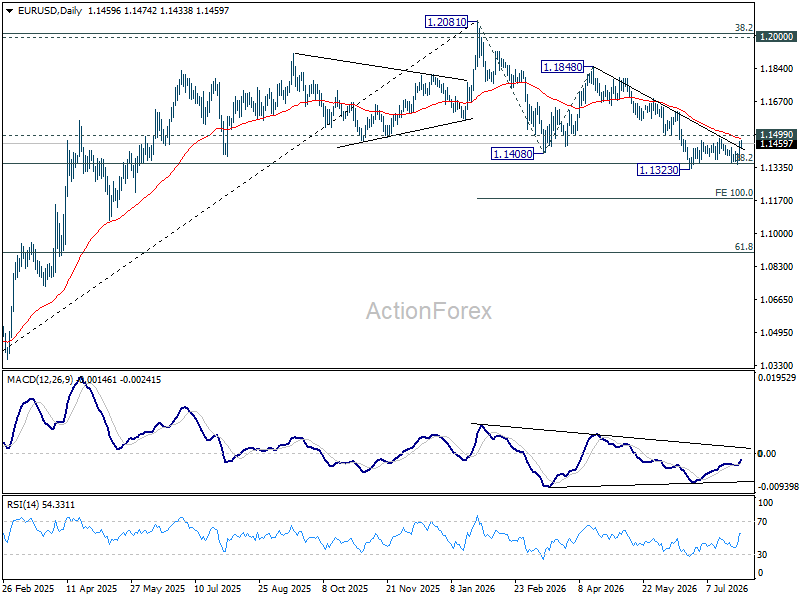
Technically, EUR/USD has improved but has yet to confirm a bullish reversal. The pair remains capped below 1.1499, which has switched from support to resistance. Encouraging signs are nevertheless emerging: the 4H MACD continues to strengthen, price has broken its near-term falling trend line, and the daily MACD continues to display bullish divergence. The pair is also finding support around the 38.2% retracement of 1.0176 to 1.2081, at 1.1353.
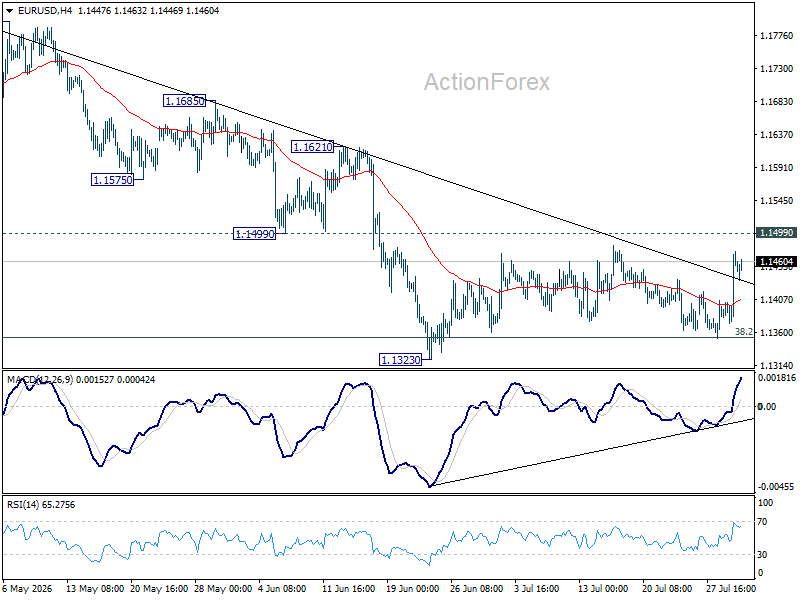
A decisive break above 1.1499, followed by sustained trading above the 55-day EMA at 1.1484, would strengthen the case that the decline from 1.2081 completed as a three-wave correction at 1.1323, opening the way toward 1.1848 and potentially higher.
Nevertheless, failure to overcome 1.1499 would keep the broader decline intact and leave scope for a deeper fall toward the 100% projection of 1.2081 to 1.1408 from 1.1848 at 1.1175.
Key Takeaways
- EUR/USD’s rebound reflects broad Euro strength against most major peers, not just Dollar weakness from fading Fed hike bets.
- Oil’s return above $100 is pushing markets toward the ECB’s own adverse inflation scenario, lowering the bar for another hike without requiring new second-round effects.
- Stronger-than-expected Q2 Eurozone GDP (0.4% qoq) removes the argument that growth is too fragile to absorb another rate increase.
- Markets now price roughly a 70% probability of a September ECB hike, with Deutsche Bank, UOB, and ING all leaning toward a move to 2.50%.
- EUR/USD needs a decisive break above 1.1499 and the 55-day EMA at 1.1484 to confirm the decline from 1.2081 has completed as a corrective structure.





