


TL;DR: With geopolitical risk fading and Brent retreated sharply this week, Gold has settled into a narrow range above $4,000 — leaving today’s FOMC vote breakdown, not the headline rate decision, as the market’s next major catalyst.
Why the Market’s Focus Is Shifting Back to the Fed
Gold has spent much of this week trapped in a narrow, established range, reluctant to break out on either side. The hesitation reflects a broader market transition. Last week, every move was dictated by developments in the Middle East, as fears of supply disruption sent Brent crude briefly above $100 and revived concerns about a renewed inflation shock. This week, that geopolitical premium has faded. Gold has settled into a narrow range above $4,000, and the baton has passed back to the Federal Reserve.
That transition reflects a rapid easing in market anxiety. Following the suspension of military strikes between the United States and Iran over the weekend, Brent crude has fallen sharply toward $80, erasing much of last week’s war premium. Reports on Tuesday suggesting attacks resumed have done little to change the picture, with oil struggling to sustain gains beyond $85. Investors appear to believe a renewed, large-scale US offensive is not currently the most likely outcome, reducing concerns that energy prices will trigger another significant inflation shock.
As a result, both Gold and the Dollar have lost the clear directional impulses that dominated trading last week. Without a sustained energy shock feeding inflation fears, investors are once again looking through the geopolitical noise and back toward the Federal Reserve. That leaves today’s FOMC meeting as the next major catalyst.
Why the Rate Decision Itself Won’t Move Markets
With geopolitical risk fading into the background, attention naturally returns to monetary policy. The FOMC rate decision itself is unlikely to surprise — markets overwhelmingly expect the Fed to leave the federal funds target range unchanged at 3.50–3.75%. Nor is Chair Kevin Warsh expected to offer extensive forward guidance. Since taking office, he has consistently argued the Fed should communicate less about future policy paths and let incoming economic data speak for itself. That philosophy suggests neither the policy statement nor the post-meeting press conference is likely to materially reshape expectations.
Instead, investors are likely to judge the meeting by something far more revealing: the distribution of votes.
The Vote Math: Who’s Hawkish, Who’s Dovish, Who’s Undecided
Fed funds futures currently imply roughly a 79% probability of a September rate hike. Whether that pricing proves justified may depend on how broad support for tighter policy has become within the Committee.
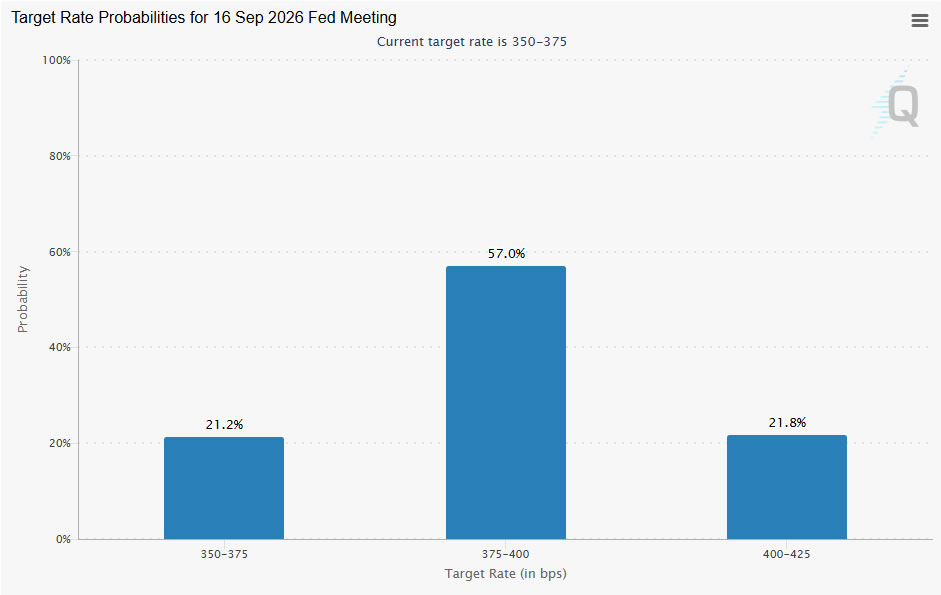
Cleveland Fed President Beth Hammack and Dallas Fed President Lorie Logan are widely expected to support an immediate hike, after consistently warning about persistent inflation risks. On the other side, Vice Chair Philip Jefferson, Governor Lisa Cook, and New York Fed President John Williams are generally viewed as favoring patience and expected to back holding rates steady.
The real uncertainty lies with several influential swing votes:
- Governor Christopher Waller has traditionally been among the Committee’s more dovish members, but recently indicated he would need only one more inflation report before supporting another rate increase. Although June CPI came in softer than expected, that alone may not rule out a hawkish vote.
- Even more closely watched is Warsh himself. While he may avoid signaling future policy intentions publicly, his vote offers a direct window into his own assessment of inflation risks. A vote in favor of tightening would likely be interpreted as a meaningful shift in the Committee’s center of gravity.
- Former Chair Jerome Powell, who remains a Governor, is another unknown after keeping a low profile on policy preferences. Minneapolis Fed President Neel Kashkari also represents a potential wildcard, while Governors Michael Barr and Michelle Bowman, together with Philadelphia Fed President Anna Paulson, round out a Committee whose internal balance is receiving unusually close scrutiny.
If only Hammack and Logan vote for a hike, markets may view the outcome as broadly consistent with current pricing. But if Warsh, Waller, or another influential policymaker joins the hawkish camp, investors could quickly strengthen expectations for a September rate increase. Treasury yields and the Dollar would likely move higher in response, increasing pressure on Gold and raising the risk of a downside break below its recent range.
ActionForex’s Technical View on Gold
Technically, Gold’s decline from the 4,166.08 high has lacked convincing downside momentum, suggesting sellers have yet to seize full control. Nevertheless, near-term risks continue to favor the downside while 4,116.09 minor resistance caps rebounds.
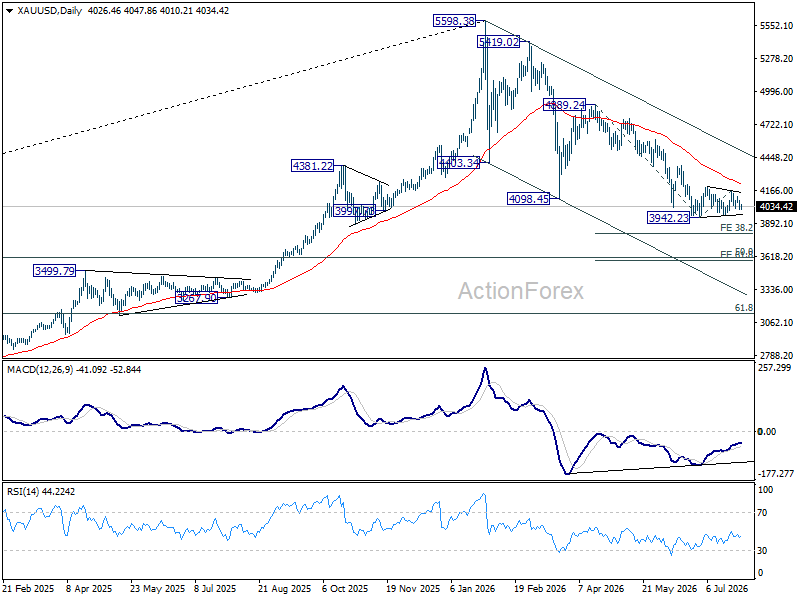
Retesting the 3,942.23 low appears the most likely scenario. A decisive break there would confirm resumption of the broader correction and target the 38.2% projection of 4,889.24 to 3,942.23 from 4,166.08, at 3,804.32. That would expose the next major projection level at 3,580.82.
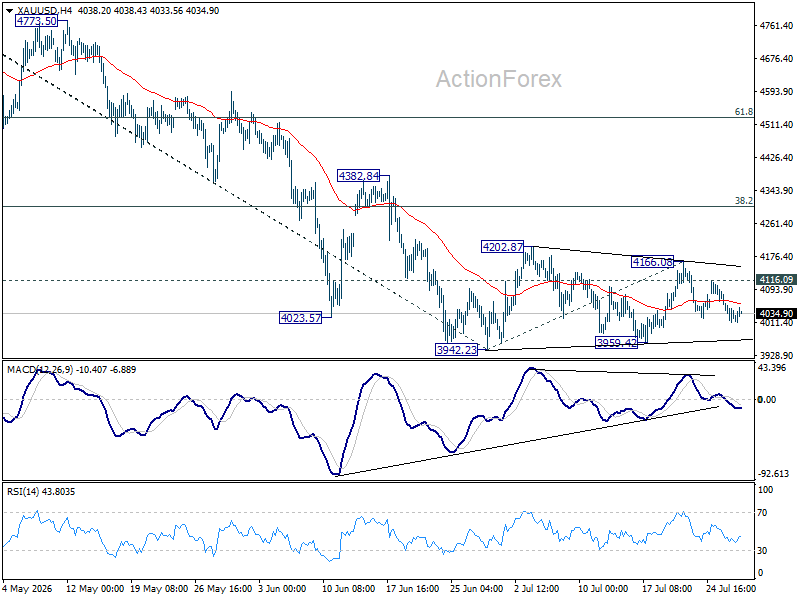
On the upside, a break above 4,116.09 would postpone the bearish scenario and instead signal the consolidation from 3,942.23 is extending. In that case, Gold could recover through 4,202.87 before the broader direction is reassessed.
Key Takeaways
- Gold has settled into a range above $4,000 as fading Middle East risk hands market focus back to the Fed.
- Today’s FOMC rate decision itself is unlikely to surprise — the real signal lies in the voting breakdown, not the headline outcome.
- Waller and Warsh are the two swing votes markets are watching most closely, given their potential to shift the Committee’s hawkish-dovish balance.
- A broader hawkish tilt in the vote count would likely lift the Dollar and Treasury yields, pressuring Gold toward a downside break of its recent range.
- 3,942.23 is the key support to watch; a break there targets 3,804.32, while a rally above 4,116.09 would extend the current consolidation instead.
Related Reading
- FOMC Vote Breakdown Explained: Why the Distribution Matters More Than the Decision.
- Christopher Waller’s Pivot: Is the Fed’s Most Dovish Voice Turning Hawkish?
- Brent Crude’s Retreat from $100: What It Means for Inflation Expectations.
- Gold Technical Outlook: Mapping Support From 3,942 to 3,580.
- Kevin Warsh’s Fed: Why Forward Guidance Is Disappearing.
CTA: Get ActionForex’s real-time coverage of today’s FOMC vote and its impact on Gold — subscribe to Action Insight for updates as the decision lands.





