


The UK’s private sector returned to growth in July as the services sector rebounded after two months of contraction. The S&P Global UK Services PMI rose to 52.1 from 48.8 in June, while the Composite PMI climbed to 52.2 from 49.3, marking the first expansion in overall business activity since April. Higher consumer spending and robust demand for technology services helped lift activity, while manufacturing output also recorded its strongest increase since September 2024.
The recovery extended beyond output. New business increased for the first time in five months, reflecting gradually improving market conditions, although the pace of growth remained modest by historical standards. Survey respondents continued to cite geopolitical uncertainty and the conflict in the Middle East as constraints on demand, despite signs that clients had become less risk-averse. Encouragingly, business confidence improved for a second consecutive month, reaching its highest level since February as firms looked for further easing in inflation pressures and geopolitical tensions.
One area that continues to lag is the labour market. Employment declined for a 22nd consecutive month, matching the longest stretch of job losses in the survey’s three-decade history, previously seen during the global financial crisis and after the dotcom bust. At the same time, input cost inflation slowed to a five-month low, providing some relief for businesses. The latest survey therefore suggests the UK economy is regaining momentum, but the recovery remains uneven, with stronger demand yet to translate into sustained hiring.
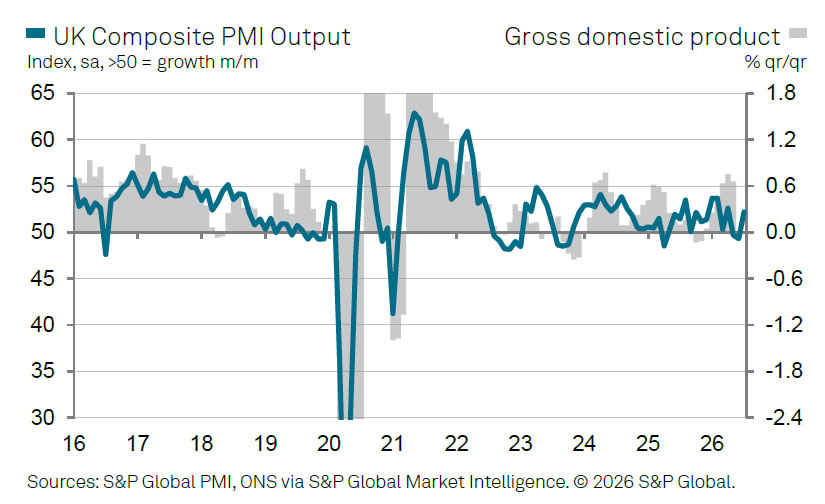
Data Summary
| Component | July 2026 | June 2026 | Trend |
|---|---|---|---|
| Services PMI | 52.1 | 48.8 | ▲ Back in expansion; highest since April |
| Composite PMI | 52.2 | 49.3 | ▲ Returned to expansion |
| Business activity | Expanded | Contracted | Recovery resumed |
| New business | Expanded | Contracted | First rise in five months |
| Business expectations | Highest since February | Improved | ▲ Confidence strengthened |
| Employment | Declined | Declined | ▼ 22nd consecutive monthly fall |
| Input cost inflation | Increased | Increased | ▼ Slowest pace in five months |
| Manufacturing output | Strongest since Sep 2024 | Expanded | ▲ Accelerated |
Key Takeaways
- The UK Services PMI rose to 52.1 and the Composite PMI to 52.2, returning both sectors to expansion for the first time since April.
- Higher consumer spending and solid demand for technology services helped drive the rebound, while manufacturing production recorded its strongest growth since September 2024.
- New orders increased for the first time in five months, suggesting domestic demand is beginning to recover despite ongoing geopolitical uncertainty.
- Business confidence improved for a second consecutive month, reaching its highest level since February on hopes of easing inflation and reduced Middle East tensions.
- The labour market remained the weakest part of the survey, with employment falling for a 22nd straight month, matching the longest period of job losses in the survey’s 30-year history.
- Input cost inflation slowed to a five-month low, providing further evidence that price pressures are gradually easing even as logistics challenges persist.





