


Japan’s PMI Manufacturing eased from 54.9 to 54.1 in September, marking a six-month low but still signalling a solid expansion in the sector. Output growth slowed to its weakest pace in three months, while new orders also lost momentum after August’s multi-year high as some customers adjusted inventories following an earlier period of stock accumulation. Even so, overall new work continued to rise at a historically strong pace.
External demand remained a clear bright spot. New export orders rose sharply, with growth holding close to August’s eight-and-a-half-year high as manufacturers reported stronger demand across a broad range of Asian economies and the US. Employment growth also remained firm, running close to August’s multi-year record and reaching the second-fastest pace since April 2018. That helped ease capacity pressures, with backlogs rising at the slowest pace in six months. S&P Global said the September survey still rounded off the sector’s best quarterly performance since Q1 2014.
Price pressures remained elevated despite some moderation. Input-cost inflation eased to a six-month low but stayed rapid, driven by higher staff, raw-material, energy and transport costs, with firms also citing the Middle East war and weak yen. Manufacturers continued to pass those costs on, leaving selling-price inflation among the sharpest rates recorded since late 2022. Overall, the report points to slower momentum rather than broad weakness, with domestic order growth cooling from high levels even as export demand, hiring and price pressures remained firm.
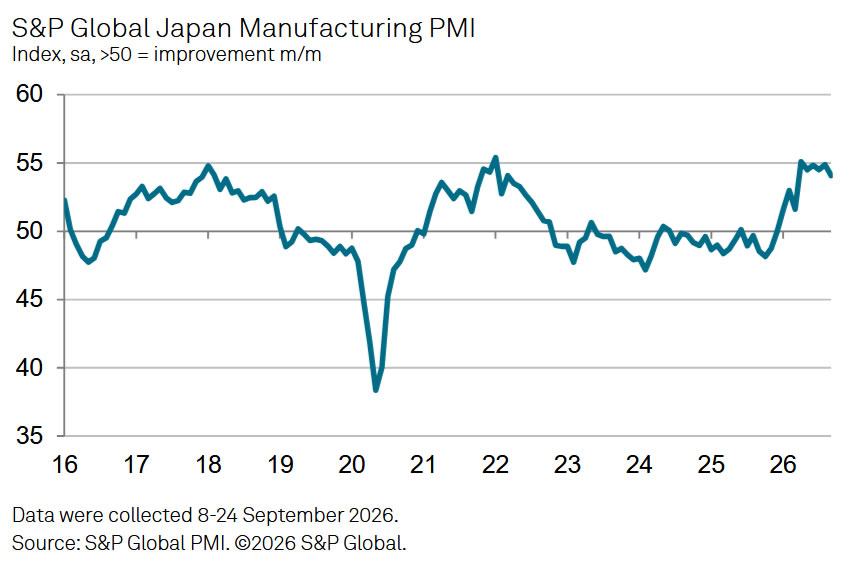
Data Summary
| Indicator | Current month | Previous month | Trend |
|---|---|---|---|
| PMI Manufacturing | 54.1 | 54.9 | Slowed to a six-month low |
Japan’s PMI Manufacturing eased from 54.9 to 54.1 in September, marking the softest pace of expansion in six months while remaining comfortably above the 50 no-change mark.
Components
| Component | Trend |
|---|---|
| Output | Expanded at the slowest pace in three months |
| New Orders | Growth slowed from August’s multi-year high |
| New Export Orders | Rose sharply; growth stayed near an eight-and-a-half-year high |
| Employment | Rose at the second-fastest pace since April 2018 |
| Backlogs | Increased at the slowest pace in six months |
| Purchasing Activity | Continued to rise, but more slowly |
| Supplier Delivery Times | Lengthened sharply |
| Input Prices | Rose rapidly, though inflation eased to a six-month low |
| Output Prices | Rose at one of the fastest rates since late 2022 |
| Business Confidence | Remained strong and above the long-run average |
The details show a sector losing some momentum from August’s strong levels, while export demand and hiring remained notably firm.
Key Takeaways
- PMI Manufacturing fell from 54.9 to 54.1, the lowest in six months, but still signalled solid expansion.
- Output growth slowed to its weakest pace in three months.
- New-order growth also cooled from August’s multi-year high, partly as customers adjusted inventories.
- Export orders remained a clear bright spot, rising sharply and staying close to an eight-and-a-half-year high.
- Employment growth stayed strong, reaching the second-fastest pace since April 2018.
- Backlogs increased more slowly, suggesting some easing in capacity pressure.
- Supplier delivery times lengthened sharply amid shortages of electronic components and AI-related technology.
- Input-cost inflation eased to a six-month low but remained rapid, with firms citing labor, raw materials, energy, transport, the Middle East conflict and weak yen.
- Selling-price inflation remained among the strongest rates seen since late 2022.
- Overall, the report points to slower momentum rather than broad weakness, with exports and hiring still supporting the expansion.





