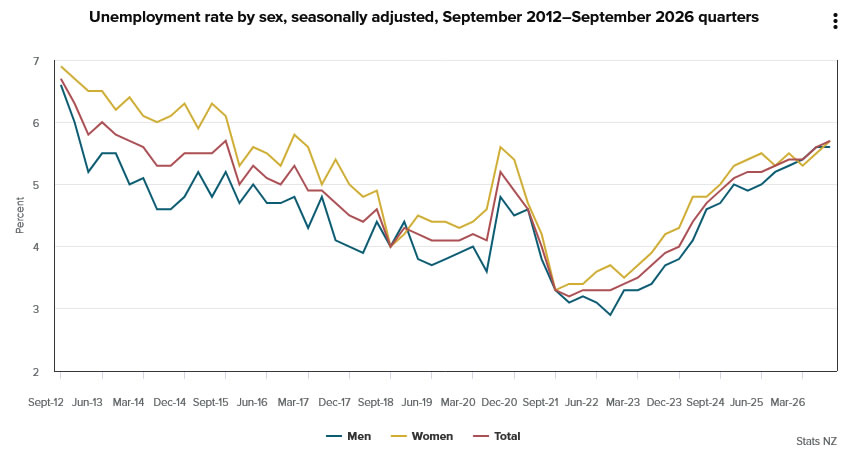
New Zealand’s labour market weakened further in Q3, with unemployment rising from 5.6% to 5.7%, its highest level since 2015, exceeding market expectations of 5.5%. Employment unexpectedly contracted by 0.1% qoq, compared with expectations of a 0.4% increase, following an upwardly revised 0.3% gain in Q2. The number of employed people declined by approximately 5,000 to 2.891 million, while the employment rate fell from 66.7% to 66.4%. Labour force participation also slipped to 70.4%, below the 70.7% consensus. The unemployment rate exceeded RBNZ’s own forecast of 5.5%, challenging its earlier expectation that labour-market conditions would begin stabilizing.
The underlying employment details point to broader weakness than the modest headline contraction suggests. Full-time employment fell by 17,000 during the quarter, partly offset by an increase of 15,000 part-time positions. Actual hours worked declined 1.6% qoq, while usual hours worked fell 0.5%, indicating that businesses were reducing labour utilisation beyond outright job cuts. The underutilisation rate remained elevated at 13.8%, representing approximately 438,000 people, while the number of unemployed rose to 174,000. Stats NZ also reported continued growth in casual and fixed-term employment over the year. Labour market spokesperson Abby Johnston noted that “there was a shift towards part-time employment over the quarter,” which contributed to declines in both usual and actual hours worked.
Wage developments provided additional evidence of subdued private-sector labour cost pressure, although the broader picture was mixed. Private-sector Labour Cost Index growth excluding overtime slowed from 0.7% to 0.4% qoq, below expectations of 0.5%, while its annual increase eased from 2.1% to 2.0%. However, the broader all-sector LCI accelerated from 2.0% to 2.1% yoy, and average ordinary hourly earnings growth edged up from 2.8% to 2.9%. The distinction suggests that private-sector wage pressures are moderating, but does not establish a uniform slowdown across all wage measures. Combined with declining hours and a shift toward part-time work, the figures indicate that labour-market conditions remain weak despite tentative signs of improvement elsewhere in the economy.
The deterioration complicates the case for further RBNZ tightening, particularly after the central bank unexpectedly held its Official Cash Rate at 2.75% last week to assess the effects of two previous increases. The rise in unemployment beyond RBNZ’s forecast, unexpected employment contraction and weaker private-sector labour cost growth strengthen the argument for allowing existing monetary restraint more time to work through the economy. Kiwibank economists observed that “a weak labour market acts as a pressure lid on price growth,” suggesting that additional increases may prove unnecessary if the trend persists. Nevertheless, RBNZ has maintained that further tightening could still be required, leaving the outlook dependent on whether persistent inflation pressures outweigh emerging labour-market weakness.
Data Summary
New Zealand Labour Market — Q3 2026
| Indicator | Previous | Q3 2026 |
|---|---|---|
| Unemployment rate | 5.6% | 5.7% |
| Employment change qoq | +0.3% | -0.1% |
| Employment rate | 66.7% | 66.4% |
| Participation rate | 70.5% | 70.4% |
| Underutilisation rate | 13.8% | 13.8% |
| Employed people | 2.896M | 2.891M |
| Unemployed people | 171K | 174K |
Employment Composition — Q3 Changes
| Component | Change |
|---|---|
| Full-time employment | -17,000 |
| Part-time employment | +15,000 |
| Actual hours worked | -1.6% |
| Usual hours worked | -0.5% |
| Employment rate | -0.3 pp |
| Underutilised people | 438,000 total |
Wage Growth
| Indicator | Previous | Q3 2026 |
|---|---|---|
| Private LCI ex. overtime qoq | +0.7% | +0.4% |
| Private LCI ex. overtime yoy | +2.1% | +2.0% |
| All-sector LCI yoy | +2.0% | +2.1% |
| Ordinary hourly earnings yoy | +2.8% | +2.9% |
Market Expectations and Reaction
| Indicator | Actual | Comparison |
|---|---|---|
| Unemployment | 5.7% | Consensus 5.5% |
| Employment qoq | -0.1% | Consensus +0.4% |
| Private LCI qoq | +0.4% | Consensus +0.5% |
| RBNZ unemployment forecast | 5.5% | Actual 5.7% |
| NZ two-year swap rate | 3.7815% | Down ~6bps |
| NZD/USD | ~0.5592 | Recovered after initial dip |
Key Takeaways
- Unemployment reached an 11-year high: New Zealand’s jobless rate increased from 5.6% to 5.7% in Q3, above both the 5.5% consensus and RBNZ’s forecast. The number of unemployed rose to 174,000.
- Employment unexpectedly contracted: Employment fell 0.1% qoq, against expectations of a 0.4% increase. The employment rate declined from 66.7% to 66.4%, highlighting continued labour-market weakness despite tentative signs of economic recovery.
- Employment composition revealed deeper weakness: Full-time jobs declined by 17,000, partially offset by 15,000 additional part-time positions. Actual hours worked fell 1.6%, significantly exceeding the contraction in employment, suggesting reduced labour utilisation.
- Underutilisation remained elevated: The underutilisation rate held at 13.8%, representing approximately 438,000 people. This indicates substantial untapped labour capacity beyond those officially classified as unemployed.
- Private-sector wage pressure moderated: Private-sector LCI growth excluding overtime slowed from 0.7% to 0.4% qoq, while annual growth eased from 2.1% to 2.0%. However, broader all-sector wage measures showed modest increases, indicating that wage moderation was not uniform.
- Further RBNZ tightening becomes harder to justify: The employment deterioration supports RBNZ’s recent decision to hold its OCR at 2.75% while assessing the effects of previous hikes. However, persistent inflation risks mean further tightening cannot yet be ruled out.
- Interest-rate markets reacted more clearly than NZD: New Zealand’s two-year swap rate fell approximately 6bps to 3.7815%, while NZD/USD recovered toward 0.5592 after an initial decline.