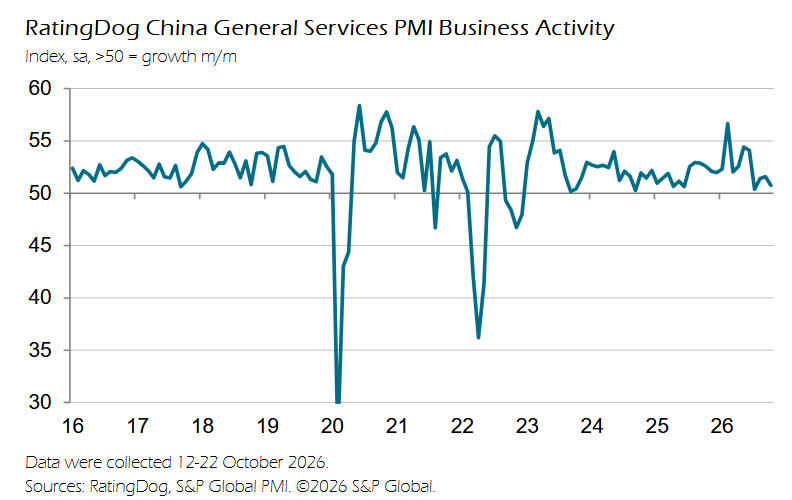
China’s private services sector continued expanding in October, although growth moderated to its weakest pace in three months. RatingDog PMI Services fell from 51.6 to 50.8, below market expectations of 51.5, as operational constraints and slower growth in new business weighed on activity. PMI Composite eased from 52.4 to 52.0, also a three-month low, with faster manufacturing output growth insufficient to offset the moderation in services. Both readings remained above the 50 expansion threshold, indicating that private-sector activity continued growing at the start of Q4, albeit with less momentum.
Underlying demand and employment conditions were more resilient than the headline slowdown suggested. Services new business continued increasing at a solid pace, supported by business development efforts and new client wins. Export orders expanded for a sixth consecutive month, although growth softened from September and remained modest. Services employment also increased for a sixth straight month, with hiring accelerating as firms recruited additional full-time and part-time workers to manage workloads. Greater workforce capacity, together with reported AI-enabled efficiency improvements, helped reduce outstanding business for the first time since October 2025. However, business confidence slipped to a three-month low amid concerns about rising costs and intensifying competition.
Profitability pressures intensified as input costs accelerated while selling prices continued falling. Services input cost inflation reached a five-month high, driven by higher labour, raw material and oil costs, alongside increased social security expenses reported by some companies. Despite these pressures, firms reduced output charges for a second consecutive month as competition and promotional discounts constrained pricing power. The same divergence appeared across the broader private sector, where both manufacturing and services cut selling prices even as operating costs rose. RatingDog founder Yao Yu noted that “renewed discounting and rising cost pressures weighed on profitability.” The figures suggest that China’s private-sector expansion remains supported by new orders and hiring, but increasingly competitive pricing conditions are making it harder for businesses to translate continued activity growth into stronger margins.
Data Summary
China RatingDog PMI — October 2026
| Indicator | September | October |
|---|---|---|
| PMI Services | 51.6 | 50.8 |
| PMI Composite | 52.4 | 52.0 |
PMI Services missed market expectations of 51.5. Both indices remained above 50, indicating continued expansion, but at their slowest pace in three months.
Services — Key Components
| Component | October Trend |
|---|---|
| Business activity | Growth slowed to three-month low |
| New business | Solid growth, slightly slower |
| Export orders | Sixth consecutive monthly increase |
| Employment | Hiring accelerated |
| Outstanding business | Fell for first time in a year |
| Input costs | Inflation at five-month high |
| Output prices | Fell for second consecutive month |
| Business confidence | Three-month low |
PMI Composite — Key Components
| Component | October Trend |
|---|---|
| Private-sector output | Growth slowed |
| Manufacturing output | Growth accelerated |
| Services activity | Growth slowed |
| New business | Continued expanding |
| Export orders | Continued expanding |
| Employment | Increased, driven by services |
| Input costs | Continued rising |
| Output prices | Declined across both sectors |
| Business optimism | Weakened |
Key Takeaways
- Services growth moderated: RatingDog PMI Services declined from 51.6 to 50.8, below expectations of 51.5 and its weakest reading in three months. Operational constraints and slightly slower new business growth contributed to the slowdown.
- Private-sector expansion continued at a softer pace: PMI Composite eased from 52.4 to 52.0, with faster manufacturing output growth insufficient to offset weaker services activity. Both indices remained above the expansion threshold.
- New business remained relatively resilient: Services new orders continued increasing at a solid pace, supported by customer acquisition and business development efforts. Export orders grew for a sixth consecutive month, although overseas demand growth moderated.
- Hiring accelerated despite weaker activity growth: Services employment expanded for a sixth consecutive month, with companies recruiting additional full-time and part-time workers. Greater staffing capacity and reported AI-enabled efficiencies helped reduce backlogs for the first time since October 2025.
- Rising costs and falling selling prices squeezed margins: Services input cost inflation reached a five-month high, driven by labour, raw materials, oil and other expenses. Yet companies reduced selling prices for a second consecutive month amid intense competition.
- Pricing pressure extended across the private sector: Both manufacturing and services reported declining output charges despite rising input costs, indicating limited pricing power and growing pressure on profitability.
- Business confidence weakened: Services sentiment fell to a three-month low as companies expressed concerns about higher operating costs and stronger competition, despite continued expectations for future business expansion.