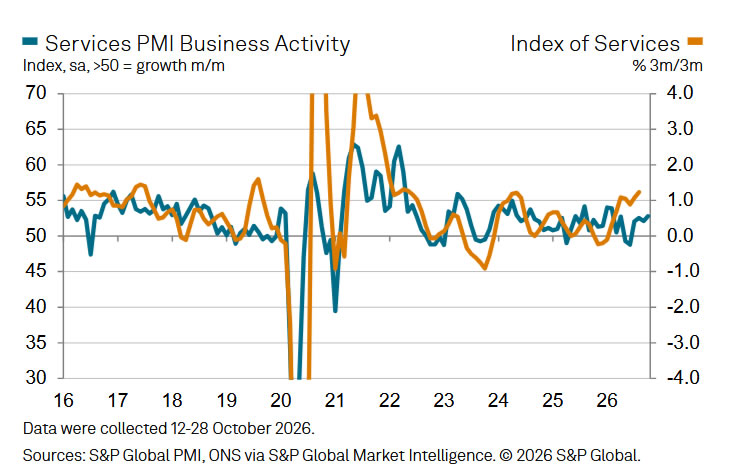
UK private-sector growth accelerated to an eight-month high in October, with PMI Composite rising from 52.0 to 52.9, supported by stronger activity across manufacturing and services. PMI Services increased from 52.1 to 52.8, its highest reading since February, marking a fourth consecutive month of expansion. New business growth strengthened to its fastest pace since January in services and a nine-month high across the broader private sector. Improving domestic demand, stronger order books and AI-related investment spending supported the upturn, while manufacturing production recorded its fastest expansion since September 2024. However, services export orders continued declining slightly, and the headline services index remained below its long-run average of 54.2.
Employment returned to growth for the first time in 25 months, driven by renewed hiring in services as firms responded to stronger workloads and improving sales opportunities. Services companies increased staffing for the first time in just over two years, ending a prolonged period of workforce reductions. However, job creation remained marginal, with some businesses maintaining hiring freezes because of elevated costs and others citing AI adoption and efficiency improvements as reasons for not replacing departing staff. Services business confidence also rose to its highest level since February, supported by improving demand expectations and reduced client risk aversion, although optimism remained below its long-run average. Continued reductions in outstanding workloads suggested that capacity pressures were still limited despite stronger activity.
Inflation pressures intensified alongside the recovery in business activity. Services input cost inflation accelerated for a third consecutive month to a five-month high, driven by higher fuel, transportation, energy, wage and raw material expenses. Around 38% of surveyed firms reported rising input prices, compared with only 1% reporting declines. Composite input cost inflation also reached its highest level since June, with faster increases across both manufacturing and services. Selling prices continued rising robustly, although services output price inflation eased slightly from September as competition constrained pricing power. S&P Global’s Tim Moore highlighted the combination of “faster output growth and stronger price pressures,” arguing that it reinforced expectations for a BoE rate hike in November and increased the likelihood of further tightening into 2027. The survey therefore points to firmer economic momentum and a tentative improvement in labour demand, but persistent cost pressures and still-cautious hiring limit the evidence for a broad, sustained recovery.
Data Summary
UK PMI — October 2026 Final
| Indicator | September | October |
|---|---|---|
| PMI Services | 52.1 | 52.8 |
| PMI Composite | 52.0 | 52.9 |
Both indices reached their highest levels since February. PMI Services remained below its long-run average of 54.2.
PMI Services — Key Components
| Component | October Trend |
|---|---|
| Business activity | Fastest growth in eight months |
| New business | Fastest growth since January |
| Export orders | Declined slightly |
| Employment | First increase in over two years |
| Outstanding business | Continued declining |
| Input costs | Inflation at five-month high |
| Output prices | Inflation eased slightly |
| Business confidence | Highest since February |
PMI Composite — Key Components
| Component | October Trend |
|---|---|
| Private-sector output | Eight-month high |
| Manufacturing output | Fastest growth since Sep 2024 |
| Services activity | Growth accelerated |
| New business | Fastest growth in nine months |
| Export orders | Returned to growth |
| Employment | First increase in 25 months |
| Input costs | Inflation highest since June |
| Business optimism | Improved |
Key Takeaways
- UK private-sector growth accelerated: PMI Composite increased from 52.0 to 52.9 in October, while PMI Services rose from 52.1 to 52.8. Both reached their highest levels since February, signalling firmer activity across manufacturing and services.
- New business strengthened: Services new orders grew at their fastest pace since January, supported by improving domestic demand, business development opportunities and AI-related investment spending. Composite new business growth reached a nine-month high.
- Hiring returned after more than two years: Private-sector employment increased for the first time in 25 months, driven by services. However, job creation remained marginal as businesses continued prioritizing cost control and efficiency improvements.
- Business confidence improved: Services expectations rose to an eight-month high, supported by stronger sales prospects and reduced client risk aversion. Nevertheless, confidence remained below its long-run average.
- Input cost inflation accelerated: Services input price inflation reached a five-month high, driven by higher fuel, transportation, energy, wage and raw material expenses. Composite input inflation was the strongest since June.
- Selling-price inflation eased slightly: Services firms continued raising prices to recover higher costs, but the pace moderated from September as competition constrained pricing power.
- BoE tightening expectations received support: S&P Global’s Tim Moore argued that stronger growth and persistent cost pressures reinforced expectations for a November BoE hike, with the possibility of further tightening into 2027. This remains his interpretation rather than an explicit policy signal from BoE.