

Sample Category Title
EUR/JPY Weekly Outlook
EUR/JPY stayed in the corrective pattern from 139.99 last week and outlook is unchanged. Initial bias stays neutral this week first. On the downside, break of 132.63 will target 61.8% retracement of 124.37 to 139.99 at 130.33. On the upside, break of 138.33 will indicate that the correction has completed, and bring retest of 139.99 high next.
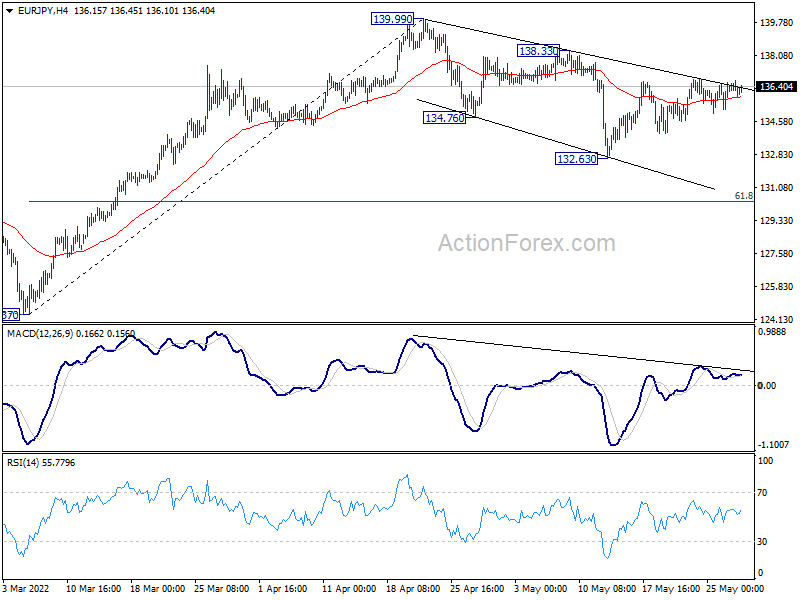
In the bigger picture, up trend from 114.42 (2020 low) is in progress. Such rise is seen as the third leg of the pattern from 109.30 (2016 low). Next target will be 100% projection of 114.42 to 134.11 from 124.37 at 144.06. In any case, outlook will now remain bullish as long as 124.37 support holds, in case of deep pull back.
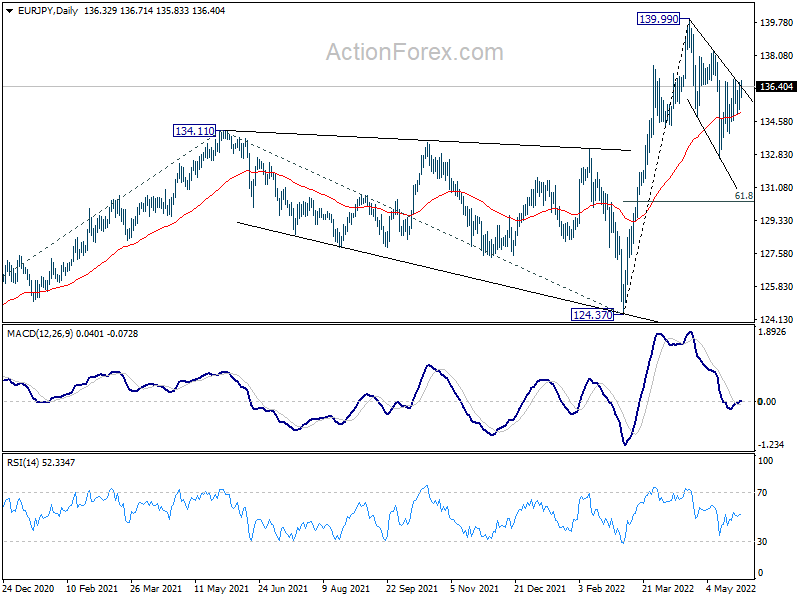
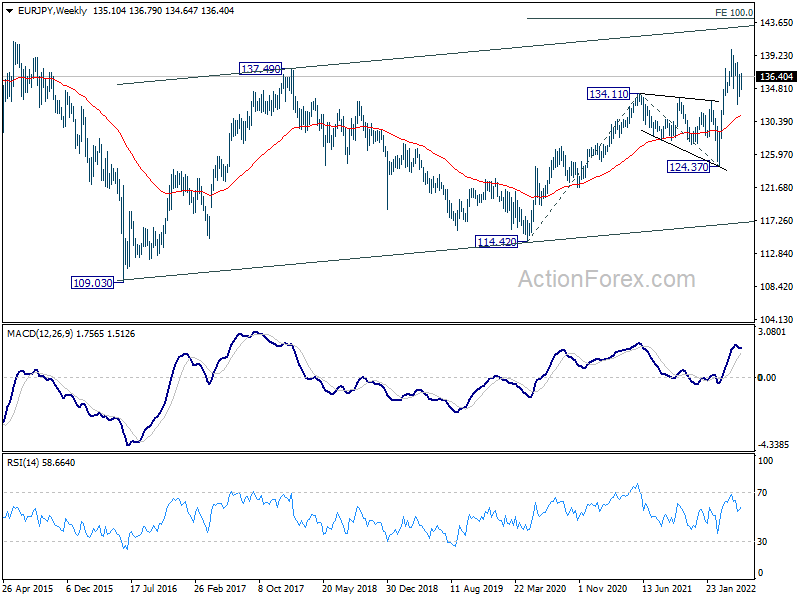
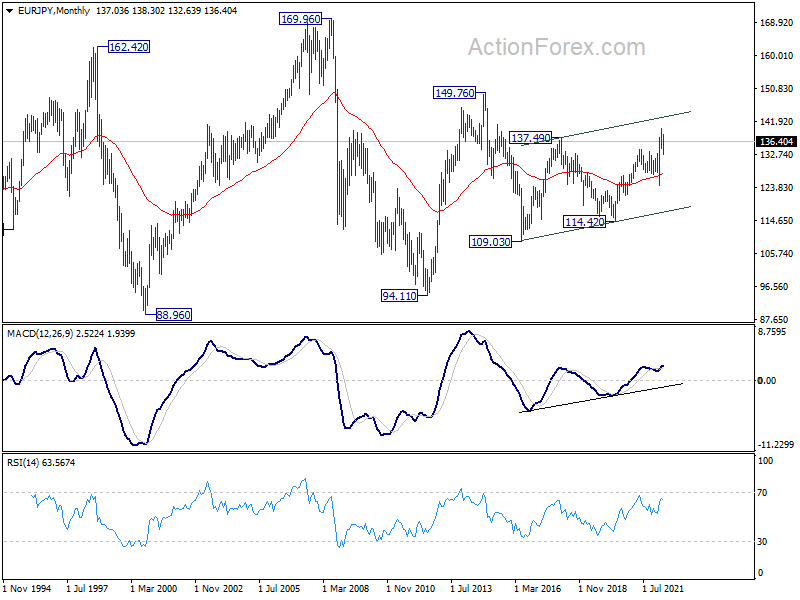
In the long term picture, focus stays on 137.49 resistance (2018 high). Sustained break there will raise the chance that whole rise from 94.11 (2012 low) is resuming through 149.76 resistance. This will be a slightly favored case for now, as long as 124.37 support holds.
EUR/GBP Weekly Outlook
EUR/GBP stayed in range trading last weekend outlook is unchanged. Initial bias remains neutral this week first. Further rally is in favor with 0.8365 support intact. On the upside, break of 0.8617 will resume rise from 0.8201 medium term bottom to 0.8697 medium term fibonacci level. However, break of 0.8365 will dampen this bullish view, and turn bias back to the downside instead.
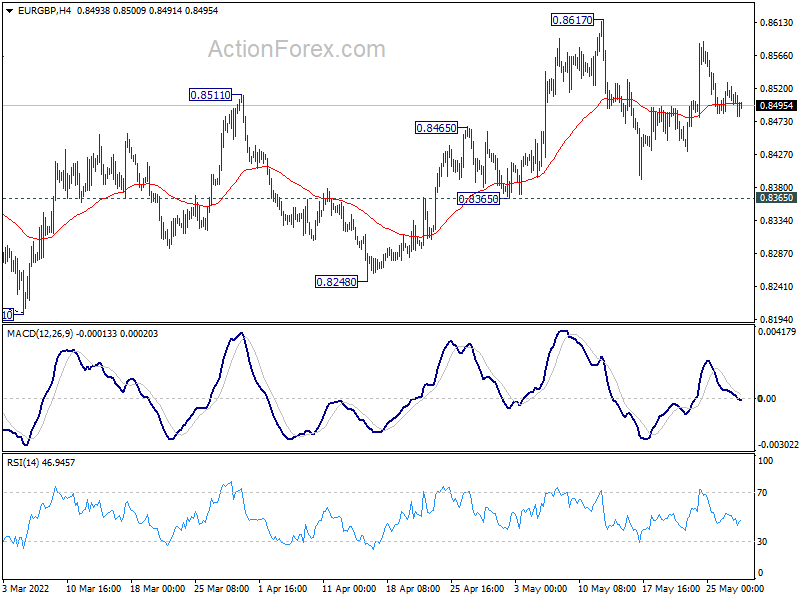
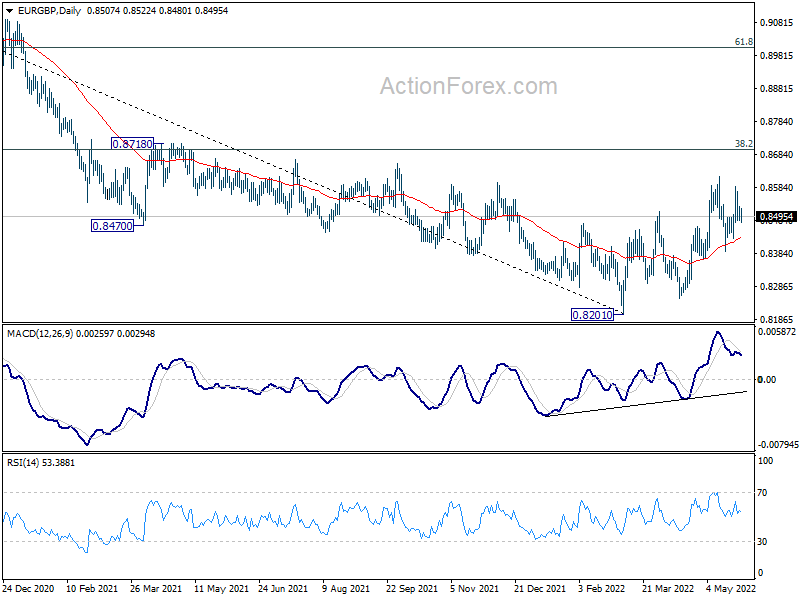
In the bigger picture, a medium term bottom could be in place at 0.8201, on bullish convergence condition in daily and weekly MACD. Rise from there could either be a correction to the down trend from 0.9499 (2020 high), or a medium term up trend itself. In either case, further rise should be seen to 38.2% retracement of 0.9499 to 0.8201 at 0.8697. Sustained break there will target 61.8% retracement at 0.9003.
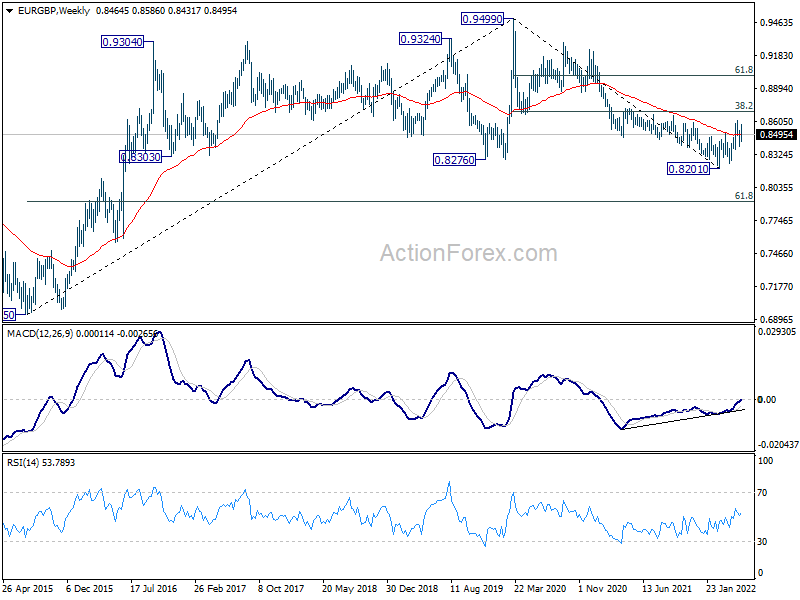
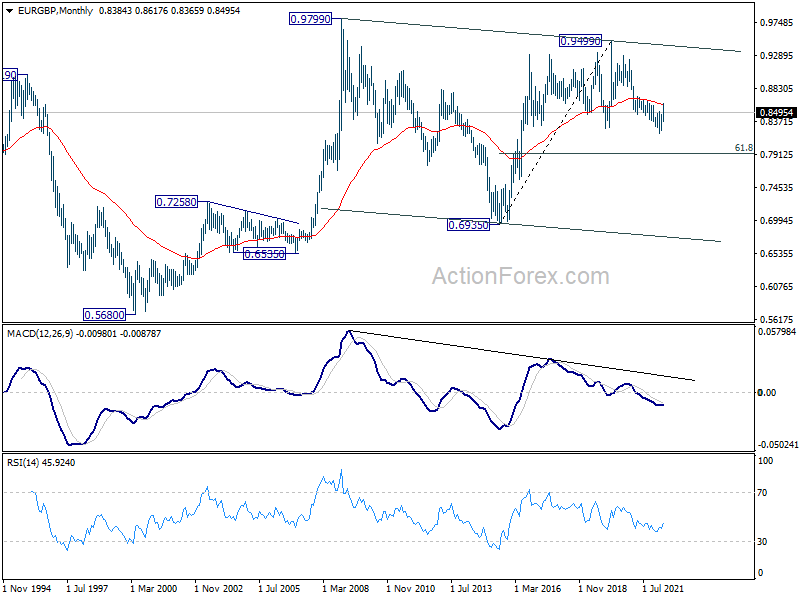
In the long term picture, current development argues that fall from 0.9499 is probably the third leg of the pattern from 0.9799 (2008 high). Sustained break of 61.8% retracement of 0.6935 to 0.9499 at 0.7917 will pave the way back to 0.6935 (2015 low) and probably below. However, sustained trading above 55 month EMA (now at 0.8604) will dampen this bearish view and bring stronger rebound.
EUR/AUD Weekly Outlook
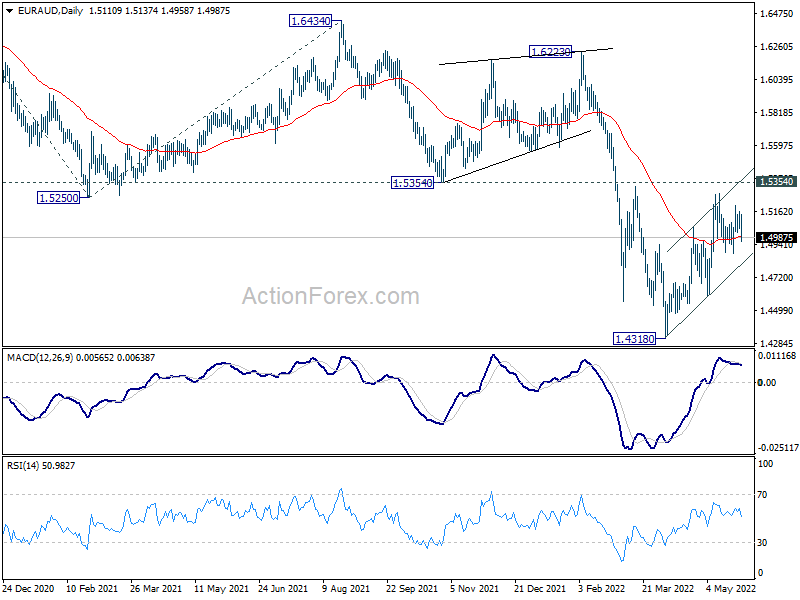
EUR/AUD stayed in range trading last week and outlook is unchanged. Initial bias remains neutral this week first. Break of 1.4882 support will reaffirm that case that corrective rebound from 1.4318 has completed at 1.5277, ahead of 1.5354 resistance. Deeper fall would be seen to 1.4597 support, and then 1.4318 low. Also, risk will stay on the downside as long as 1.5277 resistance holds.
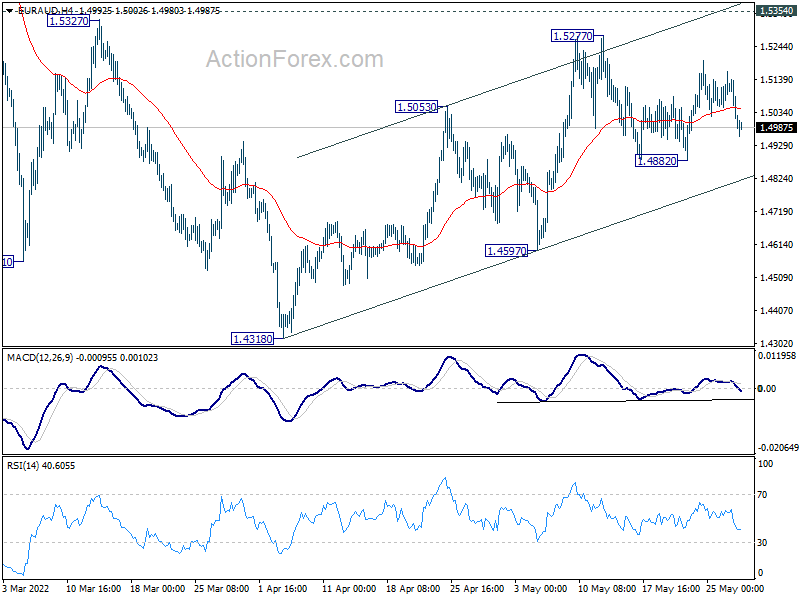
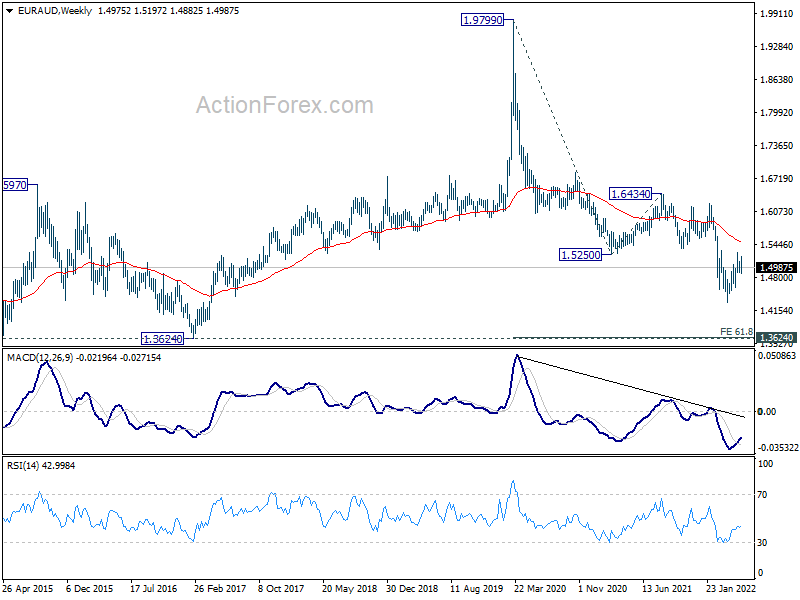
In the bigger picture, as long as 1.5354 support turned resistance holds, larger down trend from 1.9799 (2020 high) is still expected to continue. On resumption, next target is 61.8% projection of 1.9799 to 1.5250 from 1.6434 at 1.3623, which is close to 1.3624 long term support (2017 low). However, firm break of 1.5354 will indicate medium term bottoming and bring stronger rally back to 1.6434 key resistance.
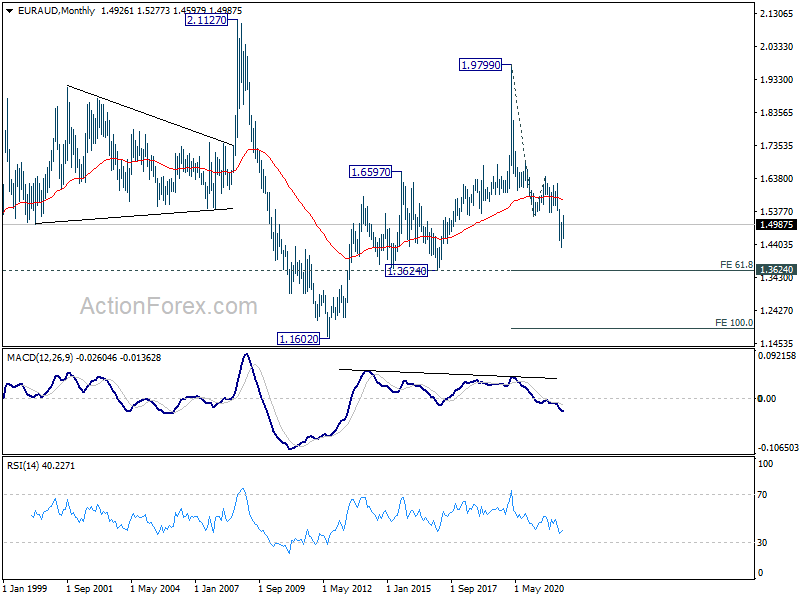
In the longer term picture, fall from 1.9799 (2020 high) is seen as the third leg of the pattern from 2.1127 (2008 high). Deeper fall should be seen to 1.3624 support. Decisive break there would pave the way back to 1.1602 (2012 low).
EUR/CHF Weekly Outlook
EUR/CHF stayed in consolidation above 1.0228 last week and outlook is unchanged. Initial bias remains neutral this week and further fall is expected with 1.0359 resistance intact. On the downside, below 1.0228 will reaffirm the case that corrective rebound from 0.9970 has completed at 1.0513. Deeper fall would be seen to 1.0086 support next. However, above 1.0359 will dampen this bearish view and bring stronger recovery back towards 1.0513 resistance.
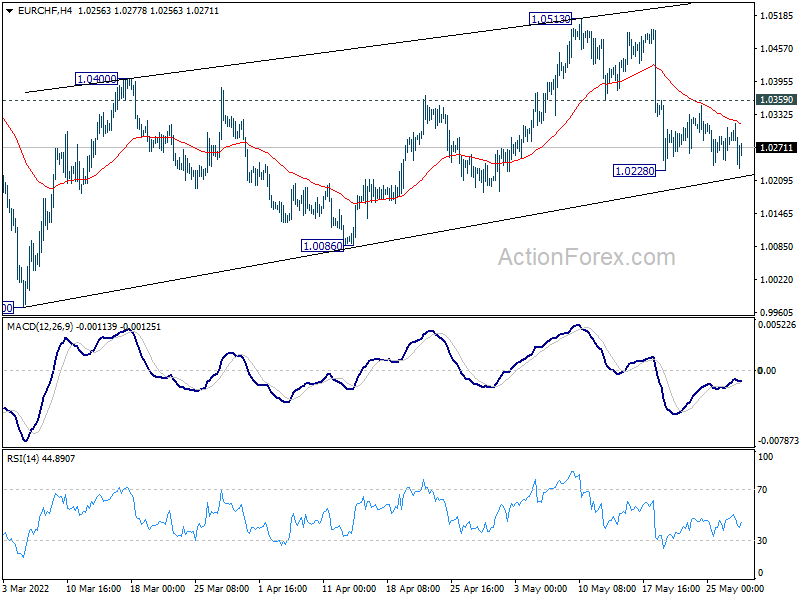
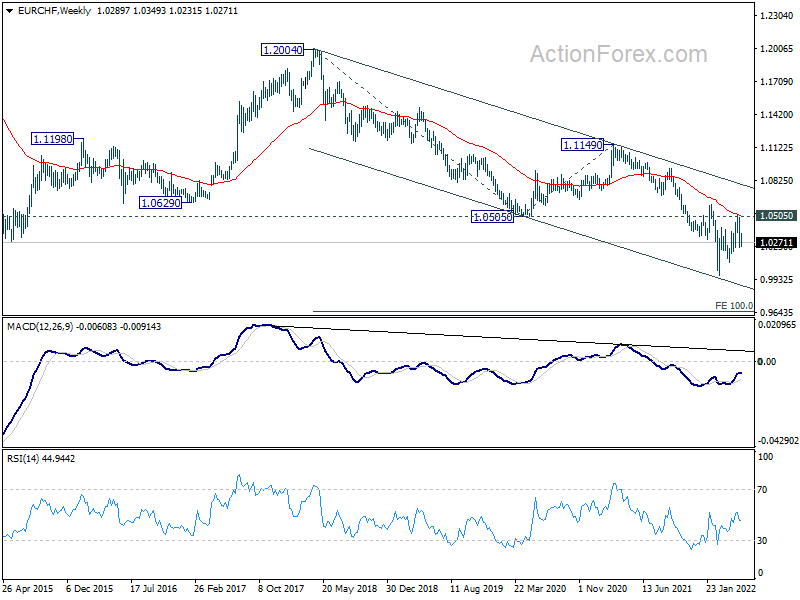
In the bigger picture, as long as 1.0505 support turned resistance (2020 low) holds, long term down trend from 1.2004 (2018 high) is expected to continue. Next target is 100% projection of 1.2004 to 1.0505 to 1.1149 at 0.9650. However, firm break of 1.0505 will suggest medium term bottoming, and bring stronger rebound towards 1.1149 structural resistance.
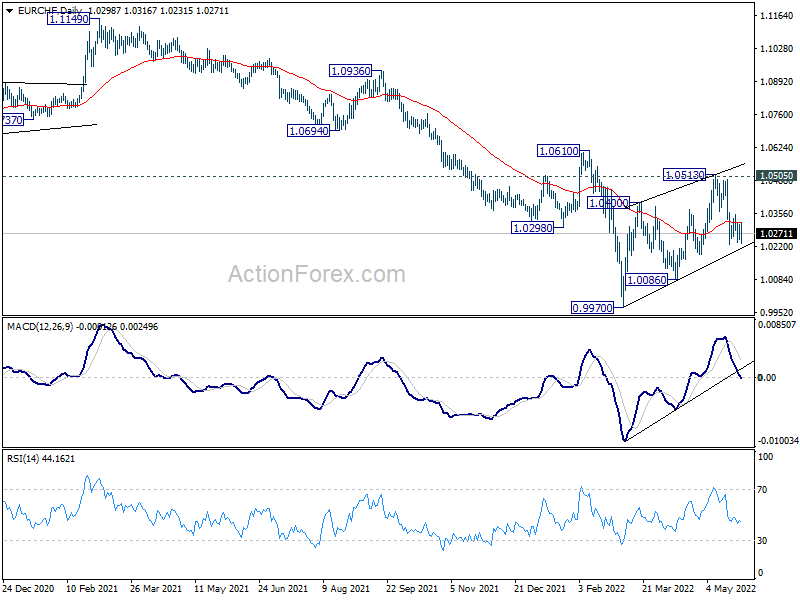
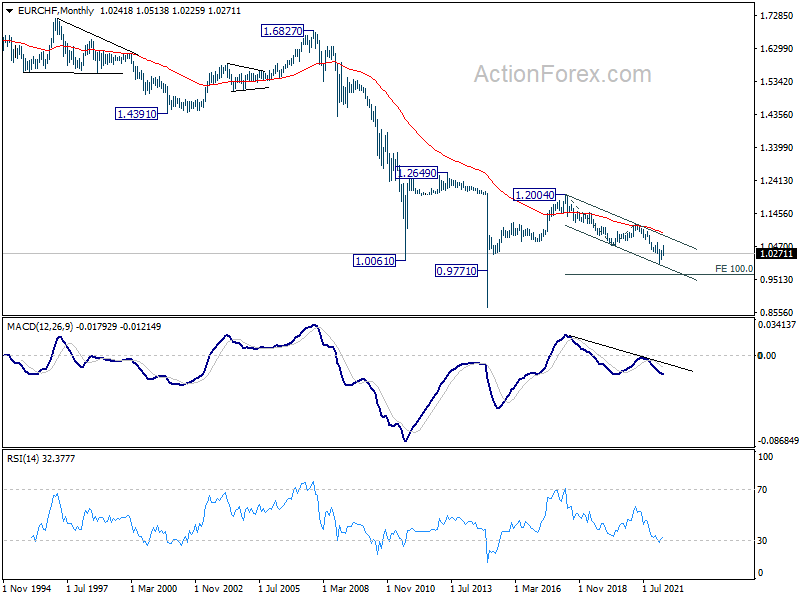
In the long term picture, capped below 55 month EMA, EUR/CHF is seen as extending the multi-decade down trend. There is no prospect of a bullish reversal until some sustained trading above the 55 month EMA (now at 1.0870).
Dollar Extended Correction as Stocks Rebound Finally Started
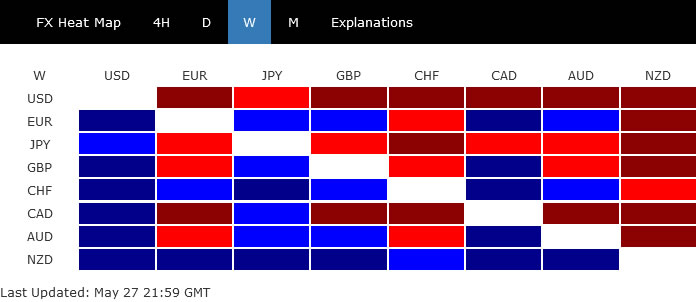
Dollar's correction continued last week and ended as the worst performer. Late rebound in stocks and extended correction in treasury yields are both weighing on the greenback. Yen followed as the second weakest, mainly on risk-on sentiment.
On the other hand, Kiwi was the best performer, additionally lifted by hawkish RBNZ rate hike, which indicated that interest could peak higher than previously projected. Euro was lifted be repeated comments from ECB officials which affirmed the chance of a July rate hike. Swiss Franc was also strong on prospect for SNB to follow ECB, if the latter exit negative rates.
Looking ahead, there is much room for the overdue rebound in stocks to extend. The development would likely give commodity currencies an advantage, even against European majors.
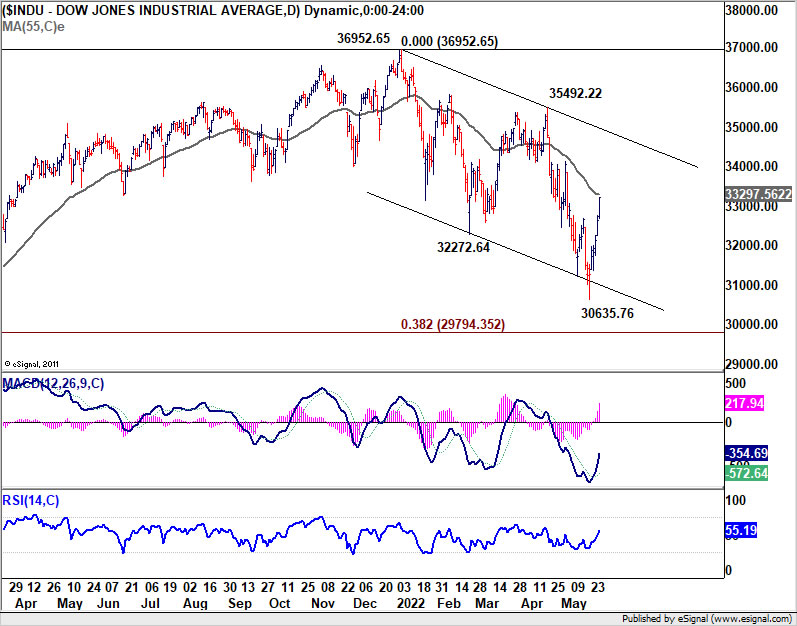
DOW and S&P 500 finished corrections with strong rebound?
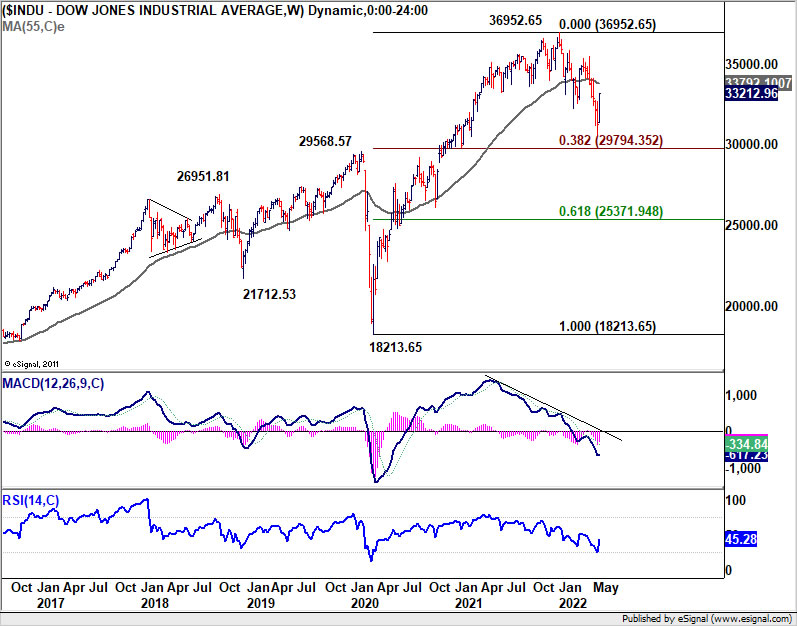
The anticipated oversold bounce in stocks finally happened last week. Current developments argues that DOW's corrective fall from 36952.62 has completed with three waves down to 30635.75, just ahead of 38.2% retracement of 18213.65 to 36952.65 at 29794.35. Immediate focus will be on 55 wee EMA (now at 33792.10). Sustained break there will affirm this bullish case and bring further rise back to 35492.22/36952.65 resistance zone. However, rejection by the 55 week EMA would probably extend the whole decline from 36952.65 with another down leg.
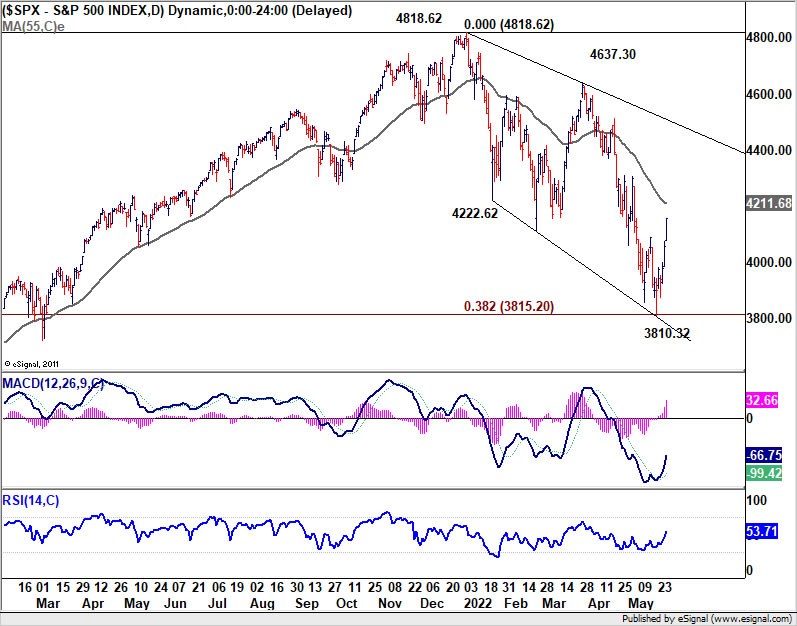
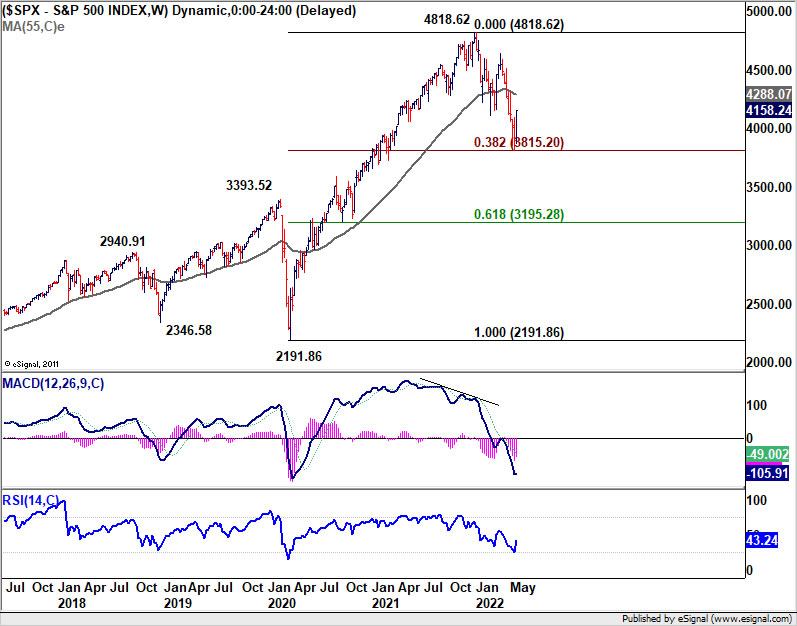
Similarly, S&P 500 could have finished the correction from 4818.62 too, with three waves down to 3810.32, after hitting 38.2% retracement of 2191.86 to 4818.62 at 3815.20. Sustained break of 55 week EMA (now at 4288.07) will bring stronger rise back to 4637.30/4818.62 resistance zone. But rejection by the 55 week EMA will keep near term risk on the downside, for another fall through 3810.32.
10-year yield still extending correction from 3.167
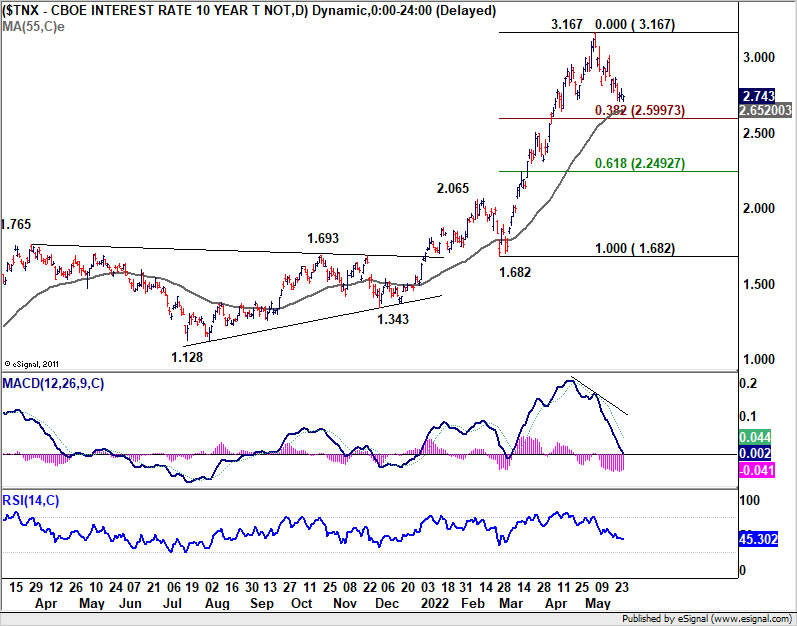
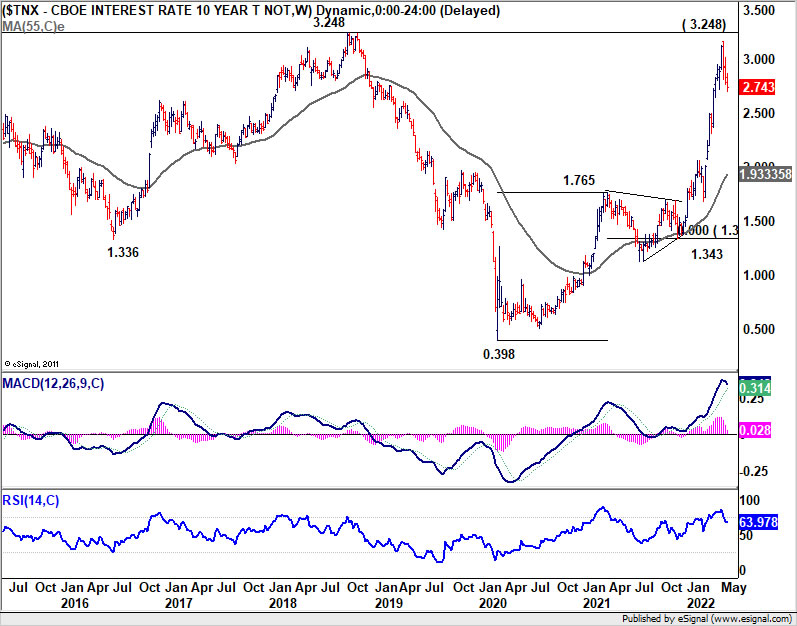
10-year yield continued the corrective pattern from 3.167 with another dip. Outlook is unchanged that further fall could still be seen. But downside is expected to be contained by 38.2% retracement of 1.682 to 3.167 at 2.599, which is close to 55 day EMA at (now at 2.652) to bring rebound. There is little prospect of breaking through 3.248 key long term resistance for now. But the range of sideway trading should be set above 2.6.
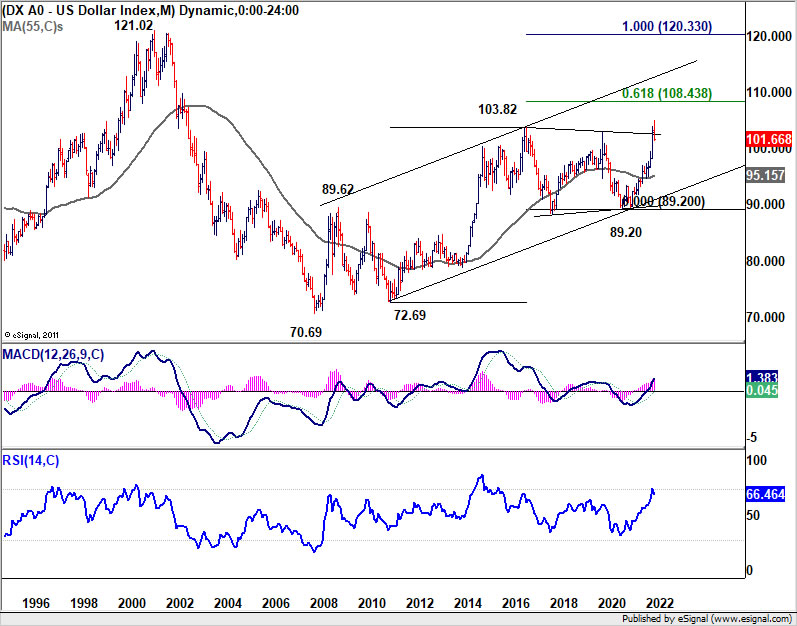
Dollar index extending correction from 105.00, more downside
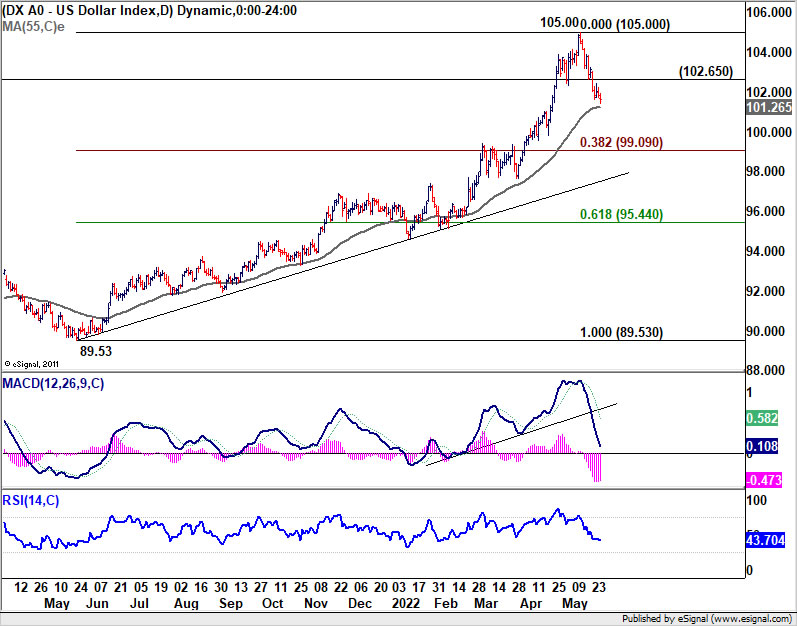
Dollar index also extended its correction from 105.00, on the back of improving risk sentiment and retreating treasury yields. It should now be correcting the whole rise from 89.53 to 105.00. Deeper decline is in favor in the near term to 55 day EMA (now at 101.26) and below. But downside should be contained by 38.2% retracement of 89.53 to 105.00 at 99.09 to bring rebound.
On the upside, above 102.65 minor resistance will bring an earlier rebound. But even in this case, long term up trend resumption should only happen at a later stage, after a deeper or longer corrective phase.
AUD and CAD to ride on improving risk sentiment
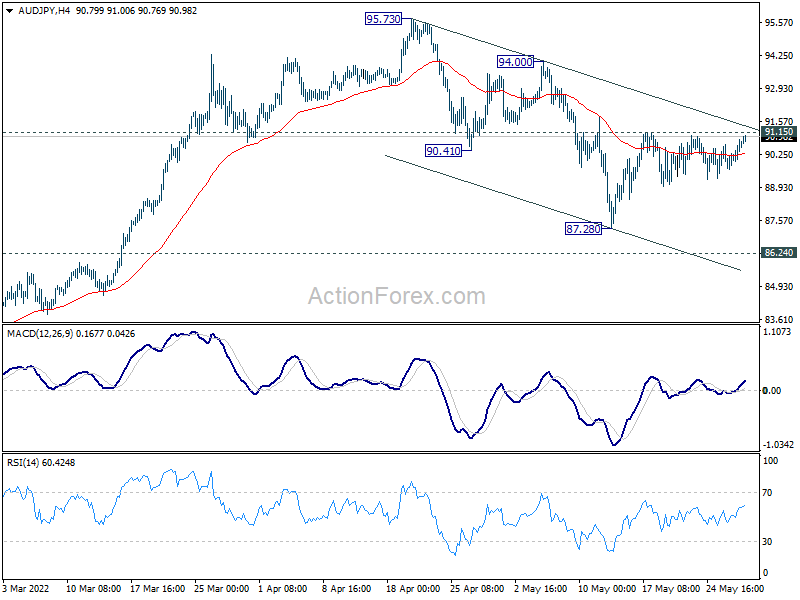
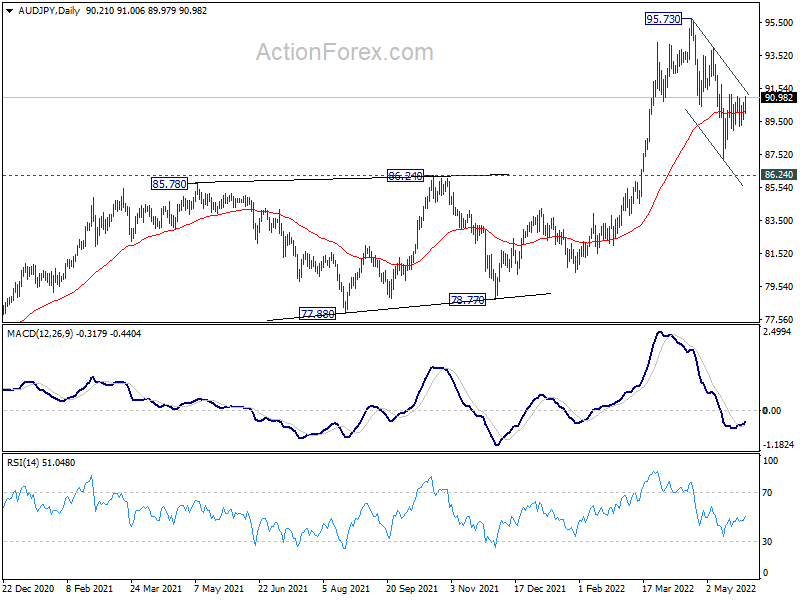
Considering improving risk sentiment, there is prospect for more upside in commodity currencies. AUD/JPY's performance was a bit disappointing as it's still staying below 91.15 minor resistance. But an upside breakout could be due. Outlook is unchanged that corrective fall 95.73 is finished with three waves down to 87.28, ahead of 86.24 medium term resistance turned support. Firm break of 91.15 resistance should affirm this bullish view and bring stronger rise back to 94.40/95.73 resistance zone.
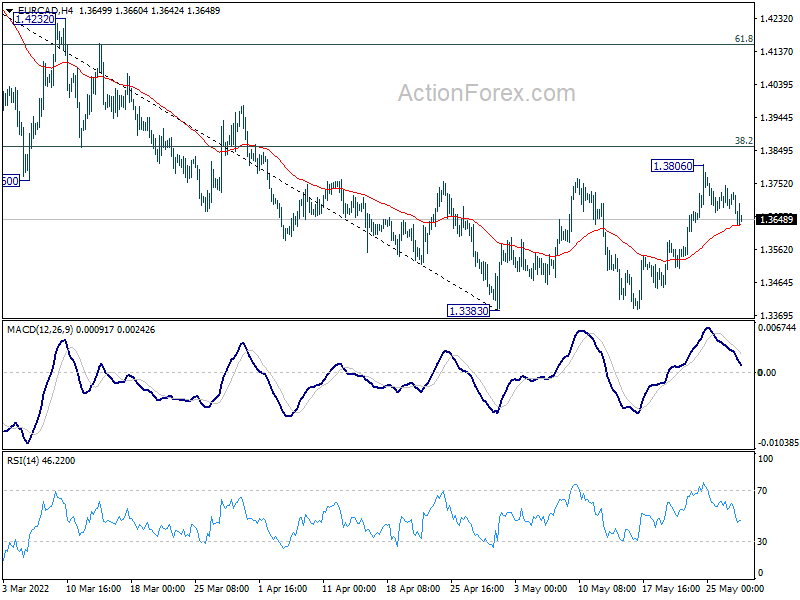
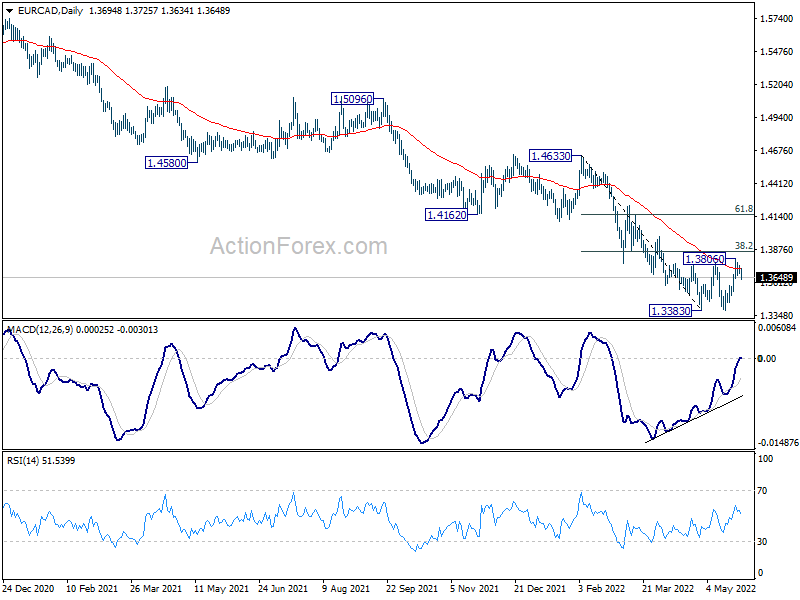
EUR/CAD's consolidation pattern from 1.3383 might have completed with three waves up to 1.3806 too, ahead of 38.2% retracement of 1.4633 to 1.3383 at 1.3861, and well below 1.4162 support turned resistance. Sustained trading below 4 hour 55 EMA (now at 1.3632) will affirm this bearish case and bring retest of 1.3383. Break there will resume medium term down trend.
USD/CHF Weekly Outlook
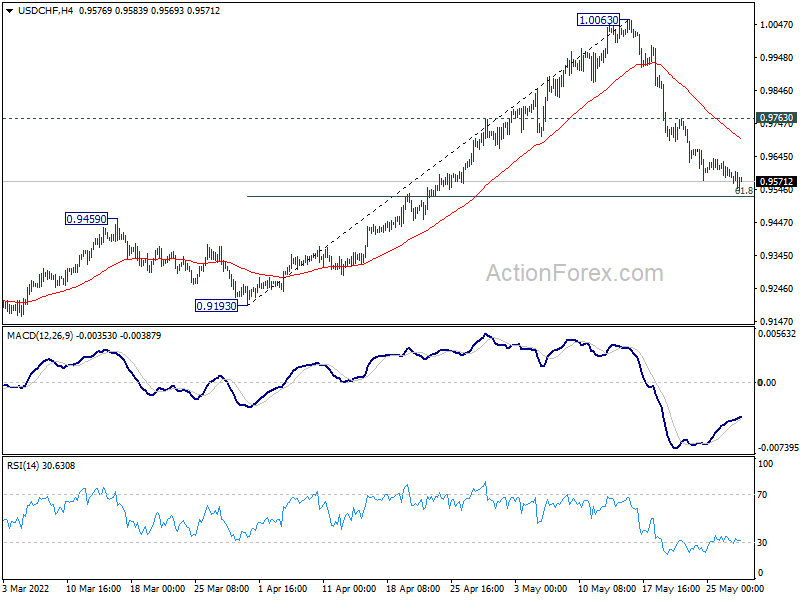
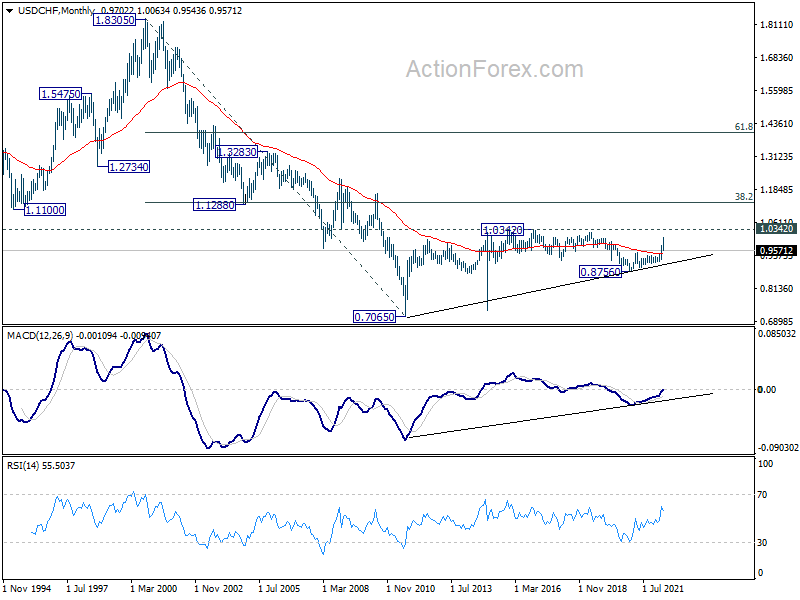
USD/CHF's correction from 1.0063 extended lower last week despite loss of downside momentum. Further decline is still in favor this week. But downside should be contained by 61.8% retracement at 0.9525 to bring rebound. On the upside, above 0.9763 minor resistance will turn bias back to the upside for recovery. However, sustained break of 0.9525 will bring deeper decline to 0.9193 support.
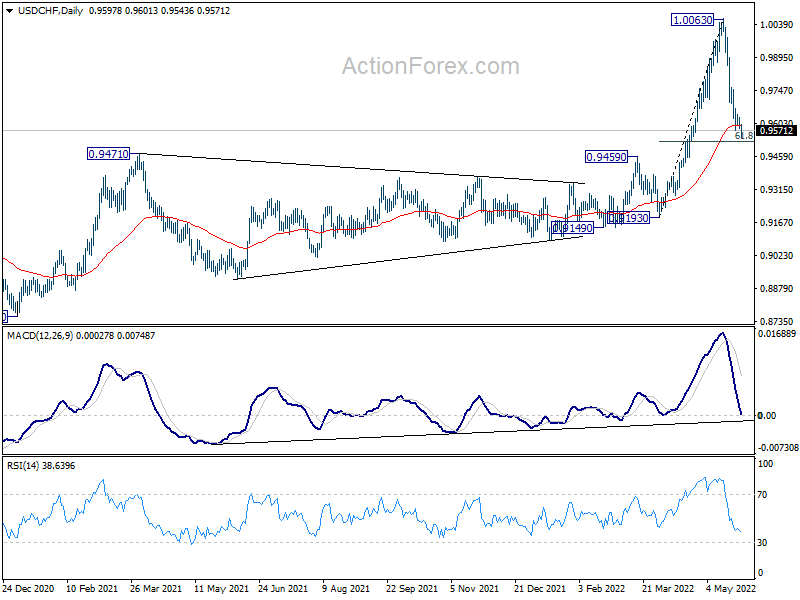
In the bigger picture, down trend from 1.0342 (2016 high) should have completed with three waves down to 0.8756 (2021 low) already. Rise from 0.8756 is likely a medium term up trend of its own. Next target is 1.0237/0342 resistance zone. This will remain the favored case as long as 0.9471 resistance turned support holds. However, sustained break of 0.9471 will extend long term range trading with another falling leg.
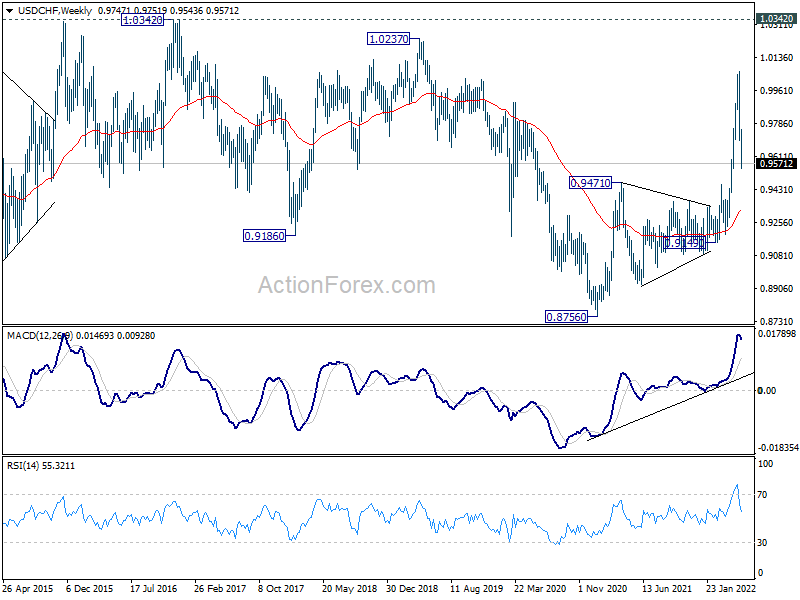
In the long term picture, current development argues that the correction from 1.0342 (2016 high) has completed at 0.8756 (2020 low) already. Rise from 0.7065 (2011 low) might be ready to resume. Firm break of 1.0342 will confirm and target 38.2% retracement of 1.8305 (2000 high) to 0.7065 at 1.1359.
Summary 5/30 – 6/3
Monday, May 30, 2022
[php_everywhere instance="1"]
Tuesday, May 31, 2022
[php_everywhere instance="2"]
Wednesday, Jun 1, 2022
[php_everywhere instance="3"]
Thursday, Jun 2, 2022
[php_everywhere instance="4"]
Friday, Jun 3, 2022
[php_everywhere instance="5"]
Weekly Economic & Financial Commentary: Signs of a Slowdown Begin to Emerge
Summary
United States: Signs of a Slowdown Begin to Emerge
- April brought a steep 16.6% decline in new home sales and a 3.9% drop in pending home sales, the latest signs the housing market is cooling down amid sharply higher mortgage rates. Personal income rose 0.4% during April, while personal spending increased 0.9%. Inflation continues to run hot. The headline PCE deflator was up 6.3% year-to-year, while the core measure rose 4.9%.
- Next week: Consumer Confidence (Tue), ISM Manu. & Services (Wed/Fri), Nonfarm Payrolls (Fri)
International: Mixed Fortunes for Europe's Economies
- This week's May PMI surveys offered the latest insight into how some of Europe's key economies are faring, and indicated varying fortunes across the region. The Eurozone PMIs reported a mild decline, suggesting a modest loss of momentum, though to levels that remain well within growth territory. For the United Kingdom however, the PMI surveys suggested the economy could suffer a sharper slowdown.
- Next week: China PMIs (Tue), Eurozone CPI (Tue), Canada GDP (Tue)
Interest Rate Watch: FOMC Minutes Show Another 50 bps Rate Hike Is Probable
- The minutes from the May FOMC meeting were released this week and offered additional evidence that a second consecutive 50 bps rate hike is imminent.
Credit Market Insights: Household Well-Being Strengthens in 2021
- This week, the Federal Reserve Board issued its Economic Well-Being of U.S. Households in 2021, a report which surveys the financial health and sentiment of U.S. adults and their families. Financial well-being among respondents reached its highest level since 2013 when the survey first began.
Topic of the Week: Biden Announces an Asia-Specific Strategy
- We unpack a few recent developments in terms of U.S. foreign relations this week, like the newly introduced Indo-Pacific Economic Framework, where things stand with trade policy more broadly and how there's a review under way of U.S. tariffs on China that likely won't lead to large changes to preexisting policy.
The Weekly Bottom Line: Bank of Canada Still on Track for Rate Hike
U.S. Highlights
- The second estimate of U.S. GDP growth confirmed that the economy contracted in the first quarter of the year, pulling back by 1.5% relative to the 1.4% reported previously.
- The housing market continued to show signs of buyer wariness as rising prices and mortgage rates erode affordability, resulting in slumping sales both for new and existing properties.
- U.S. consumers continued to post growth in both nomimal income and spending in April. Continued price pressures, however, kept real income flat. On the upside, the annual pace of price increases abated in April, as headline personal consumption expenditure inflation decelerated from 6.6% in March to 6.3% in April.
Canadian Highlights
- Retail sales slowed in March as automotive related spending fell sharply.
- Small businesses sentiment weakened in May, but continues to be optimistic about the future and businesses intend to increase headcounts and raise wages.
- A solid economic foundation and surging inflation will be top of mind for the Bank of Canada as it gears up for a 50-basis point rate hike next Wednesday.
U.S. - Walking the Inflation-Growth Tightrope
Economic developments for the week point to a U.S. economy that is in transition. As policymakers try to steer the economy from the current high inflation environment, they must walk a tightrope so as not to inflict too much damage on growth. The second estimate of first quarter GDP suggests that it is indeed a delicate balance that will have to be struck. The economy is now estimated to have contracted by 1.5% through the first three months of 2022, slightly lower than the 1.4% previously reported . The revision mainly reflected lower investment in inventory. On the upside, consumer spending and business investment continued to show strong domestic demand.
On that front, orders for durable goods decelerated in April to 0.4% month-on-month (m/m), from a downwardly revised 0.6% in March. Core capital goods orders, a closely watched proxy for business investment, rose 0.3%. The report suggests that business investment growth is starting to taper as interest rates rise. Manufacturers however have a substantial backlog of orders to fulfill, which should continue to support investment in the near term.
The Fed’s mission to tame inflation is likely to see rates rise even further. Minutes of the Fed’s May meeting reinforced previous messaging as policymakers discussed getting to a neutral rate expeditiously, as well as the possibility of tightening policy to restrictive levels. Such a move would be dependent on the evolving economic outlook, which is currently shrouded in a great deal of uncertainty. We continue to expect two successive 50 basis point rate increases at the Fed’s June and July meetings.
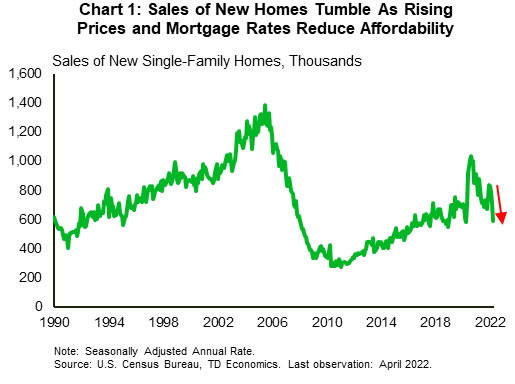
Rising interest rates are also taking some steam out of the white-hot U.S. housing market. Mortgage rates have risen sharply, and this has resulted in a pullback in buyer demand. Contracts for sales of existing homes (-3.9% m/m) as well as sales of new homes (-16.6% m/m) fell in April – both posting the largest declines since before the pandemic (Chart 1). Prices however continued to trek upwards with the median price for new homes rising 19.6% year-on-year to $450,600. The combination of high prices and rising rates is likely to see the market cool even further as affordability becomes an issue for more and more buyers.
The Congressional Budget Office also released an updated outlook this week, and is expecting both inflation and economic growth to cool later this year and into 2023. On a fourth quarter-over-fourth quarter basis, the agency expects the economy to grow by 3.1% in 2022 and by 2.2% and 1.5% in 2023 and 2024 respectively. CPI inflation is projected at 4.7% for 2022, 2.7% for 2023 and 2.3% for 2024. These forecasts were completed prior to further fallout from the Russia-Ukraine war. As such, the inflation numbers are likely to come in higher than predicted.
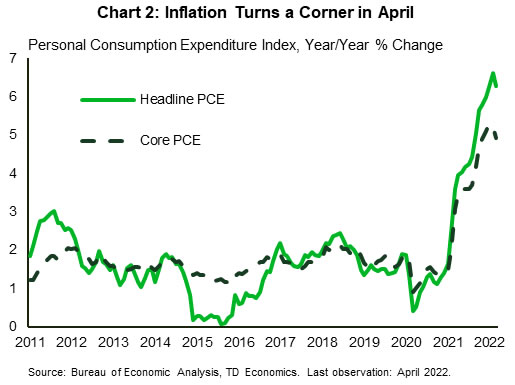
To cap off the week, nominal income and spending were up in April by 0.4% and 0.9% m/m respectively. However, due to inflation real disposable income was flat. On the upside, both headline and core personal consumption expenditure (PCE) inflation decelerated in April (Chart 2). Yearly core PCE inflation cooled from 5.2% in March to 4.9%, still well above the Fed’s comfort zone, but moving in the right direction.
Canada - Bank of Canada Still on Track for Rate Hike
With the Bank of Canada (BoC) meeting set for next week, and another 50-basis point hike all but a given, all eyes were on the retail sales report to see how consumer spending was holding up as the latest wave of the pandemic fades into the background.
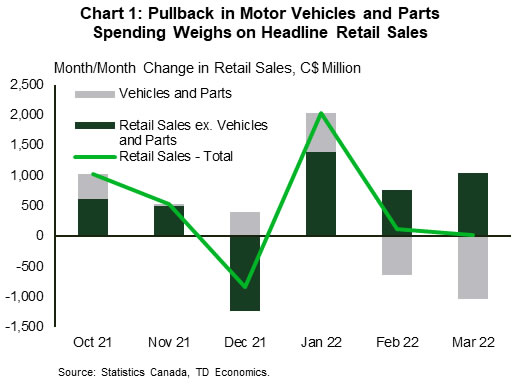
March retail sales were effectively flat from the prior month, substantially lower than the 1.4% expansion flash estimate from last month's release. The headline figure was a disappointment, but the details gave plenty of reason for optimism. The entirety of the miss was attributable to vehicles and auto parts, which contracted 6.4% for the month and dragged the aggregate down to stall speed. Indeed, core sales (excluding gas stations and autos) were up 1.5% for the month. Sales volumes reinforced the fact that there was quite a bit of resilience in spending as all non-automotive categories saw increases. It's also important to note that the automotive sector is still recovering from semiconductor and supply chain disruptions from 2021, and small setbacks in the recovery are not necessarily indicative of widespread erosion in demand.
Going forward, the Canadian consumer is expected to slow spending in the face of rising interest rates and high inflation. The BoC's April monetary policy report had anticipated 3.0% GDP growth (quarter-over-quarter annualized basis) in the first quarter and 6.0% in the second. Monthly GDP data suggest that 3.0% is rather pessimistic as even if March were to register no growth, the quarterly figure would still be a roughly 4.1% expansion. It is likely that some of the anticipated strength from the second quarter was pulled forward and the 6.0% projection will prove to be optimistic. That said, even if consumer spending slows, cumulative growth through the first half of the year will be solid, even if the second quarter is weaker than the BoC anticipated.
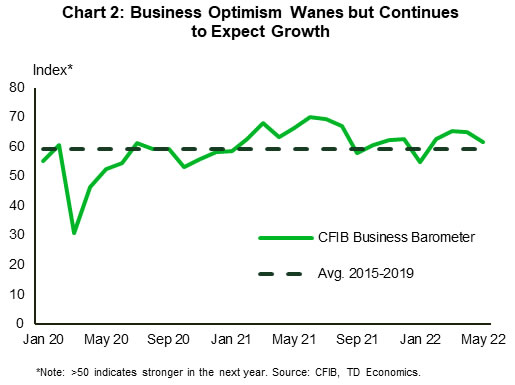
Indeed, the CFIB survey reinforced that even though optimism has waned since March, small businesses are still expecting conditions to improve over the coming year. Hiring intentions remain strong, with roughly 30% of respondents intending to increase headcounts over the coming months. However, respondents also noted that labour markets remain tight and a shortage of both skilled and unskilled/semi-skilled workers were cited as a factor limiting output. Moreover, a dearth of labor is translating into higher wages as companies now expect to raise wages by an average of 3.5% over the coming year, up from 3.2% in April. Of course, rising wage bills are only one component of the inflationary push, and with capacity utilization still running high, it is reassuring to see fewer firms reporting supply disruptions.
Overall, this week's data painted a picture of an economy whose solid expansion continues. Wage growth is picking up and concerns about rising inflation expectations will keep the BoC on course to raise interest rates by 50 basis points next week.
Week Ahead – Another Action-Packed Week
Will the recovery continue?
It’s likely to be another action-packed week despite numerous countries seeing it shortened by bank holidays. The jobs report is typically the highlight when it comes to the first week of the month but there will be competition from the OPEC+ meeting, Bank of Canada rate decision and inflation data.
We’ve seen a shift in markets over the last couple of weeks, with interest rate concerns being replaced by recession fears and then risk appetite improving after a challenging period. Can it be sustained?
There’ll be no shortage of central bank policymakers speaking over the next week which will naturally have a big role to play in the markets, as has been the case for much of the year. Can they keep investors happy or will they ruin the recovery?
US
It will be a busy week filled with a wrath of economic data and central bank speak. The majority of economic data is expected to show broad weakness. Traders will pay close attention to the Conference Board consumer confidence reading on Tuesday which is expected to show a significant deceleration. On Wednesday, the ISM manufacturing report is expected to soften alongside a decline in prices paid. The main economic release will be the nonfarm payroll report. With many companies concerned about a deceleration in consumer spending, it will be important to see if hiring remains strong. The consensus estimate for the change in nonfarm payrolls is 329,000 jobs, a decent dip from the 428,000 created in the prior month.
Fed speak begins on Monday with the hawkish Waller as he discusses the economic outlook. Wednesday is a busy day with the release of the Beige Book and remarks from the Fed’s Williams and Bullard. On Thursday, the Fed’s Logan speaks at an event on Monetary Policy Implementation and Digital Innovation and Mester talks about the economic outlook. On Friday, the Fed’s Brainard speaks at an event hosted by the Urban Institute.
EU
Speeches from ECB policymakers have become a lot more interesting in recent months as the central bank has gradually come around to the idea of abandoning its net asset purchases and negative interest rate policy. President Christine Lagarde laid out those plans clearly this week – a rate hike in July and September taking the deposit rate out of negative territory – in a highly unusual move. Others have since supported those views with some wanting more. Commentary will remain key.
A plethora of economic data from the eurozone will land next week, the highlight of which will naturally be the inflation data on Tuesday. We may soon see why the ECB felt the need to lay the groundwork for impending hikes. The individual country inflation data at the start of the week may provide clues as to what’s to come on Tuesday when the overall eurozone data is released.
UK
A shortened week for the UK thanks to the Jubilee bank holiday on Thursday and Friday. The rest of the week offers very little with tier two and three data being released on Tuesday and Wednesday.
Russia
This week, the CBR cut rates by another 300 basis points, taking the key rate to 11%. That’s only 1.5% above where it was prior to the invasion and 9% from the post-invasion peak. The move was done to arrest the appreciation in the rouble and has had some effect. But further rate cuts are likely, with many anticipating that the rouble will remain strong regardless of the central bank’s actions. It’s worth noting that the CBR is not waiting for scheduled meetings to cut rates so another could come before 10 June.
Lots of data next week as we start to see the economic ramifications of the decision to invade Ukraine.
South Africa
A number of economic releases are due next week including the whole economy PMI survey and unemployment. The central bank has been hiking aggressively recently and may not be done.
Turkey
Inflation data is the highlight next week but frankly, no one should care what it says at this point as the central bank certainly doesn’t. Maintaining that external factors are to blame rather than its misguided monetary policy, it’s clear that there will be no rate hikes any time soon, with households and businesses left to pay the price of President Erdogan’s warped ideology.
China
China releases official PMIs on Tuesday and the Caixin Manufacturing PMI on Wednesday. There is downside risk to these numbers after recent soft data, and if the prints are weak, Chinese equities could face another sell-off.
China’s covid zero policy continues to dominate the economic outlook. Although Shanghai appears to be past the worst, Chinese markets remain vulnerable to spikes in cases in major cities leading to immediate movement restrictions. Any headlines along this line could weigh on local equities and also regional markets.
The PBOC appears to have capped the rise by USD/CNY for now via the fixing. China appears conflicted as to whether to allow more weakness to boost exports and weaker fixings this week can’t be ruled out. That could be a headwind for regional currencies as well.
India
India releases PMIs this week and Q4 GDP, however, markets could range trade ahead of the next RBI meeting on the 6-8 June where another rate hike is expected. Indian equity markets have moved to the lower end of their 2022 range, while the rupee has fallen to 2022 lows. Both remain vulnerable to swings in global risk sentiment. The US dollar retracement has passed the rupee by, suggesting more weakness may come.
Australia
Australia releases Q1 GDP on Wednesday and trade balance on Thursday. The trade balance will be closely watched to see if the Chinese slowdown is impacting Australia’s terms of trade which could be a negative for equities.
The Australian dollar has ridden the US dollar correction higher but despite data, elections, and monetary policy changes, the short-term direction of the currency continues to be dominated by the swings in risk sentiment day-to-day.
New Zealand
No significant data next week. Like the Australian dollar, the New Zealand dollar remains hostage to the daily swings we are seeing in investor risk sentiment from North American markets.
Japan
Japanese PMIs on Tuesday and Friday may cause only short-term volatility. The Nikkei continues to closely track the directional movements of the Nasdaq and S&P 500. Meanwhile, USD/JPY continues to be guided by movements in the US/Japan rate differential. There is potential for USD/JPY to have a culling of long positioning, but if the US 10 year yield moves back towards 3.0%, USD/JPY could just as easily be heading higher once more.
Singapore
No significant data or events.
Economic Calendar
Monday, May 30
Economic Data/Events
- EU leaders begin two-day special meeting in Brussels
- Germany CPI
- Eurozone economic confidence, consumer confidence
- Thailand capacity utilization, manufacturing production index
- Japan machine tool orders
- Sweden GDP
Tuesday, May 31
Economic Data/Events
- US Consumer Confidence
- Eurozone CPI
- France CPI
- Poland CPI
- Canada GDP
- Czech Republic GDP
- India GDP
- Switzerland GDP
- Turkey GDP
- Japan industrial production, unemployment
- South Africa trade
- Germany unemployment
- Mexico reserves, unemployment
- Australia building approvals, BoP current account, consumer confidence
- China PMI
- Singapore money supply
- India GDP, fiscal deficit, eight infrastructure industries
- Thailand BoP, trade
- Hong Kong budget balance, money supply
- Japan retail sales, consumer confidence index, housing starts
- New Zealand building permits, business confidence
- Riksbank Governor Ingves speaks
- ECB’s Makhlouf speaks
- Bank of Italy releases annual report
Wednesday, June 1
Economic Data/Events
- US construction spending, ISM manufacturing, light vehicle sales
- Fed release Beige Book; also begins balance sheet runoff
- Fed’s Williams speaks at Colombia University
- Fed’s Bullard speaks
- Australia trade, PMI
- Eurozone PMI
- Germany PMI
- UK PMI
- India PMI
- Thailand PMI
- Unemployment: Eurozone, Italy, Russia
- Bank of Canada rate decision
- New Zealand house prices
- Hong Kong retail sales
- Hungary GDP
- Australia GDP, house prices
- Thailand business sentiment index
- China Caixin PMI
- Japan capital spending, company profits, vehicle sales, Jibun Bank PMI
- Russia industrial production
- BOE’s Hauser is a panelist at NY Fed’s conference on monetary policy and digital innovation
- BOE’s Decision Maker Panel survey results released
- ECB’s Knot gives a keynote speech at the Bank of International Settlements’ “Green Swan” conference
- PBOC Governor Yi Gang, ECB President Christine Lagarde and others speak about the green transition
Thursday, June 2
Economic Data/Events
- US factory orders, durable goods, initial jobless claims
- OPEC+ begins two-day meeting
- Fed’s Mester speaks about the economic outlook
- Riksbank Deputy Governor Jansson speaks
- Eurozone PPI
- Australia trade
- New Zealand terms of trade index
- Thailand forward contracts, foreign reserves
- Singapore electronics sector index, PMI
- Japan monetary base
- Spain unemployment
- EIA crude oil inventory report
Friday, June 3
Economic Data/Events
- US May change in nonfarm payrolls: 329Ke v 428K prior, unemployment rate, average hourly earnings
- Eurozone retail sales, Markit services PMI
- France industrial production
- Australia home loans value
- Singapore retail sales, PMI
- The UN’s Food and Agriculture Organization posts monthly food price index
Sovereign Rating Updates
- Austria(Moody’s)
- France (Moody’s)
- Saudi Arabia (Moody’s)
- Germany(DBRS)
Week Ahead – Nonfarm Payrolls on Tap, Has the Dollar Topped?
The latest US employment report will be in the spotlight next week for any signs that recession worries have started to impact hiring. The dollar has lost some of its power lately and this dataset could determine whether we are in the early stages of a trend reversal. Inflation numbers from Europe will be another crucial variable for that equation. Elsewhere, the Bank of Canada is set to raise interest rates.
Hiring freeze
The risk of recession is front and center in financial markets. The US housing market is feeling the heat of rising mortgage rates and investors are running scared that the cost of living crisis is about to infect the labor market, as cooling demand forces businesses to cut back on employment.
There’s evidence that this process has already started. Major corporations such as Amazon, Microsoft, Meta (Facebook), Twitter, Uber, Salesforce, and Nvidia among many others have announced plans to slow down hiring or freeze it. Executives are looking at a slowing economy and are trying to manage costs. Smaller companies are probably struggling more.
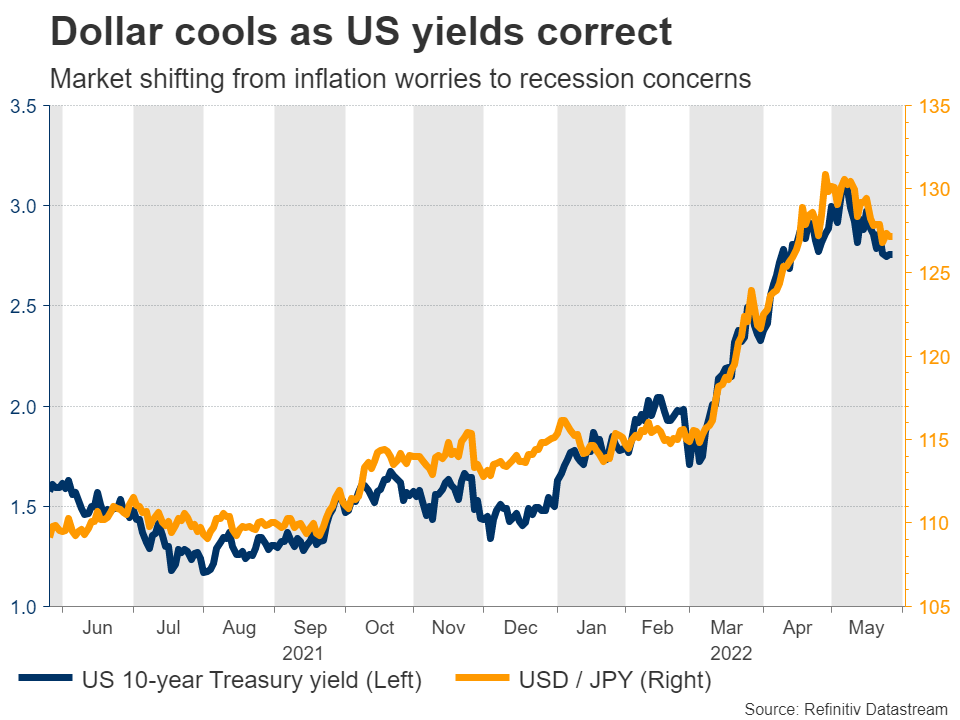
The bond market has started to price in these risks. Worries around rampant inflation have been replaced by worries around an economic slowdown, hammering Treasury yields back down and taking the shine off the dollar. The Fed could even hit the ‘pause’ button on rate increases by September if the economy slows, according to Atlanta Fed president Bostic.
In this light, the upcoming US jobs data on Friday will be crucial for markets. Forecasts point to another solid report overall, with nonfarm payrolls expected at 350k in May and the unemployment rate forecast to drop a little further. Wage growth is expected to remain healthy.
It is probably too early for the hiring slowdown to show up in this dataset, something supported by the S&P Global services PMI, which showed companies raising employment levels at the second-fastest pace in a year. That said, first time seekers of unemployment benefits rose during the month, which is never a good sign.
As for the dollar, there are some signs of trend exhaustion, but it is still difficult to call for a reversal. Yes, euro/dollar rebounded from 1.0340 lately, a region that acted as a reversal point in the past. And with US yields retreating, the dollar no longer enjoys such a tremendous interest rate advantage.
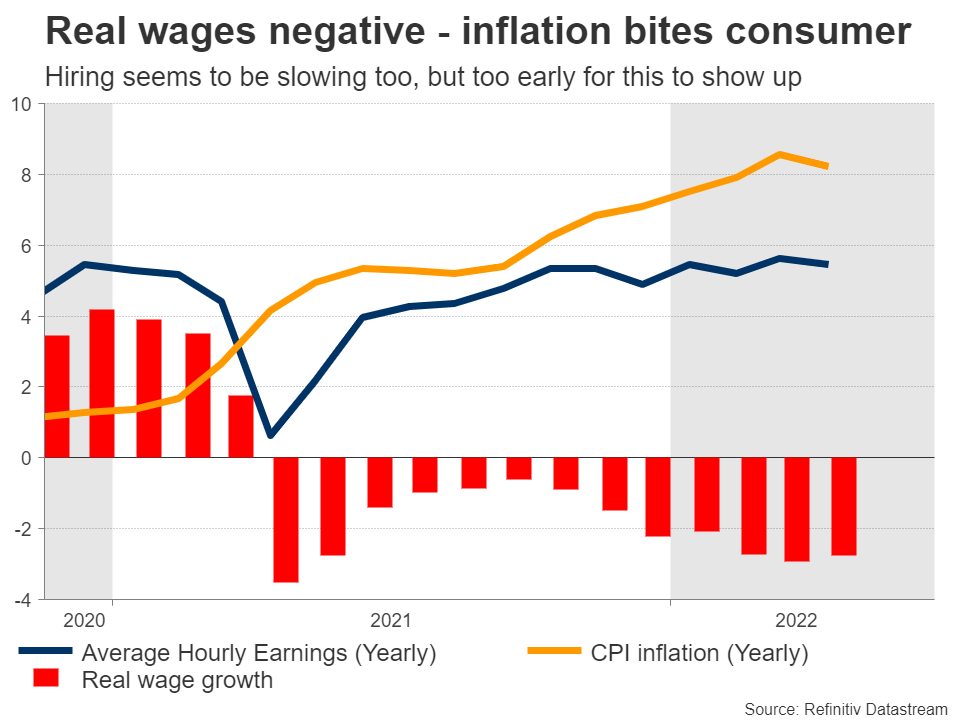
However, the fundamental picture hasn’t changed much. The Fed is still on track to raise rates quickly, the European and Chinese economies are in far worse shape than the American economy, and a global recession would probably send safe-haven flows into the dollar.
There are three fundamental catalysts to watch for a reversal in the dollar - the Fed pauses its hiking cycle, the war in Ukraine ends, or China abandons zero-covid policies. Until then, the reserve currency is unlikely to go out of fashion.
Eurozone inflation getting hotter
Crossing into the euro area, the latest inflation stats will be released on Tuesday. Forecasts suggest the yearly CPI rate continues to rise, hitting 7.6% in May. That is supported by the composite S&P Global PMI, which showed companies raising their selling prices at the second-sharpest pace on record.
Markets are certain the European Central Bank will raise interest rates in July but there’s a raging debate over how big the rate hike will be. A quarter-point rate hike is fully priced in and traders assign a 40% chance for a bigger, half-point move.
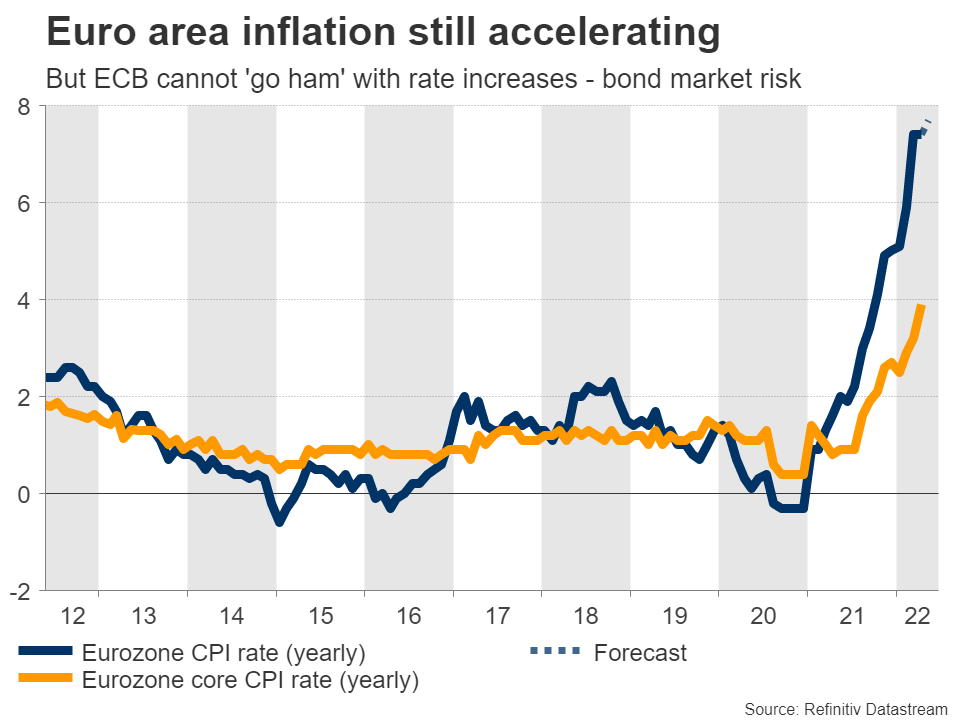
If inflation continues to heat up, that would tip the scales towards the bigger move, allowing the euro to extend its recovery. That said, there are limits to how fast the ECB can go. Raising rates with reckless abandon and stopping asset purchases implies huge risks for bond markets, especially in highly indebted economies like Italy.
Although the euro has bounced back, this looks mostly like a relief bounce from oversold levels. It will probably take something bigger than the ECB raising interest rates for a sustainable rally - possibly one of the three catalysts mentioned above.
BoC to raise rates, China reports PMIs
Over in Canada, the central bank meets on Wednesday and a half-percentage point rate increase (50 bps) is fully priced in. Hence, the market reaction will depend mainly on the signals for future rate hikes and the remarks around the economic outlook.
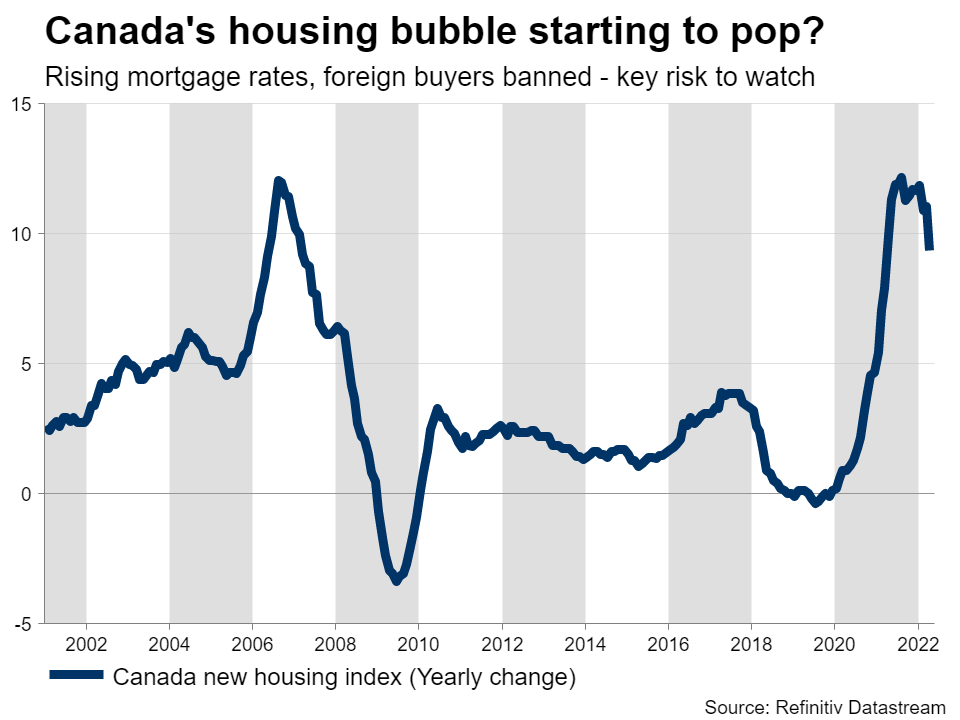
Admittedly, the Canadian economy is solid. Unemployment is at a five-decade low, inflation is sizzling hot, and consumption is healthy. The bad news is the housing market. Canadian house prices rose dramatically in recent years and with mortgage rates now going up so quickly, this ‘bubbly’ sector is in real trouble.
There are already some signs that home prices are dropping and the pain could just be getting started - something that might lead the BoC to be a little cautious, even though the broader economy is still fine.
Finally in China, the official PMIs are out on Tuesday and will provide the first look at how the economy performed in May. The lockdowns in major cities continue, so it will probably be another batch of terrible numbers.
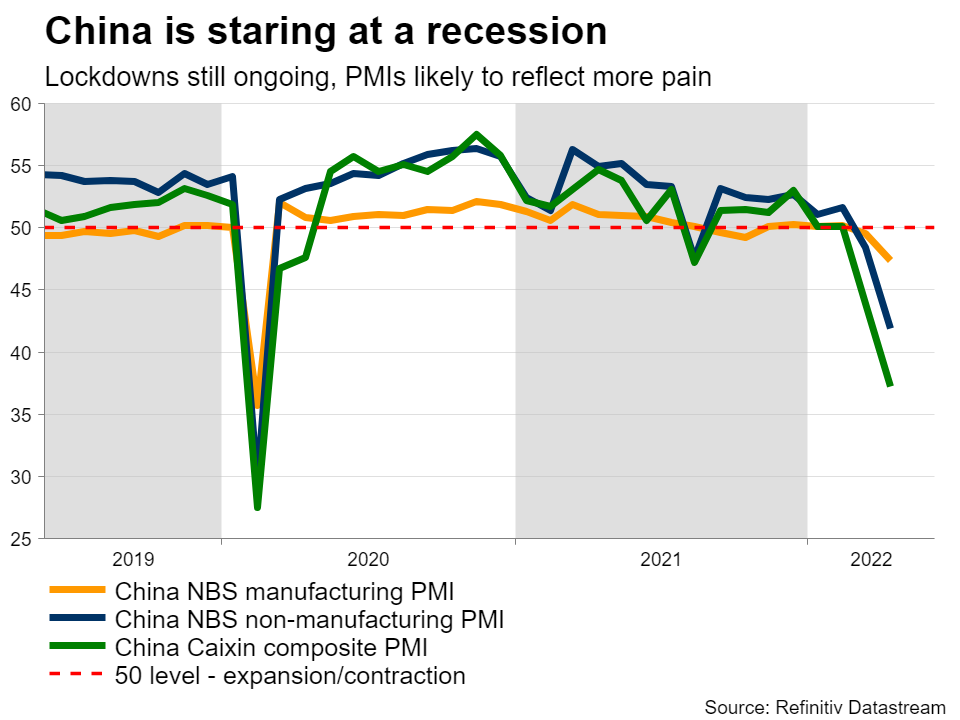
A recession looks increasingly likely, and if the upcoming data confirm that, China-sensitive currencies like the Australian dollar could take another hit. Markets are still pricing nine rate increases by the Reserve Bank of Australia this year, so there’s scope for disappointment. The nation’s GDP stats for Q1 are out on Wednesday but considering how much things have changed this quarter, these are likely outdated.