

Sample Category Title
Russia-Ukraine Conflict Not a Global Economic Risk
Summary
Tensions tied to the Russia-Ukraine situation have intensified in recent days. Although we do not have any particular insight into conditions on the ground or wish to speculate on the mindset of leaders involved, assessing the potential economic and financial market reaction to an escalation is still a valuable exercise. In our view, global economic growth is not at risk should Russia and Ukraine enter recession as a result of conflict and/or international sanctions. However, oil prices could move higher as a result of Russia supply disruptions, which could weigh on purchasing power and result in energy shortages, particularly within the European Union. Oil prices are a key influence for Russia, and current supply/demand dynamics suggest oil prices could move higher, especially if sanctions are imposed on Russia. Should oil prices remain steady or move higher, we believe the Russian economy and local financial markets will be more protected relative to 2014 even if sanctions are imposed, while the ruble selloff will likely be more contained.
Russia-Ukraine Tensions Shouldn't Disrupt Global Growth
Headlines surrounding Russia and a possible invasion of Ukraine continue to intensify. Rhetoric and rumors have created confusion as to the state of affairs on the Ukrainian border and whether the likelihood of military conflict in Ukraine is rising or not. Financial markets have been keenly focused on Russia-Ukraine developments. Over the past few weeks global equities, government bonds and currencies have been volatile as the situation has evolved. Equity prices around the world have been choppy, while sovereign yields and currencies have swung sharply in both directions as news on the situation changes. Should the current climate continue (i.e. no material escalation or de-escalation of tensions) we would expect financial markets to remain on edge, and for media headlines and political rhetoric to be a key source of volatility. While we do not have particular insight into conditions on the ground or wish to ascertain the mindset of leaders involved, assessing the potential economic and market impact of an escalation is still appropriate. Unfortunately, precedent for this type of scenario exists. There are nuances, but Russia's annexation of the Crimean Peninsula in 2014 can act as a guidepost for how the global economy as well as more specific country and regional economies could be impacted. We can also use the 2014 Crimea invasion to gauge how currency markets, in particular emerging market currencies, could respond.
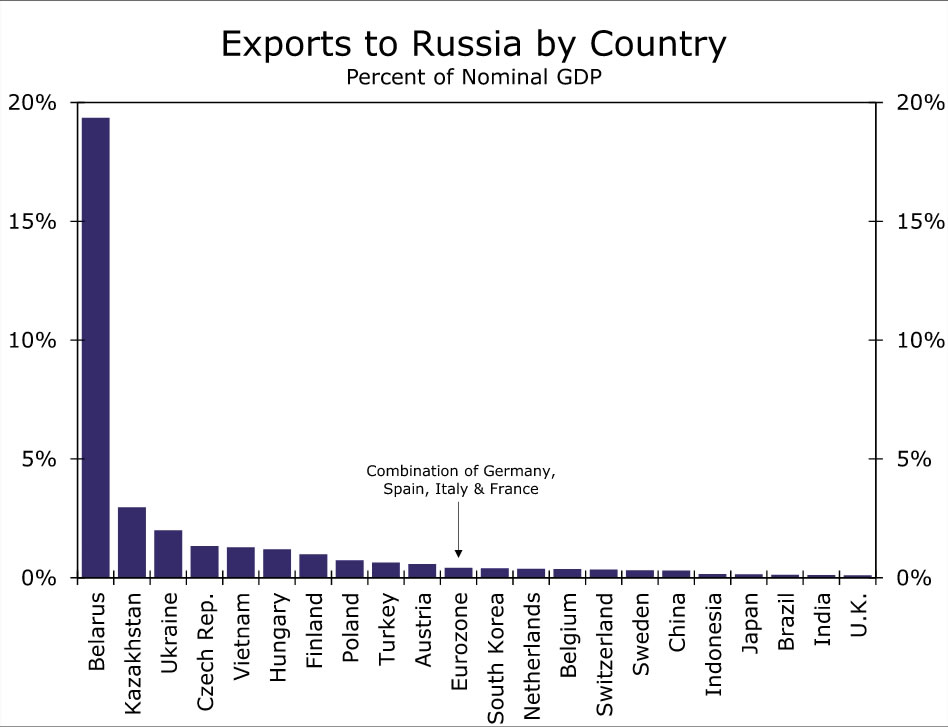
When we say "an escalation" we are being opaque by design. Obviously, "an escalation" can be interpreted many ways and result in a variety of outcomes; however, in our view, given the types of escalations and international sanctions response that appear to be the most likely at this time, we believe the impact of a Russia-Ukraine escalation on global economic growth would likely be minimal. For 2022, the International Monetary Fund (IMF) forecasts Russia's share of global GDP to be 1.6%. As far as Ukraine, the IMF expects the local economy as a share of global output to be just 0.2%. In a scenario where military conflict between the two nations and new sanctions plunge Russia and Ukraine into deep and prolonged recessions, a combined share of 1.8% of global economic output is not large enough to materially disrupt global economic growth. Even if we look at potential contagion through trade linkages with other nations, the spillover effects of recession in Russia and Ukraine would likely be limited as well. Ukraine is not a significant trading partner for any major or moderately large economy, and hence the contagion effect of an Ukraine recession would not be significant. Russia on the other hand has a bit more exposure to European Union countries as well as the Eurozone. Countries such as Hungary, Finland and Poland export goods to Russia, and while still small, those exports are not totally insignificant being worth between 0.75%-1% of each country's GDP (Figure 1). Russian demand for goods and services also stretches to the Eurozone, where we estimate the region's exports to Russia are equivalent to 0.4% of overall Eurozone GDP. While the Eurozone is economically significant in a global context, in our view, exposure to Russian demand is not material enough to disrupt the Eurozone economy or place much downward pressure on global economic growth. Russia and the United States have been decoupling for years and trade linkages between the two economies are minimal. While Russia and China have improved and strengthened ties over the years, China only exports products to Russia worth around 0.25% of its economy. Other major economies such as the United Kingdom and Japan are also not very reliant on Russian demand and would likely not experience any major economic disruptions from a Russia recession.
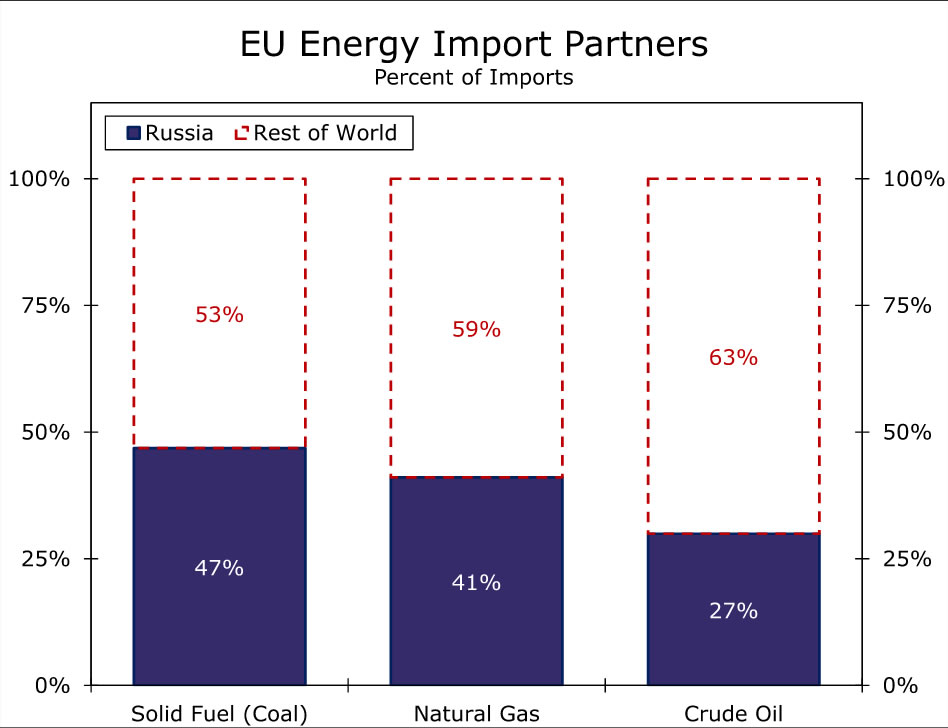
However, Russia's involvement could have more indirect effects on the global economy due to Russia being one of the world's largest oil producers and energy exporters. Right now, global oil production is around 100 million barrels per day. Of that 100 million barrels, Russia produces about 10 million barrels. Should a military conflict lead to new international sanctions being imposed on Russia, those sanctions could target Russia's ability to export oil and, should that oil supply be taken out of the market, a supply/demand imbalance could form and oil prices would likely move higher. Given many of the world's economic growth engines - including China, Japan and the United Kingdom and European Union - are net energy importers, higher oil prices could result in slower growth. In addition, higher oil prices would also increase the cost of living and could result in reduced household consumption. Of the major economies, the European Union seems to be particularly exposed not only to higher prices, but also specifically to Russian oil and to the possibility of energy shortages, an already budding problem across the European continent. Recent data indicate the European Union sources a high percentage of its energy from Russia. 47% of European Union coal, 41% of natural gas and 27% of oil imports come from Russia (Figure 2). In a scenario where Russian energy exporters become targets of new sanctions, the European Union could experience energy shortages that crimps manufacturing and raises the cost of living. Inflation is already rising across Europe, and should energy shortages push energy prices sharply higher and reduce household purchasing power even more, EU economic activity could soften.
Russia Could be Protected This Time
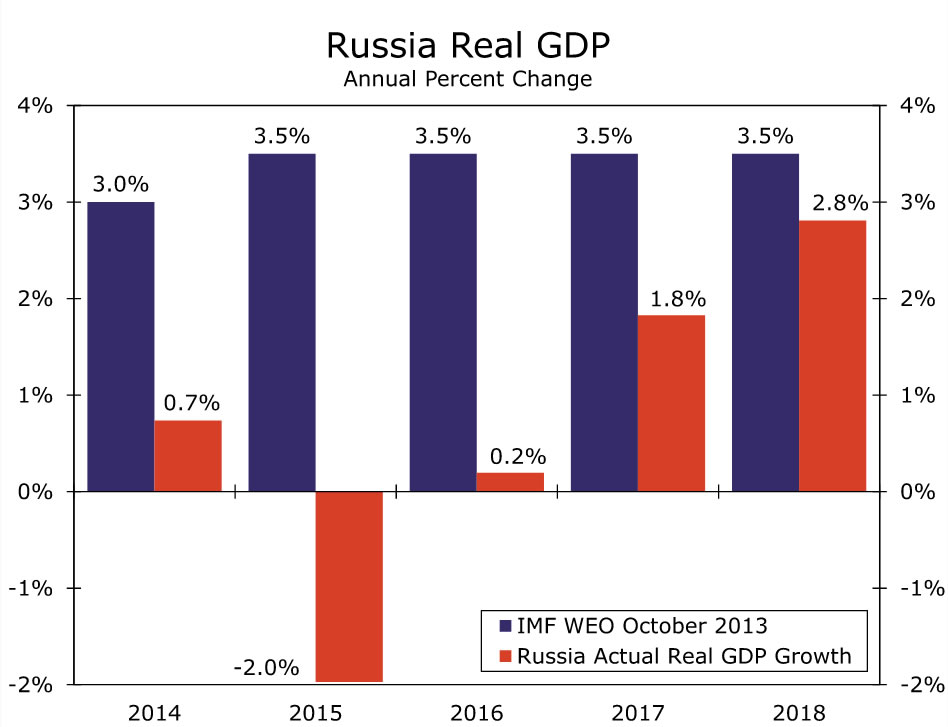
As far as the economic impact specifically to Russia, we can draw insight from the episode in 2014; however, we also note that the current scenario is not necessarily an apples-to-apples comparison. Russia's economy was certainly disrupted by the invasion into Crimea and the subsequent international sanctions; however, 2014 also marked a supply and demand imbalance in commodity markets that resulted in an oil price slump (i.e. more supply than demand). Those same supply and demand dynamics may not be in place today. For now at least, if an imbalance does exist, demand probably is greater than supply. In theory, when demand is greater than supply oil prices should rise, so an oil price shock might not be something Russia's economy will need to contend with this time around, just sanctions. With that said, the dual shock of sanctions and lower oil prices pushed Russia's economy into recession following the 2014 Crimea invasion, an economic downturn that lasted through 2016. To give a sense of how much this dual shock weighed on the economy, we can look at IMF forecasts at the end of 2013 compared to actual annual growth rates. In the IMF's October 2013 World Economic Outlook (published before the annexation of Crimea and the fall in oil prices), IMF economists forecast Russia's economy to grow 3% in 2014 and 3.5% from 2015-2018. In response to lower oil prices and the effects of sanctions, actual annual growth rates came in much lower. In 2014 Russia's economy grew only 0.7%, contracted 2% in 2015, and expanded 0.2% in 2016 before demonstrating a more robust recovery later on (Figure 3). In our view, the oil price shock had a more significant impact on the Russian economy, but disentangling the exact impact of low oil prices from sanctions is difficult. We do believe, however, sanctions would place downward pressure on growth. With that said, the severity of the sanctions would likely determine the magnitude as well as the longevity of the hit to Russia's growth prospects in 2022, as well as in years to come.
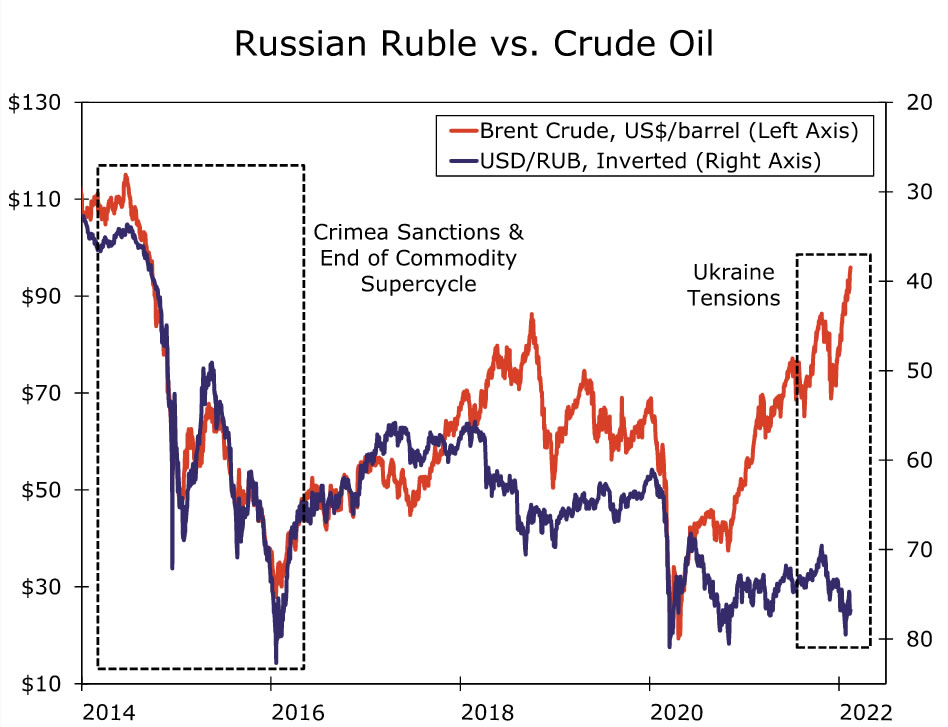
We also believe the severity of sanctions would be a key driver of the ruble over the short-to-medium term. While we will refrain from prognosticating on the specific types of sanctions that could be imposed, sanctions designed to disrupt Russia's economy as well as integration and inclusion in the global financial system would likely be the most damaging for the path of the ruble. We can also use the 2014 crisis as a benchmark for how the ruble could perform against this geopolitical backdrop, but with the same caveat that oil prices were very influential over the currency in 2014, and the same oil price action may not occur in today's environment. From 2014-2016, on a peak to trough basis, the Russian ruble depreciated over 50% (Figure 4), the worst performing currency in the world over this period. In our view, the majority of the ruble's selloff from 2014-2016 was driven by the collapse in oil prices, and we would not expect a selloff of the same magnitude should an escalation occur. However, we do believe sanctions played a role in the ruble's devaluation. Should harsh international sanctions be imposed on Russia, we believe the ruble can come under more pressure than we currently forecast; however, we do not believe the currency will test all-time lows against the U.S. dollar experienced toward the end of 2016.
Along with the ruble, we also believe regional Eastern European emerging currencies would come under pressure. Currencies such as the Polish zloty, Hungarian forint and Czech koruna could sell off, while the Turkish lira and South African rand could also be vulnerable in this scenario. We expect that other emerging market regions such as Latin America and Emerging Asia would not come under as much pressure. Trade linkages between these regions and Russia are not significant, and while sentiment could weigh on emerging currencies broadly, we believe elevated energy prices could support currencies such as the Brazilian real, Mexican peso and Colombian peso. We also believe underlying fundamentals across Emerging Asia are strong, and while Asian countries are mostly energy importers and high energy prices could impact current account balances and growth prospects, we expect any volatility to be muted and short-lived.
GBPJPY Returns Below 157 Hurdle But Maintains Bullish Mood
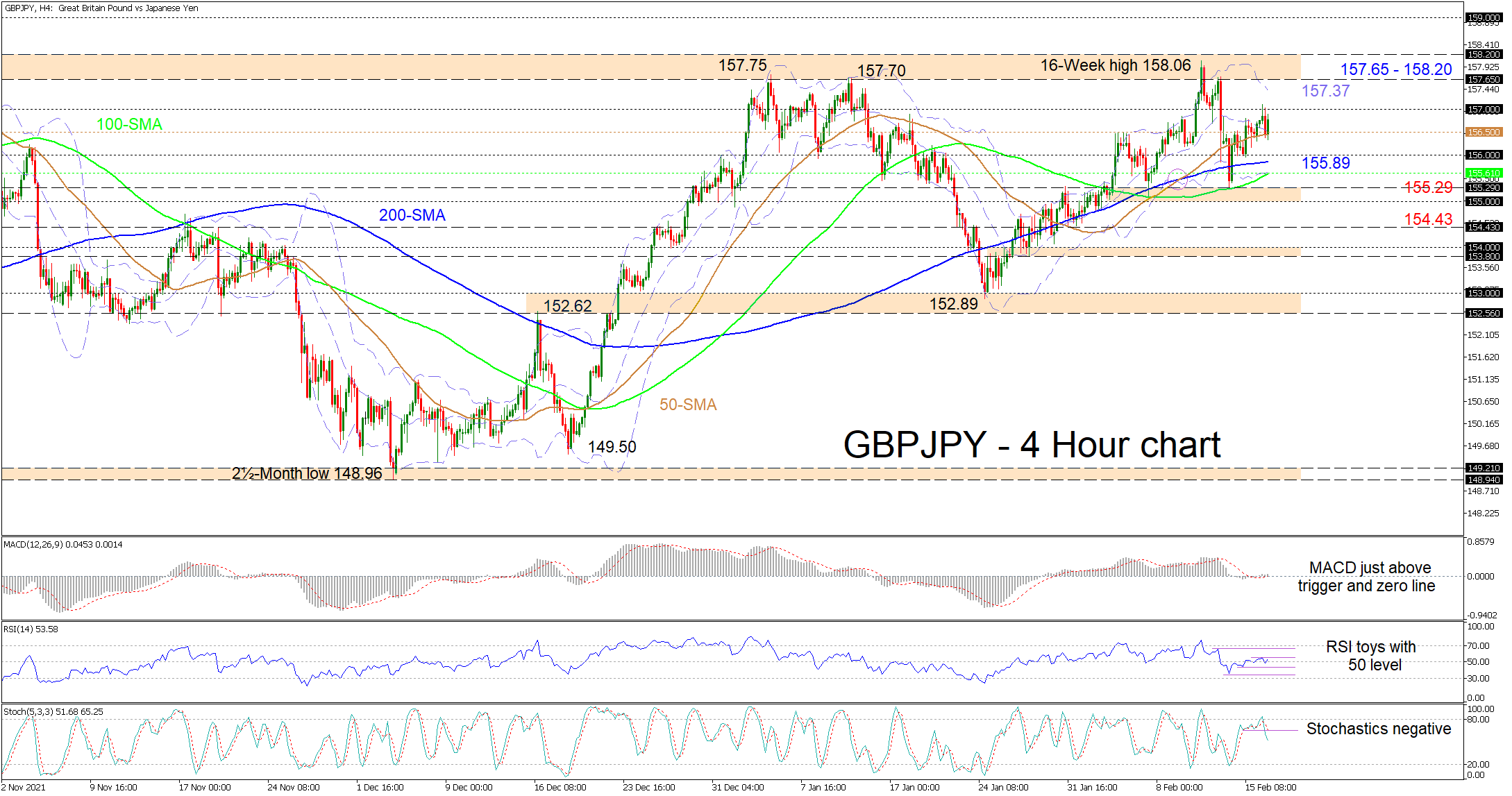
GBPJPY buyers have re-emerged around the 50-period simple moving average (SMA), shortly after the withdrawal of the pair from the 157.00 price vicinity. The gradual positive incline in the SMAs is underpinning upside moves in the pair.
The short-term oscillators are transmitting weak and conflicting messages in directional momentum. The MACD has flatlined and is marginally above its red trigger and zero lines. The RSI is fluctuating around the 50 neutral threshold but is currently pointing north a tad in the bullish region. That said, the negatively charged stochastic oscillator is reflecting the latest dip in the price and has yet to indicate that downside pressures have calmed.
If buying interest increases, immediate upside constraints could transpire from the 157.00 border and the intraday high of 157.10 before the bulls aim for the upper Bollinger band at 157.37. Looming overhead is the crucial 157.65-158.20 resistance section that has held since October 2020, which has been reinforced by multiple rally peaks over the last couple of months. A definitive climb north of this boundary could boost upside momentum, encouraging the price to propel towards the 159.00 barrier.
Alternatively, if the retraction in the price from the intraday high of 157.10 extends below the mid-Bollinger band and 50-period SMA at 156.50, sellers may then encounter a fortified region of support between the 156.00 mark and the 100-period SMA at 155.61. In the event this zone fails to dismiss downward forces, the bears may attempt to reinforce a negative trajectory with a break beneath the 155.00-155.29 support base, which could then turn the spotlight towards the 154.43 barrier.
Summarizing, GBPJPY’s neutral-to-bullish mood is intact above the SMAs and the 155.00-155.29 support base. A break above the four-month ceiling of 157.65-158.20 could boost optimism in the pair.
Strong Sales Cementing the Importance of Fed Rate Hikes
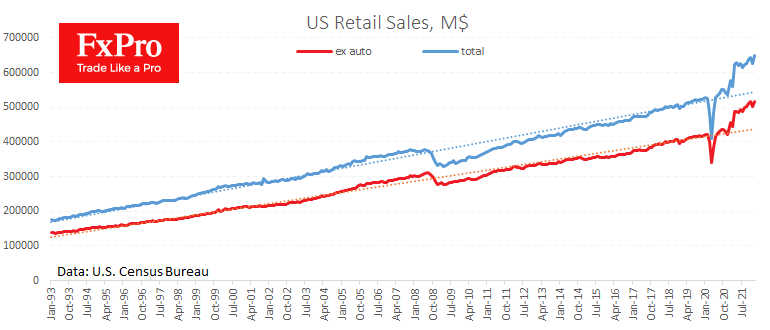
Total US retail sales rose by 3.8% in January and by 3.3% ex auto and fuel vs expected 2.1% and 1.0%, respectively. Both figures confirm a favourable environment in the world’s largest economy for a tighter monetary policy.
The nominal sales charts clearly show a break from the long-term uptrend from mid-2020. But also, a scenario of a return to the pre-2008 norm cannot be ruled out. In this case, a higher price growth rate could well coexist alongside a booming economy and a tight monetary policy where the key rate exceeds inflation by 1-2 points.
Inflation numbers above expectations are seen as support for the dollar, and retail sales and a strong labour market can also fuel equity purchases, improving global risk appetite.
Rising retail sales reduce fears that an impending interest rate hike from the Fed could push the economy back into recession in the coming quarters. WSJ’s observations in the latest article show that rate hike cycles only come to an end when the economy turns to recession.
US oil inventories rose 1.1m barrels, WTI rebounds, still on track to 100
US commercial crude oil inventories rose 1.1m barrels in the week ending February 11. At 411.5m barrels, oil inventories are about -10% below the five year average for this time of the year.
Gasoline inventories dropped -1.3m barrels. Distillate dropped -1.6m barrels. Propane/propylene dropped -5.9m barrels. Total commercial petroleum inventories dropped -9.9m barrels.
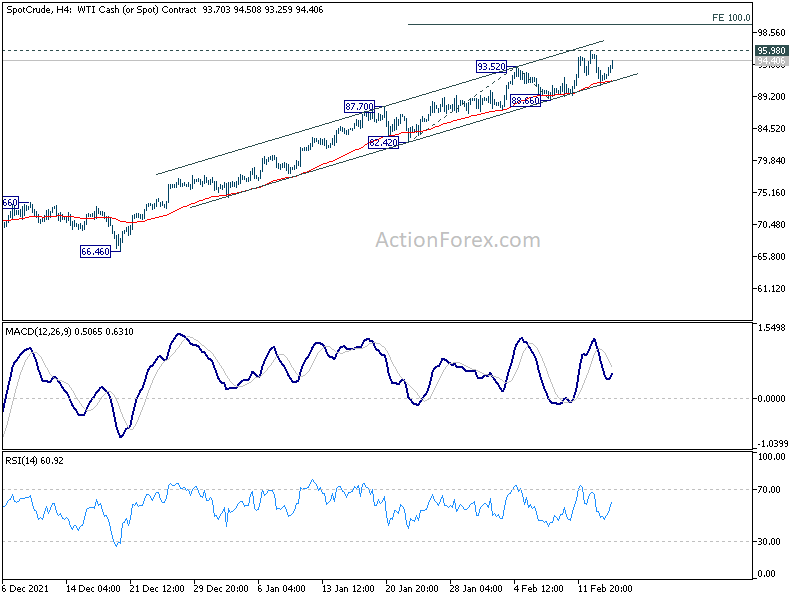
WTI crude oil is back above 94, as it rebounded after drawing support from 4 hour 55 EMA, as well as near term rising channel support. The development maintains near term bullishness and focus is now back on 95.98 resistance. Break there will resume near term up trend to 100% projection of 82.42 to 93.52 from 88.66 at 99.76 next. IN any case, outlook will now stay bullish as long as 90.80 support holds.
Japanese Yen Drifting, Fed Minutes Next
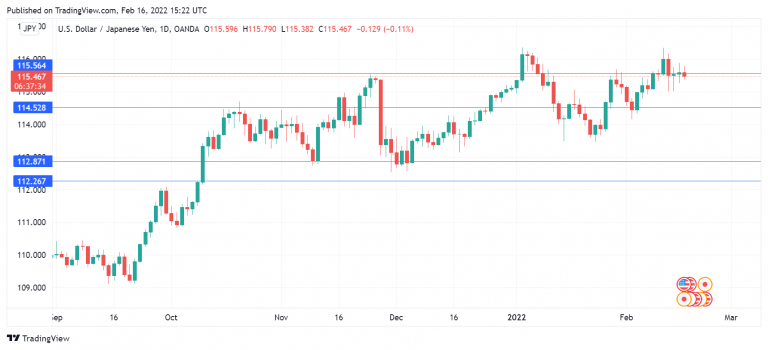
The Japanese yen continues to have a quiet week and is trading at 115.46 in the North American session, down 0.12% on the day.
What next for Ukraine?
The US dollar enjoyed a boost earlier in the week as tensions between Russia and the West reached a fever pitch. Now that the situation has stabilized somewhat, investors are breathing easier and the dollar has lost ground. Still, there is apprehension in the air and a lack of clarity as to what happens next. Russia says that it has moved some troops away from attack positions, but the US says there is no proof of this. President Biden took to the airwaves on Tuesday and warned the Russians of severe consequences if it attacked Ukraine while saying it was not too late to reach a diplomatic solution.
US retail reports sparkle
In the US, a strong retail sales report for January provided something for investors to digest other than news from Ukraine. Retail Sales jumped 3.8% m/m, crushing the estimate of 2.0% and rebounding from the 2.5% decline in December. High inflation helped boost the retail sales numbers, but consumers are buying more goods and services as well.
Investors will now shift their attention to the Fed minutes, which will be released later today. We’ve been hearing a hawkish message from some FOMC members of late, and the minutes could well reflect the hawkish pivot that the Fed has reluctantly embraced due to red-hot inflation. Fed Chair Jerome Powell recently abandoned his stance that inflation was transitory and a March liftoff for hikes is essentially a done deal. The markets have priced in six hikes, although some FOMC members have suggested that three or four hikes will suffice to rein in inflation close to the Fed’s target of 2 per cent.
USD/JPY Technical
- There is weak resistance at 115.56. Above, there is resistance at 114.52
- There is support at 112.87 and 112.26
US: Retail Sales Bounce Back, With Autos and E-commerce Doing Most of the Heavy Lifting
Retail sales jumped up 3.8% month-on-month (m/m), well above the consensus estimate for an increase of 2.0%. December's reading had a marginal downward revision to -2.0% m/m from -1.9% m/m reported earlier.
Autos & parts dealers had a strong month, rising 5.7% m/m despite December's downward revision to -1.6% vs. (-0.4% reported earlier).
Excluding autos, retail sales were up 3.3% m/m. Sales at gasoline stations declined by 1.3%m/m, while building materials retailers saw a gain of 4.1% m/m in January.
Sales in the "control group", which exclude the most volatile categories and are used in calculating personal consumption expenditures (and GDP), were up by 4.8% m/m. However, December sales were revised weaker, -4.0% m/m from the advance reading of -3.1% m/m.
- Within the group, the biggest contributors to growth were non-store retailers (+14.5% m/m), department stores (+3.6% m/m) and furniture & electronics/appliance stores (+5.2% m/m),
- Several categories were in the red, including food services & drinking places (-0.9% m/m), sporting goods, hobby, book & music stores (-3.0% m/m), health & personal care (-0.7% m/m) and miscellaneous stores retailers (-0.1% m/m).
Key Implications
What a strong start to the year! One third of the strength came from auto sales, with consumers snapping up cars as they roll off the assembly line despite increasingly higher vehicle prices. Non-store retailers returned with vengeance, recovering all of their December losses and more. Other categories also delivered a strong performance as consumer demand is proving resilient to Omicron and post-holiday spending fatigue typical of the winter months. One disappointment is the decline in sales in food establishments and bars, which may point to a momentum loss in services growth, a more detailed reading of which will come out at the end of the month.
Looking to the year ahead, retail trade growth should remain steady. Consumers haven't made a sizeable dent in their pandemic nest egg, which should support a healthy level of spending, especially as job and income growth remains healthy. One risk is that consumers become more and more pessimistic about their spending prospects as concerns over inflation continue to mount. Still, we expect that goods inflation will ease as consumer demand shifts towards services consumption, which should help balance out spending without tempering growth.
Canada: Inflation Rises Above 5%, Highest Levels Since 1991
Consumer price inflation accelerated to 5.1% year-on-year (y/y) in January, from 4.8% in December and well ahead of market expectations for an unchanged print. Energy price growth accelerated to 23.1% (from 21.2% in December), even as gasoline price growth slowed year-on-year (to 31.7% from 33.3% in December). Excluding energy, prices picked up noticeably, hitting 4.0% y/y (from 3.7 in December).
Seasonally adjusted, month-on-month prices were up a robust 0.6%. Price growth was broad and swift across categories in January. Every category saw monthly gains well in advance of their recent historic norms, with especially strong growth in recreation, reading and education (+2.2%), tobacco and alcohol (+1.1%), transportation (+0.7%), food (+0.6%), and shelter (+0.5%).
All three of the Bank of Canada's core inflation metrics rose 0.2 percentage points in January. CPI-trim hit 4.0% (from 3.8%), CPI-median to 3.3% (from 3.1%), and CPI-common measure to 2.3% (from 2.1%).
Key Implications
It is no longer possible to point to idiosyncratic factors as driving prices higher in Canada. Inflation is broad based and elevated across categories. Headlines are likely to get worse before they get better, with year-on-year comparisons boosted by softer price growth in the spring of last year.
Higher interest rate hikes won't immediately quell inflation, but they are essential to slowing it over the medium term. Inflation expectations still appear to be well moored and anticipation that the Bank of Canada will raise interest rates has lifted interest rates to their highest level since before the pandemic.
Still, it will be important to watch the evolution of supply constraints as well as geopolitical risks. Unless these ease, inflation will continue to surprise on the upside, making the job of achieving a smooth landing that much harder.
Euro Steady as Ukraine Takes a Breath
The euro is flat on Wednesday, as investors keep a close eye on developments on the Ukraine/Russia border.
The euro has been acting as a barometer of the crisis, and the currency’s lack of movement today reflects a lack of clarity on the part of the markets as to what will happen next. Russia says that it has moved some troops away from attack positions, but the US says there is no proof of this. President Biden took to the airwaves on Tuesday and warned the Russians of severe consequences if it attacked Ukraine while saying it was not too late to reach a diplomatic solution.
In the eurozone, a tight labor market and rising inflation are putting pressure on the ECB to respond by raising interest rates. We have seen Christine Lagarde bend slightly and sound less dovish, although she has not indicated that the ECB is planning any rate hikes prior to 2023. The markets remain more hawkish and expect the ECB to raise rates by 40 basis points by the end of the year.
US retail reports shine
In the US, a strong retail sales report for January provided something for investors to digest other than news from Ukraine. Retail Sales jumped 3.8% m/m, crushing the estimate of 2.0% and rebounding from the 2.5% decline in December. High inflation helped boost the retail sales numbers, but consumers are buying more goods and services as well.
Investors will now shift their attention to the Fed minutes, which will be released later today. With various FOMC members sounding hawkish lately, there’s a strong chance that the minutes will reflect the hawkish pivot that includes Jerome Powell, who recently abandoned his stance that inflation was transitory. The markets have priced in six hikes and expect an aggressive Fed that has its work cut out for it on the inflation front.
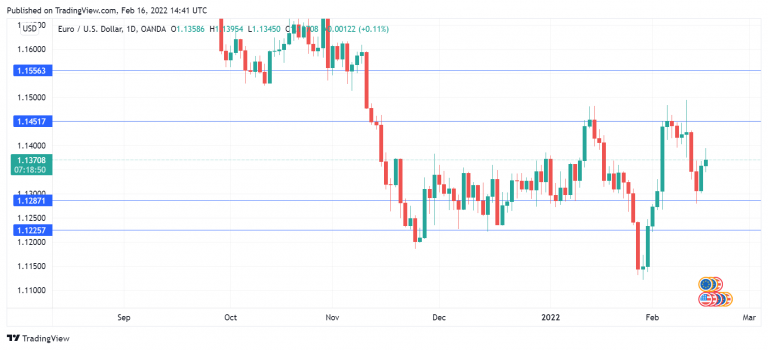
EUR/USD Technical
- EUR/USD faces resistance at 1.1452 and 1.1556
- There is support at 1.1287 and 1.1226
FOMC Minutes Next on the Radar; Canada CPI Surprises
US retail sales beat estimates; FOMC minutes next on the agenda
The minutes of the Federal Reserve's last meeting are on investor’s radar today and will be looking for details on its plans to reduce its enormous balance sheet and raise interest rates in 2022, as well as its evolving outlook on inflation. At the meeting on January 25-26, policymakers agreed that raising the Fed's benchmark overnight interest rate from near-zero would be "soon appropriate" and discussed the future of the $9 trillion in securities owned by the central bank.
The Fed's aggressiveness in tightening monetary policy, and in particular the likelihood of starting a new round of rate hikes in March with a half-percentage-point increase in its target rate, may be revealed in the debate over these themes. Investors presently expect the Fed to go down that route rather than the more cautious quarter-percentage-point rise.
The US dollar index is easing below 96.00 with weak momentum, while dollar/yen is posting some minor losses after two positive days. US futures stocks are suggesting a negative open today, after a strong bullish day on Tuesday.
As omicron infections decline and inflation continues to increase, retail sales in the United States rebounded in January, increasing by 3.8% m/m.
Russia returns some troops to base
Russian forces encircling Ukraine stated they were reducing their numbers on Wednesday; however, NATO demanded proof that they were reducing their numbers, claiming there were indications that more troops were on their way to the region.
The Ukrainian defense ministry has claimed that a cyber-attack has entered its second day. Russia denied any involvement in the incident. Following exercises in the southern and western military districts near Ukraine, Russia's defense ministry said its forces were withdrawing.
Canadian CPI surprises the market
Canada's headline inflation rate increased to 5.1% in January from 4.8% in December, greatly exceeding market predictions of 4.8%. It was the highest rate of inflation since September 1991, owing to persistent supply interruptions.
The commodity currencies are showing some positive signs as the kiwi and the aussie are returning to the upside, both testing the short-term moving averages (MAs). Dollar/loonie is heading south, holding near 1.2680.
Oil prices are rising today by 1.4% approaching the latest almost seven-and-a-half-year high of 95.78. On the other hand, gold prices are moving near their opening levels, holding above the long-term symmetrical triangle.
UK CPI jumps to 5.5%
British consumer prices grew at their fastest annual rate in over 30 years, putting pressure on consumers and increasing the likelihood of a third consecutive Bank of England rate hike. As Britain emerged from a protracted period of high wage accords, annual inflation climbed to 5.5% in January, the most since March 1992. The Bank of England estimated earlier this month that inflation will peak around 7.25 percent in April, when energy expenses will more than double. Sterling is showing some positive vibes but is still developing around $1.3555, remaining in a neutral range in the short-term.
Sunset Market Commentary
Markets
Today’s trading session revolved around US retail sales. They came in much stronger than expected, even accounting for the 0.5-0.9% (depending on the gauge) downward revision of December. Headline sales rose 3.8% m/m vs 2% expected. The control group – a proxy for private consumption in GDP – soared 4.8%, crushing the 1.3% consensus bar. While Omicron probably damped spending, it clearly did so less than feared. 8 out of the 13 categories rose with motor vehicles, furniture and non-store sales surging the most. Eating and drinking is the only service-oriented bracket in the retail sales series and showed a 0.9% m/m decline. US bond yields hesitated for a few minutes before shedding a few bps shortly after. It was the easiest way to go after showing some fatigue earlier on the day and as a still-mild risk-off intensifies (EuroStoxx50 loses about 0.5%, WS opens up to 1% lower in the Nasdaq) going into US dealings on lingering geopolitical uncertainty. US yields decline 2.3-3.5 bps across the curve with the 10y trying to retain the 2% ahead of tonight’s Fed meeting minutes. German yields decline in sympathy with changes varying from -2.5 bps (2y) to 4.3 bps (10y). ECB heavyweight Villeroy this morning said APP net buying could end in Q3 but hinted at altering forward guidance to allow for more time for a first rate hike. ECB hawk Kazaks later said a rate hike is “quite likely” this year but framed markets positioning for two 25 bps hikes as “somewhat too harsh”. Interestingly though, markets refuse to rule out such a scenario. European swaps yields slightly outpace the decline of Bund yields, easing 2.6 to 4.6 bps in a bull flattening move. UK yields tank up to 13 bps even as CPI in January accelerated unexpectedly to 5.5% headline and 4.4% core. It suggests money markets currently expect more than enough action by the Bank of England. UK retail sales on Friday thus face an asymmetric market risk.
There are no stand-out currencies in FX space today. The Canadian loonie takes first place with small gains vs all G10 peers following higher-than-expected inflation (see below). The USD and euro is a balance of weakness with the pair briefly touching minor resistance at 1.1386 before returning to opening levels around 1.136. The trade-weighted DXY is testing the 96 barrier. Sterling headed for the strongest levels vs the euro for the day while US dealings get going. EUR/GBP went from 0.839 to 0.837 at the time of writing.
News Headlines
The European court of Justice today ruled that the rule of law conditionality mechanism was legally solid and is in accordance with the treaties of the Union. The court dismissed challenges of Poland and Hungary against rules that would allow the Union to retain funding from members states that are breaking European laws. There is no appeal possible against this ruling of the ECJ. The ECJ found that the new law ‘respects in particular the limits of the powers conferred on the European Union and the principle of legal certainty’. The EU has disputes with multiple countries on compliance with its founding principles but it is expected that the mechanism might be used against Hungary and Poland in the near future. The loss of the zloty after the announcement of the ruling was modest (EUR/PLN 4.50). Forint losses were bigger with EUR/HUF rebounding from the sub 354 area to currently trade near 356.25.
Headline inflation in Canada in January accelerated 0.9% M/M (non-seasonally adjusted) to 5.1% Y/Y, the fastest pace since September 1991 (was -0.1% M/M and 4.8% Y/Y in December). The outcome was also above market expectations. Price rises were broad-based with M/M gains of 1.4% for food, 0.5% for shelter, 1.3% transportation and recreation/education (1.3%) catching the eye. All of the BoC preferred core inflation measures also printed higher than expected. Markets were already positioned for the BoC to start hiking its policy rate at the March 2 meeting. Today’s data only confirm this lift-off scenario. The loonie gained modestly after the CPI release with USD/CAD currently trading in the 1.2690 area.