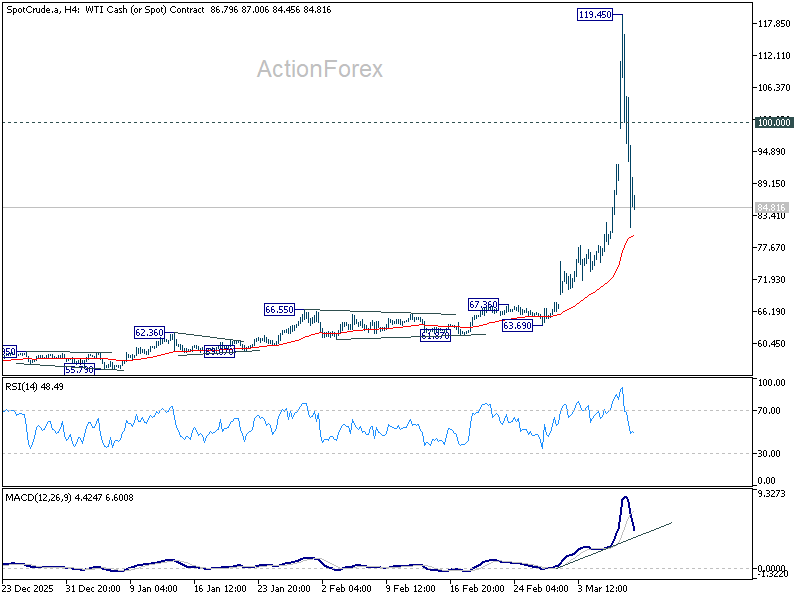
WTI crude’s rapid fall from near 120 yesterday to around the 85 area suggests that the oil market is beginning to reassess the scale of the supply shock triggered by the Middle East conflict.
The earlier surge had reflected fears that the Strait of Hormuz could face a prolonged blockade, potentially removing a massive portion of global supply from the market. That worst-case scenario now appears less dominant in market thinking. Instead of pricing a “catastrophic supply vacuum”, traders are increasingly shifting toward a “managed conflict” framework in which oil continues to flow, albeit under greater logistical and geopolitical friction.
This transition marks a classic shift often seen in commodity markets during geopolitical crises. Early in a conflict, prices tend to surge as traders hedge against extreme supply disruptions. As more information becomes available and governments signal their responses, markets gradually move toward pricing the most likely operational scenario rather than the worst-case outcome.
One key catalyst for the sudden reversal was remarks from US President Donald Trump in an interview with CBS. Trump said the military operation was “very complete” and “very far ahead of schedule,” suggesting the conflict could end sooner than many traders had feared. Those comments effectively punctured the “forever war” scenario that had driven oil prices sharply higher.
At the same time, Trump issued a stark warning that Iran would face consequences “much, much harder” if it attempted to block oil supplies. The message was interpreted as a strong deterrent against Iran attempting to sustain a long-term closure of the Strait of Hormuz.
Policy signals from major economies also helped cap the rally. Following discussions with the International Energy Agency, G7 officials said they stand ready to take “necessary measures,” including the release of strategic oil reserves to support global supply.
Although no release has been formally announced, the statement itself carries considerable weight in the oil market. Member countries of the IEA collectively hold roughly 1.2 billion barrels of public emergency reserves, which could theoretically offset the loss of Iranian and Iraqi exports for months.
The signal effectively created a policy ceiling for oil prices, giving speculative traders a clear reason to unwind bullish positions. Many hedge funds had built large long positions betting that prices could quickly surge toward 150. Once governments signaled a willingness to intervene, the risk-reward balance shifted sharply.
With these developments, the oil market now appears to be converging on a new equilibrium range between 80 and 100 per barrel. This range reflects a significant geopolitical risk premium without assuming that the conflict will completely sever global supply chains.
The lower bound near 80 effectively represents the embedded “war premium.” Before the conflict erupted, WTI was trading closer to the mid-60s. The current floor therefore implies roughly 15–20 per barrel of geopolitical risk, reflecting higher insurance costs, freight disruptions, and the persistent possibility of military escalation around key shipping lanes.
In other words, the market is still pricing the conflict—but only as a source of operational friction rather than a systemic supply collapse. As long as tanker traffic remains somewhat constrained and insurance premiums stay elevated, oil prices are unlikely to fall back to their pre-conflict levels.
For oil to fall meaningfully below 80 level, markets would need clear evidence that those risks are disappearing. A ceasefire agreement, normalization of tanker traffic through the Strait of Hormuz, or credible diplomatic progress could remove the premium currently supporting prices.
On the other side of the range, the 100 level represents the escalation trigger. A move above that threshold would signal that markets are once again pricing the risk of severe supply disruption. Such a breakout would likely require renewed attacks on shipping, direct strikes on energy infrastructure, or evidence that tanker traffic through Hormuz has been materially halted. In that scenario, traders would again begin hedging against a much deeper supply shock.