


USD/JPY rose to 159.39 on Thursday, as the yen weakened amid conflicting signals from Donald Trump on a possible de-escalation of the Middle East conflict. The situation continues to support the US dollar while weighing on the yen.
The US currency strengthened following reports that the operation in Iran is “close to completion” and could achieve its goals in the coming weeks. However, these statements were accompanied by warnings of a potential escalation in hostilities. At the same time, Trump emphasised that diplomatic contacts are ongoing, keeping investors cautious and maintaining heightened attention to geopolitical risks.
For Japan, the situation remains sensitive: the country relies heavily on oil imports from the Middle East, and fuel prices reached record levels in March, although they have since eased slightly supported by government subsidies.
New Bank of Japan board member Toichiro Asada has signalled a preference for a cautious, data-driven approach. He joins the council ahead of the 27–28 April meeting, where markets currently price in a probability of a rate hike at approximately 70%.
Technical Analysis
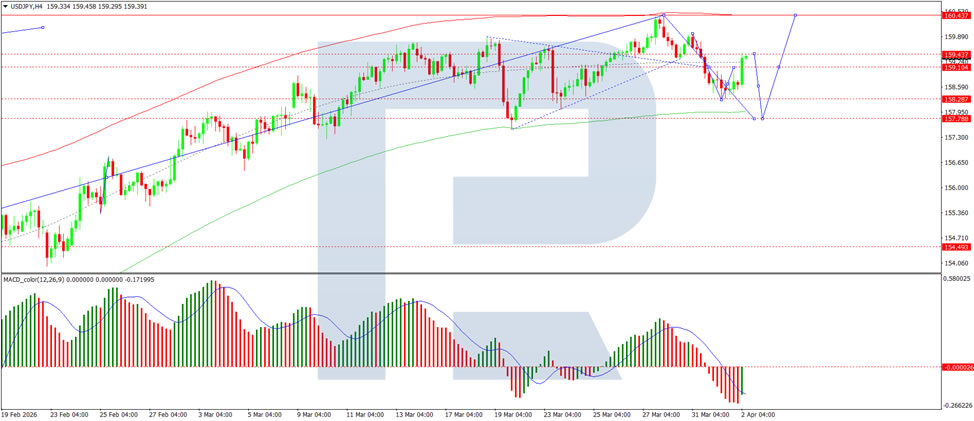
On the H4 chart, USD/JPY is forming a consolidation range around 159.10. The range is expected to expand to 159.50 today, followed by a decline to 157.70. An upside breakout could lead to a correction to 160.40, after which a new downward impulse to 157.70 is anticipated, with the prospect of a continued move towards 156.00. The MACD indicator confirms this scenario, with its signal line below zero and pointing firmly downwards, supporting the potential for the downtrend to continue.
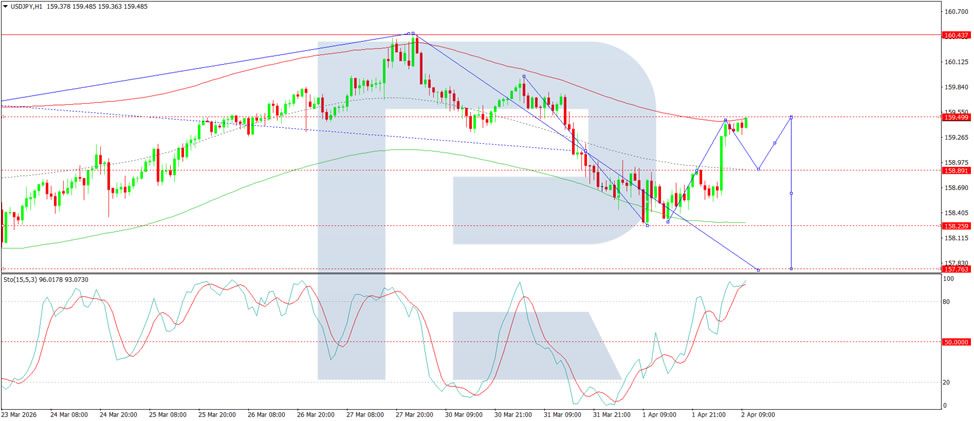
On the H1 chart, the market is forming an advance towards 159.50 and is likely to reach the target today. Following this, a downward wave to 157.70 (testing from below) is possible. The Stochastic oscillator confirms this structure, with its signal line above 80 and pointing firmly downwards, indicating continued short-term downside potential.
Conclusion
USD/JPY remains in positive territory, with conflicting signals from the US over Middle East de-escalation creating an uncertain backdrop that favours the dollar over the yen. While reports of progress in the Iran operation have supported the greenback, ongoing diplomatic contacts and warnings of escalation keep markets on edge. Japan’s sensitivity to oil price fluctuations adds to yen pressure, although government subsidies provide partial relief. With a new BoJ board member advocating a cautious approach and markets pricing in a 70% probability of a rate hike at the April meeting, the yen’s near-term trajectory will likely depend on both geopolitical developments and upcoming policy signals from Tokyo. Technical indicators point to a possible short-term correction lower.





