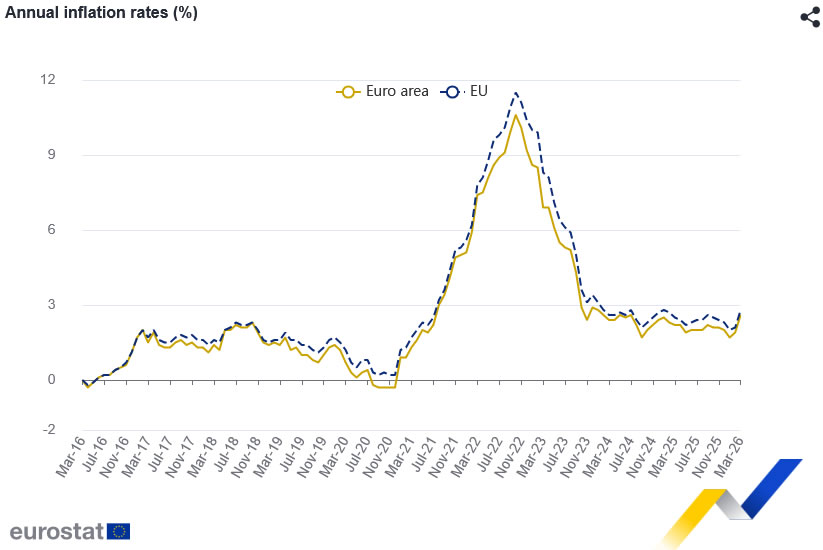
Eurozone inflation accelerated sharply in March, with headline CPI finalized at 2.6% yoy, up from 1.9% in February and marking the highest level since mid-2024. The rebound reflects a renewed pickup in price pressures, largely driven by energy and services, even as underlying inflation showed signs of moderation.
The composition of inflation highlights a shift in dynamics. Services remained the largest contributor, adding 1.49 percentage points, while energy contributed 0.48 percentage points. Food, alcohol and tobacco also added 0.45 percentage points, with non-energy industrial goods contributing modestly. In contrast, core inflation edged down slightly from 2.4% to 2.3% yoy, suggesting that underlying price pressures remain contained for now.
Across the broader EU, inflation was finalized at 2.8% yoy, with significant divergence among member states. The lowest annual rates were registered in Denmark (1.0%), Czechia, Cyprus and Sweden (all 1.5%). The highest annual rates were recorded in Romania (9.0%), Croatia (4.6%) and Lithuania (4.4%). Compared with February 2026, annual inflation fell in three Member States, remained stable in one and rose in twenty-three.
| Indicator | Latest | Notes |
|---|---|---|
| Headline CPI | 2.6% | Up from 1.9%, highest since mid-2024 |
| Core CPI | 2.3% | Slightly down from 2.4%, underlying pressures easing |
| Services Contribution | +1.49 pp | Largest driver of inflation |
| Energy Contribution | +0.48 pp | Rebound driven by rising fuel costs |
| Food, Alcohol & Tobacco | +0.45 pp | Continued steady contribution |
| Non-Energy Industrial Goods | +0.13 pp | Modest contribution |