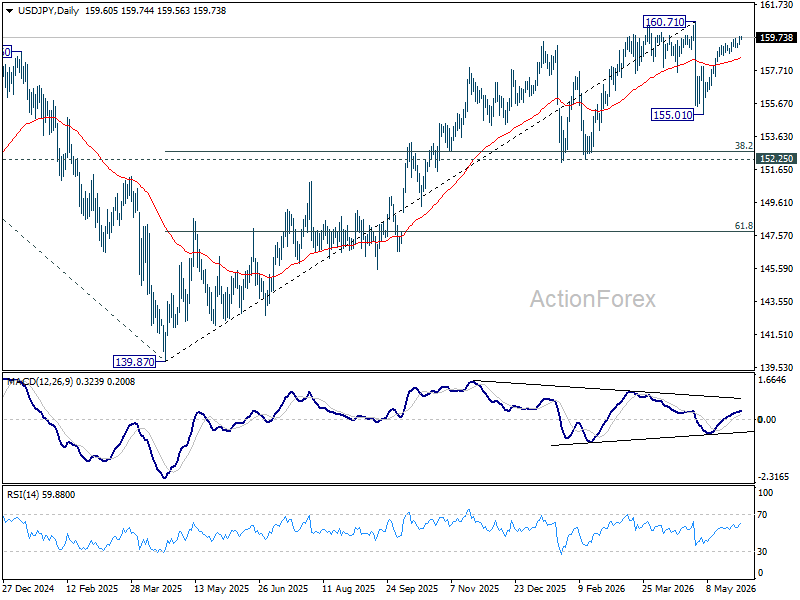
The Japanese Yen is once again approaching the intervention red line around 160 per dollar, despite growing confidence that the Bank of Japan will raise interest rates later this month. Overnight index swaps are currently pricing around an 80% probability of a June rate hike from 0.75% to 1.00%. Under normal circumstances, the prospect of tighter monetary policy would be expected to support the currency. Instead, Yen is among the weakest major currencies, highlighting a market that is looking beyond the next BoJ move.
The problem is not whether the BoJ hikes. It is what comes after. A 25 basis point increase would do little to close the enormous yield gap between Japan and the rest of the world, particularly while the Middle East conflict continues to keep energy prices elevated and inflation concerns alive globally. As long as oil prices sustain upward pressure on global bond yields, a move to 1.00% is unlikely to materially change the attractiveness of Yen-funded carry trades. Markets want a clearer roadmap for policy normalization rather than a single rate hike.
That demand for clarity is becoming more vocal within Japan itself. Sumitomo Mitsui Financial Group’s global markets chief Arihiro Nagata told Reuters that the BoJ “should raise interest rates in June, and I expect it will – surely this time.” However, he argued that the key issue for the June 15-16 meeting is how clearly policymakers communicate their path toward normalization. Nagata’s concern is not merely about interest rates but about reducing uncertainty and allowing markets to price future policy without fear of sudden disruptions.
Former BoJ board member Makoto Sakurai went even further. Warning that inflation pressures are broadening because of the Iran war, he argued that “stagflation is inevitable” and that “forgoing a rate hike in June is unthinkable.” Sakurai cautioned that delaying action could force the central bank into a much more aggressive tightening cycle later, saying Japan is “only a step away from repeating the mistake that led to Japan’s lost decades.”
Meanwhile, broader markets remain trapped in a wait-and-see mode as uncertainty over US-Iran negotiations continues. Reports from Iran suggest a proposed agreement is still under review, while US President Donald Trump insists talks are continuing. Brent crude slipped back below 95 dollars on hopes diplomacy remains alive, but there is little conviction behind the move. Investors are still waiting for a definitive answer on whether a deal will emerge or fail.
For Yen traders, that uncertainty matters. If elevated oil prices continue to keep global yields high, even a June BoJ hike may struggle to prevent another test of 160. Japan spent ¥11.7 trillion defending that level only a month ago. The market now appears willing to ask whether authorities are prepared to do it again.
Stronger Eurozone Inflation Gives EUR/CAD a Floor. But Can It Break the Ceiling?
The ECB’s June rate hike is increasingly becoming a certainty after Eurozone core inflation surprised to the upside. That should keep EUR/CAD supported on dips, but the real challenge comes afterward. With markets already pricing another ECB move and oil prices still influencing the Canadian Dollar, breaking above major resistance may require more than next week’s hike alone. Read More.
Eurozone CPI Rises to 3.2%, Core Inflation Tops Forecasts
The ECB has spent weeks preparing markets for a rate hike, and May’s inflation data may have just validated that strategy. Core inflation exceeded forecasts and services prices accelerated sharply, suggesting price pressures are spreading beyond energy alone. Read More.
Gold’s 4,400-4,600 Standoff To Be Decided by the Next Iran Headline
Gold is caught between two competing narratives. Reports that Iran could halt talks and threaten Hormuz initially challenged the peace trade, but Trump’s insistence that negotiations are continuing prevented a broader market shift. With oil still below key resistance and Gold trapped between 4,400 and 4,600, the next major move may depend on whether diplomacy regains momentum or breaks down completely. Read More.
RBA’s Harper Warns Rising Inflation Expectations Could Require “Strong Action”
Higher oil prices, rising wage pressures, and persistent inflation expectations are keeping the RBA on alert. Ian Harper’s latest comments reinforce that policymakers remain focused on preventing inflation from becoming embedded in the economy. Read More.
Australia Approves Stronger Wage Rise as RBA Monitors Second-Round Effects
Australia’s Fair Work Commission has delivered a 4.75% increase in minimum and award wages, affecting more than one in five workers. While the direct impact on inflation is expected to be small, the bigger question is whether the decision becomes a benchmark for wage negotiations across the broader economy. That risk could keep the RBA focused on inflation expectations even as growth and labor market conditions soften. Read More.
USD/JPY Daily Outlook
Intraday bias in USD/JPY is back on the upside with break of 159.64 temporary top. Rise from 155.01 should continue to retest 160.71 high. Strong resistance should be seen there to bring reversal. On the downside, break of 159.08 minor support will turn intraday bias neutral first.
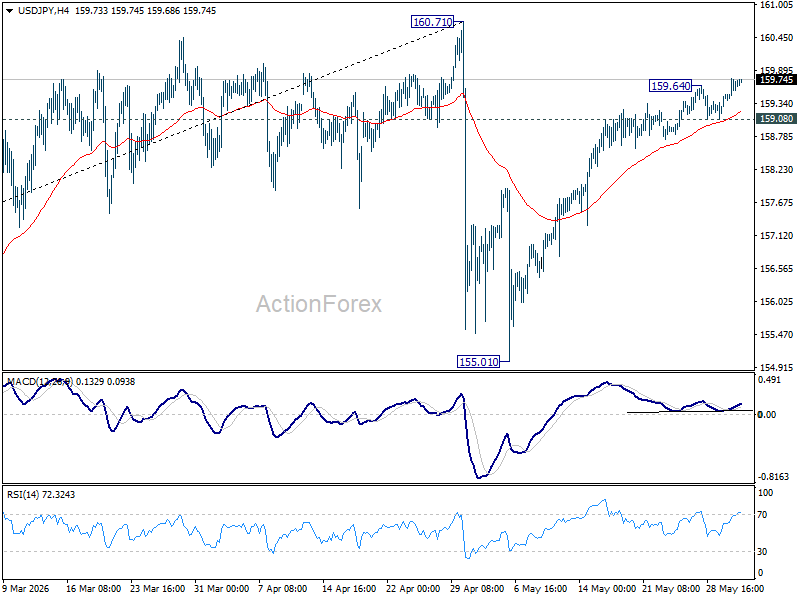
In the bigger picture, for now, corrective pattern from 161.94 (2024 high) is still seen as completed at 139.87. Rise from there is seen as resuming the long term up trend. So, break of 161.94 is expected at a later stage to resume the long term up trend. However, sustained break of 55 W EMA (now at 154.55) will dampen this view and bring deeper fall back towards 139.87 to extend the pattern from 161.94.