


Our summary of recent economic events and what to expect in the weeks ahead.
Canadian Highlights
- Canada and the U.S. are negotiating ahead of the August 19th deadline for the latest U.S. tariff threat. Details remain limited and the outcome could materially affect sector activity, investment, and business confidence.
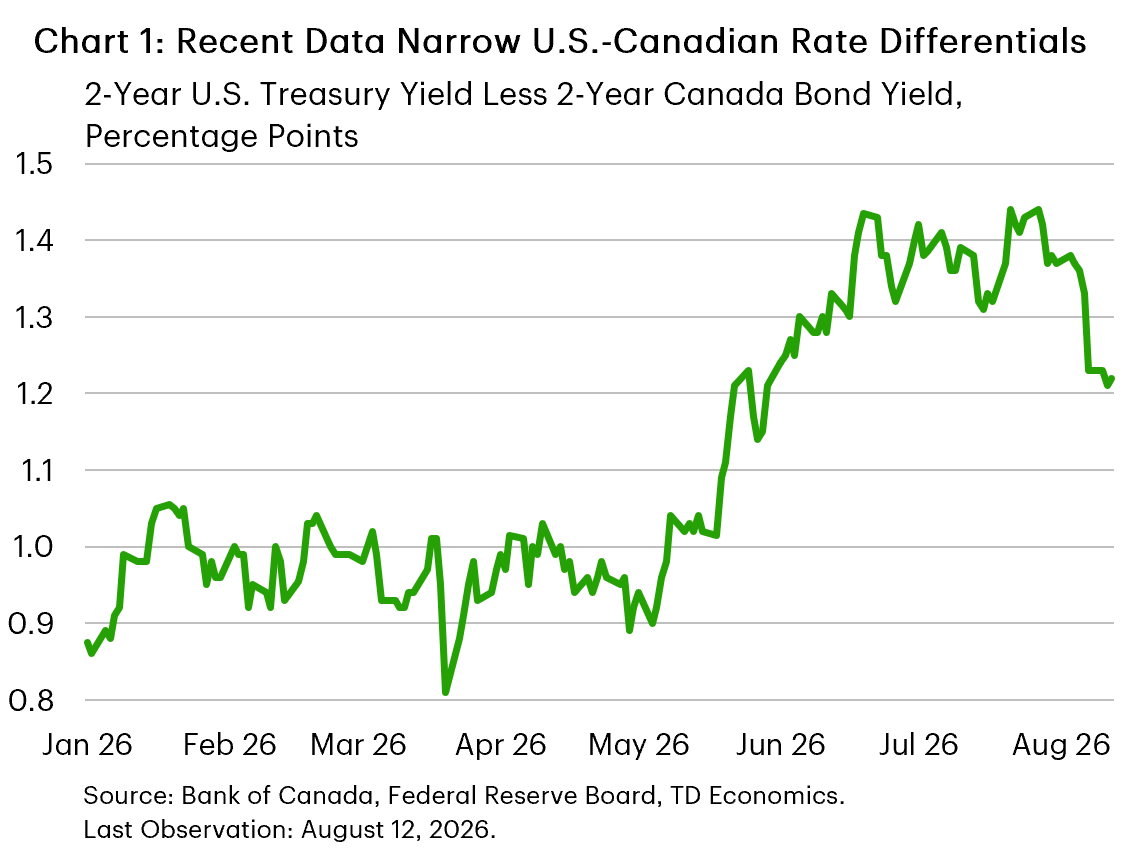
- A solid Canadian labour market report and benign U.S. CPI have narrowed Canada-U.S. rate differentials, supporting the Canadian dollar’s rally to around 72 cents U.S.
- July inflation is expected to register around 2.9% on higher gasoline prices. Core inflation and any trade update could influence yields, Bank of Canada expectations, and the economy’s recovery path.
U.S. Highlights
- Markets found their footing after Wednesday’s CPI inflation report showed inflation pressures continued to ease, pushing equities higher.
- Retail sales declined in July, but the shift in timing of Amazon Prime Days likely overstated the weakness.
- Fed commentary remained cautious, making next week’s FOMC minutes an important signal of how officials were weighing inflation and policy risks before this week’s CPI relief.
Canada: Tick, Tock, Tick, Tock
With the August 19th deadline looming for the latest U.S. tariff threat, negotiators continue to discuss a potential trade deal. Of course, the devil will be in the details (that remain scant) and economic uncertainty remains elevated. Markets meanwhile have been digesting a relatively well-behaved U.S. CPI print and last week’s Canadian labour market outperformance. The data has helped narrow the gap between Canadian and U.S. interest rates, extending the loonie’s rally to 72 cents U.S. at the time of writing. Whether the loonie’s run will continue likely comes down to how trade negotiations play out, and Monday’s Canadian inflation report.
All eyes are focused on the trade negotiations. Canada’s Minister for Canada-U.S. Trade Dominic Leblanc and Chief Trade Negotiator Janice Charette have been shuttling back and forth from meetings with their U.S. counterparts. As of Friday morning, U.S. officials have said both President Trump and Prime Minister Carney are due to be presented with “options”. The reality is that details on any possible deal remain few and far between. The scale and scope of any tariff relief on sector-specific Section 232 levies (i.e. the 50% on steel & aluminum, 25% on autos, etc.) could have a meaningful impact on sector-level activity and investment activity. Any knock-on improvements to business sentiment would also be welcome at a time that the economy is showing some bounce-back after stalling out in the winter months.
The flip side is that the 50% tariffs come into effect on August 19th. We have already discussed the potential direct macroeconomic impact, but the risk of escalating tensions, new retaliation, and a hit to business confidence, could further undercut the economy’s tentative recovery.
The Bank of Canada cited an increase in trade frictions as a possible reason to reduce interest rates. However, recent data have showcased some of Canada’s economic resilience (pushing Canadian yields higher) and dampened some of the market pricing for rate hikes from the Fed. This has helped narrow the differentials on two-year borrowing costs by over 20 basis points, bringing them to their lowest level since June (Chart 1).
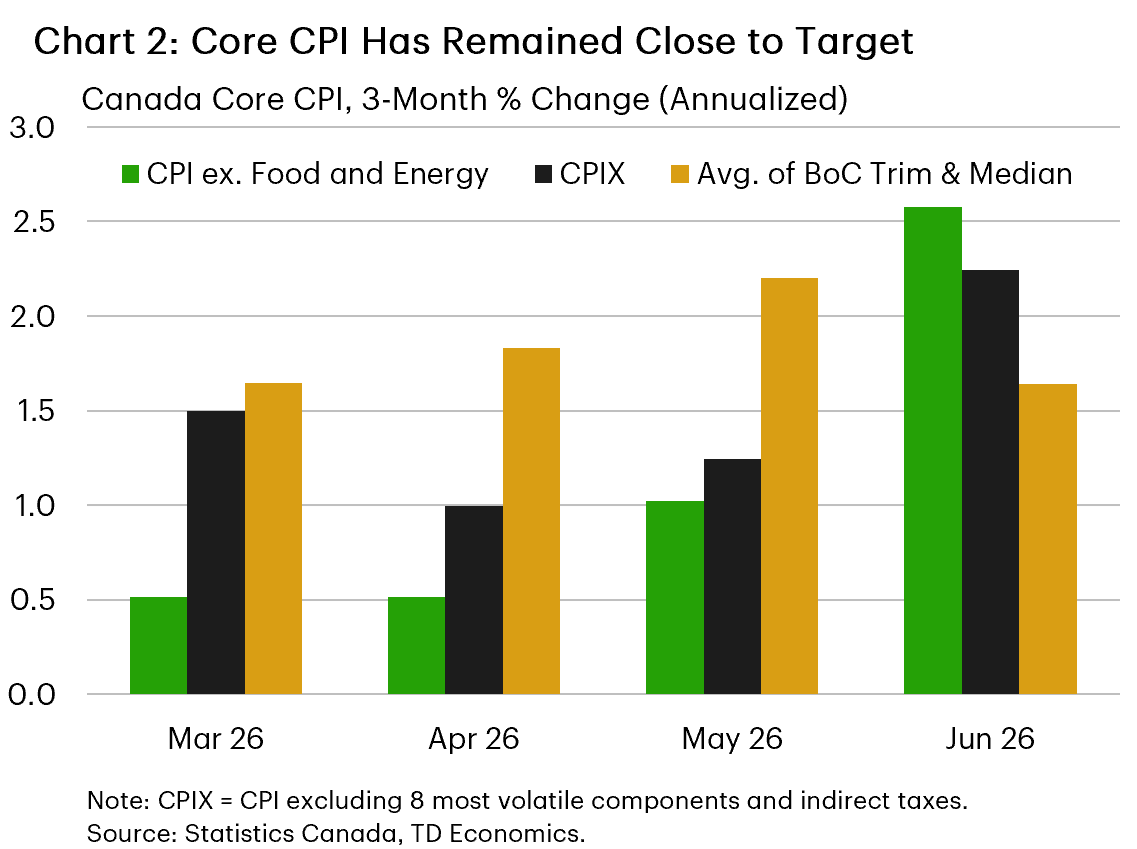
Monday could then have a doubly important impact if an update on trade negotiations arrives as July’s CPI data are released. Headline inflation is likely to register around 2.9%, owing to the rise in gasoline prices for the month. However, the focus will be on what the core measures show (Chart 2). With better-than-expected recent economic data, an upside surprise on the core measures could push near-term yields higher. However, an upside surprise to core inflation wouldn’t be entirely unexpected. Energy prices remain materially higher than in February, and some degree of pass-through to other goods and services is reasonable.
As we look to next week, the data will give us an idea of where the economy stood ahead of the August 19th deadline, but the path forward will hinge on whether the recent flurry of negotiations will avert another trade shock.
Andrew Hencic, Director & Senior Economist
U.S. – Softer Inflation, Softer Spending
The week’s story was a turn in sentiment. After a choppy start dominated by lingering concerns over oil prices, tariffs, and whether the Fed might need to lean more hawkish, Wednesday’s CPI report offered the relief valve that everyone was looking for. Equities continued to push higher, with the S&P 500 and Nasdaq benefiting from a renewed “soft landing” bid as investors took comfort that inflation showed further signs that it is no longer moving in the wrong direction. Treasury yields steadied as the data flow veered toward a goldilocks zone: growth has cooled enough to reduce inflation pressure, but not enough to undermine risk appetite.
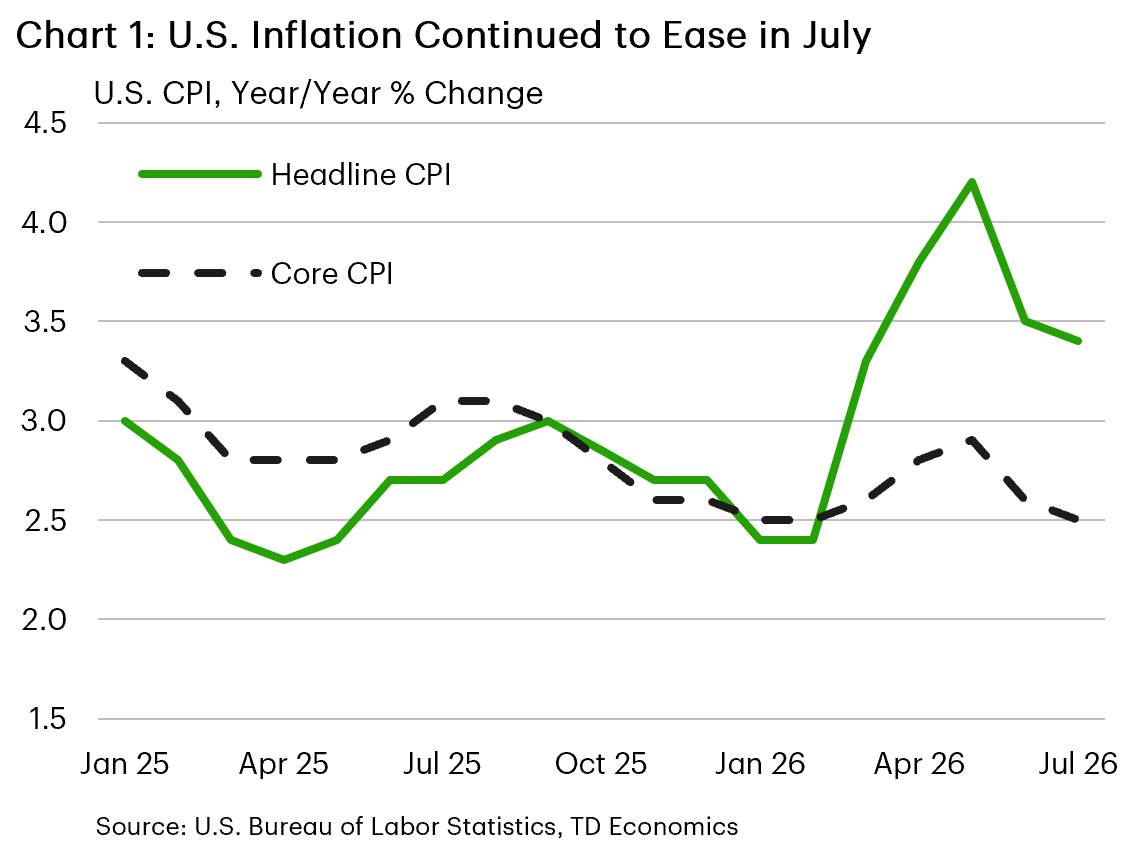
The week’s data were encouraging, but not uniformly. Two releases helped the soft-landing case: CPI provided the biggest market relief, while the NFIB Small Business Optimism Index rose 2.4 points in July to 99.8, its highest level since August 2025, with hiring and capital spending plans pointing to better Main Street confidence. Even so, uncertainty remained elevated and labor quality re-emerged as the top concern, keeping the survey from looking like an all-clear signal. With respect to the CPI release, headline prices rose just 0.1% month-on-month in July, while core prices increased 0.2%, both in line with expectations. As we noted in our commentary, underlying inflation trends are moving in the right direction: headline inflation eased to 3.4% year-on-year and core inflation stepped back to its pre-Iran conflict pace of 2.5% (Chart 1).
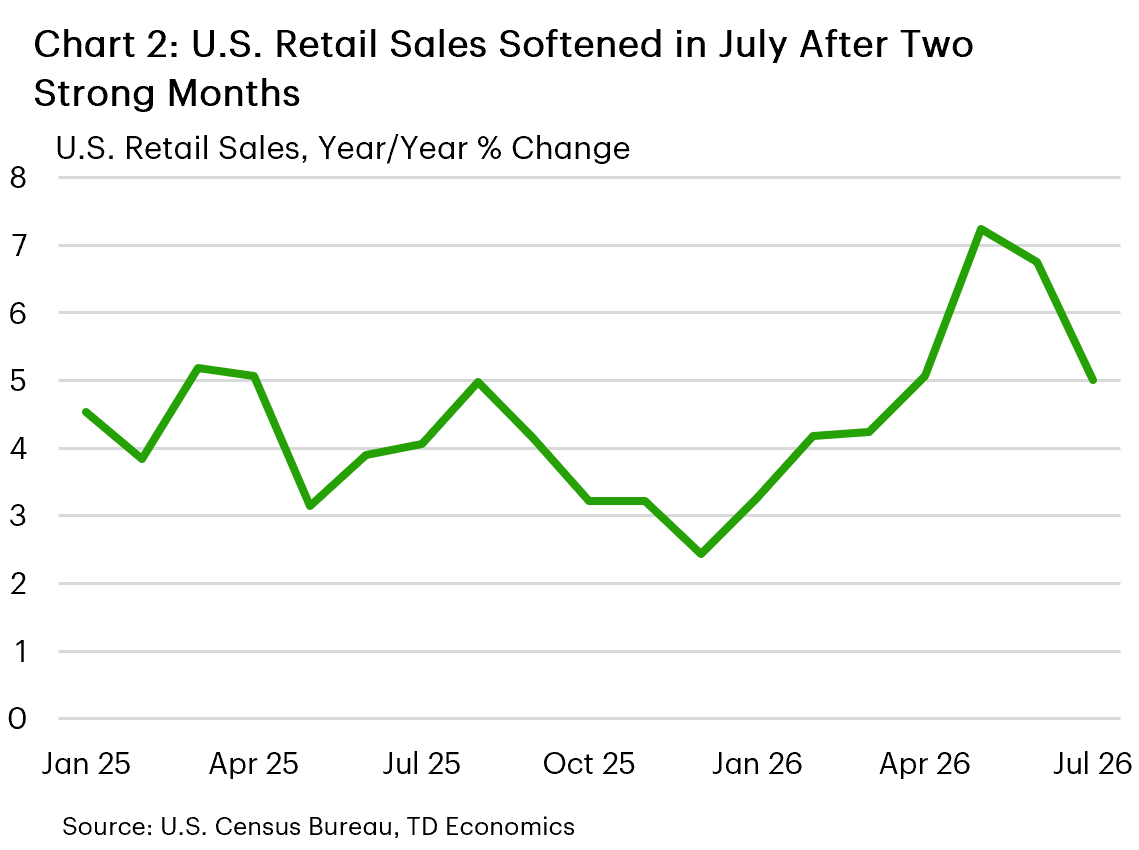
The softer piece of the week’s data flow came from retail sales (Chart 2). However, July’s decline was largely because of a pullback in vehicle sales and a sharp decline in online shopping. The latter was likely driven by Amazon Prime Days happening in late June this year, as opposed to its normal timing of mid-July. Outside of these categories, spending held up reasonably well, suggesting the pullback in retail spending was less dire than implied by the headline print. Overall, we still expect consumer spending to expand by +2% in the third quarter, a moderation from Q2’s 3.2% but still a healthy pace nonetheless.
Softer inflation and a stable labor market suggest the FOMC is likely to remain on hold for the time being. That’s exactly what we’ve seen in Fed futures pricing, with a September hike now only 29% priced, compared to 52% at the beginning of the week. That said, Cleveland Fed President Beth Hammack and Richmond Fed President Tom Barkin remained cautious in their messaging this week, acknowledging better inflation news but stopping short of declaring victory. We suspect the data this week argue for the Fed to remain in wait-and-see mode, particularly with one more jobs report and another CPI print still to come before the September meeting. Next week’s July FOMC minutes pre-date this week’s CPI release, but could still contain useful information about how worried officials were about tariff and energy risks before this week’s better inflation news.





 and economic uncertainty remains elevated. Markets meanwhile have been digesting a relatively well-behaved U.S. CPI print and last week's Canadian labour market outperformance. The data has helped narrow the gap between Canadian and U.S. interest rates, extending the loonie's rally to 72 cents U.S. at the time of writing. Whether the loonie's run will continue likely comes down to how trade negotiations play out, and Monday's Canadian inflation report.)