- We expect the ECB to hike the deposit rate by 25bp to 2.25% on Thursday 11 June in line with consensus and markets.
- We expect Lagarde to keep full optionality on the future policy rate path, including a potential summer hike but not pre-committing.
- We expect a final 25bp hike in Q3 bringing the deposit rate to 2.50%.
We expect the ECB to hike policy rates by 25bp, bringing the deposit rate to 2.25% on June 11 in line with market pricing and consensus. The recent communication from ECB’s GC members have clearly signalled a rate hike in June, both from the hawkish and dovish side of the spectrum. The size and particularly the persistency of the energy shock means that “We can no longer look through this shock. The risk of deanchoring inflation expectations is rising”, according to Schnabel. The main reason for ECB hiking is thereby to keep inflation expectations anchored by signalling a willingness to act.
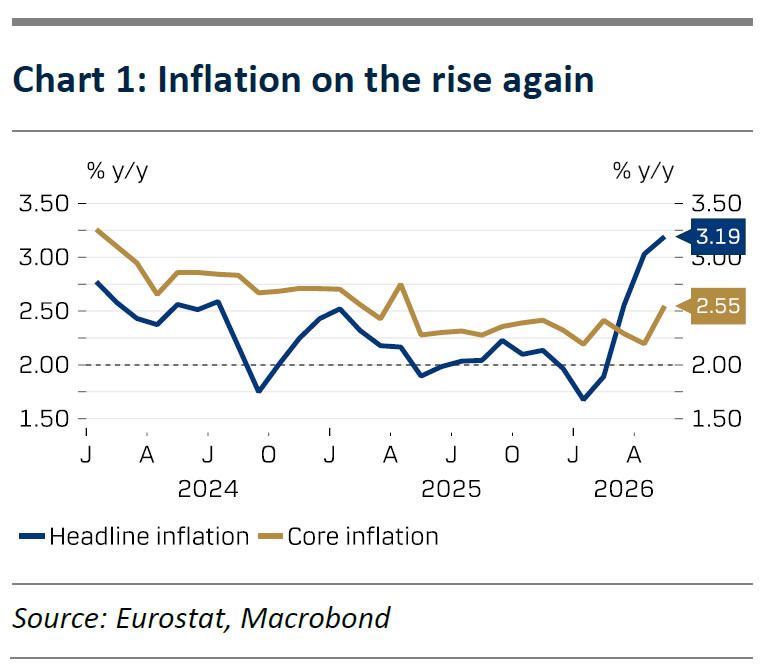
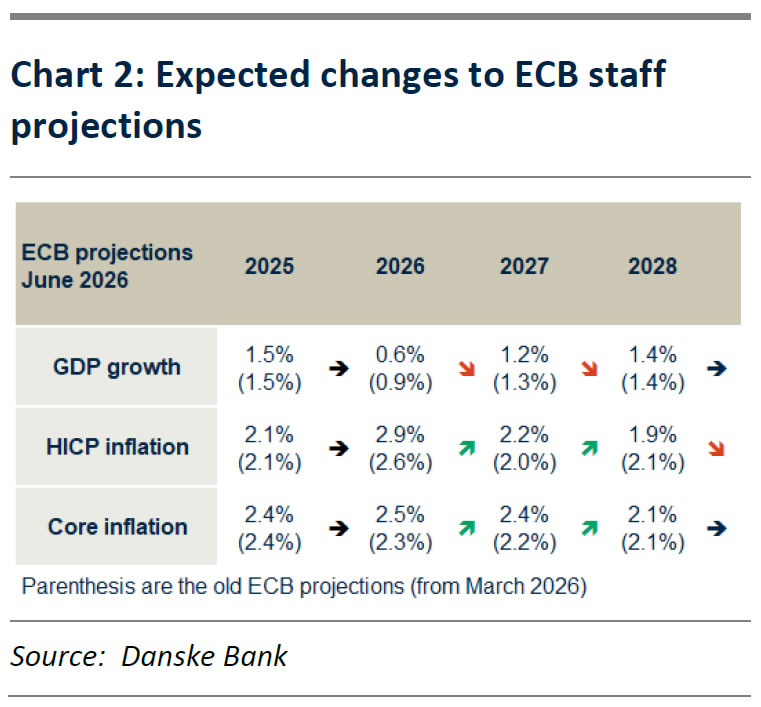
Since the April meeting, headline inflation has evolved broadly as expected by the ECB while core inflation has surprised on the upside due to a strong services reading in May. Oil futures have moved higher compared to the baseline staff projections in March and we thus expect the new staff projections to increase the 2026 inflation forecast to 2.9% y/y (from: 2.6%) and 2027 to 2.2% y/y (from: 2.0%). Growth data has surprised on the downside both in terms of Q1 GDP and survey-based indicators in Q2, so we expect a downward revision of the 2026 GDP growth to 0.6% y/y (from: 0.9% y/y) and 2027 to 1.2% y/y (from: 1.3%). See chart 2 and next page for more details. As the new staff projections likely assume around 68bp worth of hikes in the technical assumptions, we believe they give the GC arguments for hiking twice this year.
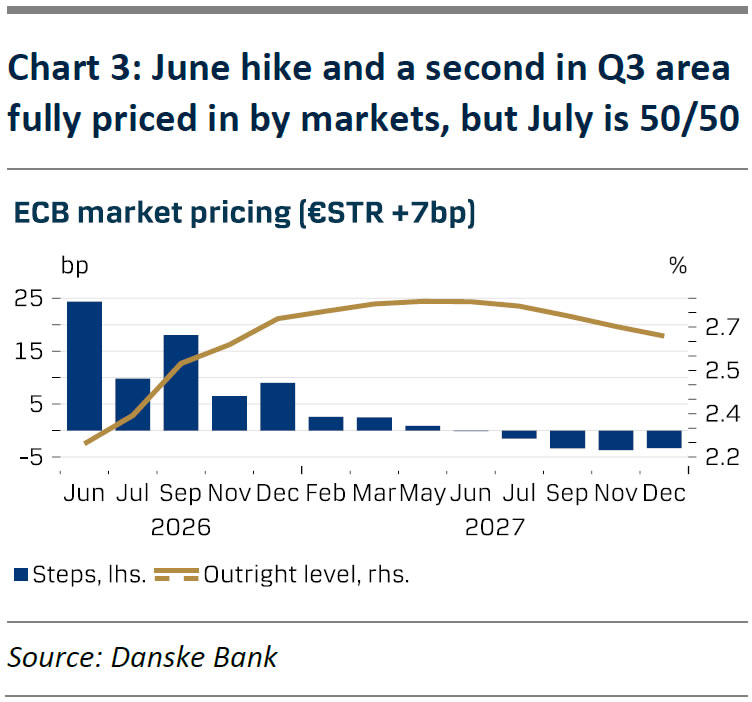
With the June hike fully priced in by markets, all focus during the press conference is on signals. We expect Lagarde to keep full optionality on the future policy rate path, including a potential second summer hike. The well telegraphed policy hike coming next week reveals a preference for curbing upside inflationary risks rather than addressing downside growth risks. As one hike is not significantly changing economic conditions, we expect the ECB to deliver another 25bp hike in Q3. Limited new data will be available by the July meeting, making a firm assessment of potential second round effect difficult, which increases the uncertainty of the exact timing of a potential second hike. We stress that the decision of a hike in July or September does not significantly affect the economic outlook nor our overall view on rates markets where we still favour playing the move for lower short-end swap rates.
New staff projections to show higher inflation and lower growth
The June ECB meeting will feature a new set of staff projections, which will be important for the monetary policy outlook. In this section, we review data since the last meeting and preview what to expect from the new staff projections. There will both be new baseline projections and updated scenarios. Starting with inflation, the March print came in slightly lower than implied by the staff projections while April and May point to Q2 headline inflation broadly as expected in the baseline projections. On the other hand, core inflation has surprised on the upside due to the surprisingly strong services print of 3.5% y/y (0.5% m/m s.a.) in May, which means Q2 core inflation is set to come in higher than both the baseline and the “adverse” scenario.
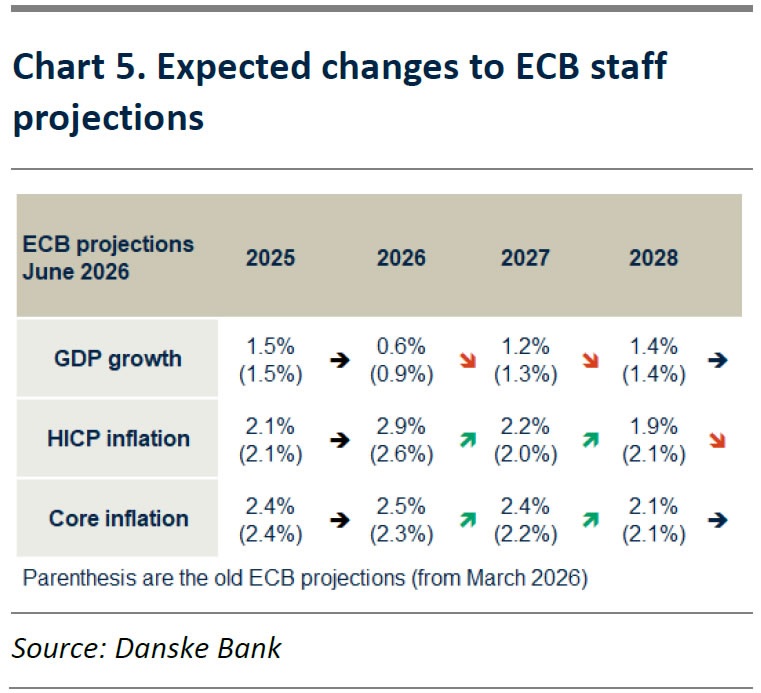
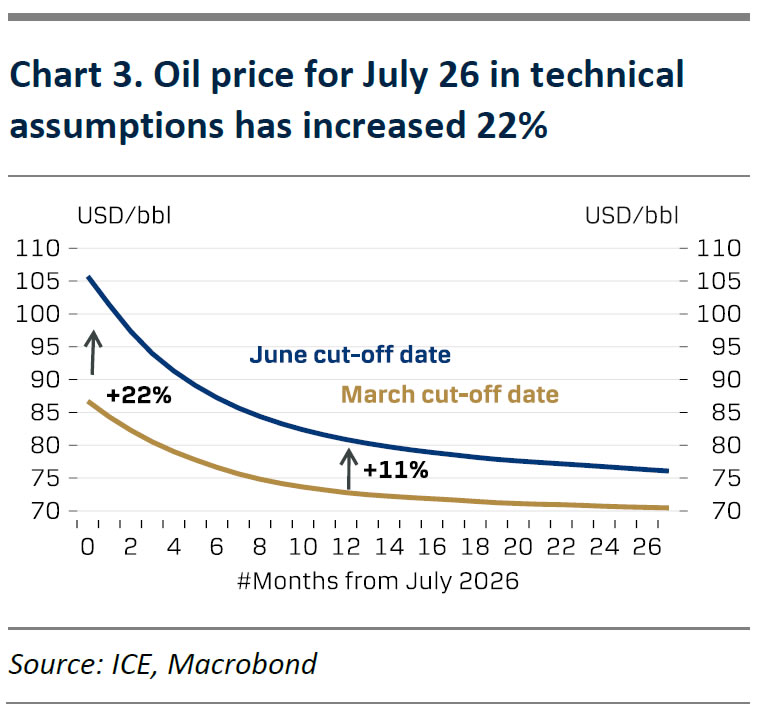
Regarding the inflation outlook, headline is likely to be revised up to 2.9% y/y in 2026 (from 2.6% y/y) and to 2.2% y/y in 2027 (from: 2.0% y/y) as the technical assumptions for the June meeting will feature higher commodity price assumptions for oil amid broadly unchanged gas prices. Specifically for the July 2026 delivery the oil future has risen by 22% from 87 USD/bbl to 106 USD/bbl and the delivery price for July 2027 has risen by 11% (see chart 3). The gas futures are broadly similar to the March cut-off date. With car fuels having a weight of 4% in the HICP index compared to gas at 1.6% we expect the higher oil futures to dominate and thus contribute to higher headline inflation. We expect core inflation to be revised up to 2.5% in 2026 (from: 2.3%) and 2027 to 2.4% (from: 2.2%), which is partly due to the upside surprise in Q2 and due to indirect effects from higher oil prices. Working in the other direction is the fact that wage growth is still clearly on a declining trend according to the ECB wage tracker and as growth in negotiated wages in Q1 was surprisingly low. Hence, we still expect a return to 2.1% y/y 2028 as in the March projections, see chart 5.
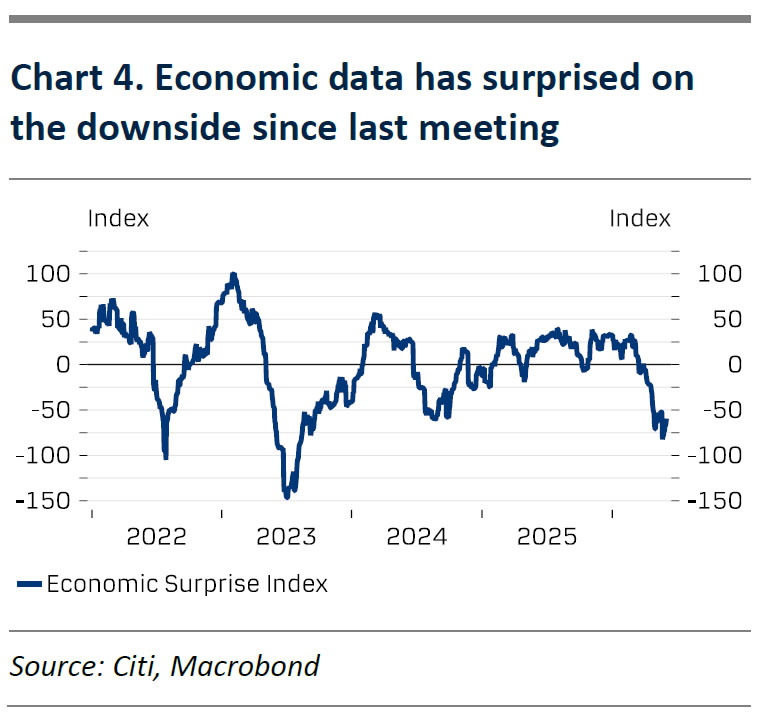
In terms of the growth outlook, we expect a sharp downward revision of 2026 GDP growth to 0.6% y/y (from: 0.9% y/y). We also expect 2027 growth to be revised down to 1.2% y/y (from: 1.3%) while 2028 is expected unchanged at 1.4% y/y. Economic data has surprised on the downside since the March meeting (see chart 4) with particularly the Q1 GDP growth rate at 0.15% q/q. The previous staff projections saw Q1 GDP growth at 0.3% q/q both in the baseline and adverse scenario. The PMI data for April and May was also surprisingly weak, and we thus expect ECB staff to assume quarterly growth of 0.0% q/q in Q2. The economy is thus expected to just remain out of negative growth territory in Q2 and likely to show a small rebound of 0.1% q/q in Q3 in the new projections. The technical assumptions on 3M Euribor will also feature around one extra 25bp hike compared to March projections, which in combination with higher oil price assumptions contribute to the weaker growth outlook in 2026 and a lowering of the 2027 forecast.
With the economy avoiding a recession in the forecast and as the technical assumptions likely assume more than two full hikes (68bp by 2026 YE), we believe the revised staff projections will provide the Governing Council arguments for hiking the policy rate twice by 25bp to bring inflation back to 2.0%.