Financial markets traded with a mixed tone today as investors tried to balance fresh signs of diplomatic progress in the Middle East against lingering concerns that the region’s energy and security risks are far from resolved. The shift in sentiment was reflected most clearly in currency markets, where Dollar weakened broadly as traders scaled back some of the safe-haven demand that had supported the greenback earlier in the week.
The latest optimism came after US President Donald Trump said in a social media post that he was “in the middle of my final negotiations to end the War with the Islamic Republic of Iran.” The comments revived hopes that Washington and Tehran could still reach some form of agreement despite several days of conflicting headlines, military incidents, and reports suggesting talks had stalled.
Supporting the more constructive mood was news of a new US-mediated ceasefire agreement between Israel and Lebanon. Lebanese President Joseph Aoun said the ceasefire could come into force within 24 hours after approval by all concerned parties. While Hezbollah has yet to publicly comment, markets interpreted the development as another sign that diplomatic efforts across the region are continuing rather than collapsing.
Oil prices responded accordingly. Brent crude slipped back below $95 a barrel, reversing part of this week’s rebound. The decline suggests traders are once again assigning a higher probability to some form of ceasefire extension or interim agreement rather than an immediate escalation toward a broader regional conflict. Yet the move lower in oil was relatively modest, reflecting continued caution about the underlying situation.
Indeed, few market participants appear willing to fully embrace the peace narrative. The US-Iran negotiations have repeatedly swung between optimism and disappointment over recent months. Traders know that a single headline can quickly reverse sentiment, particularly when key issues surrounding regional security, energy flows, and sanctions remain unresolved. The result is a market that is reducing risk premiums rather than removing them altogether.
There are also growing concerns that even if diplomacy succeeds, the economic damage may already be accumulating. According to a Politico report, energy industry executives have recently warned senior White House officials that global petroleum inventories are being steadily depleted as disruptions linked to the Middle East continue. Refiners are reportedly relying more heavily on storage inventories to replace barrels no longer arriving from the region, raising the prospect of tighter supply conditions later in the summer.
That warning helps explain why oil traders remain cautious despite improving geopolitical headlines. The concern is not limited to whether the Strait of Hormuz remains open. Instead, the market is increasingly focused on how long current supply disruptions can persist before inventory drawdowns begin to create a more visible shortage. In that sense, lower oil prices may reflect improving sentiment today, but not necessarily confidence about the outlook several weeks from now.
Elsewhere, risk appetite was also restrained by weakness in US equity futures. S&P 500 futures pointed lower as Broadcom led semiconductor shares down following a fiscal second-quarter revenue miss. The decline threatens the S&P 500’s nine-week winning streak and raises questions about whether the AI-driven equity rally can maintain its momentum.
In currency markets, Dollar was the weakest performer of the day as easing geopolitical concerns reduced safe-haven demand. Canadian Dollar followed as lower oil prices weighed on sentiment, while Yen also underperformed. Swiss Franc led gains, benefiting from the retreat in energy prices and lower global yield pressure, followed by Euro and Sterling. Aussie and Kiwi traded in the middle of the pack as markets searched for clearer direction. For now, markets are willing to price progress on Iran, but they remain unwilling to conclude that the risks have disappeared.
US Initial Jobless Claims Jump to 225K vs Exp. 211k
The US labor market may be losing a little momentum, but it is not showing signs of breaking. Initial jobless claims rose more than expected last week, yet continuing claims remained relatively stable, suggesting layoffs are increasing only gradually. With Friday’s payrolls report approaching, markets are still waiting for a definitive signal on employment conditions. Read More.
USD/CAD Surges on New US Tariff Threats. A Break Above 1.40 Could Change Everything.
Oil is rising, but the Canadian Dollar is falling. That’s because markets are increasingly worried about a proposed 12.5% US tariff that could bypass Canada’s traditional trade protections and hit an economy already struggling with stagnant growth. With USD/CAD approaching the critical 1.40 level, the question is whether this bounce is merely a correction—or the start of a much bigger trend. Read More.
Swiss Inflation Misses Expectations, unchanged at 0.6% in May
Swiss May CPI held at just 0.6%, well below expectations and comfortably within the SNB’s target range. The data reinforce the view that Switzerland remains largely insulated from the inflation pressures forcing other policymakers toward a more hawkish stance. Read More.
EUR/CHF and GBP/CHF Gain Breakout Momentum as US-Iran Stalemate Keeps Oil Elevated
Most investors associate geopolitical uncertainty with a stronger Swiss Franc. This time, the opposite may be true. As US-Iran negotiations drag on and oil prices remain elevated, inflation concerns are pushing the ECB and BoE toward tighter policy while Switzerland remains comfortably within its inflation target. The result is a widening policy divergence that may continue to support EUR/CHF and GBP/CHF. Read More.
RBA’s Bullock Warns Second-Round Inflation Risks Are Emerging
The RBA believes its rate hikes are finally starting to work. The problem is that a new inflation threat is emerging. Governor Michele Bullock warned that higher fuel costs linked to the Middle East conflict are beginning to spread through the economy, raising concerns that energy-driven inflation could become embedded in a broader range of goods and services. Read More.
EUR/USD Daily Outlook
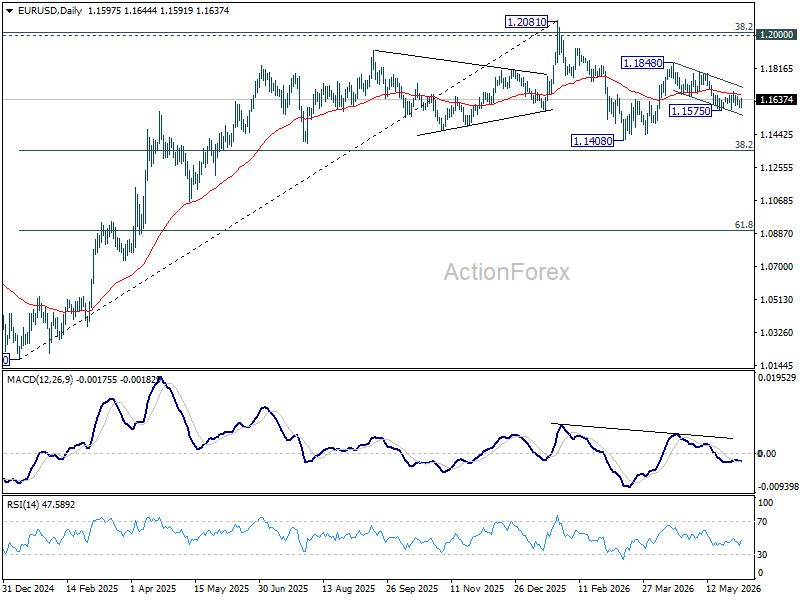
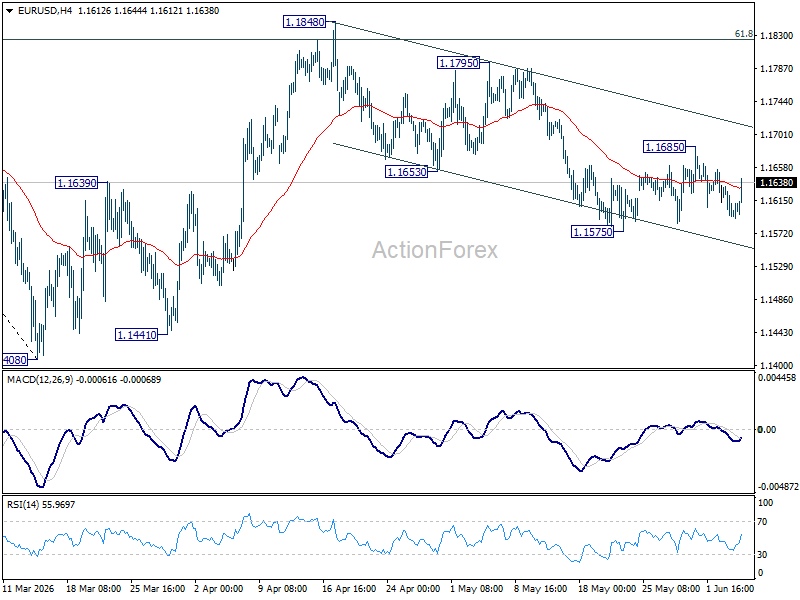
EUR/USD is staying in range above 1.1575 and intraday bias remains neutral. On the downside, break of 1.1575 support will resume the fall from 1.1848 to retest 1.1408 low. Above 1.1865 will target 1.1795 resistance. Firm break there will argue that rise from 1.1408 is ready to resume through 1.1848.
In the bigger picture, the strong support from 38.2% retracement of 1.0176 to 1.2081 at 1.1353 suggests that the pullback from 1.2081 is more likely a corrective move. Strong support was also found in 55 W EMA (now at 1.1542). Focus is back on 1.2 key cluster resistance level. Decisive break there will carry long term bullish implications. Nevertheless, break of 1.1408 support will revive the case of medium term bearish trend reversal.