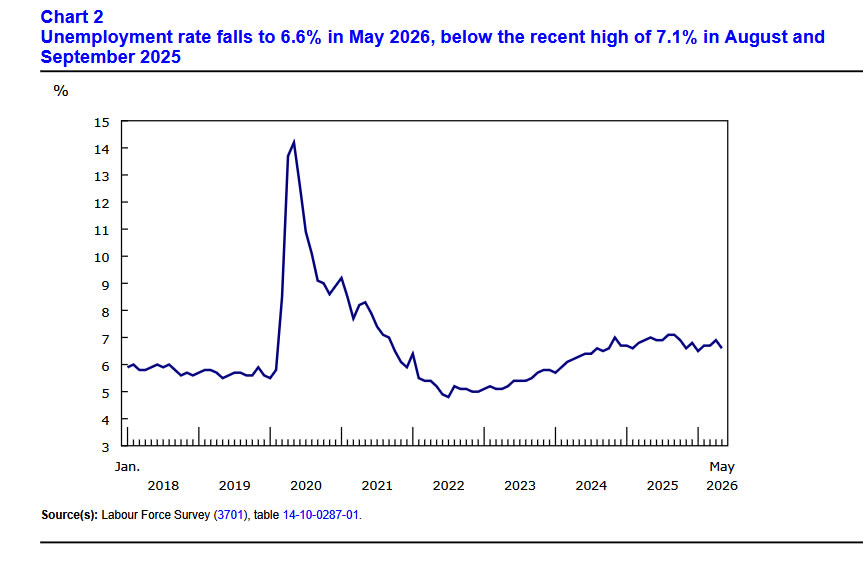
Canada’s labor market delivered a much stronger-than-expected performance in May, with employment rising by 87.8k compared with expectations for a gain of just 10.2k. The increase marked the first significant monthly advance since November 2025 and followed a decline of -17.7k in April. While the result does not fully offset the weakness seen earlier this year, it represents a notable turnaround after cumulative job losses of -112k during the first four months of 2026.
The quality of hiring was particularly encouraging. Full-time employment surged by 154k, highlighting solid underlying labor demand rather than temporary or part-time hiring. As a result, the unemployment rate fell from 6.9% to 6.6%, beating expectations for an unchanged reading. The employment rate also improved by 0.2 percentage points to 60.7%, indicating broader labor-market participation and stronger workforce absorption.
Despite the sharp rebound in hiring, wage growth eased noticeably. Average hourly earnings increased 3.0% yoy in May, slowing from 4.5% yoy in April. That moderation should help alleviate concerns about wage-driven inflation pressures and may reduce any urgency for the Bank of Canada to consider tighter policy.
| Indicator | Previous | Latest | Expectation |
|---|---|---|---|
| Employment Change | -17.7k* | 87.8k | 10.2k |
| Unemployment Rate | 6.9% | 6.6% | 6.9% |
| Employment Rate | 60.5% | 60.7% | — |
| Avg. Hourly Wages Y/Y | 4.5% | 3.0% | — |
| Category | Change |
|---|---|
| Total Employment | +87.8k |
| Full-Time Employment | +154.0k |
| Part-Time Employment | -66.2k |