Dollar remained firmly in control of global markets today, extending its broad-based rally even as risk sentiment showed tentative signs of stabilization. US equity futures pointed to a modest rebound at the open following this week’s sharp technology-led selloff, as investors appeared reluctant to make aggressive bets ahead of Micron’s earnings report after the bell. The chipmaker has become one of the biggest beneficiaries of the AI investment boom, with its shares surging more than 260% this year as companies pour billions of dollars into AI infrastructure.
The cautious tone reflects a growing debate over whether the recent tech correction is merely a temporary bout of profit-taking or the start of a more significant reassessment of AI-related valuations. Some analysts argue that the long-term earnings story remains intact given the enormous scale of corporate spending on AI. Others point to emerging signs of fundamental pressure, including increasing price competition among AI model developers, falling rental prices for older-generation GPUs, and a broader industry shift toward lower-cost models. These developments do not necessarily undermine the long-term AI story, but they raise questions about whether the sector’s most optimistic growth assumptions can continue to justify current valuations.
For now, markets appear unwilling to answer those questions ahead of fresh earnings guidance from one of the industry’s key bellwethers. Even a strong Micron report may not guarantee a sustained recovery. It is not uncommon for markets to continue selling after positive earnings if investors are already focused on broader concerns about valuation, positioning, or the economic outlook. The violent selloffs seen across Asian technology stocks this week suggest sentiment remains fragile.
Another factor hanging over equities is the Federal Reserve. Markets appear to have largely absorbed the prospect of one additional rate hike this year following last week’s FOMC meeting. The more difficult question is whether policymakers could ultimately deliver two. That risk has become increasingly important as inflation remains elevated and Fed officials continue emphasizing concerns about persistent services inflation. The uncertainty surrounding the policy outlook is making it harder for investors to justify paying premium valuations for growth stocks.
Meanwhile, Dollar continues to benefit from both safe-haven demand and expectations of tighter US monetary policy. The Dollar Index surged through the 38.2% retracement of the decline from 110.17 to 95.55 at 101.38 earlier this week, a development that strongly suggests the broader downtrend has already reversed. The breakout has shifted market focus from whether Dollar can rally further to how far the move can extend.
Two technical levels now stand out as particularly important confirmation signals. First, EUR/USD is approaching the 1.1300 area. A decisive break lower would reinforce the view that the pair is undergoing a medium-term bearish reversal after failing to sustain gains near the 1.2000 psychological level earlier this year. Second, Gold is threatening the key USD 4,000 psychological support zone. A decisive break there could trigger another wave of stop-loss selling and attract fresh momentum-driven shorts.
Taken together, these developments suggest that Dollar strength is becoming more deeply embedded across markets. Micron’s earnings may determine whether technology stocks can stabilize in the near term. But the bigger story is whether Dollar’s breakout can continue drawing confirmation from currencies, precious metals, and Fed expectations. So far, the answer appears to be yes. For the week, Dollar remains the strongest performer among major currencies, followed closely by Yen, while Kiwi and Aussie continue to sit at the bottom of the rankings.
RBNZ Hike Bets Collapse as NZD/USD Accelerates Toward Critical 0.5580 Support
Just weeks ago, markets were debating whether the RBNZ could raise rates as soon as July. Today, those bets have largely disappeared. Falling oil prices, weak domestic growth, and a stronger Dollar have combined to push NZD/USD toward a critical support zone that could determine the pair’s direction for the rest of the year. Read More.
Dollar Index Breaks Key Fibonacci Barrier, Sets Stage for July’s Bigger Battle
The Dollar’s rally is not just a Fed story. A technology-led liquidation wave, quarter-end positioning, and growing expectations of further tightening are all pushing in the same direction. After breaking a key Fibonacci barrier, Dollar Index is heading toward what could be its most important test of 2026. Read More.
Germany’s Ifo Business Climate Rises as Firms Hope for Geopolitical Relief
German companies are feeling better about the present, but they are not yet convinced about the future. June’s Ifo survey showed improving business conditions and easing geopolitical concerns, yet weak orders and cautious expectations continue to hold back confidence. Read More.
Ueda Reinforces Hawkish BoJ Message, Says More Rate Hikes Likely
The key message from Kazuo Ueda was that policymakers still believe monetary conditions are accommodative even after last week’s hike to 1%. That suggests the debate inside the BoJ is centered on the timing of future hikes rather than whether more tightening is needed. Read More.
BoJ Hawks Eye Path Toward 2% Neutral Rate, Summary Shows
The biggest surprise in the BoJ’s June Summary of Opinions was not the support for last week’s rate hike. It was the growing discussion about where rates should go next. Several policymakers argued that Japan’s neutral rate may be closer to 2%, suggesting the debate has shifted from whether to tighten policy to how quickly to do it. Read More.
Australia CPI Misses Expectations at 4%, Yet Core Inflation Sends Hawkish Signal
Australia’s inflation report delivered good news and bad news at the same time. Falling fuel prices pushed headline inflation lower than expected, but the RBA’s preferred measure of underlying inflation accelerated. The result is a report that eases immediate inflation fears while keeping the August rate debate very much alive. Read More.
EUR/USD Daily Outlook
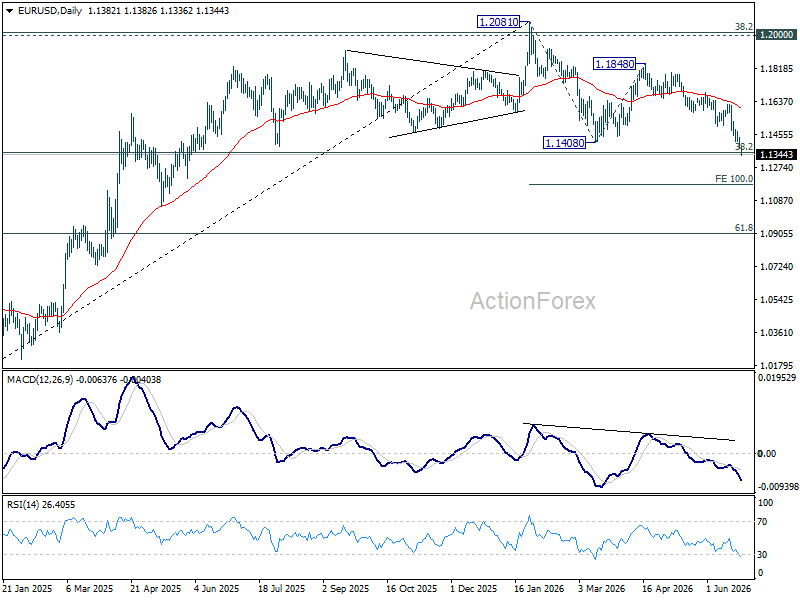
EUR/USD’s decline continues today and intraday bias remains on the downside. Sustained break of 1.1353 fibonacci level will carry larger bearish implication. Next near term is 100% projection of 1.2081 to 1.1408 from 1.1848 at 1.1175. On the upside, above 1.1416 minor resistance will turn intraday bias neutral again first.
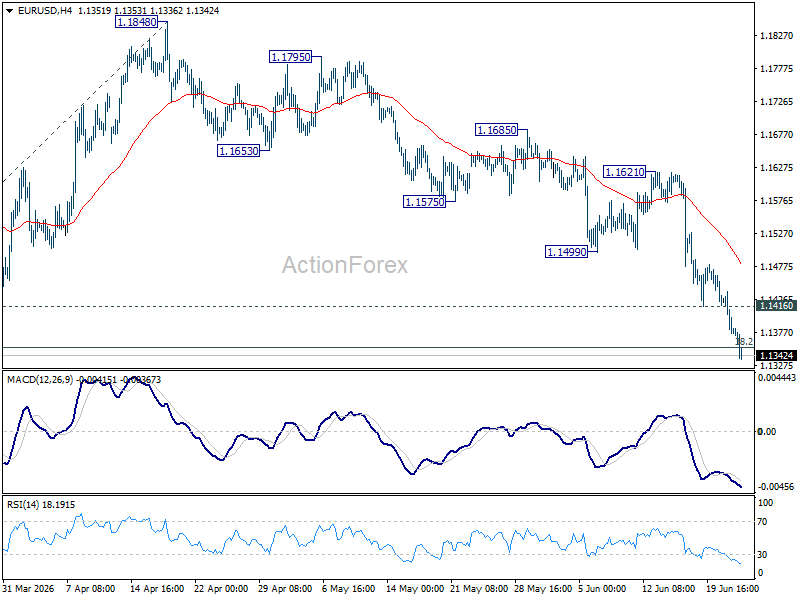
In the bigger picture, focus is back on 38.2% retracement of 1.0176 to 1.2081 at 1.1353. Decisive break there will revive the case of medium term bearish trend reversal after rejection by 1.2 key cluster resistance level. Further fall should be seen to 61.8% retracement at 1.0904. Nevertheless, strong rebound from 1.1353, followed by break of 1.1621 resistance, will retain medium term bullishness.