


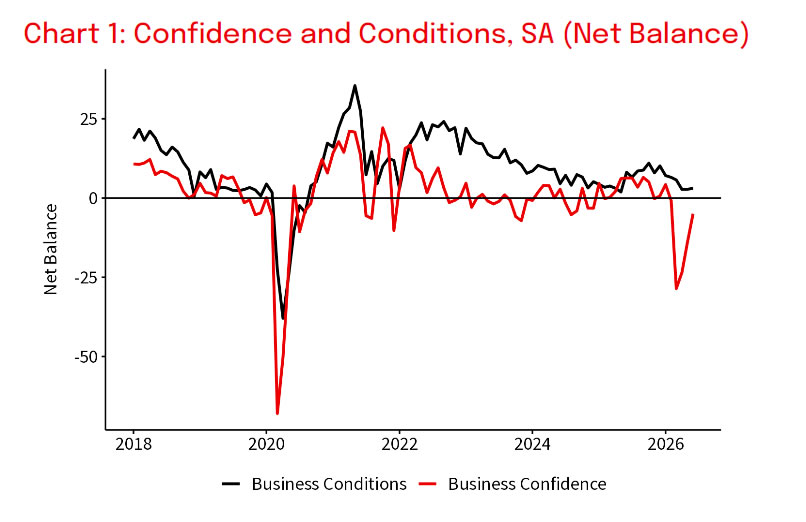
Australia’s business confidence improved noticeably in June, with the NAB Business Confidence Index rising 9 points to -5, recovering much of the sharp deterioration seen in March. While confidence remained below zero, the survey suggests businesses became less concerned as the economic fallout from the Middle East conflict proved less severe than initially feared. Business conditions were unchanged at +3, still below the long-run average of +7, indicating activity has stabilized but remains softer than earlier in the year.
The survey paints a picture of an economy that is slowing rather than contracting. NAB Chief Economist Sally Auld said easing concerns over energy markets and broader geopolitical risks had helped restore confidence, while business conditions and capacity utilization suggest growth has moderated without falling away.
That interpretation is consistent with the survey’s inflation indicators. Purchase cost growth slowed further from 2.5% to 2.0% on a quarterly basis, final product price growth eased from 0.9% to 0.6%, and retail prices fell 0.3%, the first decline in seven years. Labor cost growth accelerated from 1.5% to 2.0%, largely reflecting the increase in the minimum wage that took effect on July 1.
Survey Data
| Component | Current | Previous |
|---|---|---|
| Business Confidence | -5 | -14 |
| Business Conditions | +3 | +3 |
| Purchase Cost Growth (Quarterly) | 2.0% | 2.5% |
| Labour Cost Growth (Quarterly) | 2.0% | 1.5% |
| Final Product Price Growth | 0.6% | 0.9% |
| Retail Price Growth | -0.3% | 1.5% |
Market Takeaways
- Business confidence rebounded sharply, recovering much of the decline seen after the March Middle East conflict.
- Business conditions stabilized but remained below their long-run average, suggesting growth has slowed rather than contracted.
- Purchase cost growth and final selling price inflation both moderated, indicating the earlier energy shock had a smaller inflation impact than feared.
- Retail prices fell for the first time in seven years, reinforcing signs of easing pricing pressures in consumer-facing sectors.
- Labor cost growth accelerated following the July 1 minimum wage increase, highlighting continued wage pressures.





