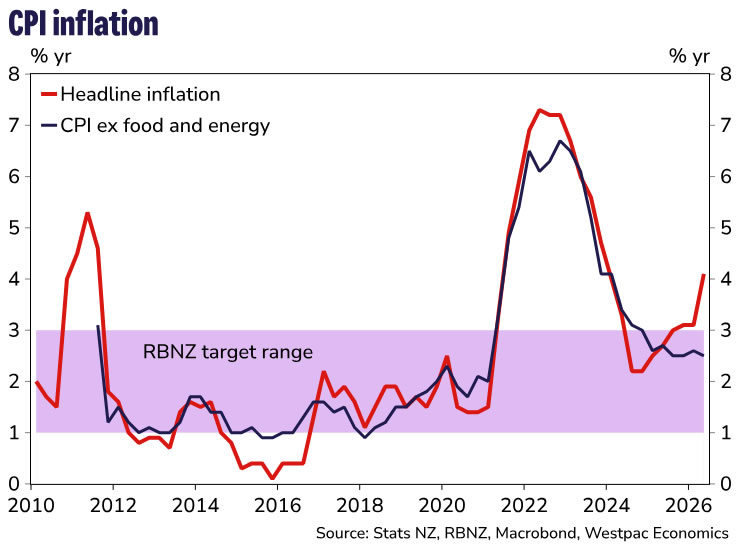
Consumer prices rose 1.5% in the June quarter. That saw the annual inflation rate rise to 4.1%. The result was in line with our forecast but slightly above the RBNZ’s July assumption.
Consumers Price Index, June quarter 2026 – key stats
Headline inflation
- Quarterly change: +1.5% (prev: +0.9%)
- Westpac forecast: +1.5%
- Market median: +1.5%, range +1.3% to +2.0%
- Annual change: +4.1% (prev: +3.1%)
- Westpac forecast: +4.1%, RBNZ: +3.9%, Market: +4.0%
Non-tradables
- Quarterly change: +0.6% (prev: +1.1%)
- Westpac forecast: +0.6%
- Annual change: +3.4% (prev: +3.5%)
Tradables
- Quarterly change: +2.7% (prev: +0.7%)
- Westpac forecast: +2.6%
- Annual change: +4.9% (prev: +2.5%)
Consumer prices rose 1.5% in the June quarter. That saw the annual inflation rate rising to 4.1% – up from 3.1% in the year to March and the highest level in two years. The result was in line with our forecast.
The result was slightly above the RBNZ’s updated July forecast for 3.9% annual inflation. However, much of that surprise is likely related to volatile items like holiday accommodation. Consequently, today’s result will not be a major surprise to the RBNZ.
Much of the rise in inflation has been due to increases in global oil prices. Under the surface, core inflation has been softening, but it remains above the RBNZ’s 2% target midpoint. That’s despite the downturn in economic growth and softness in the labour market.
With core inflation softening, the result was not as worrying as the RBNZ might have feared. But inflation is still high. We continue to expect further OCR hikes at the September and December meetings.
What contributed to inflation in the June quarter?
The main driver of June’s spike in consumer prices was the sharp rise in fuel prices since the start of the Middle East war. While prices have dropped back in recent weeks, petrol prices rose 20% over the June quarter and diesel prices were up an eye-watering 47% (together, those costs account for around 4% of the CPI).
Recent months have also seen further large increases in household energy prices (3% of the CPI). Electricity prices rose 4% over the June quarter and are up 12% over the past year. That was slightly lower than the 12.5% rise in the year to March. But before that the last time we saw increases this large was 1989.
Also adding to inflation has been the 0.4% rise in food prices over the quarter (18% of the CPI).
Notably, the June quarter also saw a 1.6% rise in the cost of a newly built home following very muted gains over the past year. Construction firms have reported increases in building costs in recent months, with at least some of that stemming from the increase in global oil prices. That’s flowed through to higher transport costs, as well as higher costs for materials like PVC piping.
On the downside, rents were up just 0.1% over the quarter and have risen only 0.5% over the past year. That’s the weakest annual rise in rents in more than two decades. With abundant supply and low population growth, average housing rents have shown no growth since late last year, and regions like Wellington have seen outright falls. We expect housing rental growth will remain muted for some time.
Annual and core inflation
The annual inflation rate rose to 4.1% in the June quarter, up from 3.1% in the year to March and the highest level in two years.
Looking under the surface, prices in the domestically oriented non-tradables group rose 0.6% over the quarter (as expected). That saw annual non-tradables inflation edging down just slightly to 3.4%, down from 3.5% last quarter.
While there continues to be firmness in administered prices (like household energy and local council rates), inflation in other domestic prices has been easing. In part, that’s due to the softness in housing rents. However, the cooling in domestic prices has been more widespread, with non-tradables excluding housing and utilities costs (which also omits rates) slowing to 3.2% yr, down from 3.5% in the year to March.
On the imported front, tradables prices rose by 2.7% over the June quarter, just slightly more than expected. Tradables prices were up 4.9% over the past year. That’s up sharply from the 2.5% rise in the year to March.
Higher fuel costs have been a significant driver of the rise in imported inflation. However, the lower New Zealand dollar is also playing an important role, with the NZD trade-weighted exchange rate down almost 4% over the past year. Excluding food and fuel costs, tradables prices were up 1.9% over the past year – the largest rise since 2023. Furthermore, with significant increases in operating costs in the wake of the Middle East war, imported inflation pressures are set to remain firm over the coming months.
While fuel prices did push inflation sharply higher over the past few months, a key focus for the RBNZ is what’s been happening to other prices in the economy. In particular, are we seeing signs of a broader pick-up in inflation pressures?
At this stage, underlying inflation pressures are still looking relatively contained. That was reflected in most of the measures of core inflation, which generally eased slightly over the past few months. (Note: core inflation measures smooth through the quarter-to-quarter swings in inflation and track the underlying trend in prices). In terms of specifics, we saw:
- CPI ex-fuel inflation: +2.9% yr (vs +3.2% previously)
- CPI ex-fuel and food: +2.9% yr (vs +3.0% previously)
- CPI ex-fuel, food and household energy: +2.5% yr (vs +2.6% previously)
- 30% trimmed mean: +2.6% (vs +2.3% previously)
Stats NZ also helpfully provide a measure of inflation excluding food, household energy, vehicle fuels (which still covers two-thirds of the inflation basket). This group rose 2% over the past year, vs 1.9% in the year to March. It’s been running around those levels for a year now.
While measures of core inflation are tracking within the RBNZ’s target band, they’re not ‘low’. Despite a sharp slowdown in economic growth and softness in the labour market, the various measures of core inflation have lingered above the 2% midpoint of the RBNZ’s target range for an extended period. However, the RBNZ will likely take some comfort from the fact that core inflation is still relatively well contained despite many firms reporting increases in operating costs in recent months.
Outlook
While oil prices have pulled back from their initial highs, ongoing geopolitical tensions could keep them elevated for some time. Consistent with those developments, we expect that headline inflation will linger above 3% through the latter part of the year.
Under the surface, while core inflation has been contained, it has lingered above 2% for some time. Furthermore, recent business surveys point to the risk of a broadening in pricing pressures.
Overall, today’s result wasn’t as worrying as it could have been, with limited signs of widespread spillover from high oil prices. But inflation is still high. We continue to expect that the RBNZ will deliver further increases in the OCR through the back part of the year. However, the pace of those increases remains dependent on the strength of economic conditions more generally. We think that hikes are most likely at the RBNZ’s September and December policy meetings.