The latest US tariffs on Canadian goods may be relatively modest in size, but the market reaction suggests investors are focusing on something bigger than the immediate trade impact. USD/CAD advanced after US President Donald Trump signed three proclamations imposing 50% tariffs on about $20 billion of Canadian exports, including alcohol, dairy products, motor vehicles, cement, hockey equipment and electrical machinery. The measures will take effect in roughly 30 days and, notably, apply regardless of compliance with the US-Mexico-Canada Agreement (USMCA, known as CUSMA in Canada), while exempting energy, potash, critical minerals and products already subject to Section 232 duties.
The significance lies less in the sectors affected than in what the latest move says about US trade policy. Since early 2025, Washington has repeatedly expanded tariffs on Canadian goods using different legal authorities rather than relying on the framework established by USMCA. Each new measure reinforces the perception that the agreement is providing less practical protection against unilateral trade actions. As a result, markets are increasingly treating US-Canada trade friction as a structural issue rather than a series of isolated disputes, adding another headwind to Canada’s economic outlook just as uncertainty surrounding the formal USMCA review continues to build.
Canada’s response has so far stopped short of matching Washington’s escalation. Prime Minister Mark Carney reiterated his preference for negotiations and emphasized strengthening Canada’s domestic economy, while Ontario Premier Doug Ford urged Ottawa to retaliate “tariff for tariff, dollar for dollar.” Whether the federal government adopts a more confrontational stance will likely determine how far trade tensions escalate. For now, the new tariffs represent another obstacle for the Canadian Dollar, particularly if investors begin pricing a more prolonged drag on growth.
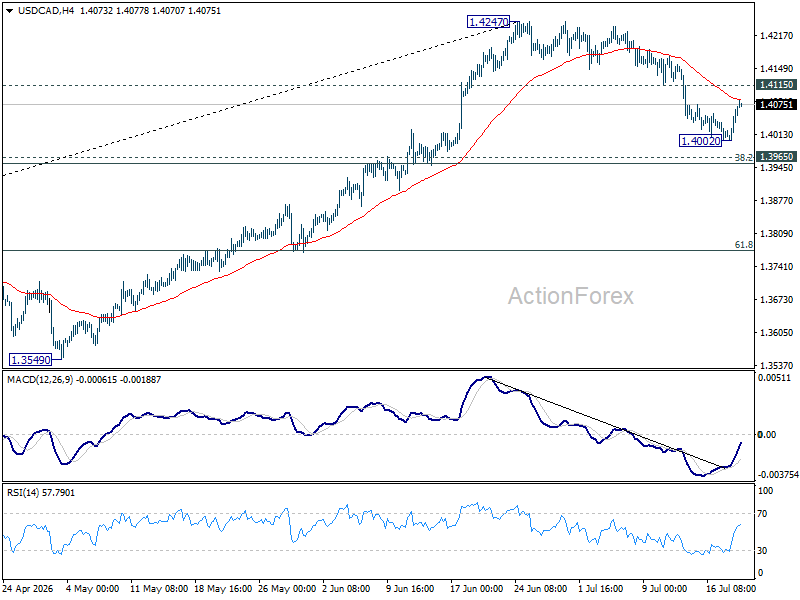
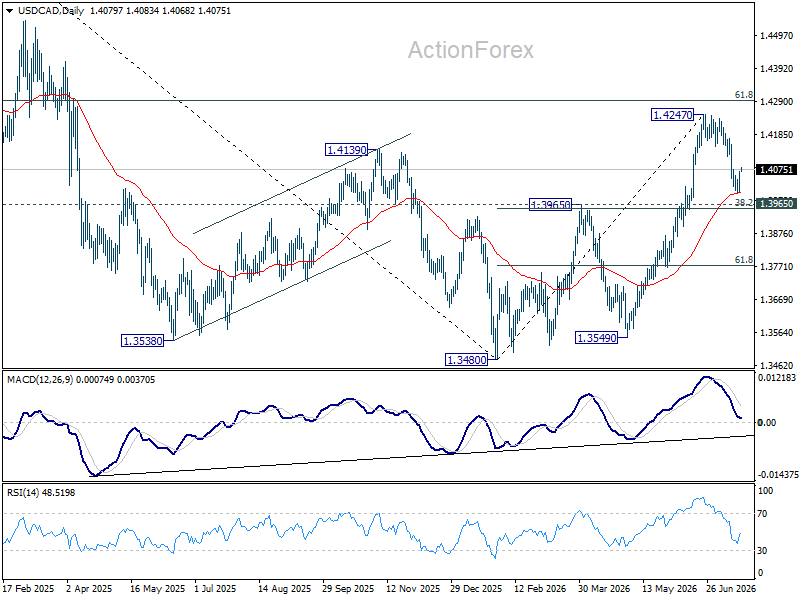
Technically, USD/CAD is also sending a constructive signal for Dollar bulls. The rebound from 1.4002 followed successful tests of both 55 D EMA (now at 1.4002) and 1.3965 cluster support (38.2% retracement of 1.3480 to 1.4247 at 1.3954), suggesting the decline from 1.4247 was corrective rather than the start of a broader reversal. Firm break above 1.4115 minor resistance would strengthen the case that the broader uptrend from the 2026 low at 1.3480 is resuming, bringing another challenge of the 1.4247 high into view.