


Why weak payrolls broke the week’s stalemate, and why Hormuz, Saudi warnings and US-China tensions mean the move isn’t a simple green light for risk
- Hormuz talks are progressing, but reported Iranian draft terms, barring US and Israeli vessels and threatening restrictions on countries deemed to have harmed Iran, look far more conditional than a genuine reopening.
- Saudi Arabia signed a new defense pact with Pakistan and Turkey while warning of possible coordinated attacks from Iran-aligned groups, raising the risk that diplomatic progress and military escalation are running on separate tracks at once.
- The US imposed a new 15% duty on polysilicon imports, extending US-China strategic competition into solar, semiconductor and AI-infrastructure supply chains just as China’s chip exports surged 117% year-over-year.
NFP Delivers the Shock Markets Were Waiting For
The US jobs report finally gave markets the catalyst they had been waiting for, sending the Dollar sharply lower and precious metals surging as traders scaled back expectations for another Fed rate hike. Nonfarm payrolls unexpectedly fell -23K in July, compared with expectations for an 85K increase, but the headline shock was only part of the story. May payroll growth was revised down from 129K to 63K and June from 57K to just 20K, wiping 103K from previously reported employment gains. Average hourly earnings also slowed from 0.3% to 0.1% month-over-month, adding to evidence that the labor market is losing momentum. The unemployment rate unexpectedly dipped from 4.2% to 4.1%, but the accompanying decline in participation from 61.5% to 61.4% made that improvement less reassuring.
July NFP Breakdown
- Headline NFP: -23K, against expectations for +85K
- May payrolls: revised down from 129K to 63K
- June payrolls: revised down from 57K to 20K (103K wiped from prior reports combined)
- Average hourly earnings: slowed from 0.3% to 0.1% m/m
- Unemployment rate: dipped to 4.1% from 4.2%, though participation fell from 61.5% to 61.4%
Why the Hawkish Case Just Got Harder
Markets responded by quickly cutting the probability of a September Fed hike to around 42%. That represents a significant challenge to the hawkish case put forward by several Fed officials this week. Kashkari argued that the Fed should begin raising rates gradually, while Musalem said policymakers should be prepared to surprise markets rather than allow prevailing pricing to dictate policy. But their argument partly rests on the economy and labor market being resilient enough to absorb additional tightening. Negative payroll growth, substantial downward revisions and softer wages raise that hurdle considerably. Inflation remains too high for the Fed to declare victory, particularly with energy risks unresolved, but the latest employment report strengthens the majority case for waiting rather than tightening pre-emptively.
Dollar Reaction Was Broad, and USD/JPY Is the Story to Watch
The Dollar reaction was broad. EUR/USD and AUD/USD broke to fresh highs for the week, while USD/JPY reversed much of its rebound and headed back toward 155. That move is particularly notable after last week’s rare US-Japan intervention. As discussed ahead of payrolls, intervention had created an asymmetric setup: traders chasing USD/JPY toward 160 after strong data would have to contend with renewed intervention risk, while a data-driven fall toward 155 would face no equivalent official deterrent. July NFP delivered precisely that downside scenario.
The Canadian Dollar performed even better after Canada simultaneously reported a 75.1K employment surge against expectations for 17.8K, while unemployment fell from 6.5% to 6.4%. USD/CAD therefore faced pressure from both sides, weak US employment and unexpectedly strong Canadian hiring.
Gold and Silver Break Higher as Fed Hike Risk Fades
The reaction in precious metals was immediate. Gold decisively cleared 4,300, a level that had capped its rebound earlier this week, and accelerated above 4,350. Silver simultaneously surged toward $65. Both moves reinforce the case that recent precious-metals rallies are developing into something more substantial than corrective rebounds. Lower Fed hike expectations reduce pressure from real yields and the Dollar, while geopolitical uncertainty provides another layer of support.
Gold’s break is particularly significant because 4,300 had represented the 38.2% retracement of the decline from 4889.24 to 3942.23, near 4303.98. Earlier attempts to clear that area had stalled as Treasury yields and Brent awaited confirmation of progress on reopening the Strait of Hormuz. NFP has now supplied a separate catalyst. If Gold can sustain the breakout, attention should increasingly shift toward medium-term trend line resistance around 4,500.
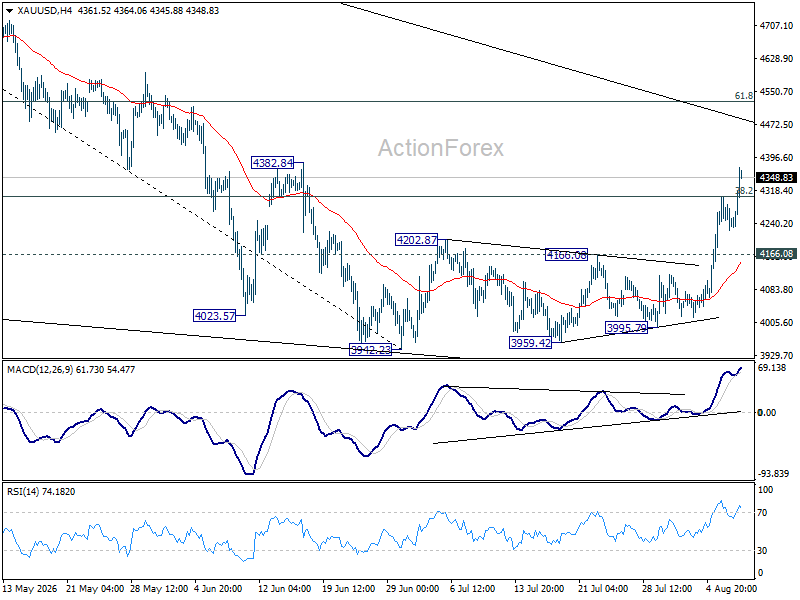
Key Technical Levels
- Gold: cleared 4,300 (the 38.2% retracement of the 4889.24-3942.23 decline, near 4303.98) and accelerated above 4,350
- Silver: surging toward $65
- Next resistance: medium-term trend line around 4,500
Equities Show Restraint: Good for Rates, Not Automatically Good for Risk
Equities delivered a more restrained response. Dow futures rose around 170 points, leaving the index within reach of another challenge to the record set earlier this week, but the reaction was nowhere near as forceful as the moves in Dollar or precious metals. That restraint is understandable. Weaker employment reduces the probability of additional Fed tightening, which supports valuations, but outright payroll contraction accompanied by substantial downward revisions also raises questions about underlying growth. Markets may therefore be approaching the point where bad economic news is still good for rates, but no longer automatically good for risk assets.
Hormuz Talks Progress, but the Details Complicate the Optimism
That caution is reinforced by increasingly complicated developments in the Middle East. Iran and Oman continue working toward an arrangement defining shipping routes through the Strait of Hormuz, but despite expectations earlier this week that an agreement could arrive quickly, no final deal has yet been announced. The latest reports suggest inbound traffic could travel through Iranian waters while outbound vessels use Omani waters. Yet the reported Iranian draft terms raise questions over how closely any arrangement would resemble a genuine normalization of shipping.
Under the apparent draft proposal, US and Israeli vessels would be barred from using the Strait, while countries deemed to have harmed Iran could face restrictions until compensation is paid. Such conditions would make the proposed arrangement substantially different from an unconditional reopening. It also remains unclear how the temporary framework would evolve into a durable settlement. Markets have spent much of the week pricing falling geopolitical risk through lower oil and stronger equities, but the details now matter more than general expectations of a deal.
Diplomatic Rhetoric Turns More Hostile
Diplomatic rhetoric is simultaneously becoming more hostile. Iran’s chief negotiator accused US President Donald Trump of engaging in “theater diplomacy,” highlighting conflicting accounts from Washington and Tehran over bilateral contacts. More importantly, progress over Hormuz is occurring alongside signs that regional military risks may be increasing rather than disappearing.
Saudi Warnings Add a New Escalation Risk
Saudi Arabia, Pakistan and Turkey signed a joint defense agreement in Mecca on Friday as Riyadh warned of possible coordinated attacks from Iran-aligned groups. A senior Saudi official said intelligence from Saudi Arabia, the US and other regional countries pointed to potential attacks from Iraqi militias to the north and Houthis in Yemen to the south, potentially targeting civilian and economic infrastructure including energy facilities, ports and airports.
Particularly important was the Saudi official’s suggestion that possible attacks could reflect “a power struggle within Iran itself” and might be intended to derail negotiations that had otherwise been “heading in the right direction.” If that assessment proves accurate, it complicates the assumption that diplomatic progress automatically translates into lower geopolitical risk. Negotiations over Hormuz could advance at the government level while other actors simultaneously attempt to undermine them through military escalation.
Two Middle East Stories on Separate Tracks
That creates two Middle East stories moving on separate tracks. One is diplomatic: Iran and Oman are trying to establish a framework that could restore more normal shipping through the Strait. The other is military: Gulf states are preparing for the possibility that regional attacks could intensify even while those negotiations continue. Brent’s recent inability to extend decisively below $78 and subsequent rebound above $83 increasingly looks consistent with that uncertainty.
US-China Competition Intensifies on Another Front
Geopolitics is also moving beyond the Middle East. The Trump administration imposed a new 15% duty on polysilicon products on Thursday and introduced minimum prices for some related imports, explicitly framing the measure as an effort to protect US solar and semiconductor supply chains from Chinese competition. Polysilicon sits at the intersection of several strategic priorities, solar power, semiconductors, AI infrastructure and energy security, making the move another example of economic policy becoming inseparable from great-power competition.
The timing is notable given China’s strong July trade figures. Chinese exports rose 23.9% year-over-year, beating expectations, while chip exports surged 117% as global AI infrastructure demand continued to power high-tech manufacturing. Washington’s latest action therefore comes precisely as advanced technology becomes an increasingly important source of Chinese export growth. That suggests trade tensions are shifting further toward sectors viewed as strategically important rather than simply those generating large bilateral deficits.
What This Means Heading Into the Weekend
For markets, the immediate driver remains the US employment shock. The Dollar has broken lower, Gold has cleared $4,300, Silver is approaching $65 and September Fed hike expectations have retreated sharply. But heading into the weekend, weaker payrolls cannot be treated as a straightforward invitation to extend risk-on positions. The Hormuz agreement remains unfinished, regional military threats are increasing, and US-China strategic competition is intensifying. NFP has broken this week’s market stalemate; whether those moves survive next week may depend increasingly on what happens outside the economic calendar.
Related Coverage
Jobs & Trade Data Deep Dives
- Read the full NFP breakdown showing how deep the downward revisions cut into prior job gains: US Non-Farm Payrolls Contract -23k. Revisions Expose Deeper Labor Market Weakness.
- See the full Canada jobs report, including why wage growth cooling to 2.8% still reduces pressure for more BoC support: Canada Jobs Surge 75K as Unemployment Falls to Two-Year Low.
- Read why China’s export beat still raises sustainability questions once tariff front-loading fades: China Exports Rise 23.9% YoY as High-Tech Demand Defies Tariffs.
Frequently Asked Questions
Q: Why did equities react more cautiously than the Dollar and Gold to the NFP miss?
A: Weaker employment reduces the probability of additional Fed tightening, which normally supports valuations. But outright payroll contraction, combined with substantial downward revisions to May and June, also raises questions about underlying growth. Markets may be approaching the point where bad economic news is still good for rates but no longer automatically good for risk assets, which is why Dow futures rose a modest 170 points while the Dollar and precious metals moved far more forcefully.
Q: Why does USD/JPY’s move back toward 155 matter after last week’s intervention?
A: Last week’s coordinated US-Japan intervention created an asymmetric setup: traders pushing USD/JPY back toward 160 on strong data would face renewed intervention risk, while a data-driven fall toward 155 would face no equivalent official deterrent. July’s NFP delivered exactly that downside scenario, reversing much of USD/JPY’s prior rebound with no offsetting pushback expected from Japanese authorities.
Q: Does progress on Hormuz shipping talks mean geopolitical risk is actually falling?
A: Not necessarily. Reported draft terms would bar US and Israeli vessels from the Strait and threaten restrictions on countries deemed to have harmed Iran until compensation is paid, conditions that make any arrangement substantially different from an unconditional reopening. At the same time, Saudi Arabia has warned of possible coordinated attacks from Iran-aligned groups, which a Saudi official suggested could reflect a power struggle within Iran aimed at derailing the negotiations. That means diplomatic progress and military escalation risk could be running on separate tracks simultaneously.
Key Takeaways
- NFP delivered a genuine shock: Headline payrolls fell -23K against expectations for +85K, while May and June were revised down by a combined 103K and wage growth slowed to 0.1% m/m.
- September Fed hike odds were cut to around 42%: The report significantly raises the hurdle for the hawkish case made by Kashkari and Musalem this week, since it rested on the economy being resilient enough to absorb more tightening.
- Dollar, Gold and Silver moved far more forcefully than equities: Gold cleared 4,300 and accelerated above 4,350, and Silver pushed toward $65, but Dow futures rose a more modest 170 points, since weak payrolls raise growth questions even as they support the case for a Fed pause.
- USD/JPY’s reversal toward 155 fits last week’s intervention asymmetry: A data-driven move lower carries no equivalent official deterrent to the one traders would face pushing the pair back toward 160.
- Hormuz progress comes with complicating conditions: Reported draft terms barring US and Israeli vessels and threatening restrictions on other countries look far more conditional than a genuine reopening, while Saudi Arabia’s new defense pact and attack warnings suggest military risk could be rising even as talks continue.
- US-China tensions are extending into strategic technology supply chains: The new US polysilicon tariff lands just as China’s chip exports surged 117% year-over-year, pointing to trade friction shifting toward strategically important sectors.
What to Watch Next
Whether this week’s moves hold into next week may depend less on the economic calendar than on developments outside it: whether the Hormuz framework firms into something closer to an unconditional reopening, whether Saudi Arabia’s escalation warnings materialize, and whether US-China tensions extend further into strategic technology sectors.





