


US labor market delivered a major downside surprise in July, with nonfarm payrolls falling -23K, far below expectations for an 85K increase. Weak headline was compounded by another round of substantial downward revisions: May payroll growth was cut from 129K to 63K, while June was revised from 57K to just 20K, leaving combined employment gains 103K lower than previously reported. July weakness was concentrated in local government education and retail trade, while health-care employment continued to trend higher. Taken together, latest figures suggest deterioration in hiring is considerably more pronounced than earlier estimates indicated.
Other parts of report were mixed, but did little to offset payroll disappointment. Unemployment rate unexpectedly fell from 4.2% to 4.1%, versus expectations for no change. But decline came alongside another drop in labor force participation from 61.5% to 61.4%. Participation has now fallen 0.7 percentage point since January, while employment-population ratio has declined 0.5 point over same period.
Meanwhile, average hourly earnings growth slowed sharply from 0.3% to 0.1% mom, missing expectations of 0.3%. Combination of weaker hiring, declining participation and softer wage growth paints a considerably less reassuring picture than lower unemployment rate alone would suggest.
Report should substantially raise hurdle for Fed to hike rates in September. This week’s employment indicators had already sent conflicting signals, with weak ADP hiring and contracting ISM Services Employment offset by stronger manufacturing employment and historically low jobless claims. NFP now tilts balance decisively toward labor-market weakness, while softer wage growth reduces one source of inflation concern.
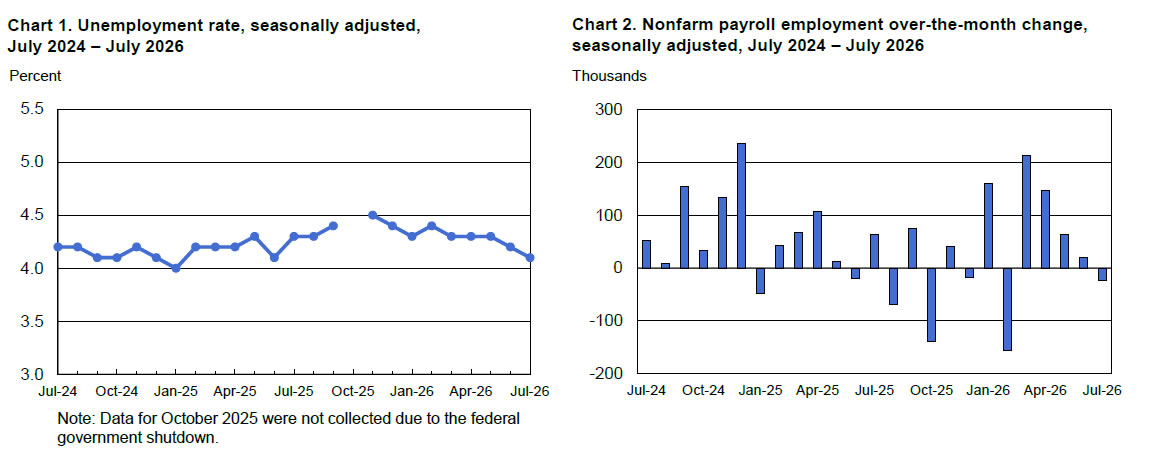
Data Summary
| Indicator | Actual | Expected | Previous |
|---|---|---|---|
| Nonfarm Payrolls | -23K | +85K | +20K |
| Unemployment Rate | 4.1% | 4.2% | 4.2% |
| Average Hourly Earnings m/m | +0.1% | +0.3% | +0.3% |
| Labor Force Participation Rate | 61.4% | — | 61.5% |
| May–June Combined Revision | -103K | — | — |
Key Takeaways
- Nonfarm payrolls unexpectedly fell 23K in July, badly missing expectations for an 85K increase and marking outright employment contraction.
- Weakness extended well beyond July. May was revised down from +129K to +63K and June from +57K to +20K, cutting previously reported employment growth by 103K combined.
- Unemployment rate unexpectedly fell from 4.2% to 4.1%, but this was accompanied by a decline in labor force participation from 61.5% to 61.4%.
- Labor force participation has now fallen 0.7 percentage point since January, while employment-population ratio has declined 0.5 point, making lower unemployment rate less reassuring.
- Average hourly earnings slowed from 0.3% to 0.1% mom, well below expectations of 0.3%, adding evidence that labor-related inflation pressure is easing.
- Employment declined in local government education and retail trade, while health-care employment continued to trend higher.
- Report significantly raises hurdle for a September Fed hike. Negative payroll growth, large downward revisions and softer wages challenge hawkish argument that labor market remains strong enough to comfortably absorb further tightening.





