


TL;DR: The US 30-year Treasury yield has climbed above 5.31%, its highest in 19 years, alongside oil’s push through $90 — but fading Fed hike expectations and softer inflation data suggest structural forces like fiscal deficits and Fed credibility uncertainty are carrying the move as much as oil is.
Oil Above $90 Makes an Easy Explanation — Maybe Too Easy
US 30-year Treasury yield has climbed above 5.31%, highest level in 19 years, while 10-year yield sits around 4.73%. Brent has simultaneously pushed through $90 as US-Iran tensions intensify. Put those charts side by side and conclusion looks obvious: oil is driving another inflation scare, and bond investors are responding.
That story is not wrong. It is simply incomplete.
Treasury yields have repeatedly followed crude during Iran-related swings this year. They rose during oil spikes in July and again in early August, then retreated when crude plunged on hopes of de-escalation. Higher oil raises inflation expectations, and investors demand more yield from long-duration bonds to compensate.
But this time 30-year yield has reached a 19-year high while recent CPI and PPI readings have softened and markets have been aggressively cutting Fed hike expectations. September hike probability has fallen dramatically, yet long end keeps selling off. If oil were whole story, those counterweights should be doing more.
Oil May Be Triggering the Move, but Term Premium Is Carrying It
Energy still matters. Year-ahead inflation expectations have stayed above 4% for five straight months, so households have not fully bought into a benign inflation story. With Brent back above $90 and Hormuz shipping heavily disrupted, bond investors have legitimate reason to protect themselves against another energy-driven inflation impulse.
What oil explains best is timing. Each new escalation gives investors another reason to sell duration.
What it does not explain as well is level. Why should 30-year Treasury require its highest yield since 2007 when markets simultaneously think Fed needs substantially less tightening than feared only weeks ago?
Answer may be that long-end yields are increasingly pricing risks that Fed funds rate cannot solve quickly: huge government borrowing requirements, uncertainty about inflation-control framework and growing competition for investor capital.
Washington’s Deficit Does Not Disappear if Iran De-Escalates
Fiscal backdrop is most obvious structural candidate. The CBO recently raised its annual deficit estimate to $2.1 trillion, roughly $200 billion above earlier projection. Greater deficits mean greater financing needs, and greater financing needs mean more Treasury securities that investors must absorb.
For long end, mechanism is simple: if supply keeps increasing faster than natural demand, price has to fall until yield becomes attractive enough to clear market.
Unlike Brent, this pressure is persistent. US-Iran de-escalation can remove an oil premium within days. It cannot remove hundreds of billions of dollars of government borrowing requirements. That is why worsening fiscal profile can keep long yields elevated even after individual inflation scares fade.
It also changes how investors should interpret future bond rallies. Softer data may still pull 30-year yield lower, but if fiscal term premium has risen structurally, those declines may increasingly struggle to return yields to old ranges.
Fewer Fed Hikes Can Actually Mean Higher Long Yields
More unusual part of story comes from Fed Chair Kevin Warsh.
Warsh has resisted conventional forward guidance, leaving investors with less certainty about Fed reaction function. That matters because long bonds are not priced only on next meeting. Investors are making judgments about inflation and monetary policy over decades. Less clarity means more risk, and more risk means higher term premium.
This produces a counterintuitive possibility. When Warsh suggests rate hikes may not be preferred way to fight inflation, markets can price fewer hikes in near term but more inflation uncertainty in long term. Front-end rates fall, while 30-year yields rise.
That may be exactly why current bond move looks so strange. Markets are no longer expecting a long sequence of Fed hikes, but that does not necessarily mean investors have become more confident about inflation control.
If Fed were simply becoming less hawkish because inflation is clearly defeated, long end should welcome it. If Fed is becoming less predictable while inflation risks from oil, tariffs and repeated supply shocks persist, long-end investors may instead demand a larger buffer.
Wednesday’s Fed Minutes Could Help Separate Those Stories
This makes upcoming FOMC minutes more useful than headline 9–3 vote alone.
Markets already know three policymakers dissented in favor of tighter policy. More important question is how majority viewed repeated supply shocks and whether hold reflected confidence that inflation would fade or concern that labor market could no longer absorb aggressive tightening.
Minutes also predate softer July CPI, PPI and retail sales releases, so they should not be treated as current Fed forecast. Their value is in revealing reaction function: what risks policymakers were trying to insure against and what evidence they would need before changing course.
For 30-year bonds, clarity itself could matter. If minutes suggest Fed has a coherent threshold for responding to inflation, some credibility premium could ease. If they reinforce impression of a highly uncertain framework, long-end yields may stay stubbornly high even as September hike odds remain low.
AI Boom Is Also Competing for Same Pool of Money
Government is not only borrower asking markets to absorb more duration.
AI infrastructure buildout has generated a large wave of corporate issuance as technology companies finance data centers, power infrastructure and related capital expenditure. That supply gives institutional investors more alternatives to long-dated Treasurys.
This factor receives less attention because it does not produce a clean daily headline like Brent or CPI. But bond markets ultimately clear through supply and demand. Heavy Treasury issuance and unusually strong corporate borrowing arriving at same time increase competition for long-term capital.
Again, it is probably not the reason 30-year yield reached 5.31%. But together with fiscal deficits and greater uncertainty over Fed reaction function, it helps explain why long yields may be experiencing something more persistent than a temporary oil shock.
Watch What Happens When Oil Falls
Best test may come not when Brent rises again, but when it eventually falls.
If Iran tensions ease and crude drops back below $90 while 30-year yield retreats sharply, oil explanation gains credibility. Inflation premium was driving much of move and bond market can normalize as energy threat recedes.
If Brent falls and long yield barely follows, conclusion changes. Bond market would be signaling that structural pressures—fiscal supply, Fed credibility and competition for capital—have taken over.
That would have much broader implications than another Iran-driven volatility episode. Persistently high long yields feed directly into mortgage rates, corporate financing costs, equity valuations and financial conditions even if Fed itself stops hiking.
ActionForex’s Technical View on the 30-Year Yield: 5.39 Could Tell Us Whether Something Bigger Is Changing
Chart is arriving at perfect place to test that thesis.
30-year yield is approaching 5.35 medium-term channel ceiling, while 5.39 marks 100% projection of 4.63 to 5.20 from 4.82. That cluster is a natural place for current advance to stall. Consolidation there would fit interpretation that latest surge partly reflects another round of oil and geopolitical repricing.
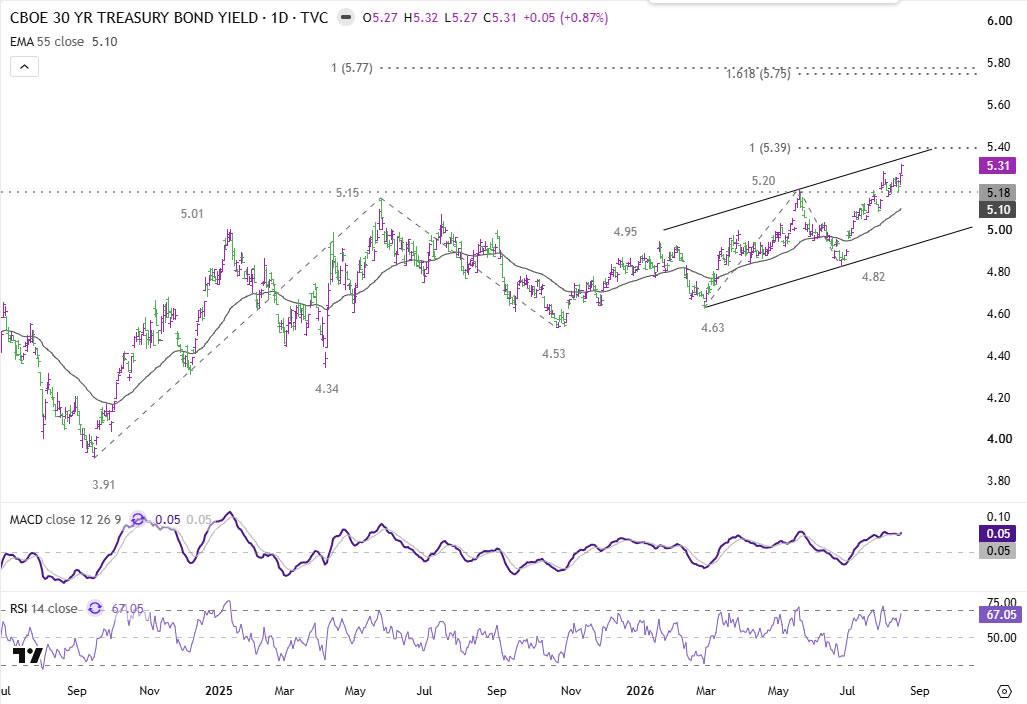
A decisive break through 5.35–5.39, however, would be much harder to dismiss. It would signal buyers are still demanding greater compensation even at yields already near two-decade highs. That could trigger acceleration toward 5.75, 161.8% projection target, and strengthen argument that something structural is changing underneath Treasury market.
On downside, break of 5.18 would indicate short-term top and shift focus back to 55-day EMA around 5.10, with scope for deeper correction.
Oil helped push 30-year yield toward this test. What happens at 5.35–5.39—and what happens when oil eventually retreats—will tell us whether Brent was driving Treasury selloff, or merely exposing a much bigger problem.
Key Takeaways
- The 30-year Treasury yield hit 5.31%, a 19-year high, even as September Fed hike odds fell sharply and inflation data softened — a mismatch oil alone doesn’t fully explain.
- The CBO’s raised $2.1 trillion deficit estimate points to a persistent, structural source of Treasury supply pressure that oil de-escalation can’t remove.
- Warsh’s minimal forward guidance can paradoxically push front-end rates down while long-end yields rise, since less policy clarity raises long-term uncertainty premium.
- Heavy AI-related corporate bond issuance is competing with Treasury supply for the same pool of long-duration capital, adding a less visible but real structural pressure.
- 5.35-5.39 is the key resistance cluster; a break opens 5.75, while a break of 5.18 support would point to a short-term top and correction toward 5.10.





