Why oil’s break above $90 is spilling into global bond yields, and why that’s flipping the usual risk-off currency playbook
Why it matters: A sustained break of 4.75% on the 10-year would signal the oil shock is spreading into global financial conditions broadly, not just energy prices, potentially forcing a wider repricing across equities, currencies and rate-sensitive assets. It’s already flipping the usual playbook: Aussie and Dollar lead while traditional havens Franc and Yen lag, because markets are trading this as an inflation and rates story rather than a conventional risk-off event.
Hormuz Shock Moves Beyond Oil
Middle East tensions continued to dominate headlines Tuesday as expiry of the 60-day US-Iran ceasefire framework left no clear diplomatic path forward. Brent pushed decisively above $90, while harder rhetoric from Washington and Tehran reinforced uncertainty over whether the current standoff will escalate further. More importantly for broader markets, the oil shock is not confined to energy: global bond yields are rising sharply as investors reassess inflation risk and how long monetary policy may need to stay restrictive.
Iranian parliament speaker Mohammad Bagher Ghalibaf said the Strait of Hormuz would remain closed until Tehran’s demands were met, including lifting the US blockade, releasing frozen assets, ending the oil embargo and stopping military threats and operations. A senior Iranian official separately said Tehran was shifting toward a “fully offensive” posture after diplomatic efforts stalled. On the US side, President Donald Trump again insisted Iran must abandon any nuclear-weapons capability while escalating rhetoric over control of Hormuz. Military confrontation has nevertheless stayed relatively contained for now, although UKMTO reported another vessel was struck by an unknown projectile in the Strait, causing engine-room damage and a crew casualty.
Tuesday’s Escalation Points
- Ghalibaf: Strait stays closed until US blockade lifted, frozen assets released, oil embargo ended and military threats stopped.
- Senior Iranian official: Tehran shifting toward a “fully offensive” posture.
- Trump: reiterated Iran must abandon any nuclear-weapons capability, escalated rhetoric over control of Hormuz.
- UKMTO: another vessel struck by an unknown projectile in the Strait, engine-room damage and a crew casualty.
Brent Has Broken Its Threshold — Bonds May Be Next
Bond markets are increasingly treating prolonged Hormuz disruption as an inflation problem rather than simply a geopolitical headline. US 30-year Treasury yield has reached its highest level in nearly two decades, while Germany’s 10-year Bund yield has climbed to its highest since 2011. Higher energy and freight costs threaten to keep inflation pressure elevated even if recent headline data have softened, strengthening the case for restrictive rates to persist longer than markets previously hoped.
That puts the US 10-year yield around 4.75% at the center of the next market test. Brent has already cleared its previous $90 barrier; a sustained break of 4.75% by the 10-year yield would suggest the oil shock is spreading more deeply into global financial conditions. Such a move could force broader repricing across equities, currencies and other rate-sensitive assets, especially if investors start treating higher yields as something more persistent than another temporary reaction to Middle East headlines.
Aussie Leads as Risk-Off Playbook Flips
Currency performance shows why this is not a conventional geopolitical risk-off episode. Aussie is the strongest major currency so far, followed by Dollar and Euro, while Swiss Franc is weakest, Kiwi second weakest and Yen third. Loonie and Sterling sit in the middle.
Normally, escalating geopolitical risk might be expected to favor Franc and Yen. This time, the inflation and rates channel is dominating. Rising global yields make low-yielding currencies less attractive, while higher energy prices increase the possibility that central banks with existing tightening biases will need to stay restrictive for longer. That combination helps explain why traditional haven currencies are lagging even as Middle East risk intensifies.
Typical Risk-Off Playbook vs. Today’s Pattern
| Typical Geopolitical Risk-Off | Today’s Pattern | |
|---|---|---|
| Expected leaders | Swiss Franc, Yen (safe havens) | Aussie strongest, Dollar second |
| Expected laggards | Higher-yielding currencies | Swiss Franc weakest, Yen third weakest |
| Dominant mechanism | Flight to safety | Inflation and rates channel: rising global yields make low-yielders less attractive |
Brent Above $90 Gives RBA Hawkish Bias Fresh Relevance
AUD’s outperformance is particularly notable. RBA deliberately kept the door open to further tightening earlier this month, saying the cash rate could rise again if upside inflation risks materialise. Officials subsequently reinforced that conditional hawkishness, making renewed oil pressure directly relevant to Australian rate expectations.
Markets may therefore be rebuilding some probability of another RBA hike as Brent pushes higher, adding a domestic policy tailwind to AUD’s already strong technical and regional-risk backdrop. That does not mean another hike is now assured. Upcoming Australian jobs data and next week’s CPI still matter. But $90-plus oil raises precisely the kind of inflation uncertainty RBA said could justify additional action, giving Aussie another reason to outperform.
Dollar Gets Yield Support, but No Full Reversal Yet
Dollar is the second-strongest major currency, helped by rising Treasury yields and a modest return of Fed tightening risk. Probability of a September hold has slipped toward 63%, suggesting markets are putting some chance of near-term action back into the curve as oil and inflation risks rebuild.
Yet the greenback has not generated a decisive reversal after its recent broad selloff. That suggests the current adjustment in Fed expectations is still relatively limited. Long-end yields may also be rising partly because of term-premium and inflation-risk concerns rather than a straightforward shift toward significantly more Fed hikes. For Dollar, a sustained 10-year break above 4.75% accompanied by a larger change in September pricing would provide much stronger evidence that the rates shock is becoming a genuine support rather than merely slowing the recent decline.
CAD Strength Shows Up More Clearly Against Low Yielders
Canadian Dollar is only around the middle of the daily ranking, but that understates oil’s support because Dollar itself is benefiting from higher US yields. CAD strength is showing more clearly against low-yielding currencies, particularly Yen, where Brent’s terms-of-trade support for Canada combines with widening global yield differentials against Japan.
That distinction matters when reading current FX moves. USD/CAD can obscure Canadian strength when both currencies receive support from the same global shock through different channels. Crosses such as CAD/JPY provide a cleaner expression of the oil effect: higher crude benefits Canada directly while higher global yields simultaneously squeeze Yen.
4.75% Could Decide Whether Oil Shock Becomes a Market-Wide Repricing
The near-term question is not simply whether Brent can stay above $90. Oil has already crossed that threshold. More important is whether higher energy prices now push global yields through levels capable of tightening financial conditions materially.
If US 10-year yield fails around 4.75% and Brent settles after the current geopolitical repricing, broader market impact could stay contained. But a sustained break above 4.75%, especially alongside further oil gains, would signal that the Hormuz crisis is moving from an energy shock into a global rates shock. That would strengthen higher-yielding currencies, increase pressure on Yen and Franc, and force markets to reconsider how quickly central banks can step away from tightening policy.
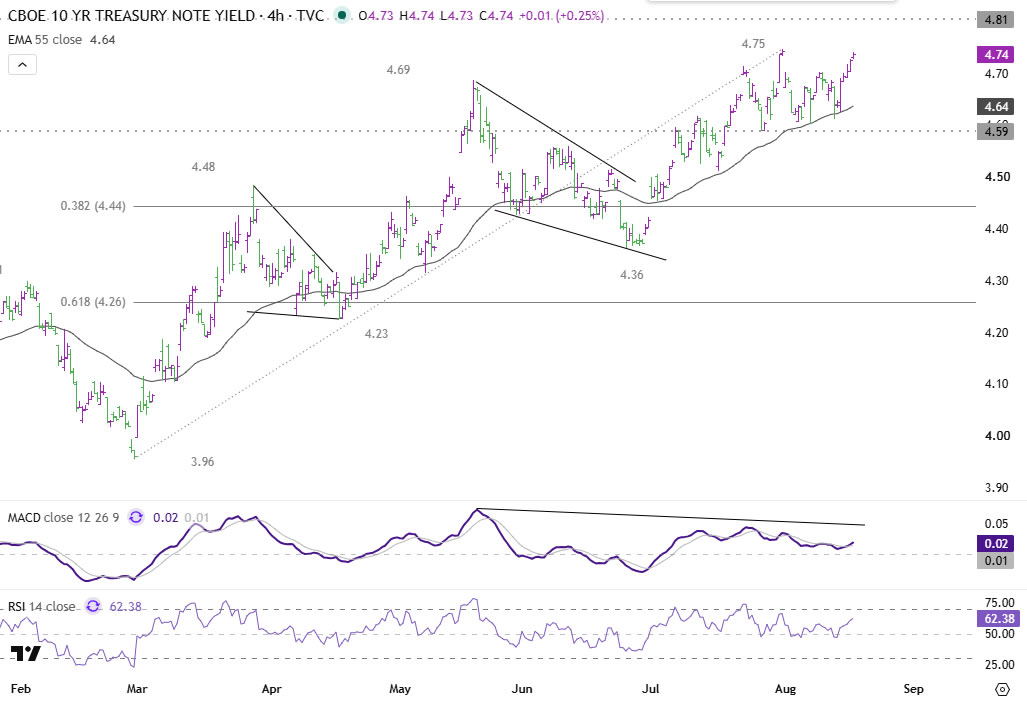
For now, rhetoric is escalating faster than military conflict. That leaves markets balancing two possibilities: the current standoff persists with Brent holding around $90, or fresh escalation pushes oil and yields into another leg higher. Brent has already given its answer. The Treasury market is next.
Related Coverage
Oil & Yields Deep Dive
- Read why CAD/JPY is benefiting from a rare double tailwind, oil supporting Canadian Dollar’s terms of trade while the same shock squeezes Yen through higher global yields, and why a break of 117.50 could open 120.86: Oil Shock Is Working Twice for CAD/JPY — Can It Reach 120?.
- See why US 30-year yield’s climb above 5.31%, a 19-year high, is only partly about oil, with fiscal deficits and Fed uncertainty also pushing long-end yields higher: US 30-Year Yield Hits 19-Year High — Oil Is Only Part of the Story.
Global Data Deep Dives
- Read why Germany’s ZEW sentiment jumped to 34.2 in August, with the Current Situation Index improving sharply and sector expectations strengthening broadly: Germany ZEW Sentiment Strengthens to 34.2 as Current Conditions Improve.
- See why UK payroll employment fell another 13K in July even as regular earnings growth edged up to 3.5%: UK Payroll Employment Falls as Unemployment Holds at 4.9%.
- Read why Australian consumer sentiment’s rebound to 88.9 after the RBA hold still leaves confidence fragile amid rising unemployment concerns: Australia Westpac Consumer Sentiment Rebounds After RBA Hold, but Pessimism Persists.
Frequently Asked Questions
Q: Why is oil breaking $90 being treated as a bond market story, not just an energy story?
A: Because bond markets are already reacting. US 30-year Treasury yield has hit its highest level in nearly two decades, and Germany’s 10-year Bund yield has climbed to its highest since 2011, as investors treat prolonged Hormuz disruption as an inflation problem that could keep monetary policy restrictive for longer, not just a geopolitical headline. That’s why US 10-year yield near 4.75% is now framed as the bigger test than Brent’s move above $90.
Q: Why are Franc and Yen lagging despite escalating geopolitical risk?
A: Because the inflation and rates channel is dominating over the usual flight-to-safety pattern. Rising global yields make low-yielding currencies like Franc and Yen less attractive, while higher energy prices raise the chance that central banks with existing tightening biases stay restrictive for longer. That’s letting Aussie and Dollar, both benefiting from that rates channel, lead instead of the traditional havens.
Q: What would confirm the oil shock is becoming a broader market repricing?
A: A sustained break of US 10-year yield above 4.75%, especially alongside further oil gains, would signal the Hormuz crisis is moving from an energy shock into a global rates shock. That would likely strengthen higher-yielding currencies further, increase pressure on Yen and Franc, and force markets to reconsider how quickly central banks can step away from tightening policy. If 4.75% fails to break and Brent settles, the broader impact could stay contained instead.
Key Takeaways
- Brent decisively broke above $90: The move came as the 60-day US-Iran ceasefire framework expired with no clear diplomatic path forward.
- The shock has spread beyond energy into bonds: US 30-year yield hit its highest level in nearly two decades, and Germany’s 10-year Bund yield reached its highest since 2011.
- US 10-year yield near 4.75% is the next key test: A sustained break would signal the oil shock is becoming a genuine financial-conditions shock rather than just a headline reaction.
- Currency performance flipped the usual risk-off playbook: Aussie and Dollar led while Franc and Yen lagged, because markets are trading inflation and rates risk rather than seeking traditional havens.
- AUD’s strength is compounded by oil reviving RBA hawkish relevance: Though upcoming Australian jobs data and next week’s CPI still matter before another hike is assured.
- CAD’s oil-driven strength shows most clearly against Yen: USD/CAD understates it since Dollar is also benefiting from the same yield shock, making CAD/JPY a cleaner read.
What to Watch Next
US 10-year yield’s ability to sustain a break above 4.75% is the key test for whether this becomes a broader market repricing, alongside whether Brent extends its gains or settles around $90. On the geopolitical side, watch for genuine military escalation in the Strait of Hormuz versus continued rhetoric-only standoff, since rhetoric has so far outpaced actual conflict.