


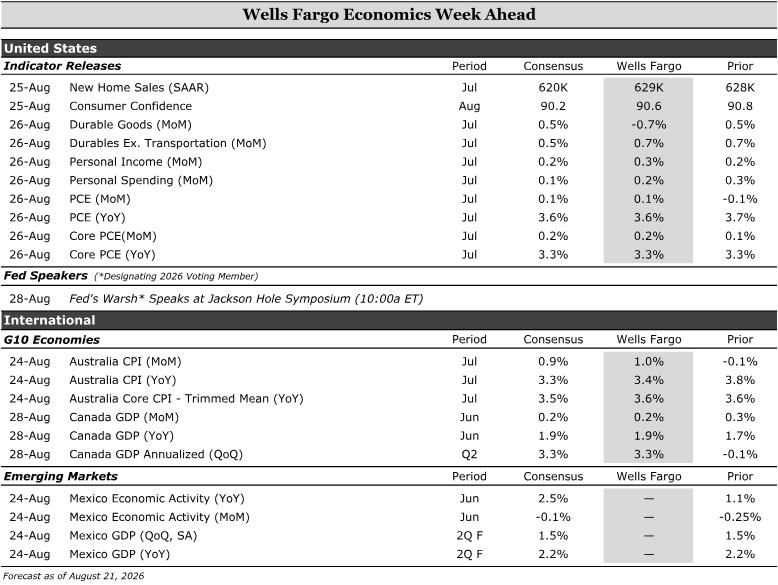
Next week, July’s personal income and spending report is expected to show resilient consumer demand, while PCE inflation should point to easing underlying price pressures. Jackson Hole will also be in focus, and Chair Warsh is likely to emphasize the Fed’s longer-term policy framework and task force priorities. Meanwhile, Friday’s benchmark payroll revision is expected to show only a modest downward adjustment, suggesting labor market conditions have tracked more closely to published estimates than in recent years.
Abroad, Australia’s July CPI report is expected to show signs of inflation picking up amid higher fuel costs and sticky underlying price pressures. In Canada, we expect the Q2 GDP report to show the strongest pace of growth in nearly two years, with the economy expanding at a 3.3% annualized rate.
United States: Personal Income & Spending (Wednesday), Jackson Hole Economic Policy Symposium (Thursday – Saturday); Preliminary 2026 Benchmark to Nonfarm Payrolls (Friday)
Advanced Economies: Australia CPI (Wednesday), Canada GDP (Friday)
Source: Bloomberg Finance L.P. and Wells Fargo Economics
U.S. Week Ahead
Personal Income & Spending • Wednesday
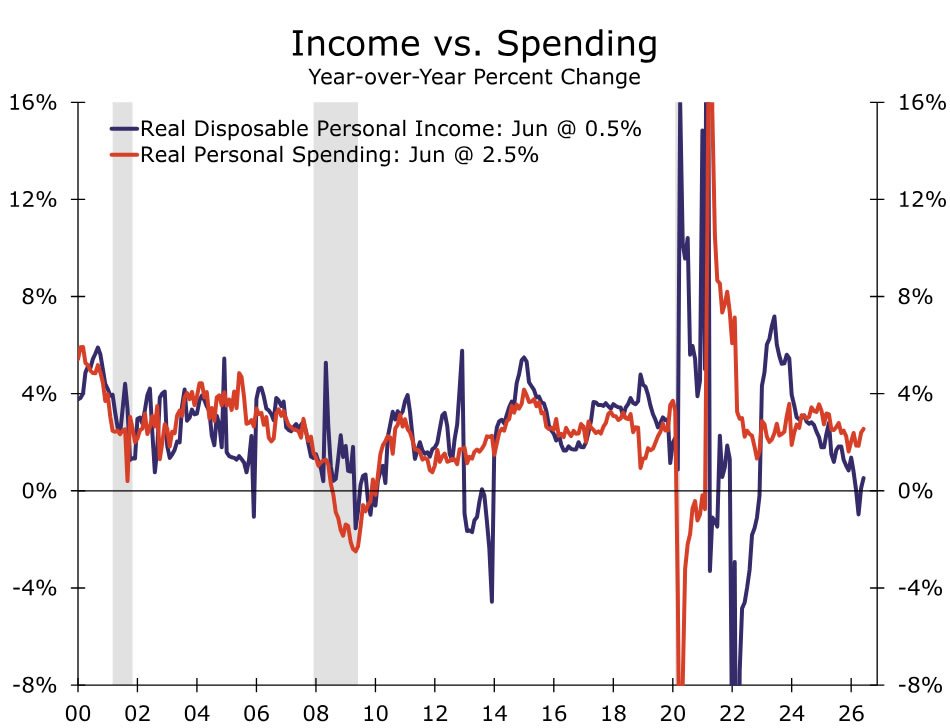
Consumer spending appears to have held up in July, and we forecast a 0.2% gain in nominal spending. While headline retail sales disappointed, the weakness was largely traced to lower gasoline prices and an unusually large drop in nonstore (online sales), likely reflecting the calendar shift of Amazon Prime Day into June this year. Excluding those distortions, control group sales excluding nonstore retailers were up 0.4%, just above its average pace over the past six months and pointing to steady underlying goods demand.
The more important story for markets is what comes next. The boost from larger-than-usual tax refunds that helped cushion households from higher gasoline prices has now largely faded, leaving consumer spending increasingly dependent on underlying income growth. We expect nominal personal income rose 0.3% in July. And if there is any upside surprise it would likely come from proprietors’ income, which has been unusually volatile this year due to the timing of USDA-related payments. Even so, real disposable income should continue to gradually improve, and year-over-year growth is likely to grind modestly higher in coming months if labor market conditions remain stable, allowing consumer spending to continue.
We’re not expecting much surprise on inflation. The latest CPI and PPI reports point to a 0.1% gain in the PCE deflator in July, nudging the year-over-year rate down to 3.6%. Core PCE inflation is expected to rise 0.2% on the month, leaving the annual rate at 3.3%. While inflation remains above the Fed’s target, the recent data are consistent with a gradual easing in underlying price pressure.
Source: U.S. Department of Commerce and Wells Fargo Economics
Jackson Hole Economic Policy Symposium • Thurs. – Sat.
We have always thought entirely too much attention has been placed on the Fed’s Jackson Hole event. Over about the last decade and a half there have been only two big speeches that we would describe as truly consequential for the near-term policy path (Powell’s “pain” speech in 2022 and Bernanke’s hint at QE3 in 2012). That’s it. Two speeches in the last 14 years.
You would think given Warsh’s proclivity to want to say less, not more, this would be another year when little actually happens. And while we tend to lean in that direction as it relates to JH, the one thing that has us wondering a bit more about this than typical is the “clean up” article that occurred in the FT following the last FOMC presser. If Warsh cared enough to bless that (assuming he did), then it may be on his mind that his current approach may need some refining and could decide to address it.
Source: Federal Reserve Board and Wells Fargo Economics
Warsh has refrained from laying out his near-term reaction function, a tactic we do not think he’ll abandon only a few months into his tenure. Besides, with the Committee clearly split on what to do next and another round of inflation and employment data between his speech and the FOMC’s next meeting on Sep. 16, revealing his leaning now risks boxing in the Committee—the very issue he’s trying to avoid by paring back guidance.
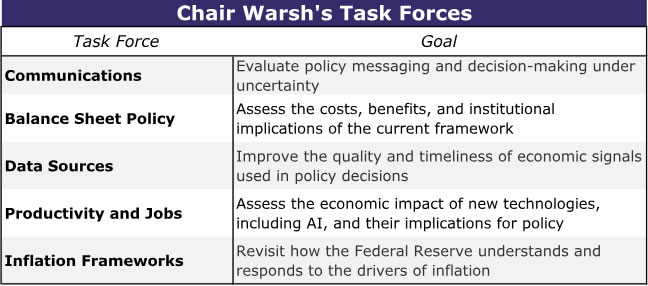
Given his response about Jackson Hole at the last FOMC presser, we wouldn’t be surprised if Warsh uses his speech to expand upon some of the “big questions” his task forces are working on that will shape the FOMC’s approach to monetary policy. For example, he could lay out some of the potential options on the table, such as the appropriate size and composition of the balance sheet, ways the Summary of Economic Projections could be more effective, or touch on how many meetings the FOMC should hold annually.
That said, we think he will be careful not to get too far ahead of the task forces and commit to any changes. We think he’ll also stress that he seeks to keep what’s working at the Fed, not just come in and completely upend the place, to warm relations with existing FOMC members and help secure buy-in for the task forces’ eventual recommendations.
It’s certainly possible Warsh touches on recent developments in the Treasury market and the overlay with monetary policy, or more clearly articulate the Committee’s near-term reaction function. However, we think the dominant aim of his speech will be to buy the Committee time until the task force findings are released, and hope the data cooperates with the current policy stance over the interim.
Preliminary 2026 Benchmark Revision to NFP • Friday
The BLS’s preliminary annual benchmark to nonfarm payrolls has received a lot of attention the past two years. That’s because the historically large downward revisions came at a time when the labor market’s momentum was already a source of concern. For the 2026 preliminary benchmark, however, we expect a much smaller downward adjustment (around -100K vs. -911K in 2025), and we even see a risk that the level of payrolls in March 2026 is estimated to be higher, rather than lower.
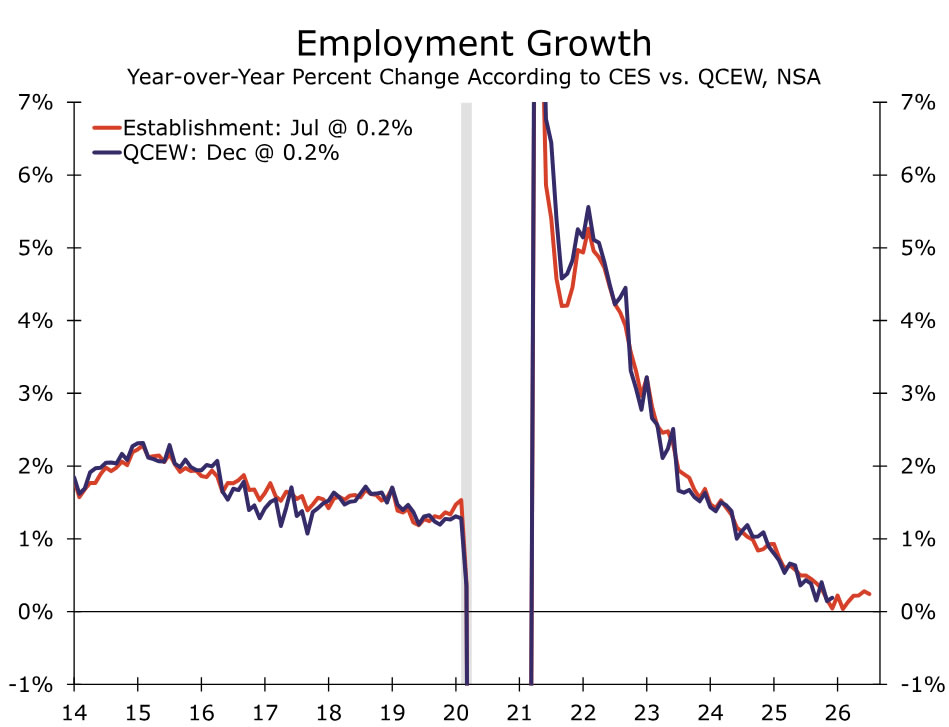
As a refresher, the annual benchmark aligns the March level of employment in the nonfarm payroll survey with administrative data that is less timely but more accurate. The primary source for this administrative data is the Quarterly Census of Employment and Wages (QCEW), and QCEW job growth through the first three quarters of the benchmark period (Q2:25 – Q4:25) has tracked closely with the published payroll data as the nearby chart shows. In fact, through December, QCEW employment has actually risen a touch faster than NFP.
The closer alignment reflects a smaller boost to NFP from the birth-death factor following recent methodology improvements. But sampling and response bias are likely to remain sources of error, with the overall payroll survey response rate (the survey response rate multiplied by the share of eligible firms opting into the survey) still depressed relative to pre-pandemic. The tendency for preliminary Q1 QCEW employment to undershoot the final print also cautions against the preliminary announcement eking out an upward adjustment.
Source: U.S. Department of Labor and Wells Fargo Economics
G10 Week Ahead
Australia CPI • Wednesday
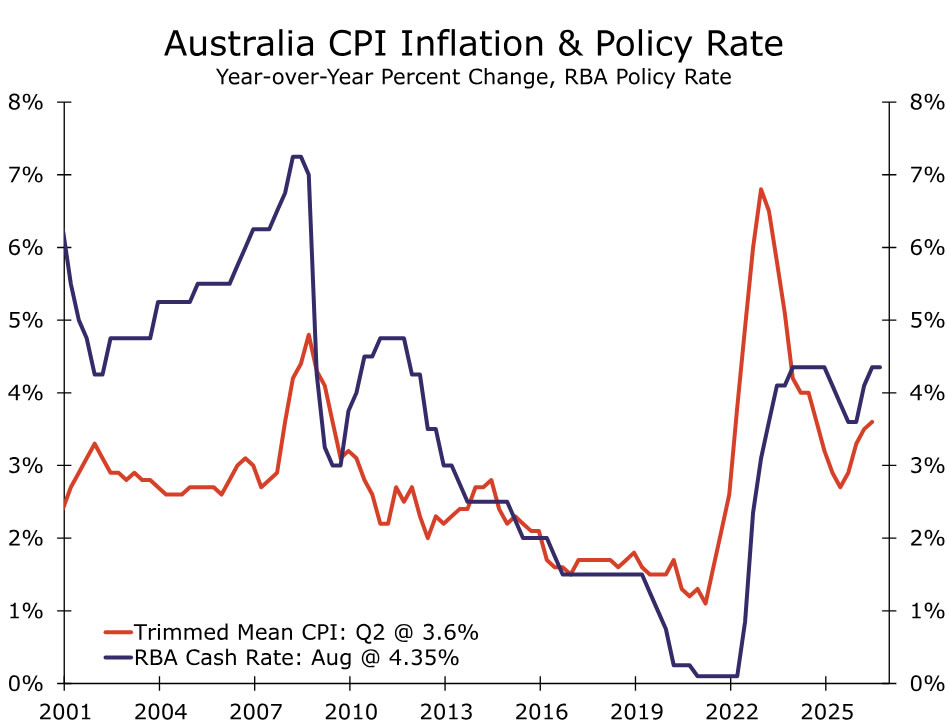
Australia’s July CPI release is due next week and will provide another test of whether the inflation relief seen in June can be sustained. We expect headline inflation to rise 1.0% in July, leading the year-over-year rate down to 3.4%, while trimmed mean inflation remains at 3.6% year over year.
The expected increase in monthly headline inflation largely reflects higher fuel prices following the expiration of temporary fuel excise relief and the renewed rise in fuel costs after the re-escalation of the Middle East conflict. Underlying inflation also remains sticky, with July’s NAB business survey showing some renewed pressure on costs and selling prices.
While June’s CPI report reduced some pressure on the Reserve Bank of Australia (RBA) to tighten further, inflation expectations have moved higher and policymakers continue to describe policy as only “somewhat restrictive.” As such, we believe a September or Q4 rate hike remains in play if inflation remains elevated and demand conditions continue to prove resilient.
Source: Bloomberg Finance L.P. and Wells Fargo Economics
Canada GDP • Friday
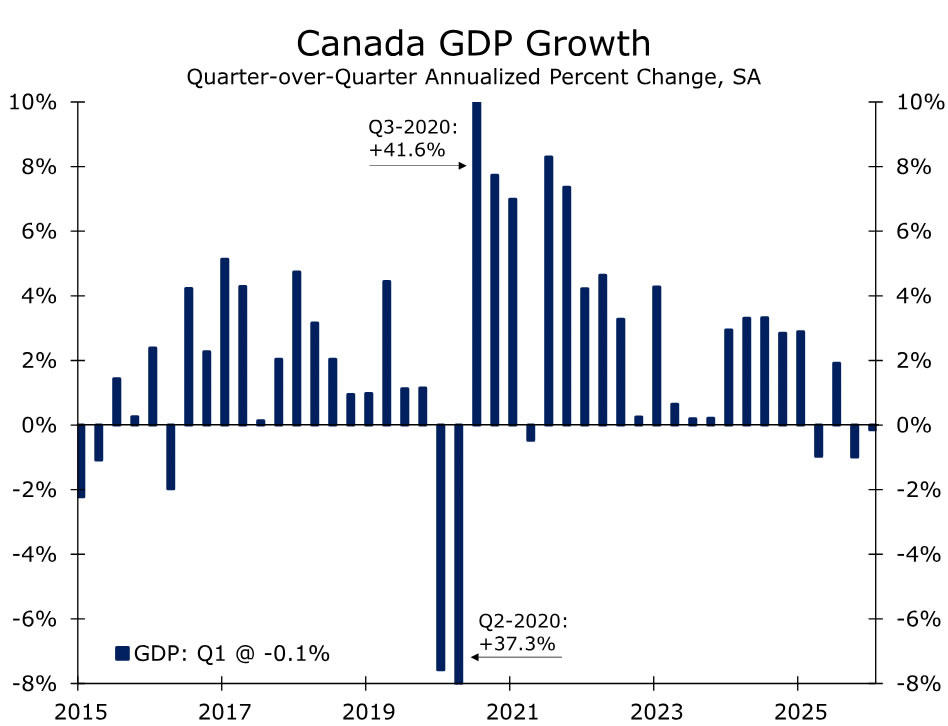
We expect Canada’s economy expanded at a 3.3% annualized clip in Q2, marking the strongest quarterly rate of growth in nearly two years.
June appears to have provided some of the quarter’s momentum. Statistics Canada’s preliminary estimate points to a 0.2% monthly increase in GDP, led by gains in wholesale trade, finance & insurance and retail trade, partially offset by weakness in utilities and agriculture. While that would mark a step-down from growth earlier in the quarter, the broad-based nature of the advance estimate suggests domestic demand held up reasonably well through quarter-end even as tariff uncertainty continued to weigh on business sentiment.
The stronger Q2 backdrop should further alleviate recession concerns and reinforce the Bank of Canada’s decision to remain on hold. While uncertainty surrounding trade negotiations continues to argue for caution, incoming data suggest the economy is adapting better than anticipated to external headwinds.
Source: Statistics Canada, Bloomberg Finance L.P. and Wells Fargo Economics





