


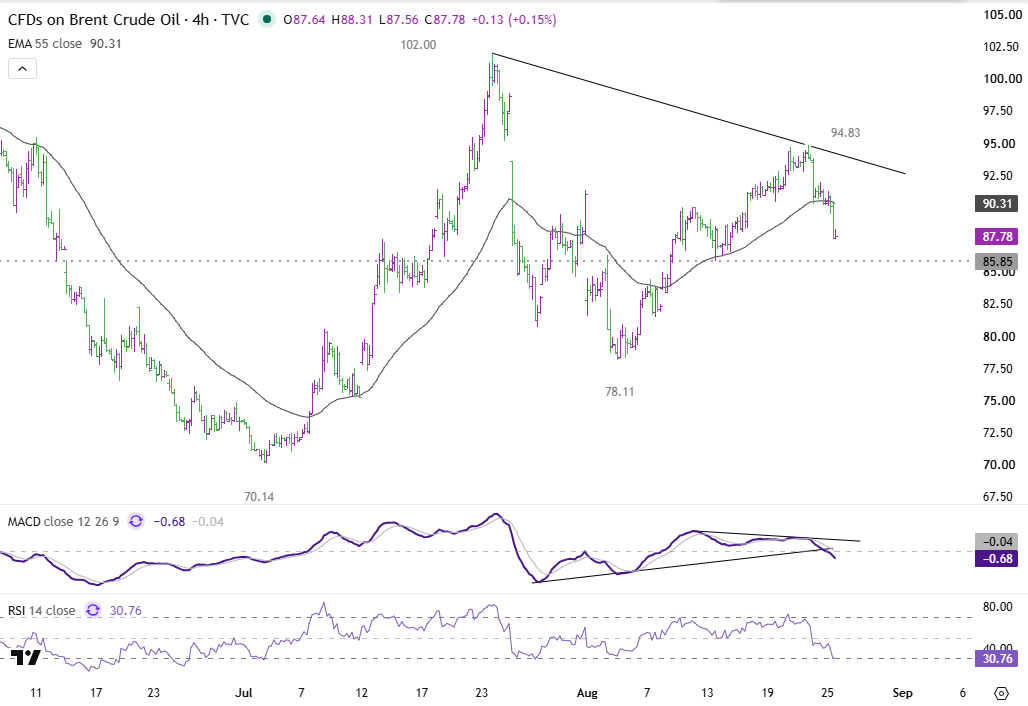
What’s happening: Brent fell to around $88, its lowest since Aug. 13, after gaining more than 5% last week. The decline followed two separate developments: Monday’s Iran sanctions rollout fell short of its own aggressive rhetoric, with no immediate move against major Chinese banks or firm compliance deadline, and Tuesday brought a New York Times report that the US State Department plans to return evacuated diplomats to the Middle East, a signal of lower near-term escalation risk.
Why it matters: Neither development alone proves geopolitical risk has disappeared. Together, they’re two partial disconfirmations of the same bullish premise, that sustained maximum pressure through both economic and military channels would remain the base case, which was enough to trigger a meaningful reduction in risk premium after last week’s rally. Markets are pricing improved odds of de-escalation, not de-escalation itself.
Oil Takes Center Stage as FX Markets Consolidate
Brent oil fell to around $88 on today, its lowest since Aug. 13, while major currencies largely consolidated against each other. The decline follows a week in which crude gained more than 5%, suggesting current move is primarily an unwind of geopolitical risk premium rather than a fresh deterioration in underlying demand. Two separate developments have driven that repricing: doubts over how forcefully Washington’s new Iran sanctions will be enforced, followed by a fresh signal that US officials may see lower near-term risk of renewed full-scale conflict.
Sanctions Fell Short of Their Own Rhetoric
First leg of decline followed Monday’s rollout of “Operation Economic Outcast.” Administration had framed campaign in unusually aggressive terms, including references to an “economic D-Day” and what it described as an unprecedented financial offensive against Iran. Yet package did not immediately target major Chinese banks, impose a firm compliance deadline, or spell out broader measures against countries sustaining Iranian trade.
That matters because China is central to effectiveness of any attempt to choke off Iranian oil revenues. Beijing buys roughly 90% of Iran’s oil exports, making enforcement against Chinese entities the most important test of whether sanctions can materially alter Tehran’s economic position. China’s response on Tuesday only sharpened that question, with Foreign Ministry spokesperson Lin Jian vowing to defend Beijing’s interests and rejecting what he called “illicit unilateral sanctions.” Market therefore appears to be discounting sanctions as less immediately binding than rhetoric implied, rather than dismissing them altogether.
Where “Operation Economic Outcast” Fell Short
- No immediate targeting of major Chinese banks.
- No firm compliance deadline.
- No spelled-out broader measures against countries sustaining Iranian trade.
- China’s response: rejected the package as “illicit unilateral sanctions,” vowed to defend its interests.
Diplomats Report Adds a De-Escalation Signal
Tuesday then brought genuinely new information. New York Times reported US State Department plans to return evacuated diplomats to Middle East, a move markets interpreted as a sign Washington may see lower immediate risk of renewed large-scale military escalation. That signal comes as several regional diplomatic channels have become active again, involving Pakistan, Oman and Qatar.
One potential avenue being discussed is an Iran-Oman arrangement over management of Strait of Hormuz, which would provide a more concrete de-escalation mechanism than broader, stalled negotiations alone. But evidence is still preliminary. US Defense Secretary Pete Hegseth simultaneously kept military options open, saying US had not ruled out kinetic strikes around Iran or Hormuz, while previous mediation efforts have already failed to deliver within expected timeframes.
Two Partial Disconfirmations of the Same Bullish Oil Story
That combination helps explain why oil weakness extended into a second session. Monday challenged assumption that Washington’s sanctions would immediately cripple Iran’s remaining economic lifelines. Tuesday challenged assumption that renewed military escalation was still dominant near-term path.
Neither development alone proves geopolitical risk has disappeared. Instead, markets have received two partial disconfirmations of the same bullish oil premise: that sustained maximum pressure, through both economic and military channels, would remain base case. After last week’s strong rally, that has been enough to trigger a meaningful reduction in risk premium.
Two Partial Disconfirmations
| Monday: Sanctions Rollout | Tuesday: Diplomats Report | |
|---|---|---|
| Assumption challenged | Sanctions would immediately cripple Iran’s remaining economic lifelines | Renewed military escalation was still the dominant near-term path |
| What actually happened | No immediate targeting of major Chinese banks, no firm compliance deadline | NYT: State Department plans to return evacuated diplomats to the Middle East |
| Caveat | China, which buys ~90% of Iran’s oil exports, publicly rejected the sanctions | Hegseth says kinetic strikes haven’t been ruled out; past mediation has failed before |
The distinction remains important. Markets are pricing improved odds of de-escalation, not de-escalation itself. Washington can still tighten sanctions enforcement, especially against Chinese entities, while military options remain explicitly open and diplomacy has stalled before. Brent’s retreat to $88 therefore signals that geopolitical premium is shrinking—not that Middle East risk has been removed.
Related Coverage
Crypto Deep Dive
- Read why Bitcoin’s break above $80,000 combines fiscal-credibility concerns, improving US regulatory prospects, a short squeeze and ETF inflows, and why Standard Chartered still backs a long-term $500,000 target: Bitcoin Breaks $80K — Can Two Catalysts Carry It Back to $100K?.
Global Data Deep Dive
- See why Germany’s Ifo Business Climate jump reflects a broadening recovery across manufacturing, services, trade and construction: Germany Ifo Business Climate Jumps as Recovery Broadens Across Sectors.
Currency & Central Bank Deep Dives
- Read why AUD/USD’s stall below 0.71790 leaves the real test to CPI, even after RBA minutes flagged monthly inflation data as a reason the September meeting stays live: AUD/USD Stalls at Resistance as RBA Minutes Leaves Real Test to CPI.
- See why RBA’s August minutes confirmed the Board actively considered a 25bp hike before holding, and why pre-emptive tightening stays on the table: RBA Minutes: Waits for More Evidence, but Pre-Emptive Hike Stays on Table.
Frequently Asked Questions
Q: Why did oil fall on sanctions that were supposed to be aggressive?
A: Because the actual package fell short of its own rhetoric. Despite framing that included references to an “economic D-Day,” Monday’s rollout didn’t immediately target major Chinese banks, set a firm compliance deadline, or spell out broader measures against countries sustaining Iranian trade. Since China buys roughly 90% of Iran’s oil exports, that gap matters enormously, and Beijing’s public rejection of the sanctions on Tuesday only reinforced doubts about how binding they’ll actually be.
Q: Does the diplomats report mean Middle East risk is over?
A: No. The NYT report that the US plans to return evacuated diplomats is a genuine de-escalation signal, and it comes alongside active Pakistan, Oman and Qatar diplomatic channels, including a discussed Iran-Oman arrangement over Hormuz management. But Defense Secretary Hegseth said the US hasn’t ruled out kinetic strikes, and previous mediation efforts have already failed to deliver on expected timeframes, so this is preliminary evidence, not confirmation that escalation risk has passed.
Q: What would need to happen for oil’s decline to reverse?
A: Either side of the current de-escalation case would need to fail. Washington tightening sanctions enforcement against Chinese entities specifically would restore doubts about the economic pressure campaign, while renewed military escalation around Iran or Hormuz, which Hegseth has explicitly kept on the table, would restore the geopolitical premium markets have just started unwinding.
Key Takeaways
- Brent fell to around $88, its lowest since Aug 13: Unwinding a meaningful share of last week’s more than 5% rally.
- Monday’s Iran sanctions fell short of their own rhetoric: No immediate targeting of major Chinese banks, no firm compliance deadline, despite “economic D-Day” framing.
- China’s response sharpened enforcement doubts: Beijing, which buys roughly 90% of Iran’s oil exports, publicly rejected the sanctions as “illicit.”
- Tuesday’s diplomats report added a genuine de-escalation signal: A NYT report on returning evacuated US diplomats coincided with active Pakistan, Oman and Qatar diplomatic channels.
- Neither development resolves the risk on its own: Hegseth kept kinetic strikes on the table, and past mediation efforts have failed to deliver before.
- Markets are pricing improved odds of de-escalation, not de-escalation itself: Brent’s retreat reflects a shrinking risk premium, not removed Middle East risk.
What to Watch Next
Watch whether Washington tightens sanctions enforcement against Chinese entities specifically, since that remains the key test of whether the economic pressure campaign can materially affect Iran. Also watch for concrete progress on the discussed Iran-Oman Hormuz arrangement and any follow-through on returning US diplomats to the region, versus renewed military rhetoric that would reopen the geopolitical premium.





